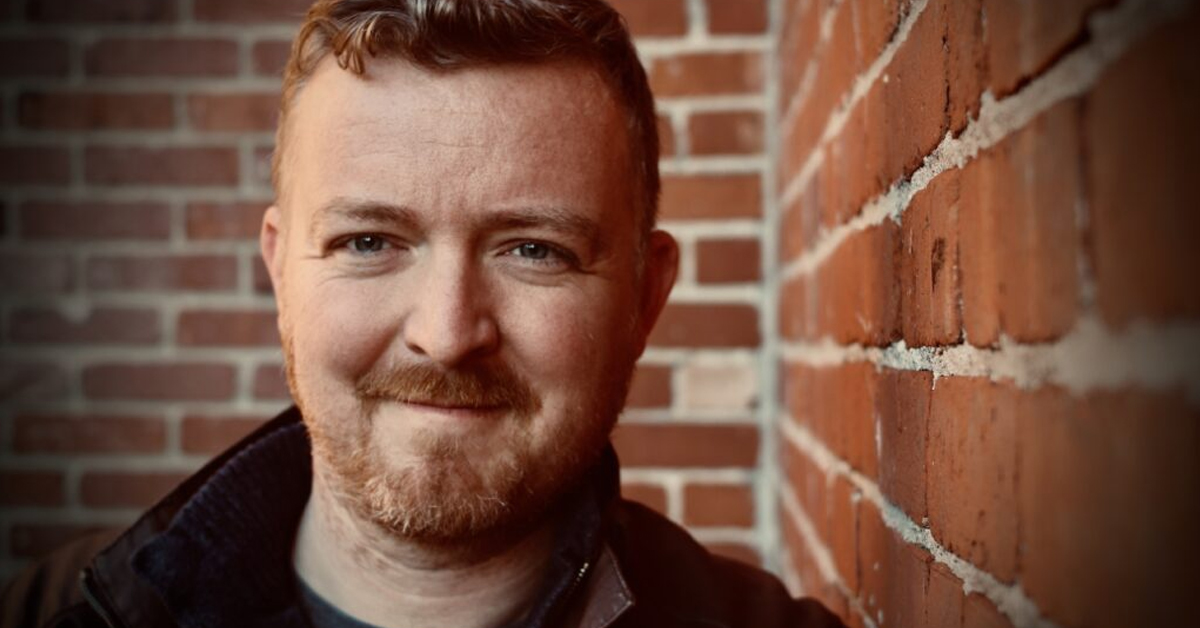
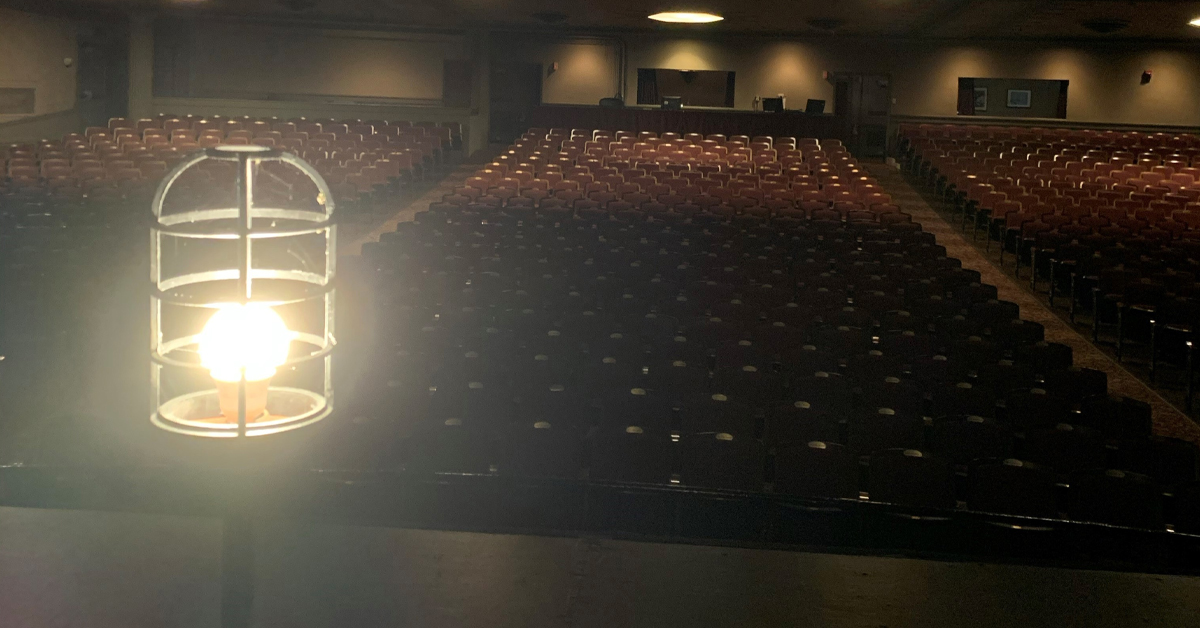
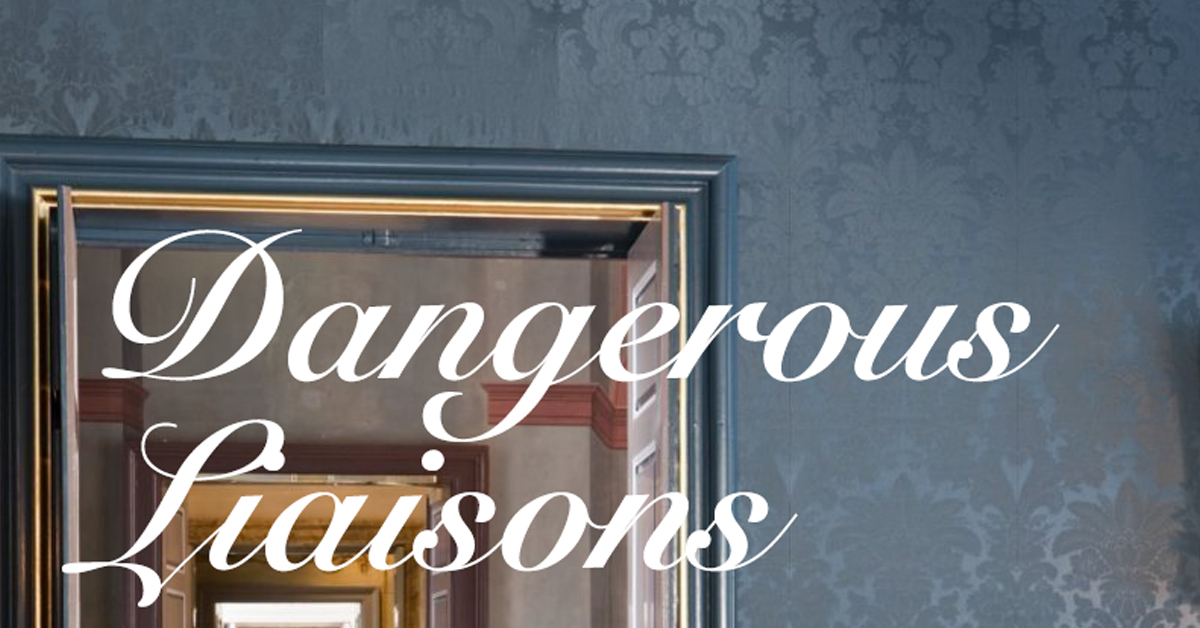
Providence’s Head Trick Theatre is all about live performance and sharing space with an audience; however, COVID forced them to shift. Their latest production is a web series, Dangerous Liaisons, adapted and directed by Head Trick founder Rebecca Maxfield from the novel by Pierre Choderlos de Laclos. “I think it works as an episodic structure. Our production is based directly on the novel rather than being an adaptation of the existing play,” Maxfield says.
In the story, master manipulator the Marquise de Merteuil seeks revenge on a former lover by trying to arrange the premarital seduction of his young and naïve bride-to-be, Cécile. However, her dearest friend, the Vicomte de Valmont, has other prey in mind: He wants to seduce the seemingly unassailable Madame de Tourvel, a virtuous married woman. The story of sexual and romantic war games is told through letters, which lends itself well to current realities.
“The story is really well-suited to the conditions we’re working under right now, with everyone writing these letters or creating these videos from their homes or wherever they’re stuck at the time, when paper or a screen is the only means you have of communicating with people,” says Maxfield.
How did all this first come together? “I think we had auditions for it in May, so it’s taken a while for it to be completed and start airing,” Maxfield says. “Everything was filmed at home via actors’ webcams. Auditions were open to people in any geographic location, but most people are local and have worked with me before.”
Maxfield met with actors in a Zoom meeting, which she says “was pretty much like what a live rehearsal would be like so we could get on the same page theatrically.” The main cast includes Stephanie Traversa, Pooja Usgaonkar, Dan J. Ruppel, Gail Rosewood, Charlie Santos and Sarah Sinclair. “I’m so excited to finally start showing the world what we were working on during the summer and fall,” says Maxfield.
What’s next for Head Trick? “We are in rehearsals for an audio production for A Midsummer Night’s Dream,” Maxfield says. This will be a site-specific audio piece. “I didn’t just want to do a Zoom reading of something. Rather than sit in your house listening in one sitting, it will be released for download with guidelines for where to listen to specific scenes, such as a natural setting, or where you might go for a feeling of authority.”
She explains, “In a normal show, the presence of the audience impacts the show in a certain way. The actors feed off the audience’s response. If you choose to listen to the forest scenes in a super deep forest, versus sitting by a river with river sounds and different bird sounds, there’s a different feel. It was important to me to create something where the audience was a partner the way that they are in live theater.”
The Dangerous Liaisons intrigue unfolds with new episodes every Tuesday and Friday. Each episode runs 5 to 10 minutes in length and airs at 8pm on Head Trick’s Youtube channel ().
Dangerous Liaisons is free to watch. Donations are appreciated and can be made through Head Trick’s web store (). Note: This series contains sexual themes and references to non-consensual sex. For more information, visit headtricktheatre.org or fb.com/headtricktheatre.
Motif previously reported (“Unemployment insurance runs out for hundreds in RI”, by Michael Bilow, Mar 1, 2021) that 213 beneficiaries had exhausted their available Pandemic Unemployment Assistance (PUA), but further information emerged on Wednesday, March 3, from the RI Department of Labor and Training (DLT), which administers the program, that many more were notified in error, setting off near panic for thousands.
The count of 213 was correct, DLT spokesman Margaux Fontaine confirmed to Motif, but many more apparently received a notice after completing their weekly re-certification on the DLT website that read, “Your certification has been successfully recorded.. However, you have exhausted your benefits balance. If you are still in need of assistance, you will need to file a new claim to have your eligibility determined.”
Screen capture from RI DLT web site of benefits exhaustion notice, often sent in error.
Adding to the panic, the DLT telephone help line, the only way for claimants to obtain information about their unemployment insurance status, has been overwhelmed to the point of inaccessibility, hanging up on callers and telling them to call back later.
Late on Tuesday, March 2, DLT sent an e-mail message explicitly countermanding their benefits exhaustion notice on the web (emphasis added): “This [e-mail] notice is to inform you that you have collected 46 weeks out of the 50 weeks available through Pandemic Unemployment Assistance (PUA). This means that you currently have four (4) weeks of benefits left. Note: If you received a message on UI Online that said you exhausted your benefits, you can disregard it. For the next four weeks, you may continue certifying as usual on UI Online or over the phone beginning Sunday, March 7, 2021. You will receive this week’s payment by Wednesday. The U.S. Congress is currently considering a bill that would extend PUA benefits. If that bill passes, DLT will work to implement the additional weeks as quickly as possible. There is no need to contact the UI Call Center.”
“People should only disregard the [web] message if they specifically received that e-mail, which confirms that they are at 46 weeks,” Fontaine told Motif in response to an inquiry. “We sent the email out to all 2,740 people who were at 46 weeks as a precaution.”
Asked to explain what happened, Fontaine told Motif, “Claimants are notified a week ahead of any benefits exhausting when they certify. We will also keep claimants informed of what happens with the bill in Congress (depending on when/if the bill passes, this may [be] an email or a message on our website and social media). Rhode Island has consistently been one of the fastest states at implementing federal programming changes so we anticipate being able to add additional weeks quickly, should they pass. We are currently working on creating an online system that will give claimants a lot more insight into their claims. This is set to launch later this spring.”
PUA is a new program created to cope with the COVID-19 pandemic by the federal CARES Act that became law on March 27, 2020, extending unemployment insurance to those not previously eligible, primarily formerly self-employed, contract and gig workers. It is distinct from the regular unemployment insurance program, which was also separately extended by Pandemic Emergency Unemployment Compensation (PEUC) that provided an additional 13 weeks for those who have otherwise exhausted unemployment benefits. Both are distinct from Federal Pandemic Unemployment Compensation (FPUC) that boosted weekly benefits by $600 until July 2020.
I’m going to be honest, the inspiration for this piece came to me while I was rummaging through my refrigerator. I grabbed a handful of strawberries, and an enthusiastic thought popped into my head: “Those leafy bits at the top will be a great treat for the chickens later.”
Yup, I have a flock of chickens. I’ve kept chickens continuously since my very early 20s, other than during a brief disruption while I ran an ultimately successful, very emotional, two-year campaign to change a stupid law and legalize them in Woonsocket.
And I haven’t looked back since. I cannot overstate just how great it is, from a holistic-food-growing perspective, to have chickens on my urban farm. They are natural foragers and omnivores with strong stomachs and pretty varied diets, which means a flock is an ideal complement to a garden and a compost pile/bin. They can eat a lot of the garden “waste” that we can’t, and they get pretty excited to eat things like fruit and vegetable scraps (hello, strawberry greens), stale bread and even slightly soured or chunky milk. (Side note: Research before feeding kitchen scraps to chickens. Certain things, such as avocados and chocolate, are toxic to them).
Keeping chickens has helped me to put regenerative, truly sustainable agricultural principles into practice on my own urban farm. They’ve helped me to think holistically, to imagine this little ecosystem as a series of closed, intersecting loops; ie, one where garden and food “waste” feeds chickens that make eggs, which feed my family, and manure, which gets composted and improves soil fertility, which produces a better garden. The more of these loops we can close, the more sustainable our urban farms can become. And in that process, we can produce more fertile soil, healthier food, a more fulfilled soul and happier chickens.
As the latest pandemic relief bill crawls through Congress with a provision that would extend the program, Pandemic Unemployment Assistance (PUA) benefits have ended for many individual recipients. According to spokeswoman Margaux Fontaine of the RI Department of Labor and Training (DLT) that administers unemployment insurance, “To date, 213 people have completely exhausted all 50 weeks of PUA.” This has been widely reported to have occurred without warning as recipients received notice only as they submitted their required weekly re-certifications of eligibility that their benefit payments this week (attributable to the prior week) would be their last.
Acting Director Matt Weldon of DLT told Motif, “Pandemic Unemployment Assistance (PUA) is a federal program that currently provides each claimant with up to 50 weeks of benefits. As we approach the one-year mark of the COVID shutdowns, unfortunately this means some PUA claimants are beginning to exhaust their benefits. We hope Congress will act soon to extend this essential program. If additional weeks become available to claimants, the Department will notify them as soon as possible.” The RI DLT Twitter feed echoed Weldon’s comments.
Tweet from RI DLT about PUA benefit exhaustion.
(Source: https://twitter.com/RI_DLT/status/1366375520213086212)
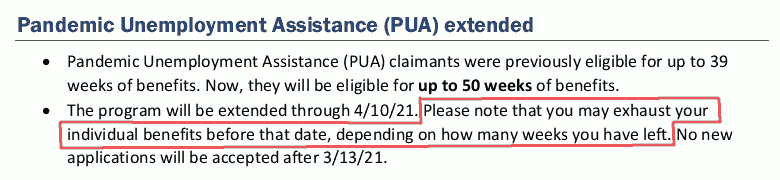
Weldon also cited a previously issued statement that warned of the problem in general terms after the most recent pandemic relief bill was signed into law on Dec 27, 2020 (emphasis added): “Pandemic Unemployment Assistance (PUA) claimants were previously eligible for up to 39 weeks of benefits. Now, they will be eligible for up to 50 weeks of benefits. The program will be extended through 4/10/21. Please note that you may exhaust your individual benefits before that date, depending on how many weeks you have left. No new applications will be accepted after 3/13/21.”
RI DLT statement on exhaustion of PUA benefits (highlight added).
(Source: https://dlt.ri.gov/emergencyui/covidupdates122720.pdf)
PUA is a new program created to cope with the COVID-19 pandemic by the federal CARES Act that became law on March 27, 2020, extending unemployment insurance to those not previously eligible, primarily formerly self-employed, contract, and gig workers. It is distinct from the regular unemployment insurance program, which was also separately extended by Pandemic Emergency Unemployment Compensation (PEUC) that provided an additional thirteen weeks for those who have otherwise exhausted unemployment benefits. Both are distinct from Federal Pandemic Unemployment Compensation (FPUC) that boosted weekly benefits by $600 until July 2020.
In response to a question from Motif, “Can someone who has exhausted PUA switch to PUEC?” Fontaine replied, “Unfortunately, they cannot. Per federal guidelines, PEUC is only available to regular UI claimants, not PUA claimants.” Fontaine said that the pending bill could address the problem: “At present, Congress is considering a bill that would extend PUA from 50 weeks to 74 weeks. If that passes and is signed into law, we will work as quickly as possible to implement those additional weeks.”
Tweet reply thread from Bob Giusti to RI DLT about exhaustion of PUA benefits.
(Source: https://twitter.com/lambgiuse/status/1366387452043231234)
Many were publicly critical of how RI handled the situation. Well-known local musician Bob Giusti (@lambgiuse) replied to RI DLT on Twitter, saying “Same thing happened to me – no warning – I would have planned differently in spending leading up (not that there’s any extra) I didn’t even apply until April last year so it definitely wasn’t 50 weeks.” Twitter user Jaydeez (@Jimdeez78) replied to Giusti, “NO heads up nothing… What a joke.. Like we don’t have enough anxiety… MA has a sweet app shows you the balance of your acct.”
This collection of 67 environmentally themed poems can be depressing and uncomfortable to read at times, which is exactly the point publisher Notable Works set out to make with this release. Local authors all contributed work inspired by our current natural world, which is, unfortunately, a disaster (to put it nicely). The poets don’t paint a positive picture of the environment we live in, instead leaving a grim reminder of the impact of our carbon footprint.
Aubrey Atwater’s “On the Changing World” sets the tone for the collection, serving as a call to action for everyone or risk losing the things we often take for granted. It’s a request for a united front to prevent the obvious (to most) dire consequences. The rest of the poems follow Atwater’s lead, focusing on where the world is, where it is inevitably going and the work that needs to be done to cause change.
Because Voices of the Earth was released in 2020, a portion of poems discuss COVID-19. Two mention it in the title, a few allude to the virus and a couple others discuss it in depth. While they were some of the most emotionally difficult to read, they will serve to be an important part of history down the line.
While this collection is full of strong writing, two poems really stuck with me. “Beyond Recycling” by Shalissa Coutoulakis is more of a guide than a poem, but it may be the most important in the book. It discusses the correct way to recycle and (especially relevant) what not to put in the recycling bin. Coutoulakis should send this to every school to start educating the young (and hopefully teaching parents something in the process). The other poem, “Don’t Stop Me When I Say I’ve Had Enough” by M. Neil, tops out at only five lines long, but paints an amazing visual of the incoming doom and change that is about to happen to the narrator. The last two lines of the poem, when read together, may be the best ending to a poem I’ve ever read. It’s striking and powerful; one I make sure to read often.
Voices of the Earth is more than a collection of poetry. It’s also a resource for people who are looking for ways they can help change the world for the better. There is a thoughtful introduction written by Lauren Parmelee, senior director of education at the Audubon Society of Rhode Island. Most importantly, there is a list of local resources via environmental agencies. The list of 53 agencies are broken down into four categories: advocacy and education; coalitions; conservation, perseveration and restoration and government agencies. All of the agencies list either their mission statement or give a description of their values and/or ways to help, as well as their contact information.
There is an aura of hope in each poem. The doom and gloom of what currently is serves as an inspiration to change. The poems serve as a blueprint as to what needs to be different and how it could potentially be done. This is a wake-up call to every reader to take a look at what they should be doing differently and why taking care of our Earth is so extremely important. Let Voices of the Earth be the first step.
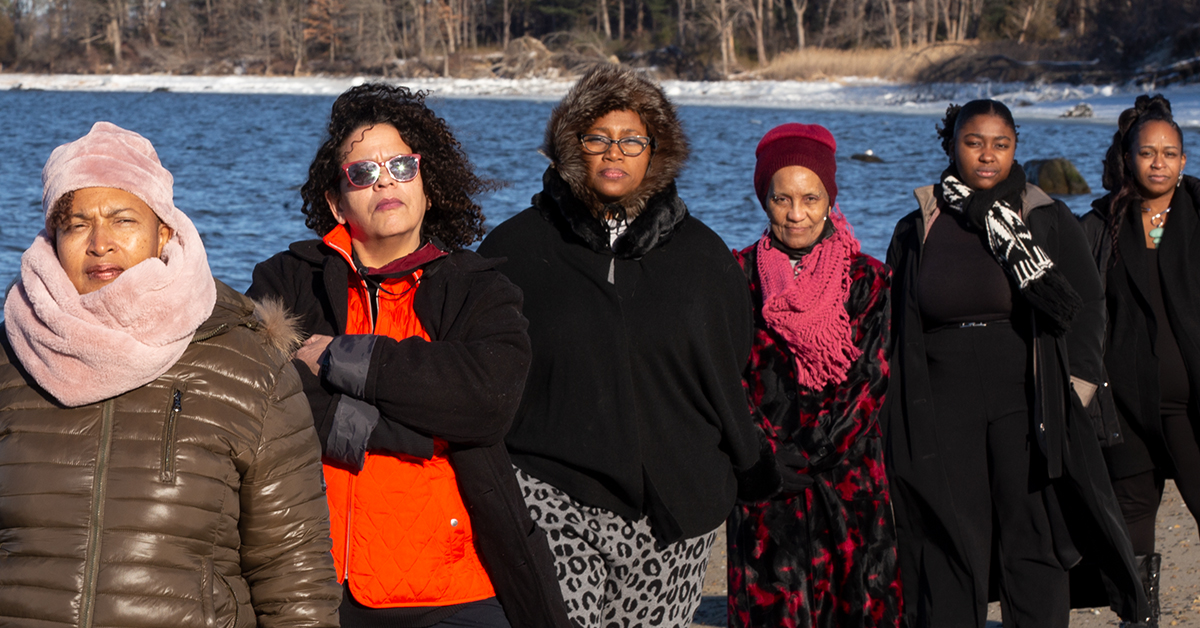
April Brown served as guest editor for Motif’s February 2021 issue celebrating Black history month, and brought with her a cadre of incredible women with powerful stories. Read their contributions here:
Kah Yangni, photo credit: Asaad Miller for QTZ Fest
Kah Yangni’s art is vital in both senses of the word—lively, full of energy, and dazzling, and also essential and compelling. They are based in Philadelphia, but lived and worked for a decade in Providence, and they recently returned to create a piece for Dirt Palace’s Storefront Window Gallery. I had the pleasure of talking with Kah about public art, how they center and celebrate resilience in their work, and what they miss about Providence.
Davis Alianiello (Motif): You returned to Providence this summer to do a project with Dirt Palace. Can you tell me a little bit about that?
Kah Yangni: It was so great! They asked me to come back and do a project in their window a long time ago, maybe January of that year, and I knew I wanted to do a mural, but I didn’t know what I wanted to do it on. Then all of the craziness of that summer happened, and I was so glad that I hadn’t settled on an idea yet, because it was cool to do something that could just respond to what was happening.
I lived in that neighborhood, and I passed that spot all the time, and I thought it would be cool to make something that people who lived there could see, and have their spirits lifted during literally the worst month of, definitely my adult life, and kind of everybody’s. It was horrible and such a dark time and I was like, I can make something light, that feels good, and I’ll put it here, and it’ll be up for a month, and people will feel light.
I’ve also seen other people do cool stuff with that window, so I’ve always wanted to do something there, and when they were like, “You can do something,” I was like, “Oh my god, I’ll get to go see my friends!”
It was also a perfect moment to come home and be around people who I knew, and who I knew cared about me and who I cared about, because it was so intense that summer.
DA: So much of your work is public art: both your murals and illustrations you’ve done. I was wondering what you think the role of public art should be.
KY: My first experience of public art was being a part of Pronk!, which is so special and makes people proud to live in Providence, and there’s this magic moment where it just changes the vibe in a spot.
Then I began to get interested in murals around 2016, so I went away to a mural painting internship here in Philly and learned how to do it.
The art I make tends to be sort of small naturally, and I’ve been really interested in pushing myself to make really big stuff that will go in places and change the energy. A mural can bring people a certain joy and make them feel like life is not just boring and plain; it’s fun and higher than your day-to-day.
DA: Your work is so vibrant and alive, and really grabs the viewer’s attention. I used to live across from your mural at Lore and I remember it becoming a part of my everyday life.
KY: Oh yeah! That one. I was in and out of that area, and it’s fun but can also be like, “New England fussy.”
DA: It is.
KY: It is! Which is mostly cute, but sometimes, like, not as cute. But I have this really strong memory from 2013 of me and my friend going to The Coffee Exchange, and we ran into Pronk! like, busting down Wickenden Street, and I was like, “This is frickin’ awesome, like, this is the opposite of New England fussy.” [With that piece] it was really cool to do something that’s really bright: not just that same light blue color of a bunch of the houses around there, but something more fun and alive.
DA: Are there things you miss about Providence?
KY: I miss walking into, like White Electric and seeing 10 people I know. I really like Philly, it’s super fun, but I think that because Providence is small, there’s more room to be weird and be freaky.
DA: What’s a recent project that you’re most excited about?
KY: So, there’s Trans Day of Remembrance, when people remember all the trans people who have died that year, but on the same day there’s also this thing called Trans Day of Resilience. So for the last two years I’ve been working with this non-profit Forward Together, which hires trans artists to make graphics that can be shared on that day about the resilience of trans people.
I was really proud of the one I made in 2020. My poster says “Trans People Exist in the Future,” and it got shared by people I really look up to in the gay world, like Indya Moore from “Pose,” and Alok Vaid-Menon, and Sara Ramirez from “Grey’s Anatomy,” and it was going everywhere. That was really, really dope.
DA: What was having that visibility like?
KY: It was awesome! Instagram has this thing where you can see who’s sharing your post, and people were sharing it in all these languages — people shared it out of Ghana, they were writing under it in Russian and Japanese, it was all over the place.
You know, like, I watch “Pose!” It really has defined for me what it is to be trans, and to be black and queer, and it really has influenced me. It has been really cool to make something that connects with people I really admire. I was like, “I’m out here, I’m serving my community, this is awesome! I’m really doing what I set out to do.”
DA: There’s something in there that connects to what you were saying earlier about the mural work. Both the community aspect, and the way that when art is shared like that, and people encounter it organically, it maybe changes the trajectory of their day, or makes them feel a certain way.
KY: Yeah! I hadn’t made that exact connection but I like it.
I definitely have thought before about how being trans is so often associated with either being a weirdo or death. I think I liked the idea of a project that focused on resilience, because I was tired with having being trans associated with being sad. I actually think it’s really awesome to be trans, and really awesome to be gay, and I want to make stuff that looks happy, and looks like my experience. It’s cool to be able to make art that feels more like a pep rally.
I have been thinking about what direction I want to go in, like, if I really want to change my focus to be public art in the sense of like, “I only do murals.” But I think that stuff like that, where they really put a lot of effort into making sure it spreads, and is seen by the entire queer community, it feels really similar to how I feel when I do a mural.
DA: I was going to ask whether a certain genre was speaking to you lately, you work in so many!
KY: I think murals are really hard, but I really like them. I like the idea of changing a landscape. That’s what’s fun for me right now. That’s what I’m the most excited about. But I’m trying a couple new things that could be cool: I’m doing the title card lettering for a film, and I’m supposed to start a children’s book pretty soon, that should be really awesome. Murals are the thing I’ve been working on the longest, but I’m also trying other stuff right now.
DA: What’s the project that you’re most looking forward to?
KY: I’m going to do a big mural in downtown Philly in collaboration with this group home here that’s only for trans people. That’s coming out during Pride Month, that’s going to be awesome, I’m really excited, that’s going to be super dope. It’s a dream project.
For more information, go to kahyangni.com or follow Kah Yangni on Instagram @kahyangni
In my community people see me as mother, minister and leader. I am also wife, sister, daughter, niece, cousin, auntie, godmother and friend. In all of these roles I put my best supportive foot forward because I am in love with God. That is my foundation for survival. God has kept me through hard times, picked me up out of the darkest moments, convinced me that I was wrong when I thought I was too weak to complete my tasks.
But even with a strong love like that, I still have shaky faith moments. I admit it because I am tired of feeling guilty about my secret – that sometimes I am broken. There. I said it. I am that vase that has been put back together again and still holds valuable content. Even with the emotional scarring of poverty, racism and white supremacy, which I have faced from the beginning of my womanhood until even just last month, I remain present and ready to work because I do not allow myself to doubt God. Well, I doubt myself as part of my personal assessments and I struggle at times with remembering that I am actually very strong. I don’t always believe it because I see my failures and my shortcomings. I hear my internal excuses and worries. How do I keep going? How do I keep doing it?
God has taken me – the introvert, the scared short fat girl – and poured into me gifts that are undeniable. He has given me chance after chance to get it right and to try it again to do better. And since I believe that God is not crazy and that God is wiser than me, I have trained myself to actively trust God.
There are times when I stay strong for so long that I become exhausted and do you know what I do? I seriously go to bed and rest. I let my Creator get through to me and remind me that I need to rest and regroup. We assess together what went well and what needs adapting. Then I worship God. Yep, right there in the bed, I praise him for the revival, the attention, and the healing. That’s when I know it is time to get up and go back into the world again. It’s when I can see the sun peeping through the clouds again, that I know I am ready for more work, more love, more life.
It took me a very long time to learn that it’s okay to get weary – that it’s smart to slow down stop rest and restart. I’m just so grateful that I figured it out. The key for me is God. That’s the key. That’s the bottom line to every single thing.
I have been in the service business for 35 years, yet I have never liked the word “service.” As a Black woman, the word feels demeaning. As a human, it feels soulless, transactional, and my experience working with folks is anything but transactional. It is deep and emotional. Blackness is magnificent. Womanhood is powerful. I was lucky enough to be given both these gifts, and I come to service with them. This could never be transactional. I do not simply pretend to care about what you care about. I do care. That is not service, that is not transaction, that is connection.
I am a bureaucrat, an arts administrator. I spend much of my time pushing paper, and it has been my pleasure to push paper. I take it very seriously. On its face, this is another transactional experience, but working with someone and taking them through the system to eventual success is a triumph. The human interaction in getting folks to their destination is the real work, and it is the part of my job that I love.
Bureaucracy has historically been used as a dangerous and powerful tool to exclude Black and brown people. As a Black woman creative, I truly believe that bureaucracy can likewise be a powerful tool for equity. Paper can be a great equalizer. For paperwork to have the effect of inclusion, it must be nimble in language and application, it must be flexible and dynamic in response to the needs of a constantly changing population, it must speak many languages, and it must be equally accessible to all. I love nothing more than to help an unlikely organizer get access to public space, to test the administrative process, to shine daylight onto the flaws and inequities in the system. I have always concentrated on the slow, steady moves — the slow tide that erodes a cliff face. All the paper I touch represents a person.
I am always surprised that my value has increased over the years, but the work I have done is always the same. I have been elevated by witnessing the success of others. In my deeply biased observations, I have redefined what success means to me and my work. My love for and my commitment to the success of my community has deepened over time. I realize that in my current position, I have the good luck to be able to really engage with folks. Slow and steady, a slow tide, never a tsunami, bit by bit, minute by minute, this is how the work gets done. I will continue to use my position to wring out every bit of access that I can into our community. It is my sacred responsibility.
My career as an educator includes responsibilities to myself, the discipline of dance, and Rhode Island College, the institution that I currently serve. I show up as an African American woman, prepared for the career that I have chosen.
Today I am at a place where I accept, acknowledge and sit in confidence of my chronological age and have matured into adulthood and womanhood. I am no longer offended by being called ma’am or Ms. and honor the knowledge, wisdom and experience that I enter with. Just as I have arrived at a deeper understanding of who I am, I am doing the same growth as an educator. As in my personal life, there are many facets that contribute to my identity of being an educator. As an educator you have responsibilities that are written, unwritten, required, suggested, optional, fluctuating and changed with leadership. Being an educator is an act of service. I arrive every day ready to serve my students, the discipline of dance and Rhode Island College.
My background of dancing at a Black dance studio as a child, professionally dancing for Cleo Parker Robinson Dance Ensemble, a modern dance company rooted in the African American experience, and attending a graduate school where the dance program was combating and in dialogue about racism and inclusion in dance, has prepared me for where we are as a society. And just as my background prepared me, recent events — #metoo, pronoun consciousness, decolonizing syllabi, and the Black Lives Matter movement — have made me change my approach to giving corrections in movement classes. I am conscious of preferred pronouns, have diversified resource authors the artists we study, and have introduced social justice topics into the classroom, which has been intimidating in the past.
Since starting at Rhode Island College, I felt it necessary that I be present on campus committees because of my race. How would it be perceived that I declined to be on a committee with the mission of diversity, equity, or inclusion? I am aware of the additional labor that this imposes, and I notice the toll that it is taking me. I fear that the alternative to not participate for the Black community that I am part of and represent.
I am an associate professor of dance at Rhode Island College. I was tenured and promoted before the age of 40. I share this accomplishment because it is a major career marker and only 3% of associate professors are African American females according to a fall 2018 study by the National Center Studies for Education Statistics. I have worked at two four-year institutions, and I am still learning and absorbing what the means for my students to have me as their professor, and not just the students of color. Representation matters, and that is a statement being repeated in many aspects of life in our current climate. Just like I have a desire for my students to think, reflect and act, I am doing the same with what does it means to be an African American woman in academia.
I am aware that being an African American woman in academia is powerful and it is my time for me to get comfortable in that seat and lean in.