Category: Nationally relevant

Articles relevant beyond the local area

  • The Impossibility of Satire: Trump-world is an inherent self-parody

    The Impossibility of Satire: Trump-world is an inherent self-parody

    On the “Weekend Update” satirical news segment on Saturday Night Live. anchor Colin Jost displayed a snapshot of an unhinged rant laced with profanity in the form of a Donald Trump post to Truth Social, before admitting he made it up – but until he said that, any viewer would assume it was real.

    I feel Jost’s pain: there is nothing left one can say about Trump, no matter how outlandish or insane, that is so implausible as to be undeniably satire. Ridiculing Islam in an expletive-laden post on Easter? Check. Threatening literal genocide by destroying a whole civilization? Check. Posting an AI-generated image of himself as pope? Check. Posting an AI-generated image of himself as Jesus? Check.

    Colin Jost of SNL “Weekend Update” shows completely made-up a Donald Trump post and then notes it was entirely credible.

    (Source: SNL YouTube)

    Fact-checking sites on the web have resorted to publishing lists of fake posts attributed to Trump on social media that are circulating as memes while falsely claiming they are real.

    It’s not just Trump: He surrounds himself with cabinet appointees who will shoot their dog and goat, cut off a raccoon’s penis, and dump a “freezer full” of roadkill meat (including a bear cub carcass) in Central Park while falsely framing it to look like a cyclist hit and run.

    A few weeks ago, I started to write a satirical news story about Donald Trump putting his own face onto Mount Rushmore.

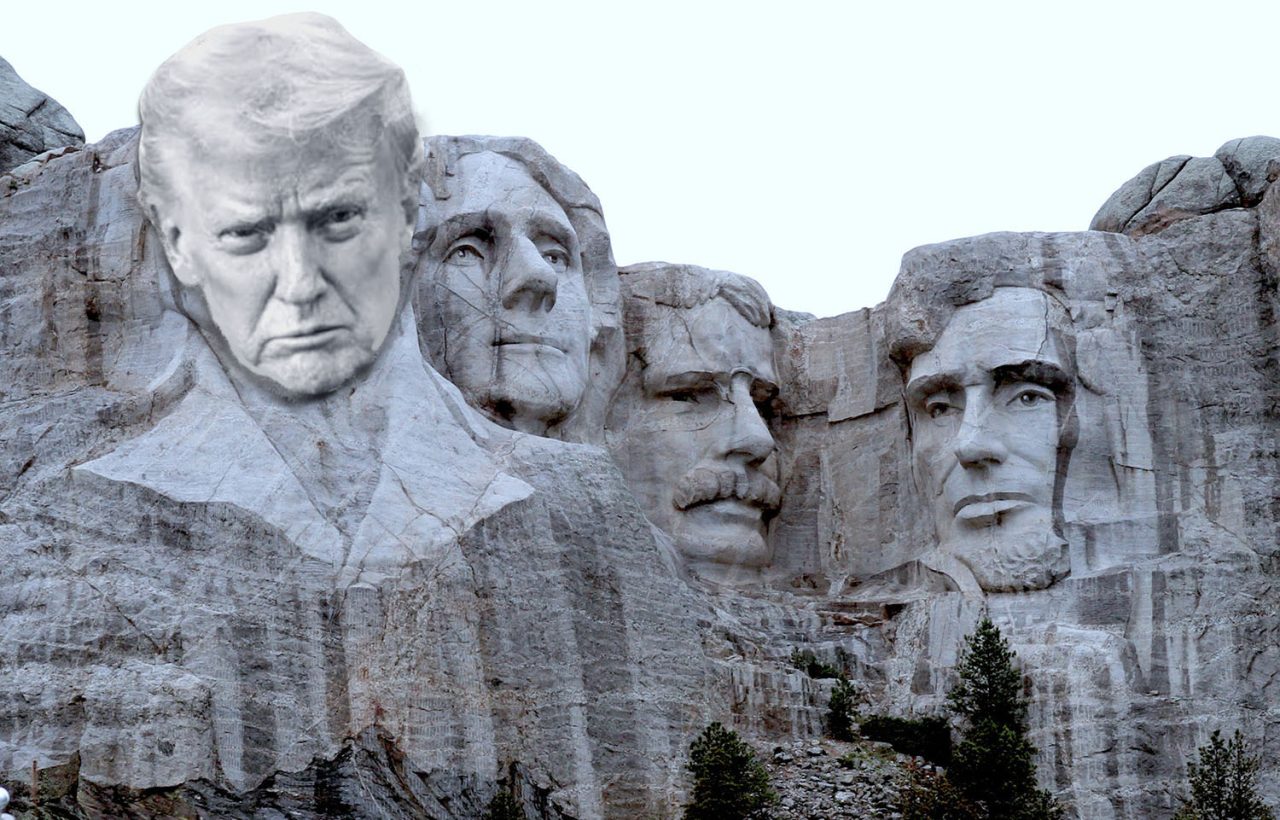
    I sent a note to our art director, Olivia Lunger. “How difficult would it be to produce a graphic for April Fools of Mt Rushmore with Trump replacing Washington? It would not have to look really good from a graphical perspective because the whole idea is a half-assed joke in the first place,” I wrote. “The idea is to make fun of the commemorative coin which, unfortunately, is completely real.” She quickly produced exactly what I asked for.

    Mount Rushmore with Donald Trump replacing George Washington.
    (Credit: Olivia Lunger)

    I had a lot of jokes planned, not least that the proposed 3-inch diameter US 24-karat gold coin would be our version of the Canadian “loonie,” a gold-colored one-dollar coin so named because there is an actual common loon, a kind of bird, depicted on its reverse side. It’s mere coincidence that the Canadians put another metaphorical loon, their head of state King Charles III, on the obverse. Kings and queens typically appear on the coin of the realm, which is precisely why democracies do not do it.

    Trump has lately been throwing his name everywhere, including adding it without authorization to the John F. Kennedy Center for the Arts whose name is specified by law as a memorial to the late president, and replacing with his own signature that of the treasurer of the United States on paper currency, who has been doing it since 1862. Putting his face on coinage, however. runs afoul of longstanding American tradition, with some members of the bipartisan Citizens Coinage Advisory Committee saying that putting a sitting president on legal tender “would break with democratic norms and reek of subservience to royalty.”

    The Trump administration has been unusually sensitive to the propaganda value of coins and currency, including canceling plans for quarters commemorating the abolition of slavery and the right to vote for women.

    What I did not realize until I began researching the topic is that Trump on Mount Rushmore has been an idea in play since 2015. According to the Sioux Falls Argus Leader, a satirical cartoon in Tulsa World showed Trump standing next to his freshly-engraved head on the mountain saying to a man in a hard hat, “Make me thinner and lose the other guys.” After Trump reportedly mentioned the idea to her in 2018, Kristi Noem, then-governor of South Dakota, where the monument is located, took it seriously and commissioned a $1,000 “bookshelf-sized” sculptural mock-up in bronze of the modified mountain.

    Mock-up of Trump added to Mt Rushmore, commissioned by then-Gov. Kristi Noem of South Dakota.
    (Source: The Daily Beast)


    Eric Trump, the son of Donald Trump, responsible for raising funds and constructing his presidential library, released artistic renderings showing a giant tower at least 40 storeys tall in Miami with a huge illuminated “TRUMP” sign at the top. The proposed library includes replicas of White House features such as the Oval Office and a 90,000 square-foot ballroom, as well as a massive colossus statue in gold of Trump raising his fist. A Boeing 747 airplane gift from the government of Qatar is planned to be displayed. It was unclear whether a 56-star flag shown on the outside library tower is an AI artifact or an aspirational reference to Canada, Greenland, or more. The site is a 3-acre plot acquired by the non-profit library foundation through a chain of donations from Miami Dade College to the State of Florida. Valued at more than $200 million, only part of the site is restricted to use for the library, with the remainder available for a for-profit hotel and condominiums.

    Trump Library architectural illustration: Exterior tower with flag.
    (Source: Eric Trump)
    Trump Library architectural illustration: Gold colossus statue
    (Source: Eric Trump)
    Trump Library architectural illustration: Qatari airplane gift
    (Source: Eric Trump)

    I follow the news more closely than most people, and I understand why it is becoming common to just tune it all out – but that’s dangerous, and perhaps fatal, to our democracy. I don’t really want to know that cabinet secretaries are dumping roadkill meat in an urban park, and I don’t really want to know why anyone would collect a “freezer full” of it in the first place, but I feel a responsibility to know how weird these people are.

    I just have no idea how to make fun of them more than they already make fun of themselves.

  • News Analysis — Iran War Update: Where are we going, and do we know?

    News Analysis — Iran War Update: Where are we going, and do we know?


    [See prior update: motifri.com/iran-war2026]

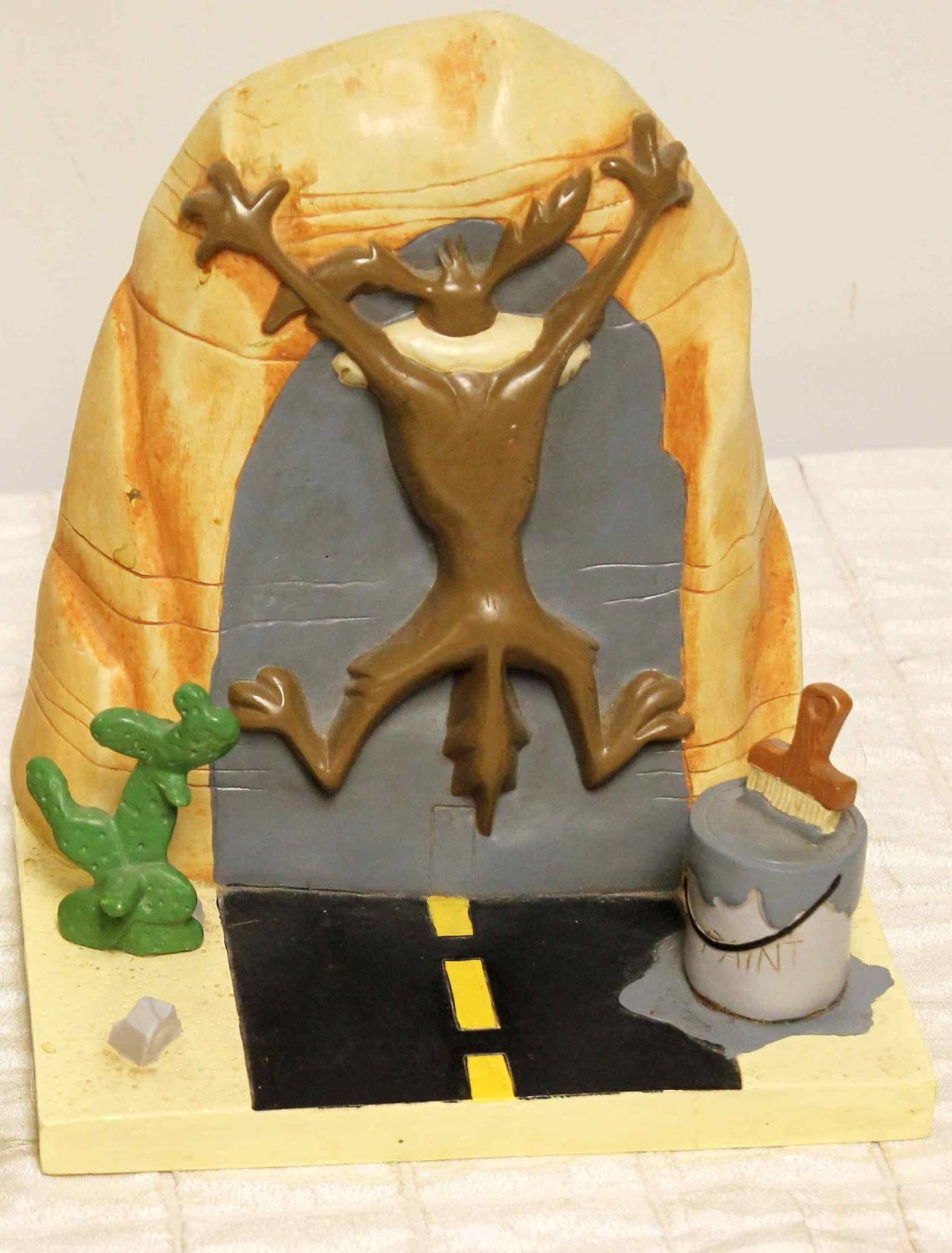
    Coyote fooled by his own painted tunnel.

    Donald Trump built his entire life and career on denial of reality, convinced he could counter every adversary with some combination of cajolery and charm or, if that failed, threatening and bullying.

    In his first presidential term, Trump hit the wall because a pandemic virus is not susceptible to such techniques, and attempts to slow down testing or speculate about injecting bleach seemed utterly absurd. His failure to manage the COVID-19 crisis led to his loss in the 2020 election although, paradoxically, it also gained him some support among those who were most harmed by activity shutdowns and therefore also most invested in his denialism. In 2018 long before the pandemic, I warned about his reliance on denial of reality:


    Trump has broken all bounds of precedent in lying: he lies about everything, so flagrantly and so often, that no one believes him about anything, anyway. This is going to lead to a major catastrophe of national scope in the future when trustworthy leadership will be essential but unavailable, Trump having squandered the credibility he would need to survive a crisis.… Trump is a man in way over his head, denying he is drowning rather than trying to swim. The unanswered question is how much of the country and the world he can take down with him.

    In his second presidential term, Trump is now entangled in a war against Iran that had no goal, no measure of success or failure, no estimate of cost, and no exit strategy. Trump seems to have expected a very short conflict, with a decapitation strike removing the “supreme leader” and much of his closest staff and advisers, expecting a collapse of the government making it amenable to regime change. To his apparent surprise, Iran is not Venezuela. Trump seems to be slowly cracking up in full public view. Instead, the result of eliminating the top civilian leadership seems to have handed increasing weight of control to the elite and politicized military, essentially the Islamic Revolutionary Guard Corps (IRGC), rapidly accelerating a years-long trend favoring hard-liners.

    Now Trump has few options. Repeated attempts to declare victory have so little credibility as to seem ridiculous, as Iran is continuing to fire missiles at US allies and halting nearly all commercial traffic through the Strait of Hormuz, thereby pushing energy costs to levels unprecedented since at least the 1970s and possibly quite a lot worse. Consumer prices in the US tracked by the federal government Energy Information Administration (EIA) have reached about $3.91 per gallon for gasoline (as of Mar 23), up $0.85 from one year ago; and $5.38 per gallon nationally (as of Mar 23) for diesel, up $1.81 from one year ago, a major factor in the shipment and supply of nearly all goods. The US Postal Service announced a temporary 8% fuel surcharge. A further increase of about $1.00 per gallon would be enough to trigger “demand contraction,” where activities stop because fuel is unaffordable and consumer behavior changes, such as deciding to take public transit instead of private vehicles.

    Trump seems to have assumed that if the war started to go badly, he could cut and run, but that now seems unlikely, as a reported US cease-fire proposal was summarily rejected. US withdrawal would not stop attacks by Iran, as occasional asymmetric attacks on cargo vessels, even as simplistic as a sole attacker with a rocket-propelled grenade and a speedboat, would be sufficient to deter attempts by ships to pass through the strait and spook insurers.

    Trump threatened to “obliterate” electrical power stations in Iran, despite such deliberate targeting of civilian infrastructure constituting a war crime. He then backed off from that threat, partly as a result of Iran vowing to retaliate against the civilian infrastructure of US regional allies. He claimed Iran agreed to negotiations, a claim denied by Iran.

    Whatever nebulous and fuzzy goals Trump may have had when starting this war, he is being forced into an overriding and likely defining goal now: reopening the Strait of Hormuz to restore the status quo ante, protecting the world supply of energy and other critical commodities such as agricultural fertilizer, and he has only a few weeks to accomplish that. Entire countries in Asia face not only inflationary economic collapse, but famine for the coming year. There is no alternative.

    Without a negotiated settlement, which seems highly unlikely given the irreconcilable demands of the belligerents, Trump will be compelled by circumstances to a maximalist, high-risk strategy of ground invasion. Reports of deployment of at most 50,000 Marines and Army special forces suggest plans for a limited action, probably focused on Kharg Island, which is the departure point for 90% of Iranian oil exports, apparently with the intention of strangling the Iranian economy. Holding Kharg Island would be enormously more challenging than capturing it in the first place, as troops stationed there, only a few miles from the Iranian mainland, would become easy targets. Trump simply cannot free himself of the mindset that everyone is vulnerable to extortion if he causes them enough pain: To stay in power, the government of Iran is willing to shoot thousands of its own people on the street, so it seems unlikely to be moved by Trump starving the population to death.

    Full-scale land invasions are incredibly costly. Many remember D-Day, the World War II landings on the beaches of Normandy in 1944 that paved the way for the reconquest of Europe from the Nazis, but it was by no means a “day” at all: It took nearly three months employing two million Allied soldiers who suffered a quarter of a million casualties, and – it is well worth emphasizing – a year of thorough and careful planning.

    Congress will be asked for a $200 billion supplemental appropriation as a down payment for the war, a staggering amount of money consistent with a massive invasion of Iran initially on a scale comparable to the war in Iraq from 2003–2011 that involved 300,000–600,000 troops in a coalition of the US and its allies, after which the US had to re-enter Iraq in 2014 before finally leaving in 2021, causing hundreds of thousands and possibly up to one million deaths. Iran is a vast country, 17th largest in the world, with just over 1.6 million km2, three times the size of Iraq, much of it mountainous and hard to traverse, so hard that parts of the country were effectively isolated from each other until the 20th Century. Iran has a population of about 92 million, including nearly one million soldiers under arms, about twice that of Iraq. Congress, so far, was not consulted about the Iran war, in violation of the War Powers Clause of the Constitution, and is expected to view the huge monetary request with severe skepticism.

    Indeed, Iran and Iraq fought each other in a long and nightmarish war, 1980–1988, that killed about 500,000. At first, Iraq made significant gains against what they expected to be an Iran in chaos after its 1979 Islamist revolution, but within a few years, Iran reconquered all of its lost territory and eventually achieved a stalemate. It remains one of the deadliest wars ever between regular armies.

    Given the absolute need to reopen the Strait of Hormuz to prevent worldwide economic collapse and the corresponding willingness of the Islamist government of Iran to turn its own population into martyrs, we seem on an inexorable path toward a full-scale invasion of Iran sufficient to dislodge the regime, possibly on a scale unseen since the invasion of Europe needed in World War II to dislodge the Nazis.

    Trump has put himself into a terrible dilemma. Allowing Iran to retain control of the Strait of Hormuz would represent a political defeat for the United States, with Iran keeping a stranglehold on one of the most critical components of world commerce and able to impose de facto tolls on cargo passing through, discriminating via extortion among allies and enemies, coercing economic fealty. Wresting control of the strait from Iran would require an enormous investment of military resources, possibly even enough to require a military draft – which the White House press secretary on Mar 8 carefully declined to rule out, saying only it is “not part of the current plan right now.”

    Are we willing to pay that cost? Even if we are, are Trump and his sycophants, including Secretary of Defense Pete Hegseth, citing Christian nationalist religious fervor, and military leaders reportedly telling those under their command to expect “Armageddon,” capable of successfully leading such a campaign?

  • News Analysis — What, Me Warry?: Iran is a long-lasting asymmetric fight with those who desire death

    News Analysis — What, Me Warry?: Iran is a long-lasting asymmetric fight with those who desire death

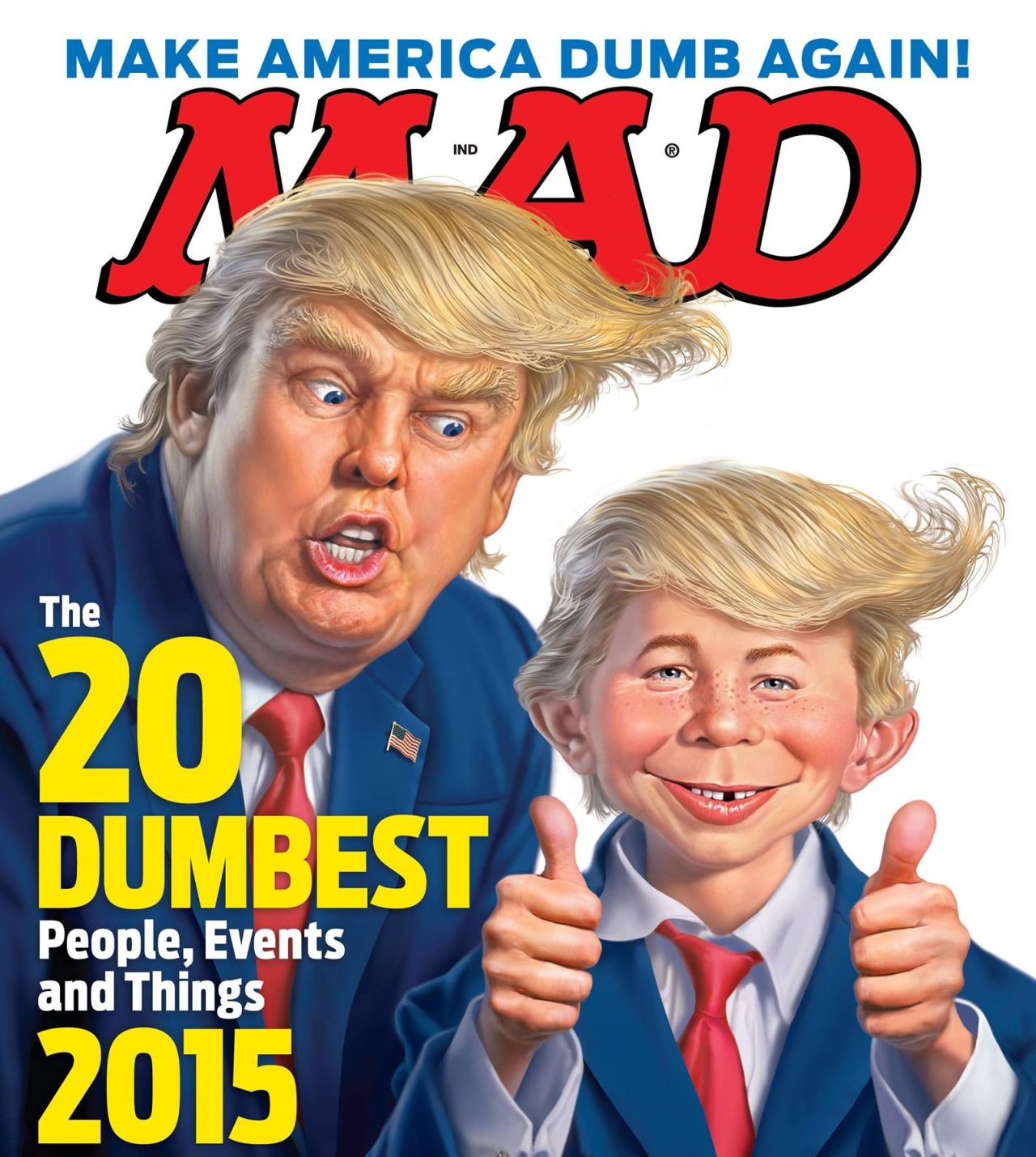
    MAD Magazine cover, Feb 2016: Donald Trump and Alfred E. Neuman

    We fought a military war; our opponents fought a political one. We sought physical attrition; our opponents aimed for our psychological exhaustion. In the process we lost sight of one of the cardinal maxims of guerrilla war: the guerrilla wins if he does not lose. The conventional army loses if it does not win. The North Vietnamese used their armed forces the way a bull-fighter uses his cape to keep us lunging in areas of marginal political importance.

    Henry A. Kissinger, “The Vietnam Negotiations,” Foreign Affairs, Vol. 48, No. 2, p. 214, January 1969.

    How did we get here?

    Persia has a vast history, dating back at least 2,500 years. It is mentioned in the bible, notably in Ezekiel which is read by some as a prophecy of the apocalypse. In 1906, a constitutional revolution limited royal power and established a democratic parliament. In 1908, oil was discovered by European explorers who founded what would eventually become British Petroleum: Oil would curse the nation and its people for the next century.

    In 1909, the constitutionalists deposed Mohammad Ali Shah Qajar in favor of his son Ahmad Shah Qajar. (“Shah” is Persian for “king.”) In 1921, facilitated by British and Russian oil interests, constitutional democracy was overthrown in a coup by Reza Khan, who titled himself Reza Shah in 1925. Beginning in 1935, he changed the name of the country to “Iran,” which means “Land of the Aryans.” Despite Iran attempting to maintain a position of technical neutrality in World War II, Britain regarded Iran’s oil resources as militarily indispensable. When Reza Shah defied British and Russian demands to intern German nationals, Britain in 1941 forced his abdication in favor of his son Mohammad Reza Pahlavi.

    The shah was then a constitutional monarch, and in 1951 the public elected Mohammad Mosaddegh as prime minister on a platform of social reform, land reform, and – crucially – a demand to audit British oil interests to verify the payment of correct royalties. When the audit was refused, Mossaddegh nationalized the oil industry. Britain imposed a severe economic boycott and began trying to manipulate the United States into overthrowing the democratically elected and popular Mossaddegh government, but then-President Harry Truman was having none of it. After the transition to President Dwight Eisenhower, in August 1953, a joint operation between the US Central Intelligence Agency (CIA) and British Foreign Secret Intelligence Service (SIS) carried out a coup that put the shah on the throne as an autocratic dictator, eliminating all vestiges of democracy. The price of participation demanded by Eisenhower was to break the British monopoly on oil production, giving shares to five American oil companies. (In 2013, on the 60th anniversary of the coup, President Barack Obama authorized the declassification of documents detailing CIA involvement.)

    The newly empowered shah was both paranoid and incompetent. During the 1953 coup, he had been so fearful of failure that his twin sister and an American military general had to make him sign the royal decrees deposing the democratic government. By 1977, the shah and his secret police methods of torture and imprisonment had alienated everyone, inspiring strikes and protests from a diverse range of groups, from communists to Islamists, until he was deposed in a 1979 revolution. The Islamists ruthlessly took power, defeating pro-democracy and other factions, installing Ayatollah Ruhollah Khomeini as ”supreme leader” of a theocratic government. (“Ayatollah” is a religious honorific.) In 1989, Khomeini died at age 89 and was replaced by Ayatollah Ali Khamenei, who held that role for almost 37 years until his assassination in a military strike at age 86 during the current war.

    What is the goal of the current war?

    President Donald Trump and members of his administration have cited a wide variety of inconsistent and even contradictory reasons for the war.

    The claim that Iran was within weeks of constructing a nuclear weapon was completely false. Iran in 2015 agreed to a deal, the Joint Comprehensive Plan of Action (JCPOA), under the administration of President Barack Obama that required dismantling most of their nuclear program and submitting to international inspections. Despite recognized compliance with the agreement by Iran, in 2018 Trump withdrew the United States and proposed negotiating a new deal to replace it, but understandably Iran saw little point to agreeing to anything that any subsequent president could arbitrarily abrogate.

    Iran then began playing a game of diplomatic “chicken,” enriching uranium to a degree far in excess of that needed for peaceful purposes but still well short of what would be needed for a bomb. This sort of hardball negotiating strategy backfired badly in the June 2025 Twelve-Day War, during which Trump claimed that American “bunker buster” bombs “obliterated” the nuclear capability of Iran.

    Although Iran claims to have tested a missile with 10,000km range, which could reach the East Coast of the United States including New York City and Washington, DC, it is certainly not operationally deployed and may not actually exist. Iran was known to possess a large stock of shorter-range missiles capable of threatening most of its neighbors and parts of Europe, but has depleted 70 – 90% of its inventory in the current war.

    Iran has invested decades in developing, arming, and funding proxies to carry out terroristic military campaigns, notably Hiz-b-Allah (“Party of God”) in Lebanon and Ansar Allah (“Houthis”) in Yemen, but most consequentially Hamas in Gaza. It was the Hamas attack against Israel on October 7, 2023, that pushed Israel into a mode committed to the destruction of its enemies, including Iran.

    As with many autocratic regimes, mistrust among and within Iranian government and military agencies led to fragmentation, with the army divided into a regular fighting force, the Artesh, of about 600,000 active duty and 250,000 reserves, and the Islamic Revolutionary Guard Corps (IRGC), a more politically and ideologically oriented force of about 125,000 whose main purpose is protecting the Islamist leadership from challenges. There is also a paramilitary Police Command of about 200,000.

    The command and control systems of Iran are visibly disintegrating. On March 7, Iranian President Masoud Pezeshkian publicly apologized for attacks against Arab neighbors Kuwait, Qatar, Saudi Arabia, and the United Arab Emirates: “I personally apologise to neighbouring countries that were attacked by Iran… We didn’t intend to violate neighbouring countries’ [territory]. As I have said many times, they are our brothers.” The next day, Iran attacked again, and the IRGC issued a public statement saying they were not bound by the promises of the president.

    The weakness of the political leadership relative to the IRGC was demonstrated by the apparent selection of Mojtaba Khameini to replace his father as new supreme leader. Generally regarded as a scholarly lightweight, he almost certainly would not have been the choice of the clerics but was promoted internally as a puppet of the IRGC. (He also is reported to have a substantial investment portfolio outside the country.) This marginalization of the political leadership hints that the IRGC will be willing to resort to desperate measures to stay in power, regardless of the dire consequences to the nation and its people. As a result, there may be no one left in Iran with whom Trump can negotiate, and there may not even be anyone left with the political clout to surrender.

    Trump and his envoys share a worldview that everything can be negotiated because everyone has a price and a deal is always possible: This mindset might work in the milieu of New York City real estate, but it is fatally flawed and wrongheaded when applied to Middle East Islamists who believe, quite literally, that they are on the side of God against the West – so compromise would constitute capitulation to satanic evil. In 633CE, just after the death of the Prophet Muhammad, the Persian empires would begin to be ended (after two thousand years) by military leader Khalid ibn al-Walid, who wrote a warning to the final Sasanian emperor, “Submit to Islam and be safe… else you will have only yourself to blame for the consequences, for I bring the men who desire death as ardently as you desire life.” Like the doomed emperor, Trump would do well to realize what he is confronting in Persia.

    Has regime change ever worked?

    Only hours after dropping the first bombs on Iran, Trump was publicly calling for regime change. “Now is the time to seize control of your destiny,” he said in a video, speaking to the Iranian people. “This is the moment for action. Do not let it pass.” How the people were to carry that out was left unsaid, especially in light of a brutal crackdown on unarmed protesters by the IRGC in January that killed thousands, perhaps tens of thousands.

    Trump had long opposed such foreign adventurism, saying in 2016, “We must abandon the failed policy of nation building and regime change.” In 2025, he said, “In the end, the so-called ‘nation-builders’ wrecked far more nations than they built,” and ironically criticized “interventionists [who] were intervening in complex societies that they did not even understand.”

    On March 6, Trump further boxed himself in by demanding “unconditional surrender,” which Iran has little motivation to do.

    Regime change by military force has a nearly perfect record of failure: Korea in the 1950s, Vietnam in the 1960s and 1970s, Nicaragua in the 1980s, Afghanistan in 2001, and Iraq in 2003. Arguably, the only times it ever worked were the postwar conversion of Germany and Japan from militaristic failed states into prosperous democracies, but that required millions of soldiers and enormous sums of money invested over nearly a decade. Unless we are willing to undertake an effort on the scale of the Marshall Plan, which cost about $140 billion in today’s money to rebuild Europe, there is little hope. Even in the eyes of his most ardent admirers, no one can seriously compare the strategic vision of Trump to then-Secretary of State George C. Marshall.

    Iran as it stands today is an Islamist theocracy run by geriatric clerics in defiance of about 80% of its 92 million people. Together with economic troubles caused by external sanctions and internal corruption and incompetence, a generational divide renders the current situation unstable and unsustainable, with three-quarters of the population too young to have been alive during the 1979 revolution and one-quarter age 14 or younger.

    What are the financial costs?

    The war has already cost $5.6 billion in military munitions in its first two days, not counting the loss of three $100 million F-15 fighter jets accidentally shot down by friendly fire from Kuwait. Operational cost of the war is estimated at least $1 billion per day.

    Cargo ships have been unwilling to risk passage through the Strait of Hormuz, which at its narrowest point is about 21 miles across with a navigable channel only two miles wide, because they would be within range of land artillery, missiles, attack boats, and even mines. Merchant crews are unwilling to risk their lives carrying cargo, despite Trump urging them to, ”Show some guts.” About 20% of the world’s oil and 30% of its liquefied natural gas (LNG) passed through the strait, about 90% of which traveled farther east to Asia. Already the Philippines, Bangladesh, Indonesia, and Pakistan have closed schools and factories to conserve fuel; Vietnam and South Korea are considering similar measures. Reopening the strait may require a ground invasion.

    Motor fuel has increased in the US by at least 60 cents per gallon since the war began less than two weeks ago. This will affect all goods shipped by road, which will drive inflation sky high.

    Not only fuel passes through the strait, but also most of Asia’s supplies of agricultural fertilizer, aluminum, and helium. While helium may seem an odd concern as a strategic commodity, it is a by-product of natural gas and critically needed for high-tech industries from semiconductor fabrication to medical diagnostics. Fertilizer is unglamorous in the extreme, but about 70% of the cost of food production is energy input.

    Expert analyst Shanaka Anslem Perera warns that it may take a long time for insurance markets to stabilize, as they are not designed to respond to systemic crises of these kinds: “The kinetic campaign may last four to eight weeks, as the administration projects. The insurance reinstatement, based on the only available reference classes, will require six to eighteen months under even a favorable scenario.”

    US Sen. Chris Murphy (D-CT) said after a classified briefing on March 10, “And on the Strait of Hormuz, they had NO PLAN. I can’t go into more detail about how Iran gums up the Strait, but suffice it [to] say, right now, they don’t know how to get it safely back open. Which is unforgiveable, because this part of the disaster was 100% foreseeable.”

    On March 11, three cargo ships were attacked and struck by hostile projectiles near the strait, with the IRGC claiming responsibility. If the strait remains closed to traffic for many more weeks, not only will commerce stop throughout Asia, but planting and harvest cycles could be disrupted for the next year or two.

    As the market price of crude oil skyrockets, the big winner will be Russia, with a desperate need for cash to prop up a failing economy and fund its war against Ukraine. Russia is one of the best customers for Iranian drones, and Ukraine has developed the world’s most advanced anti-drone defense technology which it has offered to the United States. In August. Ukraine held a high-level presentation, complete with PowerPoint, where Ukrainian President Volodymyr Zelensky offered interceptor drones to Trump. Reportedly, Trump approved the proposal but his staff did nothing until March 5, when the US scrambled to catch up.

    What is the role of Israel in this war?

    It has been universally understood for decades that Israel regards the Islamist government of Iran as an existential threat: If Iran had a nuclear weapon, Jerusalem would be their first mushroom cloud.

    US Secretary of State Marco Rubio said the timing of the war was made necessary to pre-emptively strike Iran defensively because Israel was going to strike Iran and that would provoke an Iranian response against the US. Rubio was challenged to clarify his remark, and both Trump and Israeli Prime Minister Benjamin Netanyahu denied the initial interpretation, but the damage was done. Diplomats from the Obama and Biden administrations said Israel tried the same approach on them but, in the words of US Sen. Chris van Hollen (D-MD), only Trump was “stupid enough and reckless enough” to fall for it.

    While the United States has to worry about the end result of the war, especially hoping that Iran retains some degree of stability even if not exactly evolving into a liberal democracy, Israel is looking out for its own interests. That’s a reasonable position for any country, and Iran falling into chaos or even civil war would be a win for Israel as long as it made Iran and its proxies less capable of threatening Israel. As a result, the objectives in this war between Israel and the United States are increasingly diverging.

    During the opening of the war, Israel hijacked the television broadcast channels in Iran and aired messages from Netanyahu and Trump.

    Iran has an invasive surveillance system purchased from China capable of using facial recognition to identify women in public who had their hair uncovered in violation of Islamic fundamentalist laws and automatically sending them tickets and fines. This extensive surveillance system was compromised years ago by Israel, and they exploited it to monitor Iran’s most senior political and military leaders along with their bodyguards and personal staff. When the supreme leader and many of his most senior advisers gathered for a morning meeting, Israel was able, because of signals intelligence, to send fighter jets to fire 30 precision bombs, killing him and all of those attending. The CIA reportedly confirmed the meeting based on a human source. Israel also controlled the Iranian mobile telephone network sufficiently to know who was attending the meeting, and then to block nearby cellular sites to prevent those attacked from warning others or calling for help.

    It is a reasonable inference that the timing of the war was decided by the unique opportunity to decapitate the Iranian political and military leadership at one blow, circumstances chosen by neither Israel nor the United States.

    What effects will the war have on the United States?

    Evidence reviewed by Western press organizations shows that a girls school in Iran was struck by a Tomahawk missile, killing 175 civilians including many children, likely an error because it was next to an IRGC naval base. Trump, bizarrely and incorrectly, claimed that the strike could have been from an Iranian Tomahawk: “They wish they had more. But whether it’s Iran or somebody else, the fact that a Tomahawk – a Tomahawk is very generic. It’s sold to other countries.” Challenged directly about this claim at a press conference by New York Times reporter Shawn McCreesh, Trump doubled down: “Because I just don’t know enough about it. I think it’s something that I was told is under investigation, but Tomahawks are, are used by others. As you know, numerous other nations have Tomahawks. They buy them from us.” In fact, Tomahawk missiles have never been provided to Iran, and only the US, the UK, and Australia have them. On March 11, the New York Times reported that a preliminary analysis by the US Department of Defense concluded that the strike resulted from outdated targeting data after part of the naval base was converted into a school between 2013 and 2016, unnoticed by the US Defense Intelligence Agency (DIA). A few months ago, the US eliminated a project developed over many years that studied methods to avoid civilian casualties.

    There have been isolated reports of cloud-based cyberattacks against American companies, consistent with the type carried out in the past by Iran and affiliated groups, erasing data and disabling employee devices. Shortly after assuming office, Trump directed federal government resources away from counterterrorism and counterintelligence and instead toward immigration, depriving the country of needed defenses; the Cybersecurity and Infrastructure Security Agency (CISA) has been effectively defunded.

    Russia has been reported to be sharing intelligence with Iran that helps them target, and therefore kill, American soldiers. Trump’s Special Envoy Steve Witkoff said in an interview with CNBC that Russian President Vladimir Putin denied this in a call with Trump: “So, you know, we can take them at their word… Let’s hope that they’re not sharing.” Witkoff said Yuri Ushakov, Putin’s foreign policy advisor, also denied intelligence sharing with Iran in a separate call involving himself and Trump’s son-in-law, Jared Kushner. A cynic might conclude that Witkoff and Kushner are willing to sell out their own country to conduct business deals, like the proverbial capitalist willing to sell the noose used to hang him.

    Under the US Constitution, the power to declare war is reserved exclusively to Congress. Never before in American history has a president undertaken a military action of this scale without at least consulting Congress, in most cases (including Vietnam, Afghanistan, and Iraq) obtaining formal authorizations for use of military force. Even in World War II, President Franklin Delano Roosevelt asked for and received congressional declarations of war against Japan and Germany, mere formalities because those countries had already declared war against the United States. Going to war is among the most fraught and consequential actions in a constitutional republic, asking for substantial sacrifice, including even the lives of citizen soldiers. A president owes to the people, and to their elected representatives, a clear explanation of the causes and need for war, as well as a plan for conducting it. Because of this failure to tell the American people why we are going to war, public support is at historic lows compared to the beginning of any prior conflict, and support always declines over time, even for wars that begin with solid public support.

    As of March 13, seven American soldiers have died from enemy contact, six were killed in a crash of a refueling tanker aircraft, and 140 have been wounded. Trump seems to think he can end the conflict whenever he wants and at a time of his choosing, but that is obviously wrong as long as Iran retains any capacity for asymmetric warfare: As we were reminded in Afghanistan and Iraq, an enemy may lose the ability to launch missiles but can still blow up vehicles.

    Most worrisome, Iran appears to be pursuing a thoughtful plan to exploit widely understood American political rather than military weaknesses. After absorbing initial attacks, Iran launched a large volume of rockets and missiles that forced the US to use up a significant part of its air defense inventory, which is relatively expensive and hard to replace. Iran then concentrated on attacking targets of surprisingly high logistical value, such as radar installations needed to guide intelligent weapons and refueling air tankers needed to maintain the range of fighter and bomber aircraft. This suggests a sophisticated emerging strategy by Iran to fight a long-duration war of attrition, all while the world supply of oil is severely constrained. There does not seem to have been any expectation or preparation for this by the US, leading to improvised responses that will begin to fail after a few weeks. All the Islamist regime in Iran has to do to win is survive.

    So what now? 

    Anything that weakens Iran is a benefit to the world, eliminating it as the main state sponsor of terrorism and threat to peace, ending its position as the fulcrum of the “Axis of Evil” after its partners in that endeavor, such as Syria and Iraq, have been neutralized over the past quarter of a century. A plausible case could have been made for the necessity of this war, but a thoughtful examination would address fundamental questions: What is the goal? What constitutes success or failure? What is the cost? What is the exit strategy? Answering these questions in a democracy should involve all of us, not just one man and his sycophants in the Oval Office, who seem under the delusion that he can unilaterally end the war whenever he chooses and will not become trapped in a “forever war” with devastating political and economic consequences.

  • American Horror Story

    American Horror Story

    Graphic by Eric Barao

    When the US Congress allowed the Affordable Care Act subsidies to expire on Dec. 31, 2025, they created a health insurance crisis that could have inspired a plot line for “American Horror Story.” Overnight, millions of Americans saw their premiums expand and rise like mushroom clouds from a nuclear explosion. In an article posted January 1, 2026, Peter Welch, Democratic senator from Vermont, told NPR about one of his own constituents: “Their premium is going to go from $900 a month to $3,200 a month.”

    This debacle is just the most recent gasp of a wounded healthcare system that sucks up over a third of our yearly health expenditures in administrative costs. Gaining access to medical care means running an obstacle course where the rules can change at any time.

    When we reach age 65, we are eligible for Medicare, a government-issued insurance intended to provide a lower-cost, comprehensive alternative to individual market plans. But there are glitches in the guidelines that can turn Medicare into a nightmare for low-income Americans.

    In 2014, at age 61, “Mandy” qualified for insurance under the ACA. It was a wondrous gift. She hadn’t been able to afford health insurance as a freelancer for over 25 years. But on her 65th birthday, she received an unwelcome surprise. Her ACA insurance had been canceled and she had been automatically enrolled in Medicare. There were complex decisions to be made and lifetime penalties to be feared. She went from having free healthcare to being forced into a monthly premium accompanied by additional co-pays for service. It would be a full year before she could retire and have premiums deducted from Social Security, so after paying her premiums Mandy couldn’t even afford to visit her doctors.

    She had hoped that her Social Security income would provide some relief, but after Medicare deductions, her monthly check came to only $900. As her assets dwindled, her medical needs increased. Desperate, Mandy made an appointment with Rhode Island DHS to see if she could qualify for Medicaid assistance. Here she received shock #2. 

    Before age 65, in order to qualify for ACA assistance all the government looked at was her income. If it was below the national poverty level, they paid for her healthcare. But once she turned 65, the government changed the rules. It no longer mattered how little income she had. If she had savings of over $4,000, Medicare wouldn’t give her squat. 

    Rhode Island is lucky – in most states, the limit is $2,000. Take a moment to consider how long you could live on $2,000 and you will realize that, in essence, the government is saying, “Screw You,” to low-income residents who manage to cache anything at all for retirement. But the “screw you” doesn’t end there. While 68% to 89% of doctors may be enrolled in Medicaid, very few actively treat patients. If you are uninsured or if Medicaid is the only insurance you have, these organizations can help:  https://www.providencechc.org/ and https://www.rifreeclinic.org/.

    Mandy made the best of Medicare by finding an advantage plan with a private company for $0, with premiums and perks that regular Medicare didn’t offer. She could get rides to the doctor if she didn’t have a car. They gave her an allowance for over-the-counter medications. When she had surgery, the plan delivered two weeks of frozen meals to her home. Her co-pays were lower and her primary care doctor was free. For the first time in many years, she felt a sense of security.

    But in 2026, the advantage plan that had provided her with so many extras disappeared. When she finally found a new company with a plan that worked for her, there was a major problem: Her primary care doctor, whom she had been with for nearly 12 years, was not in their network. 

    This problem is not unheard of, but in the state of RI there is a rift between two healthcare organizations, which complicates our network issues even further. On July 1, 2025, every Brown University Health hospital, including Rhode Island Hospital, Miriam Hospital, Hasbro Children’s Hospital, and Newport Hospital, became out-of-network for most United Healthcare’s Medicare Advantage plans. If Mandy wanted to keep her primary care doctor she’d be shut out of every hospital and clinic she’d been going to for the last 30 years. The only alternative was an advantage plan in Brown’s network that cost more and gave her less coverage. This was not a choice she should have been forced to make.

    Insurance shouldn’t be as painful as the health issues it is meant to cover.

    It’s a medically known fact that stress is a major contributing factor for disease, addiction, and early death. Considering the degree of trauma and anxiety that this insurance uncertainty generates, one has to ask: Is the goal of our current healthcare system to cure us…or to keep us coming back? 

    For help with insurance:

    healthsourceri.com

    shiphelp.org/ships/rhode-island

    retirementmadeez.com

  • Melt ICE: Ways to Join the Fight Against ICE

    Melt ICE: Ways to Join the Fight Against ICE

    On January 30, 2026, an estimated 5,000 Rhode Islanders – including students and numerous local businesses – participated in a historic, nationwide strike in an effort to get the tyranny of Immigration and Customs Enforcement (ICE) off our streets and out of our neighborhoods. The strike was in direct response to the unjust murders of Alex Pretti, Renee Good, and Keith Porter, which were committed by ICE and occurred in the Twin Cities of Minnesota earlier in January. This strike demonstrated that Rhode Islanders are ready to unite to fight the discrimination and oppression led by ICE.

    In Rhode Island, ICE targets and terrorizes cities with high immigrant populations such as Central Falls, Providence, and Pawtucket. Often, these masked federal agents capture civilians on the basis of appearance, not criminal record nor immigration status, leading to innocent people being detained and loving families being separated. Therefore, it is our duty to stand together and protect our neighbors from ICE. 

    Here are ways you can help:

    Join the Deportation Defense Network

    Get your feet on the ground and help protect your neighborhood by volunteering with the Deportation Defense Network organized by the Party for Socialism and Liberation (PSL), Alliance to Mobilize Our Resistance (AMOR), and other community networks. By joining, you will be assigned a job that will help inform others on vital information regarding ICE, such as ICE’s whereabouts and the rights civilians possess to protect themselves. Joining is easy – simply text “Defense” to (401) 675-1414. 

    If you can’t commit time to volunteer work, you can still help the movement and your neighbors by staying vigilant and looking out for ICE. For example, if you see an ICE vehicle,  call the Deportation Defense Line at (401) 675-1414 and tell them where you have spotted them, the plate number, and the make and model of the car. They maintain a grassroots database of verified ICE vehicles, to help identify future threats quickly.

    Boycott 

    Put your money where your values are and boycott companies that are aiding ICE. According to a list put together by the organization Boycott Citizens, companies such as Amazon and Home Depot, have been proven to allow ICE to use their resources to aid in deportation efforts. 

    While many people rely on the services of these companies, there are numerous alternatives you can patronize that have more exemplary ethical positions. For instance, instead of using Amazon to order essentials, go to Aldi or Ocean State Job Lot, both of which are not on the boycott list. Additionally, some great alternatives to Home Depot are the locally owned Jerry’s Paint and Hardware in South Kingstown, Adler’s Hardware in PVD, or any of the Ace Hardware locations. These companies pride themselves on community and have the values to support it. 

    To see the complete list of companies to boycott, visit boycottcitizens.org/ice

    Donate 

    Right now is a crucial time in America to be financially supporting organizations committed to helping immigrants receive the proper care they need. No donation is too small, but if you have the means to give generously, do so. Visit these websites of organizations that are making a change in Rhode Island and Minnesota, and give: 

    Make art

    Art communicates multitudes and has been used to promote change in times of political distress for centuries. Whether you choose to be alone or gather with members of the community while you create, art can be a healing practice that you can channel your emotions into. And the best part? You don’t even have to be artistically talented to do it! 

    The possibilities are practically endless when it comes to the pieces you can make – posters, knitwear, ‘zines, t-shirts, pins, music, etc, can all be used to communicate important messages regarding ICE’s actions. Once you have made something, I encourage you to share it with others by posting it, giving it away, or talking about it with a friend. 

    Protest

    Like we saw on January 30, protests can make an impact – people from every state in America came together, united by a cause. If you missed the strike on January 30 but want to get out there and demonstrate solidarity, join the No Kings Protest on March 28.

     It is important to note that protesting is not one size fits all. While marching is the most recognizable form of protesting, it is not the only way. For example, if you don’t have the ability to march, you can protest by signing petitions that demand a reform of ICE’s operations. 

    Stay informed

    This is the most important action you can take. Knowledge is power, and the more power you have the better equipped you are to protect yourself and your community. Continue reading and learning about what bills are being passed and what actions are being taken by Whitehouse, Reed, Smiley, Amo, and Magaziner. As you stay informed, remember to take time for your mental wellbeing and try to release any anxiety about the things out of your control.

    Work Cited

    https://www.instagram.com/pslrhodeisland

    https://www.boycottcitizens.org/ice

  • Snow, Rain Wed 7am – 1pm; Snow Thu 4pm – 10pm: Total accumulation under 1 inch

    Snow, Rain Wed 7am – 1pm; Snow Thu 4pm – 10pm: Total accumulation under 1 inch

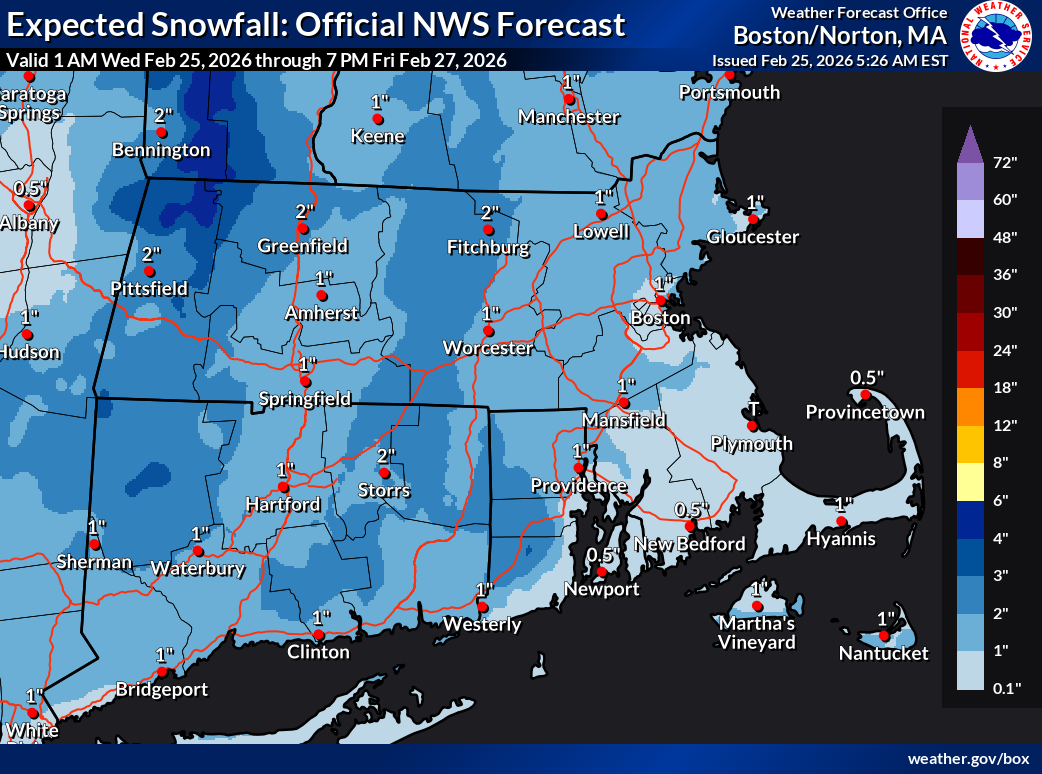
    At Providence, a clipper system will likely bring snow possibly changing to rain in a first burst Wed 7am – 1pm and a second burst of all snow Thu 6pm – Fri 4am, but the chance of any precipitation at all in the second is less than 20%. Total accumulation will be under 1 inch.

    Metropolitan area probability at least 0.1in 98%, 1in 37%, 2in 13%, 4in 4%, 6in near 0%.

    The next chance of precipitation will be Mon.

  • The Rally Against Fascism: A Love Letter to Tomorrow!

    The Rally Against Fascism: A Love Letter to Tomorrow!

    “In the end, though, love is relationships, and that is why we are here: to build relationships of caring, durability, strength, and connection. Love is a participant.”

    Emcees Moira Walsh, Cody Frazier, and Jordan Garces

    “Welcome to ‘A Love Letter to Tomorrow,’” said Moira Walsh, one of the three emcees, after a terrific musical performance by B. Dolan opened the two-hour event. “Fascism is exhausting. We spend a lot of time protesting. We spend a lot of time rallying. We spend a lot of time being angry. We don’t spend a lot of time talking about what we are fighting for.

    “I’m an activist. I’m a former state representative in Providence’s 3rd District. I used to identify as a Democrat. I don’t anymore. Now I identify as three things: a mother, a neighbor, and a fucking revolutionary. I’ve been doing activism for a long time… and one of the most important things is remembering why we’re doing this. As for me, my career in activism will end when my children and grandchildren have a world built on compassion, care, and cooperation.”

    “I am also an activist, a little bit newer to the game,” said Jordan Garces, the second of the three emcees. “I am with the Rhode Island Democratic Socialists of America, and I am also a revolutionary. I want to say that loud. Today, we’ll be talking about what we need to do going forward, but this is also a space for us to heal together and build the solidarity to keep pushing forward.”

    “I’m a worker, just like you,” said Cody Frazier, the third emcee. “I guess you could say I’ve been radicalized by what’s been going on, whatever that means. If you could indulge me in one thing: I need you guys to start stomping one foot.

    “A funny thing happens with suspension bridges. When people march across suspension bridges and begin to step in time, slowly, but surely, the bridge begins to crumble. And that’s what we can do with the constructions of fascism. All it takes is one step. One step forward, and you fall in line with the next person, and then the person behind you falls in line with you, and joins your community to destroy the constructs of fascism.”

    The Rally Against Fascism: A Love Letter to Tomorrow was organized for Valentine’s Day because that day, according to organizer Michael Araujo, “is about the heart, and a day when we publicly express our feelings towards those we love. For the organizations, performers, and speakers, it is because they want to express those feelings of care to you.”

    “In our families,” continued Araujo in his welcome letter, “We all express love in a wide quilt of ways. Each small part, like making sure we can secure food, or helping change an elder’s sheets, or teaching a little one how to ride a bike, all provide comfort, and all require showing up fully for those we love. Since you are here, it’s safe to assume you care about, or even love, your neighbors and community. Maybe you are looking for the next way to show it.”

    The event alternated between talented musicians and talented orators representing a wide variety of leftist activist organizations, including the International Workers of the World (IWW), the Rhode Island Democratic Socialists of America (RISDA), the Providence General Assembly (PGA), the One People’s Project, Counterpower, the Revolutionary Student Union (RSU), and Providence Worker’s Defense.

    Here are a few excerpts from the speaking program [to view a complete transcript, visit steveahlquist.substack.com]:

    Anthony Tinaro, Revolutionary Student Union (RSU)

    “I work for my living. There are other details to my life, but you’ve heard them all from a thousand other friends. I’ve cleaned up parks, I’ve written essays, I’ve been in bars, and I’m young. I graduated from college last year. I’ve seen a few things a young man shouldn’t see. I’ve seen some things that the ruling class has tried to prevent me from seeing. Even if the powers that be try their hardest to blot out my future with their war on our climate and their war on our freedoms, despite everything, I can still see the future.

    “When I think about the future, I think about the children… I think the reason I can still get up in the morning is that I’m trying to act like there’s going to be a tomorrow, a next year, for them.”

    Daryl Lamont Jenkins, founder of One People’s Project, presented the Keynote

    “I’ve never seen so much action when it’s this cold. They’re doing it at 22 Below in Minneapolis… I mean, maybe ICE is leaving Minneapolis, but they’re still here. The people we’ve been fighting, whether it is the government or their lackeys in the media, their biggest problem is us, because we showed them that we’re going to be fighting them. We also showed them that we’ll beat them and we’re in it for the long haul…

    “That’s why they’re angry and made it a political cause to go after Bad Bunny. How the hell did they figure out a way to make Minnesotans enemies of the state? So yeah, I’m sure a brown man performing during the Super Bowl is going to be a problem for them. Every time I see them freak out over the halftime show, it shows that they’re scared of something. Let’s give them more of it… There have to be more of these events like this going on.

    “I don’t think they’re prepared, but we’ve got to be prepared. We’ve got to make sure that we can get people out who never came out before, because that’s who were killed in Minnesota. When you talk about Alex Pretti, when you talk about Renee Good, they were just folks. They said, ‘We’ve got to do something.’ Encourage your neighbors not to wait until a victim of ICE or this government looks good enough to defend. Everybody in this room right now could have been in the exact situation as Pretti or Good… We will put an end to this, and one of the best ways to do so is to ensure we have more events like this.

    Emeline, Industrial Workers of the World (IWW)

    “We are a union, not just any union, but one of the longest-standing, most radical unions in the world… From the historic battles against Gilded Age tyrants to the ongoing battles at Starbucks, Amazon, and local institutions like Butler Hospital and Seven Stars, workers organizing against their bosses’ abuse have always formed an indisputable core of the push for progress, and everyone in this room today is better for it…

    Mike, a member of Counter Power, a founding member of the Providence Organization of Workers and Renters (POWR), and active with the Providence General Assembly

    “All of us have an obligation not to let the violence, dehumanization, and cruelty that we see every day persist, let alone get worse. The tasks at hand are daunting. The stakes are higher than any of us have ever seen, so the question is: How do we effectively and quickly build the new world in the shell of the old? How do we gather enough durable support to give birth to a new society while bearing the existing society? 

    “Members of POWR have been organizing coordinated national calls with over a dozen other cities that are holding people’s assemblies to build this model and learn from one another… Through consistent communication, solidarity, trust, and collective resistance, the groundwork for a feasible and meaningful united front might be born. It is our collective belief that that is what we’re all doing here today, and we look forward to struggling alongside all of you.”

  • Blizzard Shatters All-Time Snowfall Record with 37.9 Inches at TF Green Airport: Surpasses Blizzard of 1978

    Blizzard Shatters All-Time Snowfall Record with 37.9 Inches at TF Green Airport: Surpasses Blizzard of 1978

    Snow accumulation at TF Green Airport reached 37.9 inches, shattering the all-time record of 28.6 inches set during the legendary Blizzard of 1978.

    07:01 pm EST – 2/23/2026TF Green AP, RI37.9
    03:10 pm EST – 2/23/20261 SE Warwick, RI36.2
    04:21 pm EST – 2/23/20261 S Providence, RI36
    07:40 pm EST – 2/23/20263 W North Kingstown, RI36
    08:25 pm EST – 2/23/20261 NW Warren, RI35.5
    02:33 pm EST – 2/23/2026North Kingstown,35
    09:00 pm EST – 2/23/20261 SW Newport AP, RI34
    07:59 pm EST – 2/23/2026Whitman, MA33.7
    01:10 pm EST – 2/23/20262 E Providence, RI33.5
    07:05 pm EST – 2/23/20262 SE Coventry, RI33.5
    04:30 pm EST – 2/23/2026Dartmouth, MA33
    03:46 pm EST – 2/23/20261 SW Pawtucket, RI32
    04:30 pm EST – 2/23/2026Westport, MA32
    08:25 pm EST – 2/23/20261 NE Attleborough, MA32
    07:03 pm EST – 2/23/2026NWS Boston/Norton, MA31.8
    02:20 pm EST – 2/23/20261 E Providence, RI31.5
    01:23 pm EST – 2/23/20261 W Central Falls, RI31.3
    09:10 pm EST – 2/23/20261 E Middleborough, MA31.2
    05:28 pm EST – 2/23/2026New Bedford, MA31
    06:09 pm EST – 2/23/2026Acushnet, MA31
    07:10 pm EST – 2/23/20261 W Taunton, MA29
    02:00 pm EST – 2/23/2026Dighton, MA29
    01:00 pm EST – 2/23/20263 S Somerset, MA28.7
    02:00 pm EST – 2/23/2026Lakeville, MA28
    12:30 pm EST – 2/23/20263 W Dighton, MA27.1
    02:30 pm EST – 2/23/2026Taunton, MA27
    01:32 pm EST – 2/23/20263 NW Dighton, MA27
    05:00 pm EST – 2/23/20261 E Pawtucket, RI27
    10:42 am EST – 2/23/2026Swansea, MA26.5
    10:05 am EST – 2/23/20262 E Cranston, RI26.5
    02:00 pm EST – 2/23/2026Norton, MA26
    12:02 pm EST – 2/23/20262 S East Providence, RI26
    02:53 pm EST – 2/23/20261 SW North Attleborough, MA25
    09:00 am EST – 2/23/20261 NE Providence, RI24.6
    09:15 am EST – 2/23/20262 NE Bliss Corner, MA24
    02:00 pm EST – 2/23/2026Rochester, MA24
    03:23 pm EST – 2/23/2026Bridgewater, MA24
    02:05 pm EST – 2/23/2026North Providence, RI24
    12:00 pm EST – 2/23/20262 W Warwick, RI24
    12:00 pm EST – 2/23/20262 SW Pawtucket, RI21

  • Blizzard Sun 9pm – Mon 6pm, 32.8in Breaks All-Time Record: State of emergency for heavy snow, white-out conditions

    Blizzard Sun 9pm – Mon 6pm, 32.8in Breaks All-Time Record: State of emergency for heavy snow, white-out conditions

    [ RI declares state of emergency ]

    Blizzard Warning in effect from February 22, 04:00 PM EST until February 24, 07:00 AM EST

    Snowfall reports for last 24 hours, as of 2026-02-23 1400EST
    (Source: NWS https://www.weather.gov/source/crh/snowmap.html )
    RI Energy Outage Map, 2026-02-23 1345EST
    (Source: https://outagemap.rienergy.com/omap )

    At Providence, a major classic nor’easter developed offshore and passed to the east of RI, from Sun 9pm to Mon 6pm, bringing heavy snow and blizzard conditions with rates late Sun to early Mon exceeding 2 inches per hour. A Blizzard Warning is posted for Sun 4pm to Tue 7am. Travel will be nearly impossible; expect nearly universal parking bans.

    Mon 4am – 4pm, winds reached 30MPH sustained with 55MPH gusts, causing blowing and drifting show and severely reducing visibility. Winds and snowfall rates will decrease after 2pm.

    While the median forecast in the metropolitan area is 24 inches, as much as 36 inches is possible. At 1:00pm, the official report at TF Green Airport was 32.8 inches, breaking the all-time record of 28.6 inches set by the Blizzard of 1978 on Feb 6 – 7, 1978.

    RI Energy reports over 40,000 customers without electricity.

  • RI Gov. McKee Declares State of Emergency: Blizzard to close roads, cut electricity to more than 100,000

    RI Gov. McKee Declares State of Emergency: Blizzard to close roads, cut electricity to more than 100,000

    Forecast:
    [ motifri.com/wx-2026-01-22-1530est ]

    GOES-East weather satellite image, Day Night Cloud Combo, 2026-02-22-1936Z

    RI Gov. Daniel McKee declared a state of emergency ahead of a blizzard expected to begin dropping snow on the state Sun evening. Predicted to drop 12 – 32 inches of snow, the storm could reach historic proportions among the most severe ever recorded.

    At a press conference held at the RI Dept of Transportation (DOT) maintenance facility in Warwick Sun 12:45pm, the governor urged everyone to complete storm preparations by no later than 8:00pm, by which time they should be situated wherever they will need to stay for the next day or two.

    White-out blizzard conditions will make travel impossible by the height of the storm between Mon 1:00am and 4:00pm, with near-zero visibility and winds gusting to 55MPH. Roads will be closed to commercial traffic Sun 5:00pm and to all non-emergency vehicle traffic at 7:00pm. The state has 500 plows available, and will begin clearing efforts as soon as the storm subsides enough to do so safely, said Robert Rocchio, chief engineer at the DOT.

    An estimated 100,000 to 150,000 customers are expected to lose electricity, said Brian Shuster of RI Energy. Outages can be reported on the web at https://rienergy.com/outage or by text to OUTAGE to 743674; to check the status of an existing outage, text STATUS to 743674. He said mutual assistance will be called in from neighboring utility companies to assist recovery.

    Warming centers and shelters will opened for those losing or unable to access heat.

    McKee warned that service outages could last for several days, and rural customers dependent on well water should fill containers or even bathtubs in advance.