Sample ballot for RI special election, Nov 7, 2023, if you lived at the Motif office.
A special election to fill the US House 1st district seat vacated by David Cicilline will be held Tue, Nov 7, between candidates Gabriel “Gabe” Amo (D) and Gerry W. Leonard, Jr (R). Half of the population lives in the 1st district, and the other half in the 2nd district (represented by Seth Magaziner) will not be having a special election.
Polling places are open in almost all cases from 7am to 8pm, although there are occasional local exceptions. Where and how to vote can be found at the elections web site of the Office of the Secretary of State: vote.sos.ri.gov/Voter/VoteatthePolls
RI requires photo identification at the polls, either currently valid or expired not longer than six months. Valid identification is:
RI driver’s license/permit
US passport
ID card issued by any federally recognized tribal government
ID card issued by an educational institution in the United States
US military identification card
ID card issued by the US government or State of Rhode Island (RIPTA bus pass, etc.)
Government issued medical card
RI Voter ID card
The 1st district is heavily Democratic, with analysts estimating that had the redistricting map from the most recent census been in effect for the 2020 presidential election, the vote would have been 65% for Joe Biden and 35% for Donald Trump.
Gabe Amo
(Photo: candidate web site)Gerry Leonard
(Photo: candidate web site)
Amo previously worked for President Joe Biden as deputy director of the White House Office of Intergovernmental Affairs from 2021 to 2023 and for RI Gov. Gina Raimondo as director of public engagement and community affairs in 2020.
Leonard retired in 2019 at the rank of colonel after 30 years of service in the US Marine Corps, including as vice president of operations, chief of staff and COO with the US Marine Forces Reserve, and as chief of plans and chief strategy officer of the NATO International Security Assistance Force.
Note: This was published two days before Israel began its ground offensive in Gaza on Oct 27.
Significance
Badge of the Israeli Defence Forces
(Source: Wikimedia Commons)
The situation in the Middle East has the United States itself on the brink of war. One critical aspect of World War I that is not widely understood is that, although historians traditionally date the start of the war to the assassination of Franz Ferdinand on June 28, 1914, it took months for most of the combatants to realize they were in a war.
My view is that the world is again in a status of cold war, this time between the United States and China, with subsidiary players, especially Russia and Iran, lining up on each side. Just as in Cold War I, there are occasional flashes of hot war, where the Russian invasion of Ukraine is substantially analogous to the Korean War.
Iran sees the United States as an implacable enemy: they call us the “Great Satan” and they mean that absolutely literally, in the sense that the West is a force of evil working against God, and that much of the world including the European Union and Israel are puppets of the United States in that effort. To that end, Iran operates and funds proxy forces throughout the world, especially Hiz-b-Allah (“Party of God”) in Lebanon.
Islamism is a political ideology that claims a basis in the religion of Islam, but it is not itself a religion and it is important to understand that the vast majority of the 1.6 billion followers of Islam are not Islamists. The best estimate is that about 15% agree with the tenets of Islamism, which is a supremacist faction that believes Islam is the one true religion and it should be imposed by force on the entire world, with the population of the earth given the choice of conversion or death. Most majority Islamic nations regard Islamism as an existential threat, and many nations outlaw it and imprison the leaders of Islamist organizations.
The root Islamist group is the Muslim Brotherhood, founded in Egypt in 1928 but of little significance until after the creation of the State of Israel in 1948, which was seen as a direct challenge and threat to their goal of Islamic supremacy. The Muslim Brotherhood established what are effectively local chapters throughout the Middle East and Hamas, founded in 1987, is their Palestinian Arab chapter. Probably the most notorious act of the Muslim Brotherhood was the assassination of Egyptian President Anwar Sadat in 1981 for what, in their view, was the capital crime of signing a peace treaty with Israel in 1979, pursuant to the Camp David accords in 1978.
Iran is of enormous geopolitical significance because it is the only sovereign nation with an Islamist government. While there are Islamist sympathizers running other countries such as Turkey, Iran is constitutionally an Islamist theocracy. After the democratically elected prime minister, Mohammad Mosaddegh, nationalized the oil industry that had been under British ownership and introduced other social reforms, the American CIA and the British MI6 engineered a coup in 1953 that deposed him and put the former monarch (“shah”) back on the throne. The shah ruled autocratically and made himself extremely unpopular, and pro-democracy advocates chose a figurehead, Ayatollah Ruhollah Khomeini, in a popular revolution that succeeded in 1979. (“Ayatollah” is an honorific for a senior religious cleric in Iranian Shia Islam.) Khomeini’s Islamist and anti-democratic views were well known and he managed to politically outmaneuver the pro-democracy advocates to become what the new constitution of the “Islamic Republic of Iran” called the “Supreme Leader.” Iran is not a dictatorship: although the Supreme Leader theoretically has final say over everything the government does, he rarely personally intervenes and there is a functioning parliament (“majlis”) that has members representing a variety of views and perspectives. While there is a requirement to be vetted by religious authorities in order to even run as a candidate, there is some range of differing views that are tolerated within the scope of Islamist clerics. This tends to prevent Iran from doing anything really truly and terribly stupid.
Iran currently faces a number of major crises. Huge protests followed the death of Mahsa Amini, a young woman arrested by the religious police who accused her of improperly covering her hair as required by laws about feminine modesty. She subsequently died in police custody in Sep 2022. The main driver for these protests is the demographic balance of Iran: of its 87 million people, 74% were not yet born by the time of the 1979 revolution and 24% are age 14 or younger. The government of Iran is in the hands of geriatric clerics whose conservative religious outlook is increasingly out of sync with the people, and those clerics are increasingly willing to do anything in their desperate quest to hang onto power: More than 500 people peacefully protesting the death of Mahsa Amini were killed by the police, including about 10% – 15% under age 18. Rather than permit women to be in public with their hair uncovered, the regime of geriatric clerics is willing to shoot down teenage girls in the street.
The whole reason President Biden recently visited Tel Aviv and sent two aircraft carrier strike groups to the vicinity of Israel is to deter Iran and its proxies from getting involved in the Hamas war. Iran participated in at least a year of planning for the terrorist attacks by Hamas that killed 1,300 in Israel — wsj.com/world/middle-east/iran-israel-hamas-strike-planning-bbe07b25 — supplying money and weapons including missiles, and giving the green light to the operation. The awe-inspring military capability of two American aircraft carrier strike groups is enough to level Iran, and Iran knows it. The entire US Navy only needs 11 carrier strike groups to defend the entire world, so that gives some sense of the power that will be sitting in the Mediterranean Sea and the Persian Gulf.
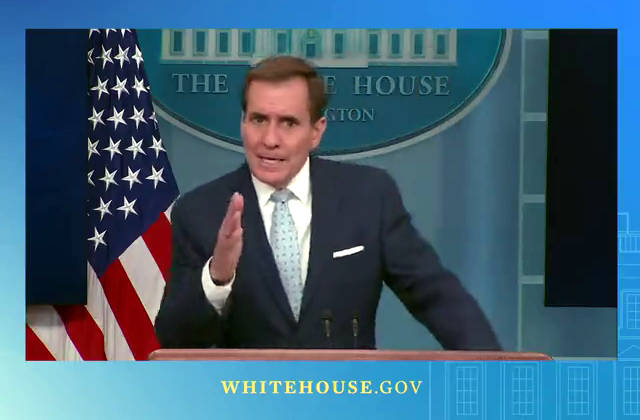
US National Security Council spokesman Rear Admiral John Kirby
Lebanese Hiz-b-Allah has threatened that if Israel conducts a widely expected ground invasion of Gaza, then it would attack Israel from the north using its massive inventory of missiles. This is a serious threat: Unlike Hamas, which had about 10,000 missiles, almost all makeshift metal tubes that are stuffed with explosives at one end and rocket propellant at the other end, making them short-range, unguided terror weapons, Hiz-b-Allah has an estimated 100,000–150,000 missiles, mostly higher quality guided weapons made in and supplied by Iran. (Iran is a major weapons producer and has a thriving export business to Russia and other customers.) If Hiz-b-Allah makes good on its threat, the only possible military response would be for Israel to pretty much obliterate southern Lebanon, which is what happened the last time Hiz-b-Allah tried it in 2006; the head of Hiz-b-Allah famously said in an interview that if he had known what the Israeli response would be then he would never have provoked it.
Israel is not willing to accept the possible tens of thousands of casualties to both soldiers and civilians that would result from a full-scale war with Lebanese Hiz-b-Allah, and their strategy may be to strike directly at Iran in order to force them to call off their proxy. The enormous danger here is that these minor players on the global stage, Hamas and Hiz-b-Allah, could set off a conflagration they do not intend as happened in World War I, and the hope to avert such a regional war between Israel and Iran is that cooler heads will prevail. While Hamas is suicidal, Hiz-b-Allah is less so and Iran is not at all. Nevertheless, the possibility cannot be ruled out that Israel and Iran will become directly engaged in war, and that may force the involvement of the United States; the worst case scenario, which is actually shockingly plausible, is World War III.
History
There is no such thing as “Palestinian history” because (as explained in my article “The Indigenous People of Israel: Zionism is reclamation and return, not colonialism“) the term “Palestine” was originally coined by the ancient Roman Empire after the suppression of the Jewish revolt and the sack of Jerusalem in 70 CE, replacing “Judea” which literally means “place of the Jews.” The term fell into disuse until the Zionist movement revived it in the 1890s, and then it was exclusively used by the Zionists through the Balfour Declaration in 1917 and the League of Nations Mandate for Palestine intended to carry out the Zionist project. Through the interwar period, the Arabs denied there was any such place as “Palestine,” insisting that the land was instead southern Syria and the Arabs living there were simply Arabs.
Only in 1948 when Israel declared itself a state pursuant to the UN General Assembly partition plan in 1947, after the Arab armies attacked and invaded Israel in an attempt to exterminate it and its people, did a refugee crisis ensue where Arabs fled in a mass movement into Jordan and Egypt. The Arabs who stayed behind in what is now Israel became citizens of the new country, but those who fled did not. (About 25% of the Israeli population now is not Jewish.) Such transfers of population are common as a result of wars: Similar things happened dozens of times following World War I. The independence of India from Britain, also in 1948, resulted in a partition into Hindu-majority India and Muslim-majority Pakistan and Bangladesh, with millions of people crossing the borders to reside where their religion was the majority.
Uniquely, the Arab refugees from the 1948 Arab-Israeli war were treated by the Arab nations as permanent refugees in order to maintain the contention — to this day — that Israel would soon be destroyed and the refugees could then move back into an Arab state that would replace Israel. Unlike any other refugees, the Arab states used them as pawns: Rather than allowing them to become citizens or even legal residents of the states in which they were given refuge, the children, grandchildren, and great-grandchildren without end are all treated as refugees by the Arabs. The identity of “Palestinian Arabs” dates only to the 1948 war: As noted, the Arab nations denied the existence of such a people prior to that.
But the refugees from Israel proper in 1948 were mostly living in Gaza and the West Bank, which were Egyptian and Jordanian respectively, and no Arab nation so much as suggested creating a Palestinian Arab state in those territories but maintained the fantasy that they were temporarily awaiting the destruction of Israel. The next major development was the Six-Day War in 1967 when a number of Arab nations, including Egypt, Jordan, and Syria, combined to mass military forces on the Israeli border to crush it out of existence. Things went so badly for the Arabs in that war that Egypt lost the Gaza Strip and the entire Sinai Desert, while Jordan lost the West Bank including the old city of Jerusalem. With the acquisition of these territories, the Palestinian Arab refugee problem, which had been created by the Arab League to exploit the refugees in their denial of recognition to Israel, became an Israeli problem. The Arab League adopted the Khartoum Resolution: no recognition of Israel’s right to exist, no negotiations with Israel, no peace with Israel. This guaranteed that the Palestinian Arabs would be totally screwed, which was the Arab League intent.
There is no “Palestinian Arab history” before 1948 because the entire ethnic identity is a creation and result of the war that year.
Peace process
It is beyond dispute that the Palestinian Arabs have been historically screwed-over, but it is important to examine why and by whom. The unwillingness of the Arab nations to tolerate the existence of a Jewish state in 1948 is the fundamental cause of the current situation, because they pretended that Israel would soon be destroyed and replaced by a Muslim-majority state. Now 75 years later, there are cracks in that position, with peace treaties signed by Egypt (1979), Jordan (1994), and the Abraham Accords with the UAE, Bahrain, Morocco, and Sudan (2020). There were highly credible rumors that Saudi Arabia was about to join, which would have been influential as it is the pre-eminent Islamic nation, the guardian of Mecca and Medina. All of these nations view Islamism and Iran as enemies and threats, especially Saudi Arabia.
Just as Hamas is the Palestinian Arab chapter of the Islamist Muslim Brotherhood, many of these nations are plagued by their own local Islamist groups: Boko Haram in Nigeria and Morocco, al-Shabaab in Somalia and Sudan, al-Qaeda and the Taliban in Afghanistan and Pakistan, and so on. All such groups have ties to Iran, the only Islamist sovereign nation.
The Arab nations have never viewed Israel as a threat, but as an embarrassment: They all give lip service to the interests of the Palestinian Arabs, but have never lifted a finger to do anything for them and care only to exploit them as political pawns. As the Arab nations sign peace treaties with Israel, even the usefulness of the Palestinian Arabs as political pawns disappears, and they become a geopolitical irrelevancy. If Saudi Arabia signed a peace treaty with Israel, that could be the death knell for the Palestinian Arab cause.
Between 1948 and 1967, when Gaza was Egyptian and the West Bank was Jordanian, there was no talk of establishing a Palestinian Arab state in those areas, and instead all of the Arab rhetoric was about destroying and replacing the State of Israel, thereby solving the permanent refugee crisis. Only after 1967 when Israel acquired control of these territories and the reality of its existence as a nation began to sink in, did anyone start to think about such a possibility.
In 1970, the Palestinian Liberation Organization (PLO) tried a violent overthrow of the government of Jordan after they were promised military backing from neighboring Syria with the endorsement of the Soviet Union. That led to an international crisis, Jordan asking for help from the United States which directed them to ask for help from Israel. The diplomatic efforts of the United States with the Soviet Union caused Syria to renege on the promise to help the PLO, with the result that the PLO were so soundly defeated on the battlefield that they were kicked out of Jordan and had to flee all the way to Tunisia. This was certainly a main reason why Egypt, getting back the entire Sinai Desert in the 1979 peace treaty with Israel, declined to accept the contiguous Gaza Strip because they were worried the Palestinian Arabs there would try in Egypt what they did in Jordan. Similarly, Jordan was not interested in the return of the West Bank, fearing that the large contingent of Palestinian Arabs there would lead to a repeat of the 1970 overthrow attempt. In other words, Egypt and Jordan decided it would be in their interest to stick the Israelis with the Palestinian Arab refugee problem when they signed peace treaties.
Almost everyone acknowledged that the situation was untenable and unstable, and that led to a largely spontaneous popular uprising among the Palestinian Arabs starting in 1987 that became known as the “First Intifada” that until it ended in 1983 resulted in about 200 Israeli and 1,200 Palestinian Arab deaths. After winning the first Gulf War in 1991, President George H.W. Bush, one of the most experienced American presidents in foreign policy, proposed a realignment of the Middle East that would include solving the Palestinian Arab refugee issue. That led to the multiparty Madrid Conference in 1991, co-sponsored by the United States and the Soviet Union, attended by Israel, Jordan, Lebanon, and Syria, and with a non-state delegation representing the Palestinian Arabs. This was followed by a series of bilateral negotiations between the parties, but eventually led to the back-channel negotiations that resulted in the Oslo Accords in 1993–1995.
This turned out to be the high point of the peace process, and nearly everyone (including me) was optimistic that the emergence of a Palestinian Arab state that would live in peaceful co-existence with Israel looked inevitable. The main effect of the Oslo Accords was that the PLO recognized the legitimacy of the State of Israel, formally abandoning the expectation that it would be replaced, and Israel recognized the PLO as “the sole, legitimate representative of the Palestinian people.” A major part of the Oslo Accords was the creation of the Palestinian Authority (PA), effectively a government-in-waiting for the eventual Palestinian Arab state, that in the meantime would have substantial control over the West Bank and Gaza. The Oslo Accords were and still are the only agreement ever signed by Israel, the PLO, and the US.
There were objections to the Oslo Accords from the extremists on both sides. In Israel, the religious right viewed the ceding of the West Bank, which they regarded as the biblically promised “Judea and Samaria,” to be a breach of sacred duty. Yitzhak Rabin, a military hero and the prime minister who negotiated and signed the Oslo Accords on behalf of Israel, was assassinated in 1995 by a right-wing Jewish religious extremist, shocking both Israelis and Arabs.
On the Arab side, the objections to the Oslo Accords came primarily from Islamists who viewed any tolerance for the existence of a Jewish state as religiously forbidden. (The PLO is a secular organization largely founded under the auspices of Soviet Marxist influence.) Nevertheless, the PA began operations and in co-operation with Israel began collecting taxes, hiring a civil service, and doing all of the basic activities of governance.
The culmination of the Oslo process was supposed to be the Camp David summit in 2000 where the US, Israel, and the PLO/PA were expected to work out the final terms for a Palestinian Arab state. Israeli Prime Minister Ehud Barak put an offer on the table that would turn out to be the best offer the Palestinian Arabs would ever receive: a Palestinian Arab state comprising 100% of Gaza and 92% of the West Bank. Yasser Arafat, the chairman of the PLO, rejected that offer for reasons that are still debated. The unexpected collapse of the talks led to grave disappointment all around and mutual recriminations in public. In turn, the diplomatic failure led to the Second Intifada, this time much less a popular uprising than a cynical effort by Arafat to exert political leverage. The Second Intifada 2000 – 2005 resulted in the death of more than 1,000 Israelis (about 75% civilians) and more than 3,000 Palestinian Arabs, effectively destroying the peace process.
In 2005, hoping in part to end the Second Intifada, Israel unilaterally withdrew 20,000 soldiers and 8,500 civilians from Gaza, leaving it as an experiment in self-governance by the PA. Palestinian Arab elections in 2006 resulted in a shock victory of Hamas over Fatah, the main component of the PLO. Because Hamas is regarded as an Islamist terrorist organization by Israel, the United States, and the European Union, seating the newly elected Palestinian Arab officials would have cut off the PA from funds and diplomatic contact. In 2007, the simmering civil war between Palestinian Arabs resulted in Hamas defeating Fatah in Gaza, publicly executing Fatah members by shooting them in the streets and throwing them off of rooftops.
Although the PA retained control of the West Bank and conditions there were far better than in Gaza, Hamas continued to be focused on the fantasy of destroying Israel and murdering all of the Jews in the world. Not only did this marginalize Hamas and isolate it diplomatically, but also resulted in Hamas diverting foreign aid from humanitarian to military purposes, such as using supplies of concrete not to reconstruct buildings that could benefit the people but to build underground tunnels used to manufacture and store weapons including explosives and rockets. These rockets were rudimentary terror weapons, incapable of being aimed, and about one-third of the time would land inside Gaza, often killing Palestinian Arabs.
While Hamas was willing to see the economy of Gaza devastated and the people suffering, it invested its resources into such projects as making tens of thousands of terror rockets to be launched against Israeli civilians just over the border. Israel developed its “Iron Dome” defense system to shoot down these rockets, freeing its government and military from being forced to respond to rocket attacks with massive force such as firing artillery into Gaza to disable the rocket launchers. Hamas sited its rocket launchers near civilian residences, and even next to hospitals and schools, to maximize the chance of an Israeli response harming these “human shields.”
Israel and Hamas reached a modus vivendi where every few years Hamas would greatly increase the volume of rocket fire and Israel would respond in a limited way, sometimes with a short ground incursion to destroy terror tunnels or other military assets in Gaza. Hamas is internally divided between a military wing that adheres to its Islamist origins and sees compromise of any sort as traitorous, and a political wing that seemed to tacitly ignore the existence of Israel while attending to the practical challenges of governing. Israel became encouraged that the political wing was in the ascendancy, and that Hamas would be changed by the need to govern Gaza to begin acting rationally and abandon the fantasy of destroying Israel.
On 7 Oct 2023, this Israeli assumption that Hamas had the potential to embrace moderation was shattered by an attack where hundreds of terrorist operatives infiltrated about 20 Israeli civilian communities, murdering almost everyone they encountered including the elderly and small children. Hamas posted videos of their terrorists with bullet-riddled, incinerated, and decapitated bodies. The evidence became clear that the attack had been planned and rehearsed for at least a year – documents recovered from dead Hamas terrorists were dated as long ago as 2022 – and the decision to undertake the attack at this specific time was likely because of an open-air music concert that would be attended by more than a thousand young Israelis at the same time, presenting an ideal “soft target” opportunity for Hamas terrorists to attack with paragliders and pickup trucks, killing at least 260.
Most seriously, Hamas captured about 200 hostages, a matter of utmost concern to all Jews and not just Israelis. Some of these hostages are nationals of 30 or 40 other countries, including the United States. Israel declared a state of siege, turning off electricity, fuel, water, and food supplies to Gaza until the hostages are returned. Hamas controls the situation: All they have to do to end the siege is return the hostages.
If Hamas is unwilling to return the hostages, their embrace of the paramount goal of martyrdom is likely to be realized at the hands of the Israeli military: It is one thing to choose martyrdom for oneself, but utterly immoral to choose martyrdom for other people, in this case the civilian population of Gaza.
What now?
At one time, I was optimistic that a Palestinian Arab state was possible, that it could live in peaceful co-existence with Israel, and this would follow from the Oslo process. Even after the Second Intifada, I believed it was still possible in time. After the Hamas attacks on Oct 7, whatever hope I had for a Palestinian Arab state is gone.
I don’t know what the solution is, nor even if a solution is possible. The Palestinian Arab people are doomed to live indefinitely in misery unless they can manage to free themselves of their own political leadership, which in the case of Hamas are nihilistic seekers of martyrdom and destruction and in the case of the PA are corrupt and complacent seekers of power.
A Palestinian State can never be allowed to exist if, instead of seeking the welfare of its people, it is run by extremists who care nothing for them and instead are only out to destroy Israel and kill Jews, the explicitly stated goals of Hamas. Islamism is a supremacist political ideology (distinct from Islam) that seeks world domination and the forcible imposition of theocracy, and is therefore a cancer out to end civilization itself. Iran may help bring about the end of civilization, especially if it triggers World War III.
Like World War I, we might discover some months from now that World War III has started up around us. Everyone always imagined that we would know immediately as ICBMs dropped warheads from the sky, but I think there is an alternative: Cold War II could slowly transition to hot and become World War III, with the slow drip of escalation moving from Ukraine to Israel to Lebanon to Iran. The US Navy will have two carrier strike forces off the coast of Israel to let us know.
The opinions expressed in this article are those of the author and do not necessarily represent those of Motif.
It’s a well-known fact that Rhode Island is the smallest state in the country – an hour and you’ll find that you’ve driven across the whole state (okay, let’s be honest, an hour and a half with the potholes and traffic). You might think you know everybody here – somebody’s cousin is somebody’s grandpa’s neighbor, and then they’re your coworker and the person in line behind you for a coffee milk. But make no mistake: Native Americans have been around since before the official founding of Rhode Island, and they aren’t going anywhere.
I sat down with Tia-Alexi Roberts – guest editor for the current Motif issue, communications student at Southern New Hampshire University, Communications and Editorial Assistant at Cultural Survival, and active, enrolled member of the Narragansett Indian Tribe – on October 9, Indigenous Peoples’ Day.
In the last few years, the United States has seen an overdue rise in the performance of land acknowledgements. Roberts, too, has observed a shift in people’s curiosity that can be traced to Western Indigenous activism and promotion of Native American cultures. “Social media platforms have had a huge boom of content creators that are Indigenous,” Roberts remarked. “There was a large difference in people wanting to know more and getting more curious [about Indigenous issues] since the pandemic.”
When asked about how to write a land acknowledgement, Roberts points out that “First and foremost, it’s important to acknowledge whose land you’re on. There’s different Tribes for different states; some states have multiple Tribes, and some just have one federally recognized Tribe. Make sure you find out who is federally recognized.”
The next important part of a land acknowledgement is to dive deeper: once the land is identified, acknowledge the history. “Touch base on the histories of what has happened, if there’s something significant – for us, it’s the Great Swamp Massacre,” Roberts reminds us. The Great Swamp Massacre took place in December 1675 during King Philip’s War. Narragansett Indians fought against the Puritan Army, resulting in the killing of 300–600 Natives. The Swamp area is now what we know as South Kingstown, Rhode Island.
FIND OUT WHOSE LAND YOU ARE ON. ILLUSTRATED BY SHAENA SOARES. Source: Wikimedia Commons, Wohngebiet Südneuengland by Nikater. Thismap is meant to encourage thought and discussion, not to represent official or legal boundaries of any Indigenous nations. To learn about definitive boundaries, contact the nations in question.
After acknowledging and paying respect to the histories, Roberts emphasizes the importance of educating people and building further awareness. While she advises us to not go too far down the many rabbit holes that are waiting to be explored (for this purpose, anyway), a land acknowledgement should be explicit in its statements of support to the Tribes. “It would be good to say ‘we strongly support’ – for example, ‘We strongly support the Narragansett,’ or the Wampanoag People. State that you support the Tribe of the area or the land you’re standing on. Recognize that they’ve been here prior to colonization; they are the first people of the land.” Roberts even suggests mentioning a timeline for when the land was officially colonized – for example, adding something to the likes of “We recognize that the Narragansett People have been here prior to 1636 and we support the fact that they are still in their homelands.”
Roberts adds that Native people are very grateful for the land acknowledgements, “Some non-Native people believe that there were no people here occupying the land, which is just not true.” A land acknowledgement certainly cannot undo or make up for any history, but when done respectfully, can spread awareness and urge the public to take action.
Roberts encourages those interested in learning more about Indigenous culture in the Northeast to explore Native American Museums, specifically the Tomaquag Museum in Exeter, RI, or the Pequot Museum in Ledyard, CT. She also suggests that “Submerging yourself into the culture is the best way to expose yourself to it,” by finding local powwows or social events hosted by local Natives.
“It’s time to recognize our land as land, something that is precious and not just something we exist on. When you take care of your land, your land will take care of you.” Roberts remarked as she culminated our conversation.
“Yes, we’re still here,” she said. “And no, we were not eradicated.” •
Flag of the State of Israel
(Source: Wikimedia Commons)
The situation in Israel is chaotic and unclear, as a surprise attack by Hamas terrorists infiltrating across the border from Gaza has been reported to have killed at least 150 Israelis and wounded nearly 900, mostly innocent civilians. The attack occurred 50 years and one day after a similar attack by massed Arab armies in what has come to be called the Yom Kippur War.
Hamas is one faction in what amounts to a longstanding civil war between Palestinian Arabs, with Hamas controlling the Gaza territory and its rival Fatah controlling the West Bank. Hamas is reported to have launched at least 2,200 rockets into Israel within the past few hours, but these are totally unguided consisting of metal tubes stuffed at one end with explosives and the other end with propellant, so they are strictly indiscriminate terror weapons that murder at random, and about one-third of them fall within Gaza and kill Palestinian Arabs before even reaching Israel.
What Hamas is doing, by targeting innocent civilians, would be considered a war crime if it were a state actor capable of engaging in war, but it is not. Hamas has been formally classified as a terrorist organization by Israel, the United States, the European Union, and pretty much the entire civilized world.
Children kidnapped and held hostage by Hamas.
(Source: Israeli Defence Force)
That Hamas managed to take Israeli hostages, confirmed by the Israel Defence Force (IDF), puts the government of Israel into an untenable political position, preventing so much as a cease fire and forcing what may turn into an Israeli reoccupation of Gaza, from which it withdrew in 2005 in the obviously dashed hope that the Palestinian Arabs would govern themselves and transition to peaceful mutual coexistence. Instead, Hamas exploited the Israeli withdrawal to escalate a civil war against Fatah, abandoning any effort to help their own Palestinian Arab people in pursuit of an Islamist theocracy committed, in the words of the Hamas charter, to destroy Israel and murder all Jews. Islamism is not a religion but is a religio-political ideology distinct from, although claiming to be based on, the religion of Islam.
No negotiation is possible with Hamas even if they were willing to engage, and the only possible result of this attack by Hamas against Israel will be their own mass suicide, which they glorify as martyrdom. Hamas has overplayed an incredibly weak hand, as Gaza is dependent on Israel for basics such as electricity and water: all Israel has to do is turn these off until the hostages are returned. When a society falls into the grip of collective insanity where its highest goal is martyrdom, this is the inevitable result.
The opinions expressed in this article are those of the author and do not necessarily represent those of Motif.
At Providence, a Heat Advisory is in effect Thu 11am – Fri 8pm for a dangerous heat index peaking to 103°F on Fri 12pm, with only slightly less oppressive heat indices 90°F Wed, 97°F Thu, and 94°F Sat. Similar conditions will affect much of southern New England with peaks to 105°F in Hartford, CT, and Cambridge, MA.
NWS Heat Index Chart, week of 2023-07-25
Heat indices this high can cause death. If outside, curtail strenuous activity, stay hydrated, take breaks, and seek shade when possible. Do not leave children or pets in vehicles. Check on elderly and other vulnerable people, especially if they have no air conditioning.
NWS Heat Safety See weather.gov/safety/heatNWS Heat Index Forecast, 2023-07-26NWS Heat Index Forecast, 2023-07-27NWS Heat Index Forecast, 2023-07-28NWS Heat Index Forecast, 2023-07-29
As our world inches closer to nuclear war than it has in decades, we prepare to observe the anniversary of the Allied victory over Japan ending World War II, finally brought about by the first (and, so far, only) use of atomic weapons in combat.
Rhode Island is the sole state where this once widely-recognized observance remains a holiday, Victory Day, legally enshrined (§25-3-1(5)) on the second Monday in August, one of only nine (like July 4th and Christmas) entitling employees to time-and-a-half pay. RI created the holiday in 1948, but as of 1975 every other state has taken it off their books. Despite repeated efforts to abolish it amidst allegations that it is a triumphalist celebration of the killing of several hundred thousand people, it survives as a state holiday due, it is generally understood, to its fortuitous position during the good weather of the summer in August and to an unwillingness to offend veterans of the war. In 2023, of the 16 million American veterans of World War II fewer than 160,000 survive, about 1,000 of them in RI, so the origins of the holiday are fading from living to historical memory.
It was clear to everyone that the war was coming to an end, and after the surrender of Germany on May 8, 1945, the conflict ceased in Europe leaving Japan the only member of the Axis still fighting. The Allied powers involved in the Pacific war (the United States, the United Kingdom, and China) on July 26 issued the Potsdam Declaration, an ultimatum demanding the unconditional surrender of Japan and threatening “prompt and utter destruction.” Ten days earlier on July 16, a secret test was carried out in New Mexico successfully proving the new American atomic bomb worked.
Japanese representatives on board USS Missouri (BB-63) during the surrender ceremonies, 2 Sep 1945. Standing in front are: Foreign Minister Mamoru Shigemitsu (wearing top hat) and General Yoshijiro Umezu, Chief of the Army General Staff. Behind them are three representatives each of the Foreign Ministry, the Army and the Navy. (Photo: Army Signal Corps Collection in the U.S. National Archives via Wikimedia Commons.)
Although running out of everything from food and fuel to soldiers, on July 29 Japan communicated its rejection of the Potsdam Declaration and an intention to continue the war. That led to decisions by the United States to use an atomic bomb on the city of Hiroshima on August 6 and on the city of Nagasaki on August 9. At the same time, unaware of the secret agreement by Russia at the Yalta Conference in February to declare war, desperate Japanese hopes for diplomatic intervention by the still-neutral Soviet Union were dashed by the invasion of Manchuria. The Empire of Japan began the process of surrendering, finally broadcasting a radio message to the Japanese people by the emperor at noon on August 15 that has come to be regarded historically as the moment ending the war.
The current controversy about the appropriateness of continuing to observe a holiday is motivated almost entirely by the moral questions raised by the atomic bombings. For many years, it was accepted that without them the war would have dragged on for at least another year with concomitant loss of life greater than from the bombs, but that came to be disputed by some historians. The effect of the bombs on convincing Japan to surrender has also been disputed, but Emperor Hirohito himself cited them in his radio address, noting “the war situation has developed not necessarily to Japan’s advantage” and explicitly saying, “Moreover, the enemy has begun to employ a new and most cruel bomb, the power of which to do damage is, indeed, incalculable, taking the toll of many innocent lives. Should we continue to fight, not only would it result in an ultimate collapse and obliteration of the Japanese nation, but also it would lead to the total extinction of human civilization.”
Evan Thomas publishedThe Road to Surrender in May and he summarized the criticism: “In more recent years, scholars of World War II have argued that it was not necessary to drop the atomic bombs on Japan, or that it was not necessary to drop more than one, or that the Japanese might have been moved to surrender if the United States had staged a demonstration of the bomb’s power on a deserted island. That argument has gained popular currency.… In school and college, many had been exposed to books and scholarship that argued that, by August 1945, Japan was ready to surrender, and that America’s real motivation in dropping the A-bomb was to intimidate Russia in the earliest days of the Cold War.”
But, he continues, “The facts are otherwise. On the morning of August 9, 1945, after the United States dropped two atomic bombs and Russia declared war on Japan, the Supreme Council for the Direction of the War, the group of six leaders who ran Japan, deadlocked on whether to surrender. The vote was a tie, three to three. The most powerful leaders, the ones who ran the army, wanted to keep on fighting. For five more days, Japan teetered on the edge of a coup d’état by the military that would have plunged Japan into chaos and extended the war for many bloody months.… The problem for [the Allied leaders] — the looming, intractable, seemingly unsurpassable obstacle — was that Japan was unwilling to surrender. By the summer of 1945, the empire appeared to be defeated. Japan’s ships had been sunk, its cities burned, and its people were on the verge of starvation. But its military leaders, who commanded 5 million soldiers under arms, as well as greater citizen armies equipped with pitchforks and scythes, seemed bent on mass suicide. To attempt to defeat them by invading and seizing territory seemed sure to produce the greatest bloodbath of all time — and the Japanese, or at least their military leaders, beckoned the Americans to it.”
After the deeds were done, doubts quickly emerged. Thomas writes, “In November 1945 J. Robert Oppenheimer, the chief scientist in charge of developing the bomb at the secret laboratories of Los Alamos, appeared in the Oval Office and cried out to President Truman, “’Mr. President, I feel I have blood on my hands!’” Truman said later that he called Oppenheimer a “cry-baby” and responded, “I told him the blood was on my hands – to let me worry about that.” Secretary of War Henry L. Stimson suffered a minor heart attack when he brought Truman photos of Hiroshima and a major heart attack a month later when he brought the first plans for the control of atomic weapons.
The Bulletin of the Atomic Scientists, which devotes its July issue to Oppenheimer, in January set its symbolic “Doomsday Clock” that measures the notional time to the end of the world through human action at 90 seconds to midnight, as close as it has ever been in its 75 years of existence. Oppenheimer is being brought back into public prominence by a new Hollywood blockbuster movie released on July 21, based on the 2005 book American Prometheus by Kai Bird and Martin J. Sherwin, their title inspired by the ancient legend: “Like that rebellious Greek god Prometheus – who stole fire from Zeus and bestowed it upon humankind, Oppenheimer gave us atomic fire. But then, when he tried to control it, when he sought to make us aware of its terrible dangers, the powers-that-be, like Zeus, rose up in anger to punish him.”
For the first time in decades, the invasion of Ukraine by Russia and the ruthlessness of Russian President Vladimir Putin has political and military leaders talking about the possible use of nuclear weapons in combat. US National Security Advisor Jake Sullivan was quoted a few days ago by Robbie Gramer in Foreign Policy: “I think that there are two caricatures in the discourse about the threat of the use of tactical nuclear weapons. One caricature is the Biden administration is paralyzed by the nuclear threat and therefore won’t support Ukraine sufficiently. I think that is nonsense. The other caricature is this nuclear threat is complete nonsense. ‘Don’t worry about it at all. It’s to be completely discounted.’ That also is wrong. It is a threat. It is a real threat. It’s one we need to take seriously. And it is one that does evolve with changing conditions on the battlefield.”
A few years ago, I witnessed an exchange as a Providence club was closing at 2:00am, open an extra hour because of the Victory Day holiday. The DJ was of Japanese ancestry (as his stage name emphasized) and, after stopping the music, delivered a political tirade about how evil the US had been to drop those atomic bombs. A close friend of mine, a patron on the dance floor, loudly challenged that version of history and shouted, “Take your garbage remarks to China and see what they think.” This was a reference not only to the current communist government of China that is unfriendly to free speech, but also to the grave mistreatment by Imperial Japan of its Asian neighbors, including China and Korea. The DJ seemed shocked that anyone could disagree with him. The exchange stayed purely verbal but it is easy to imagine that ranks might have formed up on each side because of the strongly opposing views, proof of William Faulkner’s observation, “The past is never dead. It’s not even past.” People deeply care about this.
Thomas explained in an interview with Terry Gross on Fresh Air that the Japanese knew they were defeated but, “They believed that if they could make the Americans bleed enough, suffer enough, take enough casualties, then the Americans would give them terms that they wanted.” War is hell, and we forget that at our peril. No one knew what the atomic bombs would do in practice, and its creators were surprised that about half of the deaths happened weeks after the explosions, as they had neither contemplated nor understood the consequences of radiation or psychology. Only in August 1946, a year after the bombings, did Americans begin to understand their effects when The New Yorker devoted an entire issue to a book-length report from John Hersey in Hiroshima.
Crowd of people, many waving, in New York City Times Square on V-J Day at time of announcement of the Japanese surrender on Aug 14, 1945.
(Photo; World-Telegram by Dick DeMarsico; from US Library of Congress via Wikimedia Commons)
It is difficult to understand the mindset of the American people in 1945: the war started in September 1939 with the joint invasion of Poland from the west by Germany and from the east by Russia, but America remained neutral until the Japanese surprise attack on Pearl Harbor in December 1941. It is estimated that between 70 and 85 million people died in connection with the war (including the Nazi Holocaust), about 3% of the pre-war population of the planet at the time. Japan lost 2.5 – 3.1 million, about 4% of its population. The United States lost 420,000, about 0.32% of its population. Although America came through relatively unscathed in comparison, the years of privation and uncertainty took a toll, especially as no one knew which of their family, friends, and neighbors would be among those hundreds of thousands killed. The Providence Journal estimated that 50,000 people filled the streets of Providence in a spontaneous celebration on the day of the Japanese surrender.
Japan today is a prosperous democracy, committed to the cause of peace, and thoroughly abjures its militaristic past. Japan holds a solemn commemorative ceremony every year on the date of the surrender, the National Memorial Service for War Dead (officially “the day for mourning of war dead and praying for peace”). They are not spending the day grilling hamburgers and hot dogs, but their different circumstances demand different observance.
Is our celebration of the end of the war morally wrong? Were the atomic bombings the wrong decision? After substantial examination of the historical evidence, I believe both questions should be answered in the negative. There were no good options, only options that ranged from bad to worse. We must judge the people of 1945 according to what they knew and could have known.
In the modern world, we must make every effort to avoid the use of nuclear weapons, especially because their enormously increased power makes possible not merely the destruction of a city but the destruction of a continent. Accomplishing this requires an honest appreciation of history.
I’m disturbed by many of the social media posts I see on July 4th denigrating the United States, saying Independence Day is not worth celebrating, displaying inverted flags as distress symbols, and in the worst cases saying that Americans feel alienated from and not a part of America. Providence arts organization AS220 hosted “FX4 Fest,” on July 2, toning down the title of the event otherwise advertised as “Fuck the Fourth,” so described on its web page: The United States “went on to consolidate wealth and power through genocide, slavery, theft, and cultural erasure, leaving wounds so deep that today, they threaten to rip its constituent myths to shreds. So you wanna get black out drunk? Do you need to wave tiny flags and pledge allegiance to a myth that perpetuates the exploitation of the many for the benefit of the few? Fuck no.”
I get it, this country is far from perfect, and we as a nation just passed through a terrible confluence of bad circumstances no one alive previously experienced: the most intense racial protests since 1968, the worst economic downturn since 1933, and the worst public health emergency since 1918 that has so far killed more than 1.1 million. None of this seems cause for optimism.
Yet, despite all of its problems, I don’t feel the country is in danger of slipping away from me. I regard my US citizenship as akin to winning the lottery: much of the world is in disastrously bad shape, usually of its own making. Russia is run by an unprincipled oligarchy with the operating practices of an organized crime ring, committing war crimes against Ukraine. Venezuela is run by ideologues so irrationally committed to failed socialism that they refuse foreign aid, denying their own people food and medicine. North Korea is run by a ruthless narcissist whose only concern is staying in power, regardless of the cost to the people. Saudi Arabia is run by a crown prince who found it acceptable to send a team to murder a Washington Post journalist and cut up his body with a bone saw. China is run by an isolated elite seeking financial advancement at the expense of the fundamental values of civilized society, leading to efforts to crush any expression of dissent whether in Tiananmen Square in 1989 or Hong Kong in 2020.
The path to improvement is not to give up on democracy as a goal and decide to chuck rule of law in favor of anarchy. Former slave Frederick Douglass excoriated the hypocrisy of celebration in one of his most famous speeches, “What to the Slave is the Fourth of July?” but he delivered it in 1852, years before the end of slavery in 1865. Douglass, who lived until 1895, clearly changed his view in 1881 when he compared the American Revolution and the Civil War: “It was a great thing to achieve American Independence when we numbered three millions, but it was a greater thing to save this country from dismemberment and ruin when it numbered thirty millions.” Douglass had no illusions, but he placed his faith in constitutional democracy, saying in 1867, “A man’s rights rest in three boxes: The ballot box, jury box and the cartridge box.”
A few days after the election of Donald Trump in 2016, historian Timothy Snyder wrote a Facebook post that he would eventually expand to a short book, On Tyranny, and then a longer book, The Road to Unfreedom: “The Founding Fathers tried to protect us from the threat they knew, the tyranny that overcame ancient democracy. Today, our political order faces new threats, not unlike the totalitarianism of the twentieth century. We are no wiser than the Europeans who saw democracy yield to fascism, Nazism, or communism. Our one advantage is that we might learn from their experience.” Snyder consistently attacks “memory laws” that try to suppress teaching the truth of history: “Falsifying the past legitimates oppression in the present.”
While criticism of the United States is a centuries-old tradition that is explicitly recognized in its own Bill of Rights, there is a bright line between constructive efforts toward improvement and reform as opposed to nihilist “burn it all down” despair. Authoritarian fascism can only take root when people lose confidence in the good faith of their fellow citizens, fearing them as a threat, even evil or subhuman.
The United States has achieved a state of both freedom and prosperity unequaled, indeed unimaginable, in all history; as our own cultural tradition has observed: with great power comes great responsibility, and despite our pursuit of truth, justice, and the American way, some just want to watch the world burn.
With all of its faults, the United States often falls short of carrying out in practice its stated ideals, most notably that “all men are created equal,” but it preserves the mechanism, better than anywhere else in the world, to allow its people to pursue these goals, regardless of the deficiencies of elected leaders and politicians.
Chatter using the WhatsApp and Telegram instant-messaging services and other social media prompted police departments in major metropolitan areas, including New York City, Los Angeles, and Chicago, to issue warnings about a “Day of Hate” planned for Saturday, Feb 25, by Neo-Nazi antisemitic organizations as an effort to target Jews and Jewish organizations for harassment and potential violence. Because Saturday is the Jewish holy day of Shabbat (Sabbath), Jewish organizations have called for responding in a “Shabbat of Peace.”
Anti-Defamation League (ADL) call for “Shabbat of Peace” in response to “Day of Hate,” Sat, Feb 25, 2023.
Jewish Rhody, the publication of the Jewish Alliance of Rhode Island, quoted its president and CEO, Adam Greenman: “Since first being alerted to the ‘National Day of Hate,’ the Alliance has been working to coordinate efforts with local and state law enforcement. We have also been keeping our community partners up to speed on the latest news from our national security partner, Secure Community Network. While there have been no credible threats made, we urge our communities to remain vigilant this day and every day. It can be infuriating to know a day like this is being planned, but our community is strong, vibrant, and above all, resilient. Together, we will rise above this hate.”
Asked by Motif “Has Providence put out anything on this ‘National Day of Hate’ matter?” the public information officer for the Providence Department of Public Safety answered, “Not at this time that I have been made aware of.”
Vandalism at Red Ink Community Library, night of Feb 20, 2023.
(Source: https://twitter.com/RedInkPVD/status/1628074671399743517 )Vandalism at Red Ink Community Library, night of Feb 20, 2023.
(Source: https://twitter.com/RedInkPVD/status/1628074671399743517 )Neo-Nazi flag displayed outside Red Ink Community Library, Feb 21, 2022.
(Source: Still frame extracted from video posted at https://twitter.com/guateguanaco/status/1495928149892288518 )
On Feb 21, 2022, Neo-Nazi protesters disrupted an event at Red Ink Community Library in Providence, making noise and waving flags emblazoned with a swastika, “SS” runes, and a “Totenkopf” (death’s head), but in 2023 there was vandalism and damage, Red Ink posted on Twitter: “Last night an anti-communist message was sent to us in anticipation of our Red Books Day celebration of the publication of the Communist Manifesto. Last year they showed up with flags to intimidate, this year they threw bricks through the window.” The post included photographs of glass shards and a brick on which was written “commie scumbags.”
The Anti-Defamation League (ADL) said on Twitter: “We are closely monitoring tomorrow’s anticipated ‘Day of Hate’ campaign and are in touch with local law enforcement agencies. As always, please report any bias or hate incidents to ADL at http://adl.org/incident and please join us in celebrating a #ShabbatOfPeaceNotHate.”
Leaked NYPD law-enforcement bulletin on antisemitic “Day of Hate” planned for Sat, Feb 25, 2023.
(Source: Lakewood News Network)
In a leaked law-enforcement bulletin obtained by the Lakewood News Network in New Jersey, the New York City Police Intelligence and Counterterrorism Bureau warns of “Domestic Violent Extremist” planners “of this overtly racist, anti-Semitic event are instructing likeminded individuals to drop banners, place stickers and flyers, or scrawl graffiti as a form of biased so-called activism” who are asking participants to “photograph or record direct actions and submit them online in order to create a compendium of exploits from around the country.” Various sources have identified some of these extremist groups as the Goyim Defense League (GDL), the National Socialist Movement (NSM), Crew 319, and Clockwork Crew.
Statement from NY Gov. Kathy Hochul on “Day of Hate” planned for Sat, Feb 25, 2023.
New York Gov. Kathy Hochul issued a statement on Twitter: “I have directed [New York State Police] and [New York State Department of Homeland Security and Emergency Services] to closely monitor the safety of Jewish communities this Shabbat. While there are no credible threats to New Yorkers at this time, we will remain vigilant. My top priority is the safety of New Yorkers.”
The nebulous and decentralized nature of the “Day of Hate” leaves it unclear where on the spectrum of risk it poses, ranging from a bunch of online posts that go no further up to violent terrorist acts and murder. The Jewish Telegraphic Agency, an independent service providing news to the Jewish community since 1917, noted the environment of increasing antisemitism: “The alert came roughly a week after two Jews exiting morning prayer services were shot on consecutive days in Los Angeles, allegedly by a man with antisemitic motives. Last fall, two men were arrested in Penn Station for threatening violence against New York City synagogues, and weeks earlier, police in New Jersey warned synagogues in the state about a ‘credible threat.’”
After 12 years representing RI’s first district in the US House of Representatives, David Cicilline will step down effective Jun 1, 2023, according to a statement released by his office late this morning. He will become president and CEO of the RI Foundation, a major philanthropic organization, replacing Neil Steinberg who announced his retirement several months ago.
Cicilline has held the seat since Jan 2011, most recently re-elected in Nov 2022 to a term ending in Jan 2025, defeating Republican challenger Allen Waters, 63.8% – 36.2%. The district is considered a safely Democratic seat, and the margin of victory is comparable to that estimated in the subsequently redrawn district for the most recent presidential election in 2020. As a result, a Democratic primary to fill the vacancy is expected to be fiercely competitive, effectively setting the stage for an easy win in the general election.
The Office of the RI Secretary of State said that the timing of a special election would, by law, be determined by the governor. “A vacant seat in the House of Representatives is filled through a special election. In collaboration with the Board of Elections, the Department of State will begin the special election process once requested by the Governor,” a spokesman told Motif. The law provides that the special election will be held on the first Tuesday after the first Monday of the month.
UPDATE Feb 23: The office of Secretary of State Gregg Amore told Motif, “We are beginning to map out a possible timeline for the special election that would comply with elections law and create enough time to satisfy all of the procedural elements of holding a special election. Once the election is called for, there will need to be a candidate declaration period, a signature collection and verification period, and internal ballot preparation. Then, federal law requires that mail ballots are sent to overseas voters [primarily active duty military] 45 days before both the primary and the general. At this time, we believe that statutorily, the earliest a primary could be held would be August 8. If the primary were to be held on August 8, the general would likely follow on October 3. If the primary were to be held September 5, the general would likely follow on November 7. These are only preliminary, possible dates. Later dates are possible. No dates have been set or confirmed. The Department of State is working collaboratively with the Governor’s Office, the Board of Elections, and the local cities and towns to ascertain the feasibility of different scenarios.”
Cicilline previously served as mayor of Providence from 2003 to 2010 and in the RI House of Representatives from 1995 to 2003. He is an attorney by profession, graduating from law school at Georgetown University in 1986 and receiving a bachelor’s degree from Brown University in 1983.
In a statement, Cicilline said, “The chance to lead the Rhode Island Foundation was unexpected, but it is an extraordinary opportunity to have an even more direct and meaningful impact on the lives of residents and families of our state.” He characterized the RI Foundation as “one of the largest and oldest nonprofit community foundations in the nation.”
Cicilline did not address the issue in his statement, but it is a reasonable inference that a significant factor in his decision to leave Congress was his party’s loss of majority status in the Nov 2022 election, greatly reducing his ability to accomplish anything in the narrowly divided chamber after being relegated to the minority. In his previous term, he served on the Foreign Affairs Committee and the Judiciary Committee, holding the chair of the latter’s Antitrust, Commercial, and Administrative Law Subcommittee.
“I write today to convey my deepest and most sincere gratitude to the residents of the First Congressional District. I am extremely grateful for the support of the people of Rhode Island, my dedicated staff, and the help of the many organizations and individuals that I have had the privilege to partner with over the past twelve years,” Cicilline said in the statement. “I once again extend my genuine and heartfelt appreciation for the honor to have served as your representative in the United States Congress.”
Continuity of office will be preserved, Cicilline said in the statement: “I will remain in office until I officially submit my resignation to the Speaker of the U.S. House of Representatives and Governor McKee on May 31, 2023. Constituents can continue contacting my office for assistance with federal agencies and to share your opinion or request information on pending legislative matters before Congress. After June 1, 2023, members of my staff will continue to operate offices in both Rhode Island and Washington, D.C. under the supervision of the Clerk of the House of Representatives until a new Member of Congress is elected. My office will provide additional information in the weeks ahead regarding this transition period.”
Internet joke meme modified photo: US fighter jet with painted trophies of two alien spacecraft and one balloon.
The military has shot down four objects in US and Canadian airspace within the last few days, and this has led to reactions ranging from rational concern to irrational panic.
I’m not saying it was aliens, but…
At a Department of Defense press conference on Feb 12 Helene Cooper of The New York Times asked, “Because you still haven’t been able to tell us what these things are that we are shooting out of the sky, that raises the question, have you ruled out aliens or extraterrestrials? And if so, why? Because that is what everyone is asking us right now.” Gen. Glen VanHerck, commander of North American Aerospace Defense Command (NORAD) and United States Northern Command (USNORTHCOM), answered, “I’ll let the intel community and the counterintelligence community figure that out. I haven’t ruled out anything.”
This bizarre “I haven’t ruled out anything” response from a four-star general to whether alien spacecraft are being shot down was not exactly helpful. Presidential Press Secretary Karine Jean-Pierre was forced the following day to explicitly deny the alien attack rumors: “I just wanted to make sure we address this from the White House. I know there have been questions and concerns about this, but there is no — again, no indication of aliens or extraterrestrial activity — (laughter) — with these recent takedowns. Again, there is no indication of aliens or [extra]terrestrial activity with these recent takedowns. Wanted to make sure that the American people knew that, all of you knew that. And it was important for us to say that from here because we’ve been hearing a lot about it.” That led to a follow-up question: “Would you tell us if there were, really?” Amid laughter, she answered, “I’m just — you know, I loved ‘E.T.,’ the movie. But I’m just going to leave it there.”
A national Associated Press story quoted Jim Ludes, a former national defense analyst who now leads the Pell Center for International Relations at Salve Regina University in RI: “There will be an investigation and we will learn more, but until then this story has created a playground for people interested in speculating or stirring the pot for their own reasons… In part, because it feeds into so many narratives about government secrecy.”
John Hoopes sarcastically posted on Twitter: “Big Astronomy is covering up the reality of extraterrestrial UFOs the same way Big Archaeology is covering up the reality of an advanced ancient civilization of the Ice Age.” Hoopes, an anthropology professor at the University of Kansas, is widely known as a public intellectual for his campaign to debunk the lunatic pseudo-scientific conspiracy theories advanced on the NetFlix series Ancient Apocalypse that argues, among other things, folkloric legends such as the lost continent of Atlantis are historically true.
Open Skies
The alien spacecraft stuff aside, why is anyone upset about this at all?
Nations have flown reconnaissance missions over foreign territory since the invention of aircraft: military balloons were in use as early as the French Revolution in the 1790s and in widespread use by the time of the American Civil War in the 1860s.
Balloons have not usually been perceived as threatening per se. In the final months of World War II between November 1944 and April 1945, Japan launched 9,300 “Fu-Go” balloon bombs with the expectation they would be carried by the atmospheric jet stream and start fires in the Pacific Northwest region of the continental United States. Although about 300 of the balloon bombs were found or observed, only one had any noticeable effect, killing the pastor’s wife and five children on a Sunday school picnic in the Fremont National Forest in Oregon.
From 1947 to 1949, the US Project Mogul flew reconnaissance balloons over the Soviet Union equipped with microphones capable of detecting the sound of nuclear tests; it was an early example that crashed near Roswell, New Mexico, that gave rise to the original alien spacecraft rumor. The US Project Genetrix (WS-119L) was a more advanced photographic surveillance balloon that was regularly flown over Russia and China in the 1950s at altitudes of up to 100,000 feet until it was largely replaced by the U-2 aircraft. In the mid-1950s, the US experimented with the E77 balloon bomb intended to disseminate chemical or biological weapons to destroy crops; it never entered production or deployment. The US Project Flying Cloud (WS-124A) was another balloon delivery system for chemical or biological weapons, but it was dismissed after testing as infeasible and ineffective. The US currently maintains a fleet of “aerostat” balloons as part of the Persistent Threat Detection System used in Afghanistan and Iraq to monitor hostile movements such as planting improvised explosive devices (IEDs) along roadways.
US military Persistent Threat Detection System balloon built by Lockheed Martin.
(Source: https://www.lockheedmartin.com/en-us/news/features/history/ptds.html)
The US has employed the Lockheed U-2 aircraft since 1955 and still maintains a fleet in active service: one was shot down over Russia in 1960 (pilot Francis Gary Powers was captured and repatriated in a prisoner exchange) and another over Cuba in 1962 (pilot Rudolf Anderson Jr. was killed). The 1962 incident came in the context of the Cuban Missile Crisis, which was itself a consequence of the US detecting Soviet nuclear weapons in Cuba from U-2 aerial photos; Maj. Anderson was the only American casualty of the crisis that threatened to set off World War III.
“Freedoms of the Air” is the formal diplomatic term for the post-1944 international standards and agreements that allow free passage of commercial aviation, including refueling and carriage of passengers and cargo, across borders. A comparable rubric for military aviation was proposed by President Dwight D. Eisenhower in 1955, and the Treaty on Open Skies finally came into existence under President George H.W. Bush in 1989, ratified by the US-allied NATO and the Soviet Union-allied Warsaw Pact in 1992; President Donald Trump withdrew the US during his lame-duck period between losing the presidential election in November 2020 and the inauguration of President Joe Biden in January 2021. The Open Skies concept, according to Eisenhower, was to allow each country to verify that other countries were not unilaterally preparing or mobilizing for war or otherwise violating arms control agreements.
Why balloons?
Balloons are cheap and easy to deploy. In 2009, MIT students Oliver Yeh and Justin Lee headed a few miles westward to the town of Sturbridge where they launched a $150 helium balloon project carrying a burner phone and digital camera that sent back real-time photos every few seconds, reaching an altitude of 93,000 feet (almost 18 miles) where the curvature of the earth is plainly visible and the sky appears as the blackness of outer space. In 2018, we reported on a Brown University student group building an earth-orbiting satellite: before members were qualified to work on the satellite project, they were introduced by building a balloon project. One of the project leaders said, “A lot of our first-years and sophomores join the high-altitude balloon team. We’ve launched two and they have 360-degree cameras, and they were either the first or the second 360-degree cameras on high-altitude balloons, the highest 360-degree cameras ever, [reaching 80,000 feet]. We put on electronics kind of similar to what we have on the satellite, such as an altimeter – which is not on the satellite – but also gyroscope, magnetometer, accelerometer, temperature. Each balloon tests something that we want to test for the satellite.”
There is a commercial weather balloon industry and it is estimated that about 300 are launched daily on average in the US. Weather Scientific sells the Kaymont HAB-100 for $19.00 and – I’m writing this on Feb 14 – has a Valentine’s Day discount offer. Scientific Sales has a selection from 10g capacity for $6.00 to 3kg capacity for $395.00. You can also buy instruments from them if you’re not inclined to the DIY approach like the MIT and Brown students. If you’re really hard up on the budget, Amazon will sell you a package of five 36-inch latex balloons for $10.00.
Why are we shooting down these objects?
The Chinese spy balloon that started the present frenzy was reported by US defense intelligence agencies as having flown from China to Alaska, then over Canada, and finally into the continental United States. My inference is that it was intended to maintain an altitude of about 100,000 feet but something went wrong and it descended instead to about 60,000 feet, at which point it was visible to the naked eye over Montana. With ordinary private citizens able to see it just by looking up into the sky, or at least with little more than a decent set of binoculars, that put the US government into an awkward position where they had to acknowledge its existence. Despite statements by defense and intelligence professionals who assessed the spy balloon as posing little threat, especially because China has numerous sophisticated surveillance satellites in earth orbit but probably decided to use balloons to save money.
The Biden administration came under heavy political criticism, especially from Republicans in Congress, for not shooting down the balloon as soon as it entered American airspace over Alaska, but we have never done anything like that before. We especially do not want to get into a situation where we shoot at their surveillance systems and they shoot at ours, for exactly the reasons Eisenhower explicitly articulated that some surveillance serves the interest of preserving peace. It was also revealed that this Chinese spy balloon was the fifth known incursion into US airspace since 2017, although as noted the military did not seem to see these as any threat worth responsive action. Of course, the lack of response may have been a mistake emboldening China to grow increasingly aggressive, eventually permitting their balloon to be seen from the ground. (The Chinese claim that the balloon was a meteorological research project is laughable.) It has also been revealed that US intelligence was aware of an extensive Chinese spy balloon project overflying 40 countries on five continents.
NORAD gathers an avalanche of radar and sensor data about everything flying in or above the atmosphere, reportedly as small as a grain of rice, and they have to filter these huge quantities of information in order to discard anything they can dismiss as no threat. They have spent decades looking for things that are big and fast, such as bomber aircraft or intercontinental ballistic missiles (ICBMs), so everything small and slow was pretty much ignored. After the Chinese spy balloon fracas, now they seem to be letting balloon-like objects through their filters and this is why we shot down three more objects without even fully understanding what they are.
Why are we shooting down these objects? Maybe the government knows and they’re not telling us. Maybe the government doesn’t know, either. Maybe these are homemade weather balloons constructed by a couple of ambitious college students or hobbyists.
At some point, we’re going to run into a revival of Lawnchair Larry, a man who in 1982 tied 45 helium balloons to an aluminum chair and ascended to an altitude of 16,000 feet, shutting down Long Beach Airport in California. After he landed, an inspector from the Federal Aviation Administration famously said, “We know he broke some part of the Federal Aviation Act, and as soon as we decide which part it is, some type of charge will be filed. If he had a pilot’s license, we’d suspend that, but he doesn’t.” At least he didn’t face a Sidewinder missile.