Category: Nationally relevant

Articles relevant beyond the local area
  • RI Prepares for Dangerously Cold Extreme Weather: Emergency action by state and local governments

    RI Prepares for Dangerously Cold Extreme Weather: Emergency action by state and local governments

    Dangerously extreme cold weather is predicted Fri, Feb 3, through Sat, Feb 4, that will combine ambient temperatures dropping to -6F with sustained winds of 25MPH and gusts of 45MPH to produce wind chills below -20F. (See motifri.com/wx-2023-02-02 for forecast details.) State and local governments are taking emergency actions to keep the public safe and, at the worst case, prevent deaths.

    The RI Emergency Management Agency (RIEMA) published a list of places where people without access to indoor heat can find temporary shelter — riema.ri.gov/planning-mitigation/resources-businesses/warming-centers — and a list of local city and town contact points — riema.ri.gov/planning-mitigation/local-contacts — as well as offering assistance by dialing 211.

    The RI Department of Housing has asked homeless shelters to extend their hours and until Sun 5pm will fund transportation costs to individuals in need to the 24/7 warming station at the Cranston Street Armory, using both RIPTA and, in rural and outlying communities, Uber.

    The RI Department of Health (RIDOH) issued advice for coping with extreme cold:

    • Yourself
      • Dress in layers.
      • Cover exposed skin. Wind chills this low may result in frostbite on exposed skin in as few as 15 minutes.
      • Limit outdoor time.
      • Add blankets to your home’s emergency kit.
      • Eat frequently. Food gives the body energy to produce heat.
      • Do not drink a lot of alcohol or caffeine. Alcohol and caffeine cause your body to lose heat faster.
      • Check on older family and friends; infants and older adults are more at risk for health problems related to extreme temperature.
      • Your baby should wear the same layers adults would comfortably wear plus one additional layer. Avoid using one big, bulky blanket.
      • Know the signs and symptoms of hypothermia and frostbite.
    • Your car
      • Keep your gas tank near full to avoid ice in the tank and fuel lines.
      • Make a winter emergency kit for your car. Add extra blankets and a wind shield.
      • Make sure your tires have enough air pressure and that your heater works.
      • Check your car’s antifreeze levels.
      • Tell your friends and family if you are traveling somewhere. If you can, bring a mobile phone with you.
    • Your pets
      • Limit outdoor time for your pets.
      • Bring outdoor pets inside.
    • Your home
      • Extreme cold can cause your water pipes to freeze and sometimes break. Leave your water tap open so they drip. Open the cabinets beneath the kitchen sink to let warm air near the pipes.
      • Be careful with indoor heaters; keep space heaters three feet away from anything that may catch fire.
      • Conserve heat. Don’t open doors or windows unless necessary. Close off unneeded rooms.
      • Do not use generators, grills, or camp stoves inside.
      • Install a battery-operated carbon monoxide detector to protect yourself from carbon monoxide poisoning. Put a carbon monoxide detector near your bedroom so you can hear it if you are sleeping.

    RIDOH warns that the most immediate health risks from extreme cold are frostbite and hypothermia:

    When exposed to cold temperatures, your body can lose heat quickly and develop frostbite or hypothermia or both.

    Frostbite most often impacts noses, ears, cheeks, chins, fingers, and toes. Signs of frostbite include discolored (red, white, or greyish-yellow) skin and numbness. If you notice signs of frostbite, get into a warm area as soon as possible and call a healthcare provider. Warm the affected area with warm water or with body heat. Frostbitten areas can be easily burned because they are numb. Do not use hot water, heating pads, or the heat of a stove or radiator for warming.

    Signs of hypothermia include shivering; exhaustion; confusion, memory loss, slurred speech; bright red, cold skin in infants, and very low energy in infants. If you notice signs of hypothermia, take the person’s temperature. If their temperature is below 95°F, this is an emergency, and the person should get medical attention immediately.

    The RI Office of Energy Resources is working with RI Energy (the successor to National Grid) which has “secured incremental electric resources and have additional crews available as needed” and placed “LNG [liquefied natural gas] facilities on standby and staffed to vaporize as needed.”

    The federal Centers for Disease Control and Prevention (CDC) also publish recommendations for safety in winter weather conditions.


  • COVID-19 Three Years In: Still here, still deadly

    COVID-19 Three Years In: Still here, still deadly

    The COVID-19 pandemic in RI is not over, is not going away anytime soon, and is surging for the worse.

    For the week ended Dec 31, 2022, RI reported 154 new hospitalizations, of which COVID-19 was the primary cause in 31.9%, a secondary cause in 30.0%, and not involved in 38.1%: in other words, three years into the pandemic, despite vaccines and anti-viral treatments, nearly two-thirds of hospital admissions are still caused by the coronavirus. That week, seven patients in RI died from COVID-19. The 7-day moving average of hospitalizations in RI is the most reliable indicator of severity, now that most testing uses rapid antigen tests (RAT), usually done in private. That average increased to 154 on Dec 31, from 148 on Dec 24, 136 on Dec 17, 112 on Dec 10, and 109 on Dec 3.

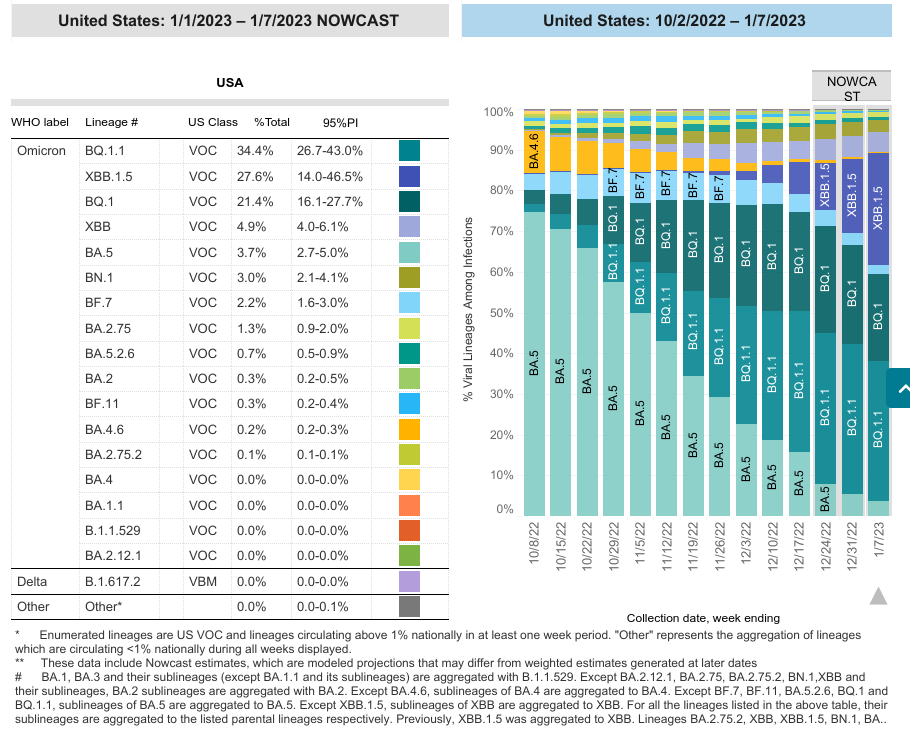
    RI recorded 675 deaths from COVID-19 in 2022. Cumulative deaths increased from 3,114 as of Dec 31, 2021, to 3,789 as of Dec 31, 2022, an average of about 13 COVID-19 deaths per week. RI remains a national leader in vaccination – 87.58% of the population completed at least the primary vaccine series.According to the Centers for Disease Control and Prevention (CDC), a more transmissible subvariant of Omicron, XBB.1.5, has become prevalent in New England as of the week ending Jan 7, 2023, accounting for an estimated 71.6% of cases (although nationally it’s responsible for only 27.6% of cases). XBB is a recombination of two earlier Omicron sublineages, BA.2.10.1 and BA.2.75.

    A study published Dec 13, 2022, in the journal Cell reported that the emerging Omicron subvariants in the BQ and XBB series are able to resist all approved monoclonal antibody (MAB) treatments and are more resistant to approved vaccines. (The study said nothing about non-MAB anti-viral treatments such as Paxlovid.) 

    The researchers note, “It is alarming that these newly emerged subvariants could further compromise the efficacy of current COVID-19 vaccines and result in a surge of breakthrough infections as well as re-infections. However, it is important to emphasize that although infections may now be more likely, COVID-19 vaccines have been shown to remain effective at preventing hospitalization and severe disease even against Omicron as well as possibly reducing the risk of post-acute sequelae of COVID-19 (PASC or long COVID).”

    As recently as last week, the World Health Organization (WHO) reaffirmed the finding of its Technical Advisory Group on Virus Evolution (TAG-VE) that there is no evidence XBB subvariants are more virulent or produce illness more severe than the earlier Delta and Omicron variants, despite increased transmissibility. The main added risk from XBB.1.5 is that it has a greater chance of re-infecting people who recovered from COVID-19 in the pre-Omicron period.

    Community transmission levels are “high” in Providence, Kent, and Newport counties, and “medium” in Washington and Bristol counties. Where transmission levels are high, the CDC recommends, “Wear a high-quality mask or respirator. If you are at high risk of getting very sick, consider avoiding non-essential indoor activities in public where you could be exposed. If you have household or social contact with someone at high risk for getting very sick, consider self-testing to detect infection before contact … Stay up to date with COVID-19 vaccines, including recommended booster doses. Maintain ventilation improvements. Avoid contact with people who have suspected or confirmed COVID-19. Follow recommendations for isolation if you have suspected or confirmed COVID-19.”

    Some schools in RI have gone back to universal mask-wearing, but this is unlikely to be widely adopted due to political controversy. The RI Department of Health (RIDOH) states, “Whether or not you’re vaccinated, you’re still required to wear a mask: If a healthcare setting, business, private school, camp, or other entity requires it [or] In public K-12 schools or institutes of higher education as required by the town, city, or school administration. RIDOH recommends wearing a mask indoors near anyone you don’t live with if Rhode Island becomes a high-risk area.”

    The respected Johns Hopkins University data tracker reported that the US exceeded 100 million COVID-19 cases on Dec 21, 2022, and their live tracker as of Jan 8, 2023, reports 664,175,097 confirmed cases and 6,706,716 deaths globally, of which 101,241,740 cumulative confirmed cases and 1,096,503 cumulative deaths were in the US.

    Worldwide, COVID-19 remains grave and is worsening. The WHO states in its most recent weekly situation report, “Globally, more than 3 million new cases and 10 000 deaths have been reported in the week [ending] 1 January 2023… In the last 28 days (5 December 2022 to 1 January 2023), over 14.5 million cases and over 46 000 new fatalities were reported globally – an increase of 25% and 21%, respectively, compared to the previous 28 days.”

  • RI Baby Names 2022: Popularity contest

    RI Baby Names 2022: Popularity contest

    In a New Year’s tradition, the Center for Vital Records at the RI Department of Health this morning announced the most popular names chosen for male and female babies born in 2022, based upon preliminary statistical data; the final results will be compiled in February.

    “Charlotte” skyrocketed in popularity for girls, while “Liam” maintained leadership for boys.

    The 2022 rankings of the top 10 names (with the top three in 2021 noted within parentheses) in order from most to least popular are:

    Female 

    1. Charlotte
    2. Amelia (3)
    3. Isabella
    4. Olivia (1)
    5. Emma
    6. Luna
    7. Sophia (2)
    8. Ava
    9. Isla
    10. Scarlett and Violet (tie)

    Male

    1. Liam (1)
    2. Noah (2)
    3. Owen
    4. Theodore
    5. Oliver
    6. Benjamin
    7. Julian (3)
    8. Luca
    9. Henry
    10. Lucas

    Several web sites compile their own data and make predictions, both nationally and by state, including names.org/lists/by-state/ri.

  • RI Recreational Cannabis Sales Begin Dec 1: Five retail venues licensed to open

    RI Recreational Cannabis Sales Begin Dec 1: Five retail venues licensed to open

    Recreational cannabis sales begin Thu, Dec 1, under a new state statute signed into law on May 25. “Five licensed medical marijuana compassion centers have been approved for hybrid retail licenses, which allow them to sell both medical and adult use marijuana products in retail settings,” the office of RI Gov. Daniel McKee said in a statement Nov 22. The governor’s office confirmed to Motif that as of Nov 30 the venues expected to commence retail sales of recreational cannabis to the public on Dec 1 are:

    These venues have been granted “hybrid retail licenses” allowing them to add recreational sales to their existing medical sales. Buyers must be adults at least 21 years old.

    “This milestone is the result of a carefully executed process to ensure that our state’s entry into this emerging market was done in a safe, controlled and equitable manner,” McKee said in the statement. “It is also a win for our statewide economy and our strong, locally based cannabis supply chain, which consists of nearly 70 licensed cultivators, processors and manufacturers in addition to our licensed compassion centers. Finally, I thank the leadership of the General Assembly for passing this practical implementation framework in the Rhode Island Cannabis Act and I look forward to continuing our work together on this issue.”

    “We were pleased with the quality and comprehensiveness of the applications we received from the state’s compassion centers, and we are proud to launch adult use sales in Rhode Island just six months after the Cannabis Act was signed into law, marking the Northeast’s fastest implementation period,” Matt Santacroce, interim deputy director of the Rhode Island Department of Business Regulation (DBR), said in the statement. “We look forward to continuing to work with the state’s cannabis business community to ensure this critical economic sector scales in compliance with the rules and regulations put forward by state regulators.”

    As regulated markets continue to expand under structured frameworks, consumers are presented with more clearly defined options that prioritize quality, safety, and consistency. This evolution has also encouraged interest in alternative cannabis-derived products, including CBD offerings that appeal to those seeking a more measured and approachable experience. Retail environments such as Cookies Dispensary reflect this shift by curating selections that align with regulatory standards while offering a range of products designed to meet varying preferences. By emphasizing compliance, transparency, and thoughtful product development, these businesses contribute to a marketplace where innovation and responsibility move forward together, supporting both consumer confidence and the continued growth of the industry.

    Part of DBR, the Office of Cannabis Regulation issues four classes of cannabis licenses to retail sellers such a dispensaries, to cultivators, to handlers of industrial hemp, and to sellers of non-psychogenic cannabidiol (CBD) products.

  • RI Election 2022 — Magaziner, McKee, cannabis sales win big: Democrats sweep all state general offices

    RI Election 2022 — Magaziner, McKee, cannabis sales win big: Democrats sweep all state general offices

    Republican candidates, expected to mount strong challenges in marquee races, went down to defeat against Democratic opponents in RI in the Nov 8 election, although by varying margins.

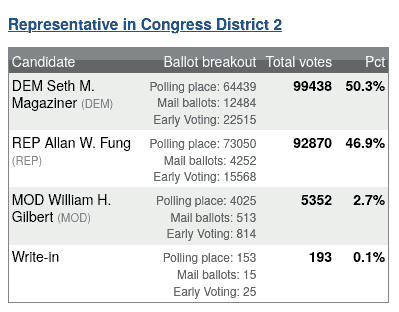
    For the seat being vacated by retiring James Langevin (D) in the US House of Representatives for the 2nd congressional district, Allan Fung (R), who served as mayor of Cranston for 12 years, lost by a narrow margin to Seth Magaziner (D), who is completing eight years as general treasurer. Fung conceded around 10pm, his 92,870 votes (46.9%) significantly behind Magaziner’s 99,438 votes (50.3%) with 99% (412 of 414) of precincts reporting. At one point in the counting an hour earlier, there was a virtual tie between Fung 81,275 (48.6%) and Magaziner 81,192 (48.6%) separated by only 83 votes. What tipped the scales irretrievably were mail ballots reported into the tally over an hour after polls closed at 8pm, as usually happens, Magaziner’s 12,484 beating Fung’s 4,252, a ratio of nearly 3-to-1. Fung was hurt by worse than expected performance in Cranston (Fung 50.1% – Magaziner 48.2%) and Warwick (Magaziner 51.5% – Fung 45.3%), which should have been Fung’s base. Polls consistently showed Fung leading, but we criticized those polls on the basis of biased statistical sampling and consequent over-weighting, and our criticisms proved vindicated. William Gilbert, formerly head of the Moderate Party but running as an independent after that party lost ballot access, received 2.7% of the vote, well below the margin separating Magaziner and Fung and therefore too little to be a “spoiler” as some feared.

    In the other major contest expected to be somewhat competitive, incumbent Daniel McKee (D) (57.7%) handily defeated newcomer Ashley Kalus (R) (39.1%), a margin of 18.6 percentage points and much greater than the 45% – 32% polling prediction and its margin of 13 percentage points.

    Among the other statewide general officers, Gregg Amore (D) (59.2%) trounced Pat Cortellessa (R) (40.6%) for secretary of state as did incumbent Peter F. Neronha (D) (61.2%) over Charles C. Calenda (R) (38.7%) for attorney general. In a closer race than expected, incumbent Sabina Matos (50.9%) defeated Aaron C. Guckian (R) (43.4%) and Ross K. McCurdy (I) (5.5%) to win her first full term as lieutenant governor after being appointed to replace McKee when he became governor as a result of the resignation of Gina Raimondo to become US commerce secretary. For general treasurer, a stepping stone to higher office in recent years for Magaziner and Raimondo, former Central Falls mayor James A. Diossa (D) (54.0%) defeated James L. Lathrop (R) (45.8%), also somewhat closer than expected.

    For US House in the 1st district, incumbent David N. Cicilline (D) (63.6%) faced no meaningful opposition from Allen R. Waters (R) (36.2%).

    All three statewide bond referenda (new facilities at the URI Narragansett Bay Campus, Pre-K through grade 12 public school facilities, and “environmental and recreational” projects for the “green economy”) were approved by strong margins.

    Issuance of licenses for new cannabis-related businesses was on the local ballot in 31 of the 39 cities and towns in RI, approved in 25 and rejected in six. Voters rejected cannabis businesses in a few relatively wealthy or rural municipalities: Barrington, East Greenwich, Jamestown, Little Compton, Scituate, and Smithfield. Voters authorized new cannabis businesses in most places: Bristol, Burrillville, Charlestown, Coventry, Cumberland, East Providence, Glocester, Hopkinton, Johnston, Lincoln, Middletown, Narragansett, New Shoreham (Block Island), Newport, North Kingstown, North Providence, North Smithfield, Richmond, South Kingstown, Tiverton, Warren, West Greenwich, West Warwick, Westerly, and Woonsocket. Because the new act only allows municipalities to opt out if they have not already licensed cannabis-related businesses in the past, eight cities and towns did not vote on bans: Central Falls, Cranston, Exeter, Foster, Pawtucket, Portsmouth, Providence, and Warwick.

    Full RI election results are available at www.ri.gov/election/results/2022/general_election on the web.

  • Opinion – Fung Squirms as Magaziner Treads Water: 2nd Congressional District a Toss-Up

    Opinion – Fung Squirms as Magaziner Treads Water: 2nd Congressional District a Toss-Up

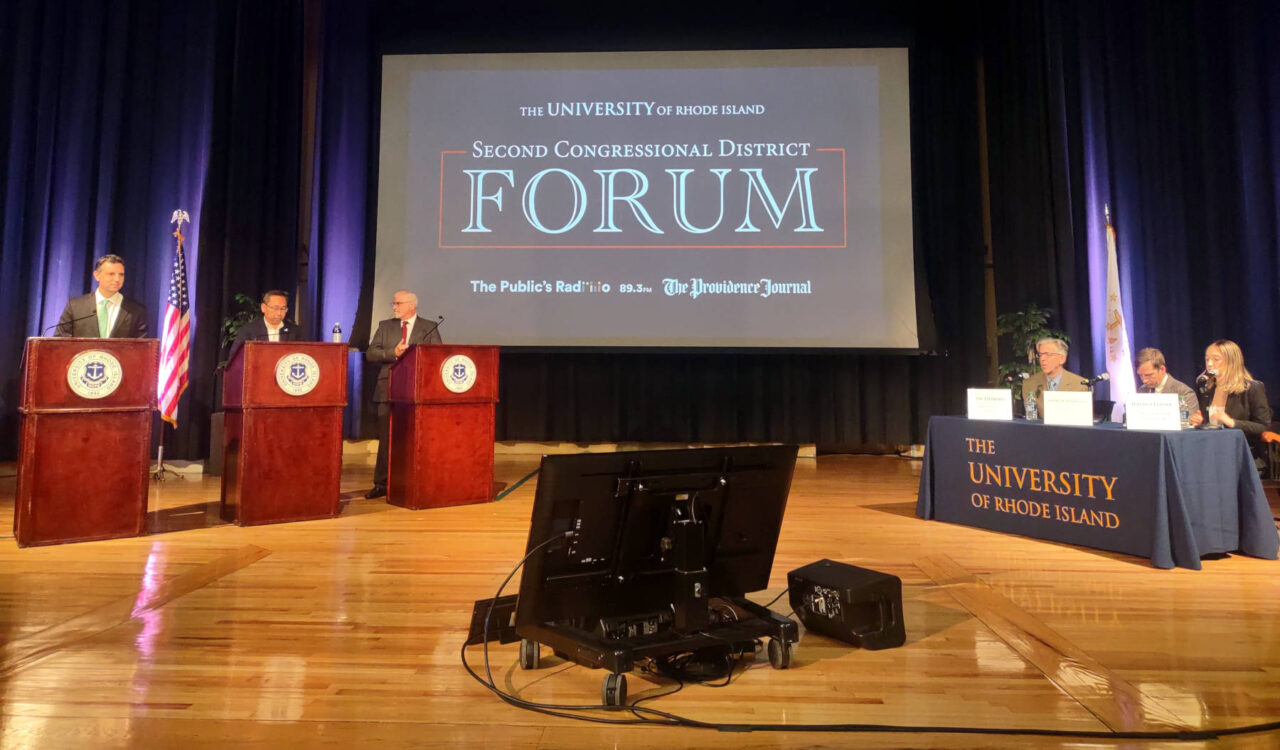
    Candidates forum at University of Rhode Island Edwards Hall, Oct 17, 2022. L-R: Seth Magaziner (D), Allan Fung (R), William Gilbert (I), Ian Donnis (The Public’s Radio), Patrick Anderson (Providence Journal), Juliana Lepore (Good Five-Cent Cigar).
    (Photo: Michael Bilow)

    See how this turned out.

    In a three-way contest to represent the RI 2nd congressional district in the US House – among Republican Allan Fung, independent William Gilbert, and Democrat Seth Magaziner – polling has consistently shown a dead heat between Fung and Magaziner with considerable uncertainty as to whether Gilbert could serve as a spoiler either way.

    In two candidate forums on Oct 17 and 18, Fung struggled to distance himself from the national policies of the Republican Party, essentially saying that he opposes most of what they support but nevertheless promising to help elect them to House leadership if, as is likely, Republicans become the majority party in the chamber. Whether Republicans in Congress would really try to carry out their most radical proposals if they had the power is hardly certain, especially given their track record for many years under Presidents Barack Obama and Donald Trump, threatening to repeal Affordable Care Act (“Obamacare”) health insurance and repeatedly failing to do it. But some of the proposals are shocking.

    RI 2nd congressional district candidates forum at University of Rhode Island Edwards Hall, Oct 17, 2022. L-R: Seth Magaziner (D), Allan Fung (R), William Gilbert (I). (Photo: Michael Bilow)

    The Washington Post reported Oct 18, “House Minority Leader Kevin McCarthy (R-CA) said that if Republicans win control of the House that the GOP will use raising the debt limit as leverage to force spending cuts – which could include cuts to Medicare and Social Security – and limit additional funding to Ukraine.” Catherine Rampell explained this in a separate analysis accompanying the news story in The Washington Post: “Republicans have withheld their support from raising the debt limit before, usually framing their hostage-taking as a commitment to fiscal restraint. But the debt ceiling has nothing to do with new spending; rather, it’s a somewhat arbitrary statutory cap on how much the government can borrow to pay off bills that it has already incurred, through tax and spending decisions that Congress has already made. Refusing to raise the debt limit is like going to a restaurant, ordering the lobster and a $500 bottle of wine, and then declaring yourself financially responsible because you skipped out on the check.” Using the federal deficit as justification for cutting Social Security and Medicare is particularly disgraceful while Republicans in Congress argue to make permanent the Trump tax cuts for corporations and wealthy individuals and block renewal of the tax credit that cut child poverty in half from 2020 to 2021 before it expired.

    A number of Republicans in Congress have advocated even stranger proposals. Ron Johnson, seeking re-election to a third term in the Senate from Wisconsin, wants to convert Social Security and Medicare to discretionary programs, requiring Congress to vote every year whether to fund them, thereby putting them into play as political footballs. Rick Scott, senator from Florida, similarly wants to “sunset” every federal spending program after five years and require votes to renew them, saying “If a law is worth keeping, Congress can pass it again.” An essential component of Social Security and Medicare is that people can rely on the programs to be there in future years when they need them, and eliminating that assurance would effectively destroy them.

    On the one hand, Fung characterized claims that he would support cutting entitlement programs as an “outright lie from Seth,” saying “Here’s why I would not do that. You see that woman that’s sitting in the front row right there? That’s my mom. My mom, who after a 35-year career, opening and running Kong Wen restaurant, a small family business, after her and my dad came to this country as immigrants, retired. She’s on Social Security, that fixed income like millions of other mothers and fathers and grandparents across the country, I will stand up and make sure they do not cut Social Security down in Washington, DC.”

    Magaziner immediately attacked Fung’s statement as hypocritical: “The Republican leadership in Washington isn’t even trying to hide it. They have said that one of their top priorities is to cut Social Security and Medicare… The head Republican of the Budget Committee, a guy named Jason Smith… said in an interview with Bloomberg two weeks ago that his top priority if the Republicans take control – his top priority, as chair of the Budget Committee – will be to cut Social Security and Medicare, and that he is willing to shut down the government in order to get his way.… So for [Fung] to say that he’s for Social Security, he’s for Medicare, but he wants to put the leadership team in Washington that has made this one of their top priorities to cut those programs, is beyond disingenuous. That’s like saying, ‘I’m gonna put the fox in charge of the hen-house, but don’t worry, I like hens, I’m pro-hen, I like it. But I’m gonna put the fox in charge, just don’t worry about it.’”

    Forum panelist Ian Donnis of the Public’s Radio asked Fung, “You say you would not support a national abortion ban, but it was the Republican Party that engineered the rise of the conservative majority on the US Supreme Court that overturned Roe v. Wade. Considering that, why should women concerned about abortion restrictions vote for you?” Fung answered, “I would preserve that ability for a woman to make that important, deeply personal medical decision and reserve the ability for late-term abortions for the life of the mother, rape, or incest.” Magaziner countered, “Three years ago, many of us worked together to protect abortion rights in Rhode Island. And Allan and a lot of Republicans said, ‘Oh, you know, Roe v. Wade is never going to be overturned, you’re fear-mongering.’ Well, look what happened. We passed a law in Rhode Island three years ago to protect women in Rhode Island. Allan was against that bill, vocally. I was for it just like most Rhode Islanders. There’s a fundamental difference between us here.”

    RI 2nd congressional district candidates forum at University of Rhode Island Edwards Hall, Oct 17, 2022. L-R: Ian Donnis (The Public’s Radio), Patrick Anderson (Providence Journal), Juliana Lepore (Good Five-Cent Cigar). (Photo: Michael Bilow)

    Forum panelist Juliana Lepore, news editor of The Good Five-Cent Cigar, the University of Rhode Island student newspaper, asked all of the candidates, “Should the United States continue to offer aid to Ukraine for the length of its war with Russia?” All answered in the affirmative, with Magaziner simply saying “Yes, absolutely” and Gilbert saying “I would increase it.” But Fung gave a subtly nuanced response (emphasis added): “Yes, I do support additional humanitarian aid there because the devastation you’re seeing coming out of Ukraine is unimaginable.” No one pursued this at the time, but Fung is a very intelligent trained lawyer with 20 years of experience in politics, so it is a good assumption that he chooses his words carefully: Specifically supporting humanitarian aid is diplomatic code for opposing military aid. (Motif invited the Fung campaign to clarify, but they have not responded.)

    Evidence is mounting of war crimes by Russia on a scale unseen since World War II: mass graves of thousands of murdered Ukrainian civilians, Iran supplying drone bombs and troops to enable Russia to destroy the Ukraine electric grid and fuel lines, and increasingly unhinged threats from Russia to attack US space satellites if intelligence information is shared. Fung’s seemingly minor distinction in wording may turn out to be enormously significant because support for Ukraine is under attack from both the far-right and the far-left, and McCarthy is reported to plan to cut aid to Ukraine if Republicans retake the US House. Josh Hawley, Republican senator from Missouri, said in May that Ukraine aid is “not in America’s interests” and “allows Europe to freeload.” When President Biden asked Congress to approve an aid package to Ukraine in the spring, all 57 votes in the House and 11 votes in the Senate opposing it were from Republicans. The New York Times reported on Oct 27 that Russian strongman dictator Vladimir Putin is actively soliciting support from “conservative-minded people in the West,” quoting him saying “In the United States there’s a very strong part of the public who maintain traditional values, and they’re with us.” When Putin speaks of “traditional values,” this refers to his long-standing attacks against LGBTQ rights and minority non-Christian religions.

    RI congressional districts are lopsided, with the 1st district overwhelmingly Democratic and most of the Republicans in the state concentrated into the 2nd district; in the 2020 presidential election, Biden beat Trump in the 1st district 63.9% – 34.6% (net 29.3 percentage points) and in the 2nd district 56.0% – 42.5% (net 13.5 percentage points).

    While Fung has been leading Magaziner in telephone polls (about which we raised substantial systemic accuracy concerns), analysts still consider Magaziner the slight favorite. The non-partisan Cook Political Report as of Oct 25 gives a 4-point advantage to the Democrat, which it considers a “Democratic toss up.” FiveThirtyEight (a subsidiary of ABC News) as of Oct 26 gives Magaziner a 57% chance of winning with an expected vote of 48.8% to 47.5% for Fung (and 3.6% for Gilbert), which it also calls a “toss up.” A telephone poll conducted Oct 1 – 4 by Suffolk University in collaboration with The Boston Globe found Fung leading Magaziner 45% – 37%, but the large 13% undecided bloc means the seat is really up for grabs. The Democratic Congressional Campaign Committee polling arm DCCC Analytics on Oct 26 released their own poll of 812 likely voters, conducted Oct 23 – 24, showing a tie 48% Fung – 48% Magaziner with 5% undecided; the DCCC is a partisan group and their poll did not include Gilbert.

    The real obstacle for Fung is that US House races have become nationalized in a highly-polarized climate where Democrats are struggling to defend their slim 221 – 214 seat majority in a “mid-term” election (that is, without a presidential contest). As of Oct 27, FiveThirtyEight ranks 219 seats either strongly, likely, or leaning Republican; 203 seats either strongly, likely, or leaning Democratic; and 13 seats a toss-up: 218 seats are needed for a majority – resulting in an 82% likelihood of Republicans winning control of the House, but leaving Democrats a respectable 18% chance.

    Voters in the RI 2nd congressional district have a rare opportunity to play a major role in national politics by tipping the balance of control in the US House of Representatives. Fung is in the race of his political career, capitalizing on two decades as a known quantity and familiar name to voters, but he is forced to run against his own party to do it. Will voters take that risk? If he wins, is a moderate Republican congressman from New England an anachronism who would find it impossible to function in a hopelessly polarized environment?

  • Opinion – Cannabis Bans on 31 of 39 Local RI Ballots: Revenue implications could be substantial

    Opinion – Cannabis Bans on 31 of 39 Local RI Ballots: Revenue implications could be substantial

    [See how this turned out.]

    Prohibiting licensing of cannabis-related businesses directly defies the underlying principle of the new Cannabis Act that legalized adult recreational use, which is to regulate it like alcohol. Allowing local bans of cannabis-related business was a necessary political compromise to get the legislation passed after well over a decade of stalling and obstruction.

    As Sen. Joshua Miller (D-28), the prime sponsor of the Cannabis Act in the RI State Senate, told Motif  in 2020*, “The idea with us not putting limits on it is that we do have free enterprise, and the market will at some point limit it. Let the market limit it rather than the state regulating the limits. As an example, I think there are 1,500 liquor stores in the state by the amount of licenses available. At any given moment, there’s probably a few hundred of those dormant and the market expands into those or shrinks based on the retail marketplace, and alcohol is an example of something that was considered at one point something that should be prohibited and is now virtually regulated not by the state but by free enterprise.” As with the failed national experiment of alcohol prohibition in the 1920s, bans are likely to provide incentives and encouragement for a black market, foregoing benefits of quality control and tax revenue.

    “Municipalities not already hosting medical compassion centers may by referendum opt out of allowing sales. Municipalities currently hosting licensed cultivators or testing laboratories may opt out for the future, but existing facilities will be grandfathered in. A procedure is provided that allows communities to revisit their decision to opt out in later years, should they choose to do so. Municipalities may by local ordinance ban use of cannabis in public places.”**

    Because the new act only allows municipalities to opt out if they have not already licensed cannabis-related businesses in the past, larger and urban communities will not see a referendum question like this: “Shall new cannabis-related licenses for businesses involved in the cultivation, manufacture, laboratory testing and for the retail sale of adult recreational-use cannabis be issued…?” Such a question is on the local ballot in 31 of the 39 municipalities in RI:

    Barrington, Bristol, Burrillville, Charlestown, Coventry, Cumberland, East Greenwich, East Providence, Glocester, Hopkinton, Jamestown, Johnston, Lincoln, Little Compton, Middletown, Narragansett, Newport, New Shoreham, North Kingstown, North Providence, North Smithfield, Richmond, Scituate, Smithfield, South Kingstown, Tiverton, Warren, Westerly, West Greenwich, West Warwick, and Woonsocket.

    (The eight cities and towns not voting on bans are Central Falls, Cranston, Exeter, Foster, Pawtucket, Portsmouth, Providence, and Warwick.)

    While local bans are being considered primarily in less-populated areas, these would cover a large amount of real estate, possibly making it difficult for their residents to lawfully access retail cannabis products without traveling halfway across the state. Of course voters may shoot down a lot of these bans: It is difficult to imagine that such cities as Johnston, Newport, North Providence, and Woonsocket, which are certainly not rural at all, would really expect that a local ban could succeed, and it would be downright strange for South Kingstown, the home of the state flagship University of Rhode Island, to think that banning retail sales would be a step forward.

    Aside from surrendering tax revenue for cannabis-related businesses, proponents of bans would be shifting whatever problems might be associated with such businesses to neighboring municipalities or even to neighboring states. It is obvious that forcing alcohol purchasers to drive for a half-hour each way to reach the nearest liquor store would have undesirable consequences. Why such NIMBYism (“not in my back yard”) is acceptable with cannabis but not alcohol is mystifying.

    How the election results shake out will determine the consequences, and there are a number of different possibilities that could emerge. If only a few rural areas adopt bans, they will turn themselves into isolated islands among a sea of retail commerce that passes them by, and the practical effects will be minimal. If a large fraction of the proposed bans are adopted, especially in populous urban communities such as Newport and Woonsocket, then much of the benefits of the Cannabis Act will be lost to the existing black market that will not be brought under a regulatory and tax structure, and widespread defiance of the law will simply continue as it has for decades. If the middle ground occurs and there are many bans enacted but not too many, then the state will have a patchwork of permissive and restrictive areas scattered essentially at random, and customers will take their patronage to nearby retailers who pay taxes to neighboring jurisdictions.

    Where local bans pass, as the black market and loss of revenue become apparent, there will be pressures to reconsider the bans through referenda at nearly every election in the future, until almost every such ban is repealed. In the meantime, the last vestiges of prohibition will keep struggling, zombie-like, against their inevitable demise.

    UPDATE Nov 9, 2022: Of the 31 municipalities considering bans, 25 voted to allow and six voted to deny licensing of new cannabis-related businesses (“RI Election 2022 — Magaziner, McKee, cannabis sales win big: Democrats sweep all state general offices”, by Michael Bilow, Nov 8, 2022).

    *(“News Analysis: Cannabis Proposal Focuses on Medical as Lead-In to Recreational“, by Michael Bilow, Apr 1, 2020)

    **(“Pot in Every Pot: RI Legalizes Recreational Cannabis”, by Michael Bilow, May 25, 2022).

  • Early voting now open to all in RI: No explanation or application required

    Early voting now open to all in RI: No explanation or application required

    Motif has analyzed a few of the hotly contested races and the statewide referendum questions (“News Analysis – Elections 2022: Few contested races remain after primaries”, by Michael Bilow, Oct 5).

    Every registered voter in RI is allowed to vote early with no need for explanation or pre-approval: just show up at your local city or town hall during their published hours and vote. Early voting began Oct 19 and continues until Nov 7, the day before election day, which is Nov 8. If you do not vote early, you can vote on election day when polls are open statewide 7am – 8pm (except on Block Island where they open at 9am).

    For the current election cycle, you must have been registered on or before Oct 9. You can check your registration status: vote.sos.ri.gov/Home/UpdateVoterRecord You can look up your in-person election day polling place and view a sample ballot for your precinct: vote.sos.ri.gov/Home/PollingPlaces

    Each city or town has its own schedule for early voting, published by the secretary of state – vote.sos.ri.gov/Elections/PollingPlaceHours – on the web. Most are Mon – Fri during the business day, 9am – 4pm, but some are open a little earlier or a little later, a few close early on Fri, and in some cases they are open on the last weekend before election day.

    RI requires that you present photo identification in order to vote: to be used for voting purposes, it must not be expired more than six months prior but need not list a current address. Valid forms of photo identification include RI driving license or permit, US passport, ID card issued by any federally recognized tribal government, ID card issued by an educational institution in the US, US military ID card, ID card issued by the US or RI government agency (such as a RIPTA bus pass), government-issued medical card, or RI Voter ID card. If anyone needs photo identification to vote, they can get a RI Voter ID card at no cost from the Elections Division at the RI Department of State; telephone (401)222-2340 or e-mail elections@sos.ri.gov to learn how. The Elections Division can also accommodate those, such as transgender voters, whose current appearance or name may not match their photo identification.

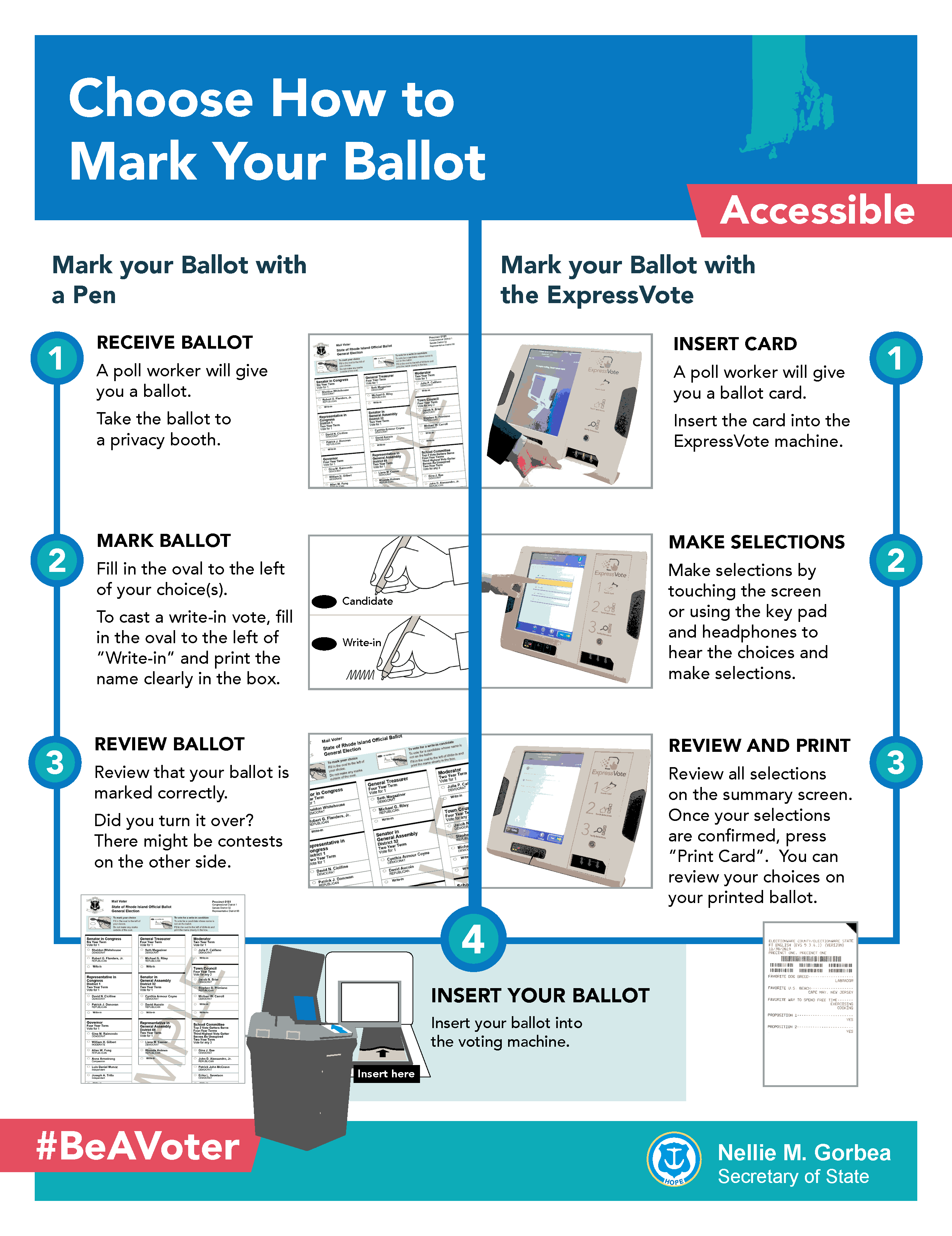
    The voting process in RI uses a large-format paper ballot on card stock that is marked with a felt-tip pen and then inserted by the voter for optical scanning. If for reasons of disability a voter is unable to use the regular system, they can be accommodated by an accessible “ExpressVote” using a touch-screen.

    After completing the process, you should be issued an “I voted” sticker.

  • News Analysis — Elections 2022: Few contested races remain after primaries

    News Analysis — Elections 2022: Few contested races remain after primaries

    For information about the upcoming RI general election on Nov 8, see the web site – vote.sos.ri.gov – that explains how and where to vote, options for early voting, and lists of candidates for all offices. RI has early in-person voting Oct 19 through Nov 7 at city and town halls; no special application is required to vote early in-person.

    The deadline to register to vote for this general election is Sun, Oct 9. The deadline for registered voters to apply for a mail ballot is Tue, Oct 18. Registering to vote can be done in-person, by postal mail, and on-line.

    Most of the RI races in the 2022 general election are not considered seriously competitive, and more than a few major offices do not even have an opposition candidate. For mayor of Providence, Democrat Brett Smiley won an aggressively contested primary with 41.9% against Gonzalo Cuervo with 36.2% and Nirva LaFortune with 21.9%, but no Republican declared candidacy at all and a lone independent, former city council member (then as a Democrat) Wilbur Jennings Jr, failed to submit nomination papers to qualify for the ballot.

    US House, 2nd district: Fung v. Magaziner

    Allan Fung and Kevin McCarthy in RI, Aug 6, 2022. (Source)

    The marquee race is unquestionably for the second district seat in the US House of Representatives being vacated by James Langevin who has held it since 2002. In the Democratic primary, outgoing General Treasurer Seth Magaziner trounced a crowded field of five other candidates, with 54.0%. On the Republican side, Allan Fung, who served as Cranston mayor from 2009 to 2021, earned the nomination unopposed.

    In the only public poll of the race, conducted by Suffolk University in collaboration with The Boston Globe, Fung led by 6 percentage points head-to-head against Magaziner (45% – 39%), but the result is of dubious value because it was conducted Jun 19 – 22, long before the Sep 13 primary; and it included all of the other Democratic candidates at that time.

    Nevertheless, Fung is an unusually strong Republican candidate by RI standards and has a credible chance of winning the House seat. He is well-regarded and his twelve years as mayor of Cranston are generally seen as a successful example of good governance of a municipality that recently eclipsed Warwick to become the second most populous city in the state. (Cranston was in third place while Fung was mayor.)

    No one thinks Fung is the favorite in heavily Democratic RI, and political forecasting news service Five Thirty Eight considers the race “likely Democratic” with an 83% probability of Magaziner winning with 52.0% of the vote to Fung’s 44.1%. That would still be a considerably stronger showing by Fung than his two gubernatorial losses against Gina Raimondo in 2014 (40.7% – 36.2%) and 2018 (52.6% – 37.2%), although 2014 was quirky because “Cool Moose” and Moderate Party candidate Robert Healey drew 21.6%, apparently almost entirely from Raimondo and nearly enough to make Fung governor.

    The real obstacle for Fung is that US House races have become nationalized in a highly-polarized climate where Democrats are struggling to defend their slim 221–214 seat majority in a “mid-term” election (that is, without a presidential contest). As of Oct 2, the Five Thirty Eight ranks 214 seats either strongly, likely, or leaning Republican; 208 seats either strongly, likely, or leaning Democratic; and 13 seats a toss-up: 218 seats are needed for a majority. In other words, control of the House is absolutely up for grabs.

    Fung has been doing an awkward dance with national Republicans. House minority leader Kevin McCarthy tweeted a photo of himself visiting Fung in RI on Aug 6, and a few weeks later Ted Nesi of WPRI reported that Fung had flown to McCarthy’s annual donor retreat in Wyoming. According to Punchbowl News, the event “was loaded with millionaires and billionaires (including Elon Musk, the world’s richest person) who want [McCarthy] to become the next speaker of the House.” This is dangerous company for Fung to keep as he risks scaring off RI voters. Punchbowl wrote, “Just hours after the Jan. 6 insurrection, even as the tear gas still wafted through a blood-stained Capitol, McCarthy and 146 other House Republicans refused to certify Joe Biden’s Electoral College victory. Just weeks after Trump left Washington in disgrace, McCarthy visited him at Mar-a-Lago, kicking off the process of resurrecting Trump’s national standing. And McCarthy worked to derail a separate House investigation into the insurrection, even repudiating a deal that one of his own Republicans made with Democrats to create a bipartisan commission to look into the Capitol attack. And now, should McCarthy become the speaker in January 2023, he’ll preside over a conference filled with those either disinterested, unwilling, unable or afraid to speak out against Trump. And the result of that dynamic is that the House GOP will be made up of loud voices who want to impeach Biden, investigate the Jan. 6 select committee’s investigation, defund the FBI and take Trump’s revenge tour to the House floor.” It’s understandable why Fung is not anxious to have his fundraising and other ties to McCarthy displayed too openly.

    Motif has in the past given generous coverage to Magaziner, for example with his BankLocal program using state investments to back loans to RI small businesses. In the end, though, most voters are not going to make their choice based on any personal qualities of the candidates, neither competence nor track record, but rather on whether they want to see Kevin McCarthy as speaker at the head of the Republican majority in the US House. Despite his efforts to remain aloof from national politics, that is likely to sink Fung.

    RI Governor: Kalus v. McKee

    In theory, Republicans can win the governor’s office in RI. They have held it repeatedly: most recently, Edward D. DiPrete (1985–1991), Lincoln Almond (1995–2003), and Donald Carcieri (2003–2011) served as Republican governors. But RI is heavily Democratic: In the 2020 presidential election, Joe Biden trounced Donald Trump in the state by more than 20 percentage points, 59.4% – 38.6%. Other state offices are overwhelmingly won by Democrats.

    Daniel McKee was weakened severely by a difficult five-way primary that he won with only 36.8% against a surprisingly strong performance by newcomer Helena Foulkes with 30.1% and outgoing Secretary of State Nellie Gorbea with 26.1%. Exactly what happened, and whether Foulkes and Gorbea split the anti-McKee vote, will be debated for years.

    The result set up a general election contest against Ashley Kalus who is running as a Republican conservative. Kalus has been taking real shots at McKee, and some of them have been landing. She attacked his giving government money to renovate the Industrial National Trust Tower (the “Superman building”) as a boondoggle: “Here’s an idea – instead of giving $69 million in corporate welfare to the developer of the Superman Building, why don’t we invest in RIPTA? Considering the average driver makes $16.75/hour – imagine how impactful even an additional $1 million would be for RIPTA’s abilities to provide services,” she has said. She likewise praised the federal court ruling that tractor-trailer tolls were unconstitutional as applied, a mess McKee inherited from former Gov. Raimondo.

    The Kalus campaign called a McKee ad claim that she would roll back abortion rights “blatantly false,” saying “Ashley would not support any effort to overturn the 2019 law” that enshrined the Roe v. Wade viability standard into state law despite its overruling at the federal level. But she would oppose the Equality in Abortion Coverage Act supported by McKee and which his office said on Sep 30 would be included in the budget for next year, to “provide insurance coverage for abortion-related services for state employees and individuals enrolled in Medicaid.” By contrast, the Kalus campaign said “she stands with the overwhelming majority of Rhode Islanders, 77%, that do not support taxpayer-funded abortions.”

    McKee succeeded from his role as lieutenant governor when Raimondo resigned to become secretary of commerce in the Biden cabinet. Other than succeeding a gubernatorial vacancy, there are no remaining duties of the lieutenant governor since the state constitution was amended a few years ago to remove the ex-officio job of presiding over the State Senate. I remember being shocked at a press conference when a reporter asked then-Gov. Raimondo to respond to comments then-Lt. Gov. McKee had made, and she dismissively said he was welcome to call her office like any other citizen. McKee never fit into the Raimondo administration: With her Ivy League pedigree (Harvard undergrad, Yale Law) and Rhodes Scholarship (Oxford D.Phil.), Raimondo was used to being the smartest person in the room and surrounded herself with other people who had the same outlook. McKee, despite his Harvard Kennedy School M.P.A., is very much not that sort of person.

    McKee is also as good a politician as Raimondo is not: he can relate to ordinary people while Raimondo has no tolerance for fools, and his experience as mayor of Cumberland helped him learn to govern. I’ve had the opportunity to observe him closely, including his management of the state through a blizzard and a hurricane, and his approach was to surround himself with competent experts and listen to their advice. He has clearly made mistakes, such as approving a no-bid contract for government services, and he may pay a price for that, politically or worse. The most charitable interpretation is that McKee trusted his friends and they exploited him.

    The political weakness of McKee should have served as an invitation for the Republicans to nominate a candidate with a solid management background and broadly moderate ideological views, but Kalus seems to have blown that opportunity. Kalus gave an extended interview to the experienced and incisive political reporter Ian Donnis for his “Political Roundtable” show on RI Public Radio, the overall effect of which could only be described as disastrous for the candidate. Donnis pressed her repeatedly on refusal to answer “whether you believe teaching about race and racism should be restricted or whether certain books should be banned” and she ducked the question, saying “My focus is on the things that we can agree on… which is math, and reading, and writing.”

    Donnis said “You started a business with your husband that operated COVID-related services in Rhode Island, and then got into a dispute with the State Department of Health. That’s now the subject of closed-door mediation.” Kalus responded, “And what we see with Dan McKee is we see a governor that is under FBI investigation for giving out federal money, contracts to insiders and his friends.” Donnis had to correct her in real-time, saying “We should know there’s no information at this point indicating that Dan McKee himself is the subject of this probe.”

    Donnis asked Kalus several times whether she voted for Donald Trump in the presidential election, and she avoided answering, saying, “The question of Donald Trump is not the question of the governor’s race in Rhode Island.”

    Kalus has also faced embarrassing questions about how she filed for a homestead tax exemption for a $1.2 million property in Illinois while claiming to live in RI. As WPRI reporters Eli Sherman and Ted Nesi explained, “Under state law, the homestead exemption is supposed to be only for homeowners who live in their residence full-time. Kalus said that was always true for her husband, who she said stayed in Illinois while she was living in RI to manage a state COVID-19 contract they won.” Sherman and Nesi note that Kalus, whose RI declaration of candidacy lists her domicile at a second house in Newport, voted in Florida in the 2020 election, residing at a third house the couple bought in 2015.

    All Republicans running for office in RI face the same dilemma: how to separate themselves from a national party that has embraced a culture war that is deeply unpopular in RI, let alone Trump’s “big lie” about which the Polling Institute at Monmouth University has been asking a representative sample of the electorate this question monthly: “Do you believe Joe Biden won the 2020 election fair and square, or do you believe that he only won it due to voter fraud?” and consistently about one-third of the public says voter fraud.

    Kalus, without any local track record like Allan Fung, is an unknown and possibly unknowable quantity about whom all assessments are necessarily based on her own statements and campaign, and by that measure she has been doing herself no favors. There has been no public polling of the race because the conventional wisdom is that Kalus has the chance of a snowball in hell of upsetting McKee.

    Bond referenda

    There are three bond referendum questions on the ballot with the 2022 general election, the first two pretty ordinary.

    Question 1 asks for $100 million to design and construct new facilities at the URI Narragansett Bay Campus. “This project would support educational and research needs in ocean engineering, oceanography, and other marine-related disciplines,” according to the secretary of state. Over the 20-year life of the bonds, interest would add an estimated $60 million to the total cost.

    Question 2 asks for $250 million “to improve Pre-K through grade 12 public school facilities and equip them for 21st-century learning,” mostly construction projects. “Funding may be used to address immediate health and safety concerns, early childhood education, career and technical education, and other educational needs including but not limited to science labs, libraries and modern learning technology,” according to the secretary of state. Over the 20-year life of the bonds, interest would add an estimated $151 million to the total cost.

    Question 3 combines nine separate items under a $50 million umbrella of “environmental and recreational” projects for the “green economy.” We will consider these from largest to smallest, preserving the item letters as they will appear on the ballot.

    Item a: $16 million for up to 75 percent matching grants to help cities and towns identify hazards resulting from climate change, such as more frequent and intense storms that cause increased flooding of coastline, rivers, and streams flood plains.

    Item i: $12 million for Roger Williams Park and Zoo to construct a state-of-the-art, carbon-neutral education center and event pavilion.

    Item b: $5 million to establish a Rhode Island Infrastructure Bank, essentially a revolving fund lending to small businesses with zero interest and below-market-rate loans and grants to help implement clean energy projects.

    Item e: $4 million to clean up former industrial or commercial “brownfield” sites that may be contaminated by hazardous waste or other environmental pollution, providing up to 80% matching grants for remediation projects that bring sites back into productive use.

    Item c: $3 million for matching grants to complete projects that restore and protect the water quality, aquatic habitats and the environmental sustainability of Narragansett Bay and RI’s watersheds, furthering efforts to clean water for drinking, shell-fishing, recreation, commerce and other uses.

    Item d: $3 million for maintenance of forests, wildlife habitat, and related infrastructure on state properties, such as state management areas, including removal of dead and/or dying trees and tree planting.

    Invasives removal and other forest health and wildlife habitat activities; and the repair and maintenance of fire roads, trails, and bridges to improve and maintain recreational public access and mitigate the risk of wildfire.

    Item f: $3 million for the State Land Acquisition Program allowing the state to acquire open space, farmland, watershed, and recreation lands, investing these funds in the preservation of working farmland and recreational resources. Funds will be matched by federal, local and non-profit sources in a 1-to-3 ratio with every state dollar being matched by three other dollars.

    Item g: $2 million for up to 50% in matching grants to cities and towns, local land trusts and non-profit organizations to acquire open space lands in Rhode Island.

    Item h: $2 million for up to 80% in matching grants to cities and towns to develop or rehabilitate local public recreational facilities such as parks, playgrounds, and athletic fields, and up to 50% in matching grants to acquire land for public recreational facilities.

    Over the 20-year life of the bonds, interest would add an estimated $30 million to the total cost.

  • Destroying Twitter in Order to Save It: Elon Musk Throws Around Billions

    Destroying Twitter in Order to Save It: Elon Musk Throws Around Billions

    Bilow’s Law of Twitter: “No worthwhile ideas can be expressed in 140 characters, and even fewer in 280.”

    My public journalist Twitter account (@MikeBilow) was created in 2015 by which time Twitter was fairly mature, although still long before the 2016 election and 2020 pandemic that saw social media sink into a swamp of misinformation and disinformation. For several years, I’ve been the maintainer of the Motif Twitter account (@MotifMagRI) that is an important on-line presence for the magazine.

    I created my private personal Twitter account in 2008 when the service was less than two years old and mostly seemed to cater to attendees of the South-by-Southwest Festival. In those days, few had mobile web access and most users interacted with Twitter via text message. More than 14 years later, since what was by technology standards the paleolithic era, the ice age has ended and the glaciers have receded.

    To give some sense of time scale, Twitter antedates both the Apple iPhone (2007) and Google Android (2008), which brought mobile internet to the masses. Although mobile internet existed before then – I had a Windows Mobile “Pocket PC” in 2006, replacing a Palm VIIx used for years earlier – it was an inconvenient rarity. For example, web sites were only accessible on the Palm if a “Palm Query App” was designed specifically for the site, and I wrote the PQAs for both The Providence Journal and The Boston Globe. By 2009, either I gave up on Windows Mobile or it gave up on me, and I switched to early Android then at version 2.0.

    Nobody had any idea then where social media would go. The sector was dominated by MySpace (founded 2003) from 2005 to 2009 and then by Facebook (founded 2004), but neither was mobile-friendly. Early competitors dropped away: LiveJournal (founded 1999) was sold to a Russian media owner by 2007.

    The model for most social media was the “blog,” shortened from “web log” and occasionally even spelled with a leading apostrophe (‘blog) to indicate the elided letters. A blog entry was an essay, usually at least a few hundred words, formulated with thought, care, and editing. Readers could subscribe to someone else’s blog and reply, usually in full sentences formed into paragraphs. LiveJournal turned this into an automated formula where everyone subscribed to the blogs of their friends and could interactively reply.

    What Twitter revolutionized was that it was the first social media site intended to be used primarily on mobile, limiting the size of each post to the emphatically anti-blog-like 140 characters of a text message. Go to a show or a concert, or happen to be present at a newsworthy incident at the right time and place, and the place to tell others about it has been Twitter. Everyone with a cellular handset that could handle text-messaging could be a Twitter author in an age before mobile apps, let alone before app stores. By 2020, mobile internet access was so ubiquitous that text-message access to Twitter was discontinued in most of the world.

    By emphasizing text as its medium, Twitter was going against the grain from inception. Multimedia seemed the wave of the future, with MySpace and its fellow travelers embracing music, photos, and videos. Eventually entire non-text competitors developed such as Vine, an antediluvian precursor to TikTok with content limited to six-second looping videos, that was bought by Twitter in 2012 and shut down in 2016.

    A lot of ideas just collapsed in failure, and the Wikipedia category for defunct social media lists 134 named entities, surely a gross undercount. Quibi, for example, yet another video microblogging service, had the misfortune to launch at the start of the COVID-19 pandemic and burned through $1.75 billion of investor money before shutting down after only six months. Yet Twitter has survived, despite being consistently unprofitable during its entire existence.

    Financially, investors have been losing confidence in Twitter, with its market capitalization (the stock price multiplied by the number of shares outstanding) crashing from $54.91 billion on Jun 30, 2021 to $34.55 billion on Dec 31, a 37% decline in the value of the company in only six months. A major reason for that lack of confidence is operating losses in 2020 of $1.14 billion and in 2021 of $0.221 billion. More seriously, long-term debt tripled from $1.76 billion at the end of 2018 to $5.32 billion at the end of 2021. The financial community knew this was not sustainable and the depressed stock price made it an attractive target to be acquired by a buyer, preferably one who was willing and able to shovel vast amounts more money into keeping it afloat.

    Enter Elon Musk who announced on April 25 a deal to acquire the entire company for $44 billion. He is, among other things, the 7th most-followed user on Twitter (@elonmusk, 86.3 million), neatly squeezed between Taylor Swift (@taylorswift13, 6th, 90.3 million) and Lady Gaga (@ladygaga, 8th, 84.5 million). Widely recognized as the richest person in the world with an estimated net worth of $252 billion according to the Bloomberg Billionaires Index (well ahead of Amazon founder Jeff Bezos in second place at $164 billion), Musk has been involved in running numerous businesses ranging from electric car maker Tesla to aerospace contractor SpaceX. However, he has also too often made public comments that called his judgment into question, including tweeting that children are “essentially immune” from COVID-19, an objectively false statement that almost resulted in his Twitter account being suspended. Musk’s consistently strange tweets were themselves recently the subject of an article in The Guardian, a well-respected UK newspaper, under the headline “Chaotic and crass: a brief timeline of Elon Musk’s history with Twitter.”

    Notably, Musk successfully defended himself in a libel trial brought by Vernon Unsworth, a diver who had been instrumental in the rescue of boys trapped in a cave in Thailand, whom Musk in a tweet called a “pedo guy.” According to Reuters, “…the jury was apparently swayed by the arguments put forth by Musk’s attorney, Alex Spiro, who said the tweets in question amounted to an off-hand insult in the midst of an argument, which no one could be expected to take seriously. ‘In arguments you insult people,’ he said. ‘No bomb went off.’… U.S. District Judge Stephen Wilson had said the case hinged on whether a reasonable person would take Musk’s Twitter statements to mean he was actually calling Unsworth a pedophile.” The legal community considers the dispute precedent-setting as the first jury verdict about the consequences of a tweet.

    Musk took advantage of the depressed price of Twitter shares and began buying up stock in January 2022, disclosing in a required filing with the US Securities and Exchange Commission (SEC) (known as a Schedule 13D) only on April 4, after the end of the quarter, that he had acquired 9.1% of the company for $2.64 billion, making him the largest shareholder. By keeping his activity secret as long as he could until the required disclosure, Musk got a huge bargain, implying a market capitalization of only $29.0 billion. Presumably the entity created by Musk to finance the purchase of the company at a reported total price of $44 billion would pay 9.1% of that, or $4.00 billion, to Musk for his existing shares, allowing him to personally pocket a cash profit of $1.36 billion.

    The SEC previously fined Musk for what he considered a cannabis-inspired joke in 2018 that he would be buying up all outstanding shares in Tesla to take it private at $420 per share, an announcement that many investors took seriously enough to move the stock price. Musk and Tesla each paid a $20 million fine and were required to vet in advance through lawyers any future statements that could affect the market. Just this morning (April 27), a federal judge came down hard on Musk who was seeking to get out from under what has come to be known as his “Twitter sitter” restriction, writing that “Musk, by entering into the consent decree in 2018, agreed to the provision requiring the pre-approval of any such written communications that contain, or reasonably could contain, information material to Tesla or its shareholders. He cannot now complain that this provision violates his First Amendment rights. Musk’s argument that the SEC has used the consent decree to harass him and to launch investigations of his speech is likewise meritless and, in this case, particularly ironic.”

    Twitter has spent years trying to navigate between what should and should not be acceptable to post on the site, a few weeks ago being drawn into a controversy about Adm. Rachel Levine, the head of the US Public Health Service, who identifies as a transgender woman and is the first openly transgender American to hold commissioned four-star rank. The Babylon Bee, a Christian-themed satire web site, tweeted that Levine was their “man of the year,” and their Twitter account was suspended when they refused to delete the tweet; at the same time, Twitter allowed a tweet from Texas Attorney General Ken Paxton that said “Rachel Levine is a man.” Such inconsistency has exposed Twitter to substantial criticism and accusations of hypocrisy.

    On March 25, shortly before disclosing his large acquisition of shares, Musk posted a poll: “Free speech is essential to a functioning democracy. Do you believe Twitter rigorously adheres to this principle?” resulting in 29.6% yes and 70.4% no with 2,035,924 votes. The next day he replied to his own poll: “Given that Twitter serves as the de facto public town square, failing to adhere to free speech principles fundamentally undermines democracy. What should be done?”

    No one is entirely sure what motivated Musk to buy Twitter, but it is generally assumed that he wants to dial down its content moderation policies. “If you’ve been paying attention to how things work in our plutocratic society, this turn of events won’t surprise you. The arsonists routinely cosplay as firefighters,” wrote Anand Giridharadas in a guest essay for The New York Times.

    Musk appears to have already breached the non-disparagement clause of his acquisition agreement with the board of directors by publicly attacking two of the top lawyers at Twitter. Getting the deal to completion requires jumping over a number of hurdles, including convincing regulators to allow it and the basic task of convincing shareholders to accept his offer price, and to accomplish both he needs to maintain sufficient self-discipline to keep his mouth shut. The current stock is trading below Musk’s offer price, a clear signal that the market has grave doubts that the deal will really happen: in theory, someone could buy the stock today and wait for it to be acquired at the higher price, which would be a slam-dunk as long as the acquisition goes through.

    Serious concerns about privacy and security have been expressed from the tech community about what seem to be Musk’s intent to de-anonymize Twitter users and publish internal algorithms as open source, according to Carly Page on Techcrunch. The Electronic Frontier Foundation, a leading advocate for personal liberty in technology, called on Musk to reaffirm the previous commitment by Twitter to the Santa Clara Principles, published in 2018 to protect the transparency and accountability of “content moderation at scale,” also endorsed by Apple, Facebook (Meta), Google, Reddit, and Github.

    I’ve been outright threatened on Twitter because I said that I thought it was reasonable for schools to require students and employees to wear face coverings in the pandemic, and this resulted in claims that I therefore supported “child abuse” and deserved to die. I don’t throw around terms such as “hate speech” lightly, but if that doesn’t qualify then nothing does. Telling me that I deserve to die may not technically be an illegal threat, but is at best on the very edge skirting First Amendment protection and arguably is outside it. Just because an incitement is not criminal does not imply it is harmless: It would be absurd for the standard of review to be the same for criminal charges and social media bans. While I recognize that someone saying that I deserve to die is not necessarily a criminal threat and may be protected by the First Amendment, it can have very bad real world consequences that justify it being prohibited on social media.

    Such incitements can motivate people to undertake clearly criminal acts. While the decision to progress to crime is primarily the responsibility of the one committing it, the party making the incitement has responsibility it would be wrong to ignore. Conspiracy theorists who claimed that a pizza restaurant in Washington DC was a front for senior Democrats including the Clintons abducting children to extract adrenochrome from their blood to be used as an elixir of youth, commonly known as “Pizzagate,” did in fact motivate a man to cross state lines and show up with a rifle in a deluded quest to rescue children held captive in non-existent subterranean tunnels, for which he ended up in federal prison. A woman who believed that the Sandy Hook shooting was a hoax, encouraged by conspiracy theorist Alex Jones on InfoWars, made death threats against the parents of the dead children, for which she also ended up in prison.

    Twitter is particularly important to journalists because it is their primary means of interacting with each other. I have regular exchanges with writers and academics, and this is very useful and valuable. The key to effective use of Twitter is to be aware of the sources: I know the difference between getting updates from the Kyiv Independent (@KyivIndependent), an extremely trustworthy and reliable on-the-ground news reporting service, as opposed to random trolls. Official entities are on Twitter, ranging from the ministries of foreign affairs for both Ukraine (@MFA_Ukraine) and Russia (@MFA_Russia) to embassies of countries to each other. Both the Israel Defence Force (@IDF) and the al-Qassam Brigades of Hamas who launch terrorist rockets from Gaza are on Twitter (using various accounts that are often suspended), sometimes interacting with each other to exchange public messages directly. From a news point of view, there is no substitute for this stuff.

    At one point I considered joining Gab.ai, an alternative to Twitter that explicitly claims no censorship or restrictions of any kind. In theory this appealed to me, but actually looking at the site made clear that is a refuge for those thrown off Twitter, with the practical result that most of the traffic is from literal fascists, neo-Nazis, white supremacists, and similar people with whom I have no desire to be associated and even less desire to interact. Twitter is valuable to me because it is not Gab.

    I understand that for someone who is an infrequent user of Twitter, it seems to be a flat swamp of people screaming at each other. Much of my responsibility as a journalist is to learn how to tell these apart and sift through these sources, applying my own knowledge and expertise. Just because there are some crazy people (or even a lot of crazy people) does not mean they are all crazy people.

    Whether Musk ends up owning Twitter or not, substantial backing away from content moderation would likely destroy it, running it into the ground and rendering it as worthless as MySpace. Economists see the value of social media in the “network effect,” meaning that each user finds it more valuable because of the presence of other users. The term originated with the invention of the telephone: What value is a telephone unless there are people to call? In Musk’s utopian libertarian free-for-all model of social media, all of the sane users would be driven away.

    I remember exactly where I was on August 9, 1995, because that was the day of the first dot-com initial public offering: Netscape. By chance I was attending a cookout, and everyone wanted my opinion on it as the “internet expert.” My advice was that I could not understand why the market had valued the company at $2 billion when it had no business model to generate income, and its sole activity at the time was to make software, the web browser, they gave away for free. It took about five years of riding the roller-coaster, but eventually the market figured out that I had a point.

    Twitter is a private company owned by its shareholders, and if they want to sell out to Musk then this is their right. Certainly the world has no reasonable expectation that investors will continue to throw money into the firebox indefinitely to keep the fire lit. But there is no law of conservation of money: it can be created or destroyed.