The Iran war cannot continue as it is for much longer, and this is a result of simple math.
Time is running out for energy and food supply
(Source: US Bureau of Labor Statistics)
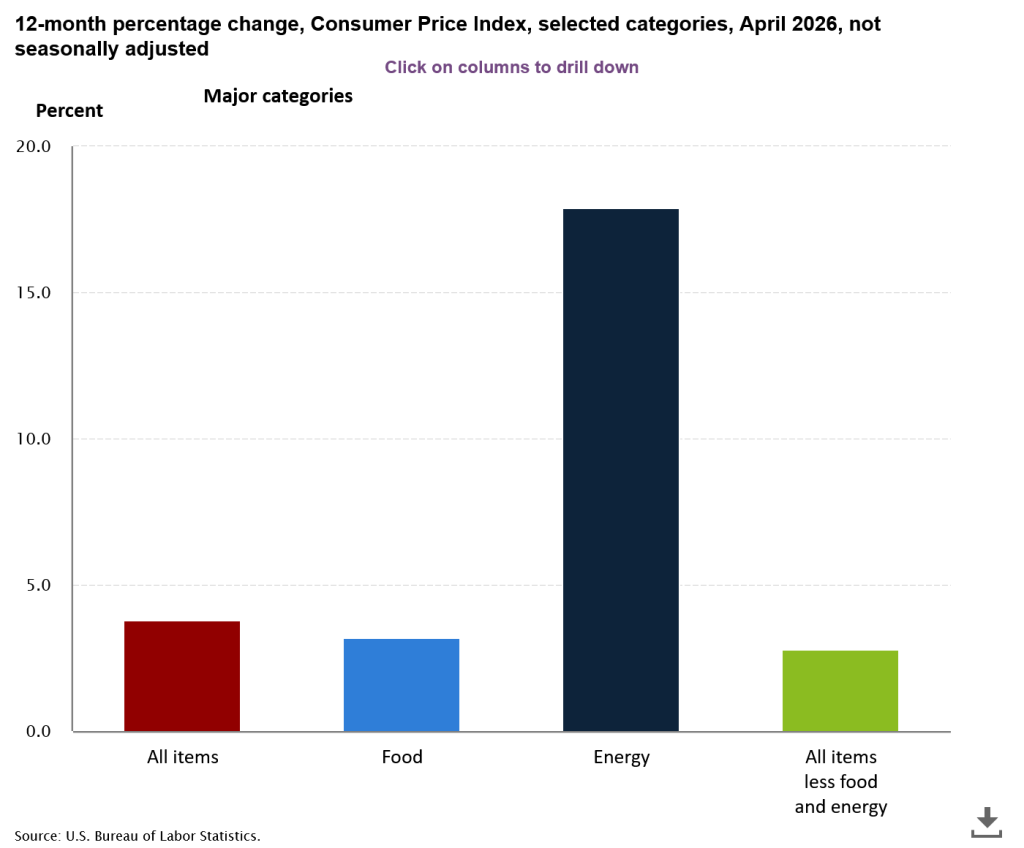
The commonly cited US Consumer Price Index for All Urban Consumers (CPI-U), the primary measure of the rate of inflation, reached 3.8% year-on-year in Apr 2026, nearly double the Federal Reserve target of 2.0%, jolted by a 17.9% rate for energy and a 3.2% rate for food. Wage gains of 3.6% did not keep pace with prices. The Producer Price Index (PPI), a leading indicator suggestive of future supply chain disruptions, reached 6.0% year-on-year in Apr 2026, the highest rate since Dec 2022 during pandemic recovery. Although closure of the Strait of Hormuz is causing damaging economic effects in the US, with the price of diesel fuel reaching (as of May 11) $5.639/gal, up $2.163/gal from one year ago, the rest of the world is experiencing physical shortages.
As the spring planting season begins in much of Asia, farmers are leaving land fallow because limited supply and rising prices of fertilizer make it uneconomical to plant for this season. About one-half of the world supply of urea, a nitrogen-based agricultural fertilizer that is a by-product of natural gas processing, has been interrupted. “The disruption of the Strait of Hormuz can push 45 million more people into hunger and starvation,” according to Jorge Moreira da Silva, Executive Director of the UN Office for Project Services (UNOPS), citing data from the World Food Programme (WFP). Most of those driven past the tipping point are far from the Middle East, the WFP explains: “Nearly two‑thirds live in Africa and Asia – the two regions hardest hit by the spillover. That would bring the global total to 363 million people facing acute food insecurity, the highest level on record.” Although farmers in wealthy countries can outbid those in poorer countries for available fertilizer, they must then recover the increased costs from consumers, raising the price of food.
(Source: JPMorgan via Bloomberg)
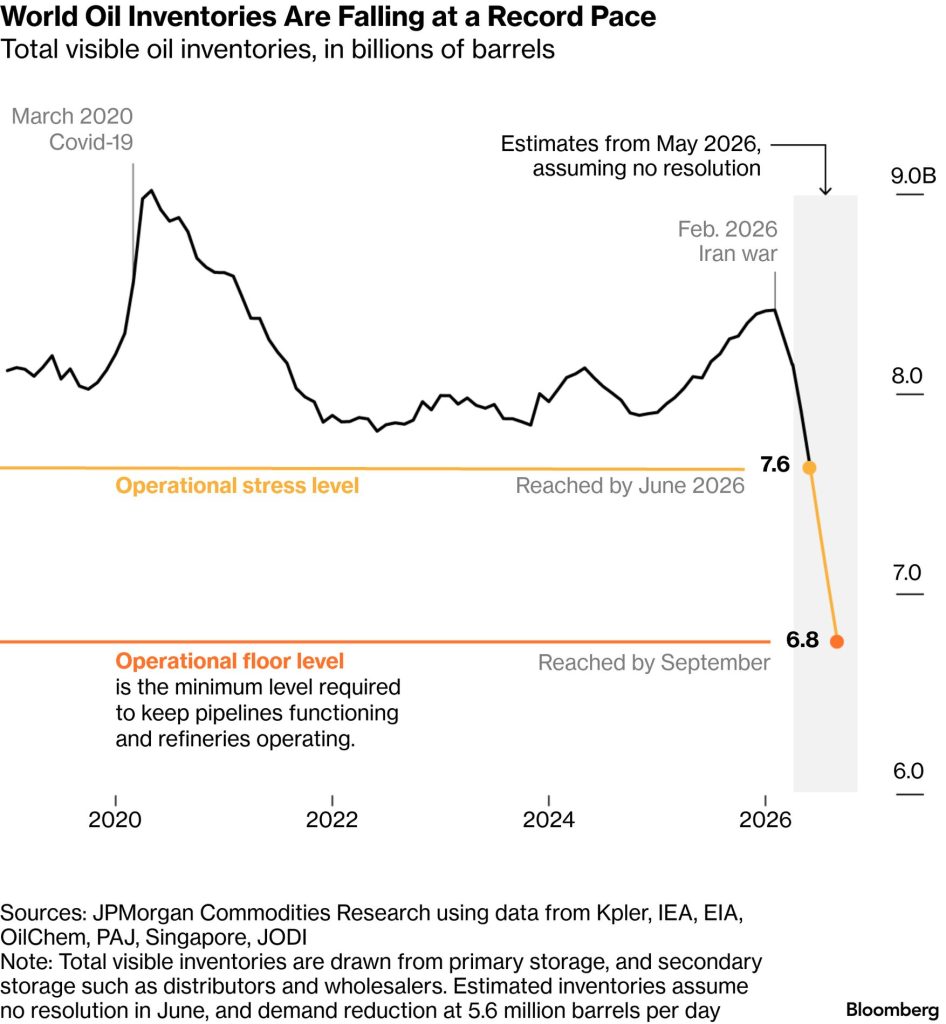
The world economy has only a few more weeks until supply shocks become severe and possibly irreversible. JPMorgan Commodities Research, as reported by Bloomberg, combined data from several reliable sources (Kpler, IEA, EIA, OilChem, PAJ, Singapore, JODI) to estimate that worldwide oil inventories, would fall below the “operational stress level” by June and below the “operational floor level” by September. Oil infrastructure depends on bare minimum amounts for pipelines, storage tanks, and export terminals to function properly, and equipment may be permanently damaged if this level cannot be maintained. Smaller national economies, particularly Indonesia, Vietnam, Pakistan, and the Philippines, will suffer effects earliest, with larger national economies, such as India and China, relatively less vulnerable. At first.
The US is now forced into a war that it must fight to the end
While Donald Trump may have picked a fight it was incredibly stupid to have started, he is now committed to finishing it with two axiomatic and non-negotiable constraints; Iran cannot be permitted to:
- Have or develop nuclear weapons
- Control the Strait of Hormuz
Almost anything else is negotiable from the point of view of the US, but neither of these are – and they are precisely the points on which Iran refuses to negotiate. Trump, a devotee of professional wrestling, has signed up the US for a cage match.
Control of the Strait of Hormuz, and the consequent power to asphyxiate the entire world economy, is a more dangerous tool than a nuclear weapon because it has more practical use: Iran could conceivably threaten to explode a nuclear bomb knowing that the inevitable retaliation would totally destroy the country, but closing the strait is something they can do, and are actually doing, without much immediate response.
For the first time since the conclusion of World War II in 1945, the US faces an existential conflict it cannot afford to walk away from, something not widely understood by the public or reported by the press. When the US withdrew from Korea in 1953 with a stalemate, from Vietnam in 1973 with a defeat, and from Afghanistan-Iraq in 2014 with an arguable defeat, it could afford to do so. If the US withdraws now from Iran, by contrast, it would leave the Strait of Hormuz in enemy hands and make the entire world economy their hostage. American allies in the Middle East, ranging from Israel to the Arab Gulf Cooperation Council (Bahrain, Kuwait, Oman, Qatar, Saudi Arabia, and the United Arab Emirates), cannot tolerate an empowered Iran able to choke off world commerce. American allies in Europe and Asia likewise cannot have their national economy and industry be placed at the mercy of Iran.
The most effective strategy currently pursued by the US is a naval blockade of Iranian commerce, which eventually could starve the economy enough to produce unrest against the Islamist clerical government. About 80% of the population would prefer to see the Islamists removed, but unfortunately they have no organization and no weapons, so the clerics get away with massacring tens of thousands of peaceful protesters. Although the blockade has already cost Iran about one million unemployed and caused underemployment on a scale ten times that, the CIA estimated that the blockade would take at least three or four months to have significant effect, as reported May 7 by the Washington Post. This was blindingly obvious: despite lacking the resources of the CIA, I estimated four to six months right after the blockade began on Apr 13.
Classified intelligence assessments publicly reported by the New York Times suggest that Trump and the Pentagon have been knowingly lying by claiming that the military capability of Iran is substantially destroyed: 30 of the 33 Iranian missile sites along the Strait of Hormuz have been restored to operation, and about 70% of mobile launchers and 70% of inventory remain available to Iran including both long-range ballistic missiles and short-range cruise missiles. Iran has apparently taken advantage of the cease-fire to repair and restore its offensive missile capability, while US defensive inventory remains depleted. Because sophisticated and expensive US weapons systems require lengthy timelines to resupply, there is concern that materiel purchases already paid for by European nations to help Ukraine will be diverted by the US to the Iran war. Over the past few weeks, the US already used half of its long-range stealth missiles, ten years worth of orders for Tomahawk missiles, and two years of orders for Patriot interceptor missiles. While production can be increased and sped up, that itself will take years and huge sums of money, and there are limits on how badly the most highly complicated components, such as rocket motors, will serve as bottlenecks, slowing the process to a crawl.
There are only two ways out of this that I can see: (1) the naval blockade works and Iran descends into economic and political chaos, possibly even civil war, that results in regime change where the Islamist clerics are overthrown and some sort of popular government comes into power; (2) a massive land invasion of Iran, involving a half-million to one-million troops, is carried out to remove the regime, comparable to the Allied victories in Germany and Japan in World War II. Other possible exit strategies seem implausible to me: the Islamic clerics would lead their nation into martyrdom rather than any kind of substantive surrender, and Trump could never settle for a deal that would be rightly perceived as a defeat. Although Trump probably believes he could spin a military defeat into a political win with the American public, and he may be correct about that, he could never get away with leaving national allies hanging out to dry, vulnerable to kinetic attack from drones and missiles in addition to economic strangulation.
If Trump sits on his hands while maintaining the naval blockade, the economy of the world (including the US) will teeter on the precipice of disaster in a game of chicken to see who can endure more economic pain longer. If Trump grows impatient with the blockade, he will have to undertake enormous military escalation. Trump has to choose one of these options.
Time is running out for Donald Trump
Trump, about to turn 80 years old in June, is in evident mental and physical decline, rapidly accelerating since long before the Iran war. Trump regularly falls asleep in public; on May 11 he was observed to close his eyes for 18 seconds during a meeting in the Oval Office, which his staff described as merely “blinking.” Later that night into the next morning, he apparently went without sleep, posting on Truth Social dozens of strange comments averaging every three minutes, including paranoid false claims that Barack Obama plotted a coup against him and personally profited over $100 million from the Affordable Care Act, and expressing displeasure that the New York Times accurately reported their discovery that his no-bid contract to repaint the reflecting pool on the National Mall would cost nearly ten times what he claimed it would.
(Source: Data aggregation by Real Clear Politics)
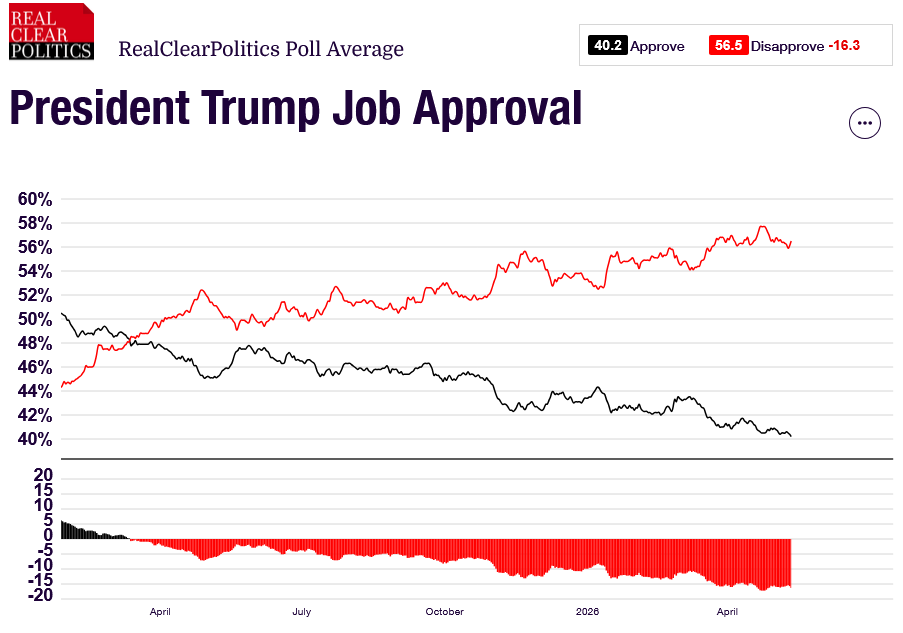
As Trump’s job approval is cratering in polls, and Republicans seem resigned to losing control of the House of Representatives in the Nov election, his freedom of action in conducting the war would be imminently restricted. Aside from the economic fallout from the war, including inflation generally and energy cost specifically, this creates enormous time pressure on Trump to bring the war to some kind of conclusion, any kind of conclusion, rather than let it drag on indefinitely past an election that is expected to render him disempowered.
So far, Trump has not made a coherent case to Congress or to the American people for why he started this war, what he hoped to achieve with it, or how he plans to end it. Instead, he consistently makes ridiculous assertions in defiance of reality. The American people are therefore unprepared to give him another $200 billion to fund the war in the current fiscal year, eventually costing at least $1 trillion. That works out to about $7,700 per household (across 130 million households).
The question now seems to be whether Trump will be able to continue to function as president long enough to dig himself out of the terrible problem he created with no goal, no understanding of the implications, and no plan. What can he do now, and what will the American people let him do?