[See related long prior article “Opinion — Has the Hamas attack on Israel started World War III? We’ll soon find out”, by Michael Bilow, Oct 29, 2023.]
We fought a military war; our opponents fought a political one. We sought physical attrition; our opponents aimed for our psychological exhaustion. In the process we lost sight of one of the cardinal maxims of guerrilla war: the guerrilla wins if he does not lose. The conventional army loses if it does not win. The North Vietnamese used their armed forces the way a bull-fighter uses his cape to keep us lunging in areas of marginal political importance.
— Henry A. Kissinger, “The Vietnam Negotiations,” Foreign Affairs, Vol. 48, No. 2, p. 214, January 1969.
How did we get here?
Persia has a vast history, dating back at least 2,500 years. It is mentioned in the bible, notably in Ezekiel which is read by some as a prophecy of the apocalypse. In 1906, a constitutional revolution limited royal power and established a democratic parliament. In 1908, oil was discovered by European explorers who founded what would eventually become British Petroleum: Oil would curse the nation and its people for the next century.
In 1909, the constitutionalists deposed Mohammad Ali Shah Qajar in favor of his son Ahmad Shah Qajar. (“Shah” is Persian for “king.”) In 1921, facilitated by British and Russian oil interests, constitutional democracy was overthrown in a coup by Reza Khan, who titled himself Reza Shah in 1925. Beginning in 1935, he changed the name of the country to “Iran,” which means “Land of the Aryans.” Despite Iran attempting to maintain a position of technical neutrality in World War II, Britain regarded Iran’s oil resources as militarily indispensable. When Reza Shah defied British and Russian demands to intern German nationals, Britain in 1941 forced his abdication in favor of his son Mohammad Reza Pahlavi.
The shah was then a constitutional monarch, and in 1951 the public elected Mohammad Mosaddegh as prime minister on a platform of social reform, land reform, and – crucially – a demand to audit British oil interests to verify the payment of correct royalties. When the audit was refused, Mossaddegh nationalized the oil industry. Britain imposed a severe economic boycott and began trying to manipulate the United States into overthrowing the democratically elected and popular Mossaddegh government, but then-President Harry Truman was having none of it. After the transition to President Dwight Eisenhower, in August 1953, a joint operation between the US Central Intelligence Agency (CIA) and British Foreign Secret Intelligence Service (SIS) carried out a coup that put the shah on the throne as an autocratic dictator, eliminating all vestiges of democracy. The price of participation demanded by Eisenhower was to break the British monopoly on oil production, giving shares to five American oil companies. (In 2013, on the 60th anniversary of the coup, President Barack Obama authorized the declassification of documents detailing CIA involvement.)
The newly empowered shah was both paranoid and incompetent. During the 1953 coup, he had been so fearful of failure that his twin sister and an American military general had to make him sign the royal decrees deposing the democratic government. By 1977, the shah and his secret police methods of torture and imprisonment had alienated everyone, inspiring strikes and protests from a diverse range of groups, from communists to Islamists, until he was deposed in a 1979 revolution. The Islamists ruthlessly took power, defeating pro-democracy and other factions, installing Ayatollah Ruhollah Khomeini as ”supreme leader” of a theocratic government. (“Ayatollah” is a religious honorific.) In 1989, Khomeini died at age 89 and was replaced by Ayatollah Ali Khamenei, who held that role for almost 37 years until his assassination in a military strike at age 86 during the current war.
What is the goal of the current war?
President Donald Trump and members of his administration have cited a wide variety of inconsistent and even contradictory reasons for the war.
The claim that Iran was within weeks of constructing a nuclear weapon was completely false. Iran in 2015 agreed to a deal, the Joint Comprehensive Plan of Action (JCPOA), under the administration of President Barack Obama that required dismantling most of their nuclear program and submitting to international inspections. Despite recognized compliance with the agreement by Iran, in 2018 Trump withdrew the United States and proposed negotiating a new deal to replace it, but understandably Iran saw little point to agreeing to anything that any subsequent president could arbitrarily abrogate.
Iran then began playing a game of diplomatic “chicken,” enriching uranium to a degree far in excess of that needed for peaceful purposes but still well short of what would be needed for a bomb. This sort of hardball negotiating strategy backfired badly in the June 2025 Twelve-Day War, during which Trump claimed that American “bunker buster” bombs “obliterated” the nuclear capability of Iran.
Although Iran claims to have tested a missile with 10,000km range, which could reach the East Coast of the United States including New York City and Washington, DC, it is certainly not operationally deployed and may not actually exist. Iran was known to possess a large stock of shorter-range missiles capable of threatening most of its neighbors and parts of Europe, but has depleted 70 – 90% of its inventory in the current war.
Iran has invested decades in developing, arming, and funding proxies to carry out terroristic military campaigns, notably Hiz-b-Allah (“Party of God”) in Lebanon and Ansar Allah (“Houthis”) in Yemen, but most consequentially Hamas in Gaza. It was the Hamas attack against Israel on October 7, 2023, that pushed Israel into a mode committed to the destruction of its enemies, including Iran.
As with many autocratic regimes, mistrust among and within Iranian government and military agencies led to fragmentation, with the army divided into a regular fighting force, the Artesh, of about 600,000 active duty and 250,000 reserves, and the Islamic Revolutionary Guard Corps (IRGC), a more politically and ideologically oriented force of about 125,000 whose main purpose is protecting the Islamist leadership from challenges. There is also a paramilitary Police Command of about 200,000.
The command and control systems of Iran are visibly disintegrating. On March 7, Iranian President Masoud Pezeshkian publicly apologized for attacks against Arab neighbors Kuwait, Qatar, Saudi Arabia, and the United Arab Emirates: “I personally apologise to neighbouring countries that were attacked by Iran… We didn’t intend to violate neighbouring countries’ [territory]. As I have said many times, they are our brothers.” The next day, Iran attacked again, and the IRGC issued a public statement saying they were not bound by the promises of the president.
The weakness of the political leadership relative to the IRGC was demonstrated by the apparent selection of Mojtaba Khameini to replace his father as new supreme leader. Generally regarded as a scholarly lightweight, he almost certainly would not have been the choice of the clerics but was promoted internally as a puppet of the IRGC. (He also is reported to have a substantial investment portfolio outside the country.) This marginalization of the political leadership hints that the IRGC will be willing to resort to desperate measures to stay in power, regardless of the dire consequences to the nation and its people. As a result, there may be no one left in Iran with whom Trump can negotiate, and there may not even be anyone left with the political clout to surrender.
Trump and his envoys share a worldview that everything can be negotiated because everyone has a price and a deal is always possible: This mindset might work in the milieu of New York City real estate, but it is fatally flawed and wrongheaded when applied to Middle East Islamists who believe, quite literally, that they are on the side of God against the West – so compromise would constitute capitulation to satanic evil. In 633CE, just after the death of the Prophet Muhammad, the Persian empires would begin to be ended (after two thousand years) by military leader Khalid ibn al-Walid, who wrote a warning to the final Sasanian emperor, “Submit to Islam and be safe… else you will have only yourself to blame for the consequences, for I bring the men who desire death as ardently as you desire life.” Like the doomed emperor, Trump would do well to realize what he is confronting in Persia.
Has regime change ever worked?
Only hours after dropping the first bombs on Iran, Trump was publicly calling for regime change. “Now is the time to seize control of your destiny,” he said in a video, speaking to the Iranian people. “This is the moment for action. Do not let it pass.” How the people were to carry that out was left unsaid, especially in light of a brutal crackdown on unarmed protesters by the IRGC in January that killed thousands, perhaps tens of thousands.
Trump had long opposed such foreign adventurism, saying in 2016, “We must abandon the failed policy of nation building and regime change.” In 2025, he said, “In the end, the so-called ‘nation-builders’ wrecked far more nations than they built,” and ironically criticized “interventionists [who] were intervening in complex societies that they did not even understand.”
On March 6, Trump further boxed himself in by demanding “unconditional surrender,” which Iran has little motivation to do.
Regime change by military force has a nearly perfect record of failure: Korea in the 1950s, Vietnam in the 1960s and 1970s, Nicaragua in the 1980s, Afghanistan in 2001, and Iraq in 2003. Arguably, the only times it ever worked were the postwar conversion of Germany and Japan from militaristic failed states into prosperous democracies, but that required millions of soldiers and enormous sums of money invested over nearly a decade. Unless we are willing to undertake an effort on the scale of the Marshall Plan, which cost about $140 billion in today’s money to rebuild Europe, there is little hope. Even in the eyes of his most ardent admirers, no one can seriously compare the strategic vision of Trump to then-Secretary of State George C. Marshall.
Iran as it stands today is an Islamist theocracy run by geriatric clerics in defiance of about 80% of its 92 million people. Together with economic troubles caused by external sanctions and internal corruption and incompetence, a generational divide renders the current situation unstable and unsustainable, with three-quarters of the population too young to have been alive during the 1979 revolution and one-quarter age 14 or younger.
What are the financial costs?
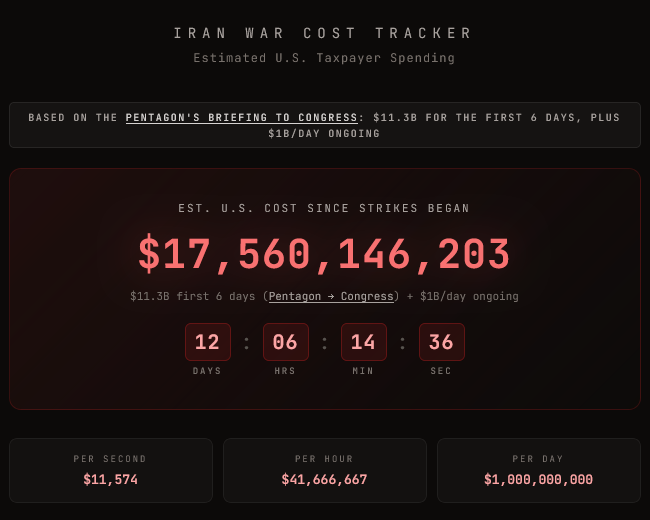
The war has already cost $5.6 billion in military munitions in its first two days, not counting the loss of three $100 million F-15 fighter jets accidentally shot down by friendly fire from Kuwait. Operational cost of the war is estimated at least $1 billion per day.
Cargo ships have been unwilling to risk passage through the Strait of Hormuz, which at its narrowest point is about 21 miles across with a navigable channel only two miles wide, because they would be within range of land artillery, missiles, attack boats, and even mines. Merchant crews are unwilling to risk their lives carrying cargo, despite Trump urging them to, ”Show some guts.” About 20% of the world’s oil and 30% of its liquefied natural gas (LNG) passed through the strait, about 90% of which traveled farther east to Asia. Already the Philippines, Bangladesh, Indonesia, and Pakistan have closed schools and factories to conserve fuel; Vietnam and South Korea are considering similar measures. Reopening the strait may require a ground invasion.
Motor fuel has increased in the US by at least 60 cents per gallon since the war began less than two weeks ago. This will affect all goods shipped by road, which will drive inflation sky high.
Not only fuel passes through the strait, but also most of Asia’s supplies of agricultural fertilizer, aluminum, and helium. While helium may seem an odd concern as a strategic commodity, it is a by-product of natural gas and critically needed for high-tech industries from semiconductor fabrication to medical diagnostics. Fertilizer is unglamorous in the extreme, but about 70% of the cost of food production is energy input.
Expert analyst Shanaka Anslem Perera warns that it may take a long time for insurance markets to stabilize, as they are not designed to respond to systemic crises of these kinds: “The kinetic campaign may last four to eight weeks, as the administration projects. The insurance reinstatement, based on the only available reference classes, will require six to eighteen months under even a favorable scenario.”
US Sen. Chris Murphy (D-CT) said after a classified briefing on March 10, “And on the Strait of Hormuz, they had NO PLAN. I can’t go into more detail about how Iran gums up the Strait, but suffice it [to] say, right now, they don’t know how to get it safely back open. Which is unforgiveable, because this part of the disaster was 100% foreseeable.”
On March 11, three cargo ships were attacked and struck by hostile projectiles near the strait, with the IRGC claiming responsibility. If the strait remains closed to traffic for many more weeks, not only will commerce stop throughout Asia, but planting and harvest cycles could be disrupted for the next year or two.
As the market price of crude oil skyrockets, the big winner will be Russia, with a desperate need for cash to prop up a failing economy and fund its war against Ukraine. Russia is one of the best customers for Iranian drones, and Ukraine has developed the world’s most advanced anti-drone defense technology which it has offered to the United States. In August. Ukraine held a high-level presentation, complete with PowerPoint, where Ukrainian President Volodymyr Zelensky offered interceptor drones to Trump. Reportedly, Trump approved the proposal but his staff did nothing until March 5, when the US scrambled to catch up.
What is the role of Israel in this war?
It has been universally understood for decades that Israel regards the Islamist government of Iran as an existential threat: If Iran had a nuclear weapon, Jerusalem would be their first mushroom cloud.
US Secretary of State Marco Rubio said the timing of the war was made necessary to pre-emptively strike Iran defensively because Israel was going to strike Iran and that would provoke an Iranian response against the US. Rubio was challenged to clarify his remark, and both Trump and Israeli Prime Minister Benjamin Netanyahu denied the initial interpretation, but the damage was done. Diplomats from the Obama and Biden administrations said Israel tried the same approach on them but, in the words of US Sen. Chris van Hollen (D-MD), only Trump was “stupid enough and reckless enough” to fall for it.
While the United States has to worry about the end result of the war, especially hoping that Iran retains some degree of stability even if not exactly evolving into a liberal democracy, Israel is looking out for its own interests. That’s a reasonable position for any country, and Iran falling into chaos or even civil war would be a win for Israel as long as it made Iran and its proxies less capable of threatening Israel. As a result, the objectives in this war between Israel and the United States are increasingly diverging.
During the opening of the war, Israel hijacked the television broadcast channels in Iran and aired messages from Netanyahu and Trump.
Iran has an invasive surveillance system purchased from China capable of using facial recognition to identify women in public who had their hair uncovered in violation of Islamic fundamentalist laws and automatically sending them tickets and fines. This extensive surveillance system was compromised years ago by Israel, and they exploited it to monitor Iran’s most senior political and military leaders along with their bodyguards and personal staff. When the supreme leader and many of his most senior advisers gathered for a morning meeting, Israel was able, because of signals intelligence, to send fighter jets to fire 30 precision bombs, killing him and all of those attending. The CIA reportedly confirmed the meeting based on a human source. Israel also controlled the Iranian mobile telephone network sufficiently to know who was attending the meeting, and then to block nearby cellular sites to prevent those attacked from warning others or calling for help.
It is a reasonable inference that the timing of the war was decided by the unique opportunity to decapitate the Iranian political and military leadership at one blow, circumstances chosen by neither Israel nor the United States.
What effects will the war have on the United States?
Evidence reviewed by Western press organizations shows that a girls school in Iran was struck by a Tomahawk missile, killing 175 civilians including many children, likely an error because it was next to an IRGC naval base. Trump, bizarrely and incorrectly, claimed that the strike could have been from an Iranian Tomahawk: “They wish they had more. But whether it’s Iran or somebody else, the fact that a Tomahawk – a Tomahawk is very generic. It’s sold to other countries.” Challenged directly about this claim at a press conference by New York Times reporter Shawn McCreesh, Trump doubled down: “Because I just don’t know enough about it. I think it’s something that I was told is under investigation, but Tomahawks are, are used by others. As you know, numerous other nations have Tomahawks. They buy them from us.” In fact, Tomahawk missiles have never been provided to Iran, and only the US, the UK, and Australia have them. On March 11, the New York Times reported that a preliminary analysis by the US Department of Defense concluded that the strike resulted from outdated targeting data after part of the naval base was converted into a school between 2013 and 2016, unnoticed by the US Defense Intelligence Agency (DIA). A few months ago, the US eliminated a project developed over many years that studied methods to avoid civilian casualties.
There have been isolated reports of cloud-based cyberattacks against American companies, consistent with the type carried out in the past by Iran and affiliated groups, erasing data and disabling employee devices. Shortly after assuming office, Trump directed federal government resources away from counterterrorism and counterintelligence and instead toward immigration, depriving the country of needed defenses; the Cybersecurity and Infrastructure Security Agency (CISA) has been effectively defunded.
Russia has been reported to be sharing intelligence with Iran that helps them target, and therefore kill, American soldiers. Trump’s Special Envoy Steve Witkoff said in an interview with CNBC that Russian President Vladimir Putin denied this in a call with Trump: “So, you know, we can take them at their word… Let’s hope that they’re not sharing.” Witkoff said Yuri Ushakov, Putin’s foreign policy advisor, also denied intelligence sharing with Iran in a separate call involving himself and Trump’s son-in-law, Jared Kushner. A cynic might conclude that Witkoff and Kushner are willing to sell out their own country to conduct business deals, like the proverbial capitalist willing to sell the noose used to hang him.
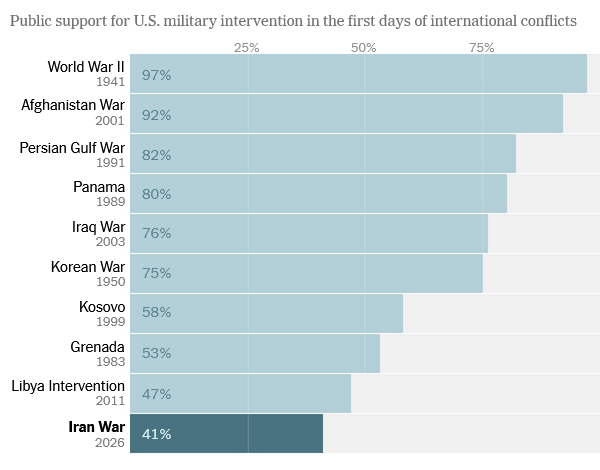
(Source: New York Times)
Under the US Constitution, the power to declare war is reserved exclusively to Congress. Never before in American history has a president undertaken a military action of this scale without at least consulting Congress, in most cases (including Vietnam, Afghanistan, and Iraq) obtaining formal authorizations for use of military force. Even in World War II, President Franklin Delano Roosevelt asked for and received congressional declarations of war against Japan and Germany, mere formalities because those countries had already declared war against the United States. Going to war is among the most fraught and consequential actions in a constitutional republic, asking for substantial sacrifice, including even the lives of citizen soldiers. A president owes to the people, and to their elected representatives, a clear explanation of the causes and need for war, as well as a plan for conducting it. Because of this failure to tell the American people why we are going to war, public support is at historic lows compared to the beginning of any prior conflict, and support always declines over time, even for wars that begin with solid public support.
As of March 13, seven American soldiers have died from enemy contact, six were killed in a crash of a refueling tanker aircraft, and 140 have been wounded. Trump seems to think he can end the conflict whenever he wants and at a time of his choosing, but that is obviously wrong as long as Iran retains any capacity for asymmetric warfare: As we were reminded in Afghanistan and Iraq, an enemy may lose the ability to launch missiles but can still blow up vehicles.
Most worrisome, Iran appears to be pursuing a thoughtful plan to exploit widely understood American political rather than military weaknesses. After absorbing initial attacks, Iran launched a large volume of rockets and missiles that forced the US to use up a significant part of its air defense inventory, which is relatively expensive and hard to replace. Iran then concentrated on attacking targets of surprisingly high logistical value, such as radar installations needed to guide intelligent weapons and refueling air tankers needed to maintain the range of fighter and bomber aircraft. This suggests a sophisticated emerging strategy by Iran to fight a long-duration war of attrition, all while the world supply of oil is severely constrained. There does not seem to have been any expectation or preparation for this by the US, leading to improvised responses that will begin to fail after a few weeks. All the Islamist regime in Iran has to do to win is survive.
So what now?
Anything that weakens Iran is a benefit to the world, eliminating it as the main state sponsor of terrorism and threat to peace, ending its position as the fulcrum of the “Axis of Evil” after its partners in that endeavor, such as Syria and Iraq, have been neutralized over the past quarter of a century. A plausible case could have been made for the necessity of this war, but a thoughtful examination would address fundamental questions: What is the goal? What constitutes success or failure? What is the cost? What is the exit strategy? Answering these questions in a democracy should involve all of us, not just one man and his sycophants in the Oval Office, who seem under the delusion that he can unilaterally end the war whenever he chooses and will not become trapped in a “forever war” with devastating political and economic consequences.
[See next update: motifri.com/iran-war-update-01]