Khalil during a Down Syndrome Society of Rhode Island photo session at Big John Leyden’s Tree Farm in West Greenwich; Photo credit: Laura Kilgus, 9ten Photography
For 10 years, the United Nations has designated March 21 as World Down Syndrome Day. As the 21st day of the third month of each year, the date symbolizes the genetic foundation for Down syndrome — the triplication of the 21st chromosome. Building upon the Convention on the Rights of Persons with Disabilities, the UN’s declaration of a dedicated holiday reinforced how “adequate access to health care, to early intervention programs, and to inclusive education, as well as appropriate research, are vital to the growth and development of the individual.” Motif’s Sean Carlson interviewed Crystal Greene, president of the Down Syndrome Society of Rhode Island, about the strides made locally and the hurdles that remain.
Sean Carlson (Motif): On March 21, 2019, the Rhode Island House of Representatives passed a bill to formally commemorate World Down Syndrome Day. What significance does this have two years later?
Crystal Greene: To have Rhode Island celebrate this day shows that the Down syndrome community is not forgotten. Even though people with Down syndrome should be included every day, we hope March 21 provides an annual reminder of our need to educate, advocate and empower. We’re hoping to see more progress politically as well. We’re working to light up the Rhode Island State House in blue and yellow to celebrate individuals with Down syndrome. We’re advocating for state legislation to prohibit physicians from denying organ transplants to people with intellectual disabilities like Down syndrome or autism. We’re supporting resolution H 5833 to improve compliance and accountability in Rhode Island’s public schools around Individualized Education Programs and 504 Plans for students with disabilities.
(Editor’s note: An Individualized Education Program (IEP) is required to be eligible for special education, whereas a 504 plan summarizes how a school intends to accommodate a student with a disability.)
SC: Do you still hear Down syndrome misunderstood as a disease? What misconceptions persist?
CG: Misconceptions and stereotypes are still prevalent. We hear family members refer to Down syndrome as a “condition,” and the word “retarded’ is still used as a label to define individuals. Our language should be more sensitive and inclusive. One of the most common misconceptions is underestimating the capabilities and potential of a person with Down syndrome. People often seem surprised to hear about somebody with Down syndrome living on their own at a university, for example, but these accomplishments shouldn’t be seen as a surprise. People with Down syndrome have wide-ranging abilities. With proper support and understanding, they can thrive. When we think about what it means to be human, we in the Down syndrome community like to say, we’re more alike than different.
Celia during a Down Syndrome Society of Rhode Island photo session at Goddard Memorial State Park in East Greenwich; Photo credit: Laura Kilgus, 9ten Photography
SC: Programs like the Special Olympics are well-known, and occasional stories about people with Down syndrome generate great interest, such as Lucas Warren, the 2018 Gerber baby, and Chris Nikic, who recently completed a full Ironman. What do you see in such moments of visibility?
CG: These stories are full of joy and hope, but I also wonder, would we be celebrating this if any other person accomplished the same? The media plays a pinnacle role in how people with Down syndrome are personified and perceived. It’s fortunate their accomplishments are highlighted so the community at large can see and applaud these individuals’ capabilities. But if you also don’t appreciate how much a person with Down syndrome has to overcome, some of the celebration can feel patronizing.
SC: We tend to be drawn to stories about great successes and worst-case scenarios. What do you see as the effect of this tendency on people whose experiences fall somewhere in between?
CG: Visibility goes a long way in helping change perceptions of how able, and how capable, people with Down syndrome can be. But one of the negative consequences we see when celebrating individuals who are extraordinary, is that they do not necessarily represent the typical experience of people living with Down syndrome. This can cause unrealistic social comparisons. We should try to see every individual as unique and variable in their skill sets, whether or not they have Down syndrome.
SC: Are local businesses and employers thinking about their roles and responsibilities too?
CG: Some companies may celebrate individuals with Down syndrome, or even feature them in advertisements, but that’s not the same as providing the support or services afforded to the general public. For instance, it’s extremely difficult to purchase life insurance, or shoes that fit, or dolls that carry similar physical characteristics as individuals with Down syndrome. We have a long way to go there.
SC: How has Rhode Island fared with providing support and care for children or adults living with Down syndrome and their families?
CG: We’re working hard to provide support and education to our community and institutions. We just sent out an informational flyer about resources to the superintendents of our public schools, and to a variety of non-public schools as well. But there’s a lot of work to be done locally to support our mission and to provide the resources necessary. Much of the support network comes from families who spend countless hours researching and self-educating about Down syndrome. The process can feel overwhelming, especially for people who don’t know their legal rights or have difficulty navigating the system. There are enormous gaps from our towns, cities and state overall when it comes to enabling social activities and providing lists of qualified doctors and specialists. In our schools, procuring an IEP over a 504 plan remains tremendously difficult. And unless a family or caregiver knows their options, there are few resources for people with Down syndrome who have aged out of the public school system.
Down Syndrome Society of Rhode Island’s 2019 Buddy Walk and Fall Harvest Festival at Goddard Memorial State Park; Photo credit: Laura Kilgus, 9ten Photography
SC: These challenges have only worsened during the pandemic. A study from researchers at Emory University suggested that adults older than 40 with Down syndrome were roughly three times more likely to die of COVID-19 than the rest of the population. How have you had to confront such unique challenges?
CG: People without Down syndrome may not know that individuals with Down syndrome often have multiple medical needs at the same time, ranging from cardiac to gastrointestinal to neurological to respiratory. Many individuals also experience low muscle tone, feeding issues and communication deficits. These comorbidities can make it more difficult to ward off illnesses like the common cold, the flu and pneumonia — and most certainly COVID-19. Because many individuals with Down syndrome are immunocompromised, they’re at a high risk of life-threatening complications. But what’s also challenging is how many of the therapies and supports that are imperative for success in daily living have been decreased or stopped completely over the past year. Many families have had to choose between a major regression of skills with fewer — or without — in-person services or face a risk of hospitalization or even death. But even if a therapy provider provides a virtual option and insurance companies approve of the session, this method tends to be far less effective, especially for individuals with communication barriers.
SC: I trust many people who don’t have firsthand experience with Down syndrome will empathize.
CG: The pandemic created a plethora of challenges for parents in general, such as distance-learning struggles and difficulties enacting special education provisions. We’ve heard from parents who’ve lost jobs or changed careers to try to balance their work while caring for someone at home. We’ve seen increases in financial insecurity and food insecurity. The community we support relies on certain kinds of services. At the beginning of the pandemic, many early intervention agencies that support children from birth to age 3 closed, lost employees and laid off adjunct providers. For local residents who need to look beyond Rhode Island for specialized care from clinics that specialize in Down syndrome, this has often meant getting to and from Boston Children’s Hospital or Mass General. And of course we’re also seeing the consequence of parents and family members getting sick. In fact, we’re currently supporting one man with Down syndrome who lost his father to COVID-19 and is struggling both emotionally and financially.
SC: Like everybody else, you’ve had to make changes to your own operations. What should we expect?
CG: In-person events remain cancelled because of the pandemic, but we’re supporting our community with a monthly speaker series online, covering topics like how to stay active and how to manage the IEP and 504 process. We packaged board games and snacks for families to pick up in Johnston and play at home on World Down Syndrome Day, and Easy Entertaining Inc. has organized a fundraiser for us. Isaiah Lombardo recently hosted a virtual dance party with us. We’re sharing updates on Facebook, Instagram and our website, and we’re looking forward to when we can meet face-to-face again safely.
Down Syndrome Society of Rhode Island’s 2019 Buddy Walk and Fall Harvest Festival at Goddard Memorial State Park; Photo credit: Laura Kilgus, 9ten Photography
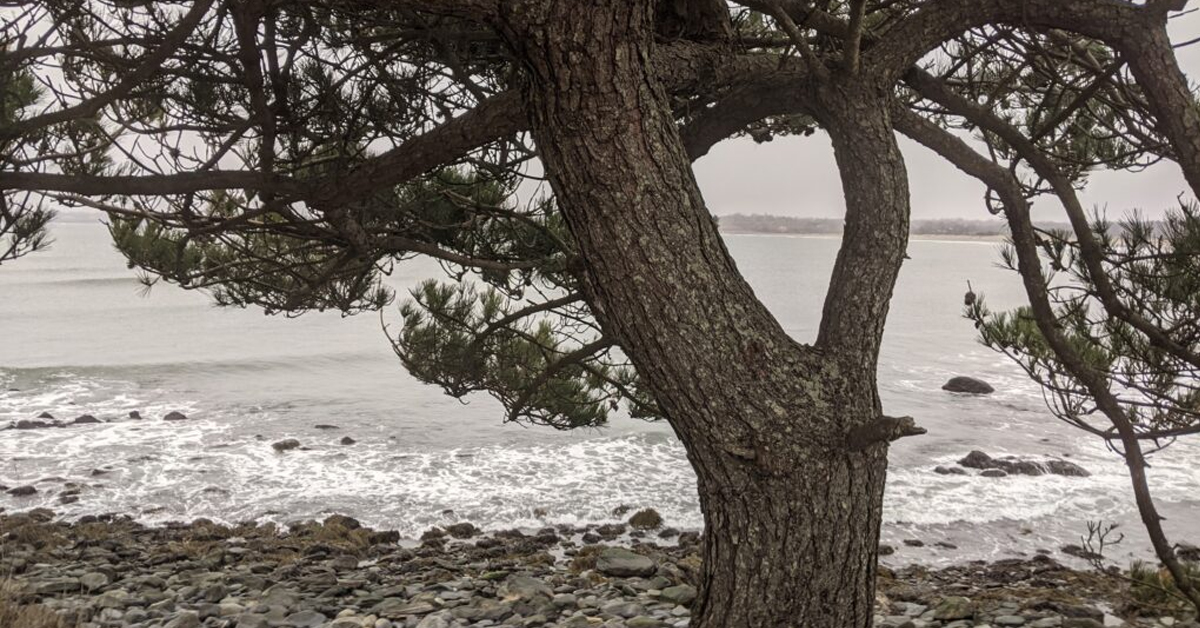
Sachuest Point National Wildlife Refuge in Middletown; photo credit: Sean Carlson
The bitterness brought an upside, greeted the attendant at the Norman Bird Sanctuary in Middletown: Fewer people on the trails meant more peace for the birds. But, besides an errant rustle underfoot or chirp overhead, the birds seemed to have sought other sanctuaries. As the temperature eked up to 24 degrees, I wandered in solitude.
Relatively new to Rhode Island, I’ve found a winter of weekend walks has teased the vastness within the smallest state. At Sachuest Point, within sight of the Norman Bird Sanctuary, my daughters tottered in snowsuits to watch waves break against the stone shore. At John H. Chafee Nature Preserve, white-tailed deer blocked a powdered path toward the arc of Rome Point at sunset. Submerged tree trunks and marsh grasses at Trustom Pond and Ninigret National Wildlife Refuges reinforced the risks and reality of rising seas, even if tinged with ice.
As I kept balance on slick patches of packed snow one recent morning in North Kingstown’s Ryan Park, the day warmed past freezing and birdsong peppered the hum of Route 4. No hint of buds on the branches yet, but the air felt lighter. Along the trails, chickadees warned that I had broken their peace.
More than 340 million miles beyond Mars, an icy moon awaits its first close-up. Days before NASA’s Perseverance rover reached the surface of the Red Planet, the US space program announced updates to another long-awaited mission with the potential to find signs of life. In October 2024, the Europa Clipper will leave Earth on a private rocket, destined to begin orbiting Jupiter nearly six years later to study Europa, the smallest of the yellow planet’s largest moons.
“Unlike what one day might be discovered on Mars,” writes David W. Brown in The Mission, a swirling exploration of the history, science, money and policy maneuverings behind the two-decade journey behind the mission to Europa, “Europan life has a real chance of complexity.”
In 1610, German astronomer Simon Marius and his Italian adversary Galileo Galilei each sighted four satellites orbiting Jupiter using homemade telescopes. Galilei published his findings first. Despite centuries of improvements to telescopic technology, the Galilean moons of Jupiter — including Callisto, Ganymede, and Io — remained a mystery until NASA’s Pioneer and Voyager missions in the 1970s beamed glimpses of their surfaces back to Earth. A distant speck amidst the celestial spheres, many of the revolutions of Europa began in Providence.
“We’re mentally hardwired to think in the short term,” said Jim Head, a distinguished professor of planetary geosciences at Brown University. “We have to cultivate and work toward trying to think more in the long term.”
The Galilean moons, or satellites, of Jupiter; from left to right: Io, Europa, Ganymede, and Callisto; Image credit: NASA/JPL/DLR
In 1961, having failed out of his sophomore year at Washington and Lee University in Lexington, Virginia, Head listened to breakthroughs in the space race at home in Washington, DC, on what he calls “my first sabbatical.” Within six weeks, Soviet Yuri Gagarin became the first person in space, Alan Shepard followed as the first American, and President John F. Kennedy addressed Congress to propose not only landing on the Moon, but also “even more exciting and ambitious exploration of space… perhaps to the very end of the solar system itself.”
After gaining readmittance to Washington and Lee, Head continued his major in geology. He had enrolled in an introductory course to fulfill a science requirement. Unlike chemistry and physics, the labs took place outdoors and involved field trips. Head fell for the study of the Earth’s surface and carried his curiosity to graduate studies at Brown, writing his dissertation on the 400 million year old history held in the sedimentary rocks of the Appalachian Mountains.
As Head completed his PhD in 1969, he thumbed through an employment directory. Most of the listings for geologists involved teaching at small colleges or working for the oil industry, but in a separate section, Head found an unexpected advertisement. With the Apollo 11 mission months away, a photograph of the Moon was accompanied by the text “our job is to think our way to the Moon and back.” Although lacking lunar expertise, Head called the phone number printed in the corner. The experiences that followed, he said, “opened up the heavens.”
“When I went to NASA, I was deathly afraid they would find out I didn’t know anything about the Moon or the planets,” said Head. “And I quickly learned, of course, nobody knew anything about the planets. That’s why we were going.”
Working on the Apollo program, Head helped select lunar landing sites, trained astronauts in geology and surface exploration, and analyzed the samples they brought back from the Moon. In 1972, he returned to Providence as a member of the faculty at Brown, though shuttled back and forth to Houston for a year as interim director of the Lunar Science Institute. At home, Pink Floyd’s The Dark Side of the Moon orbited around the needle of Head’s record player.
Lunar Module (left) and Lunar Roving Vehicle (right) during the Apollo 15 mission to the Moon; Image credit: Johnson Space Center
Researching the geological processes found across the planets and the historical record they left behind, Head studied Arctic and Antarctic glaciers and volcanic deposits in Hawai’i, in Iceland and along the sea floor. To improve scientific collaboration between the United States and the USSR, he established a research partnership between Brown and the Vernadsky Institute in Moscow. He advised missions to Mars, Venus and Jupiter and also worked as part of the mission teams, but said he viewed teaching undergraduates and supporting graduate research as central to his role. One of those graduate students was Louise Prockter.
Growing up in London, Prockter learned at the Natural History Museum that rocks “told stories about the world they left behind,” writes Brown. After high school, she decided not to pursue university studies. Instead, she spent several years in a series of sales roles, starting with local newspaper advertisements before finding work selling typewriters and later PVC ring binders.
“I got to think creatively at that time,” said Prockter, now chief scientist of the space exploration sector at the Johns Hopkins University Applied Physics Laboratory. “I learned a lot of things that, while having nothing to do with science, were very useful. I learned to work under pressure. I learned to work with deadlines. And that’s very useful in the space business.”
After enrolling in a part-time correspondence program on general sciences, Prockter continued her education. Attending Lancaster University as a “mature” undergraduate student, in one of her classes she read a Journal of Geophysical Research paper about crater formation on Venus. Written by Peter Schultz, a professor at Brown, the publication — a “meticulous work conducted over a number of years to solve a small oddity on another world,” writes Brown — set an example she wished to follow. As Prockter considered US graduate programs, in July 1994 she flew from England to meet with Jim Head. Her arrival in Providence coincided with the 25th anniversary of the Apollo 11 moon landing. That week, she found a pizza party set up alongside telescopes on campus to witness a comet shattering into Jupiter.
In her own research at Brown, Prockter studied geomorphology, interpreting planetary surfaces and their relationships with geology. She focused on volcanic activity in the Earth’s ocean and on Venus, writing her dissertation on features in the Mid-Atlantic Ridge. When in 1995 Prockter witnessed images from NASA’s Galileo space probe, she understood the transferability of her research across the planets. She led the imaging plans for two of the mission’s Europa flybys.
“The payoff is unbelievable,” said Prockter. “When you get images from spacecraft that no one’s ever seen before.”
“It’s just almost a universal language, of space,” she said. “Everybody dreams, and everybody aspires to learn more about the universe and why we’re here.”
Head and Prockter were joined in their work by Geoff Collins, now a professor at Wheaton College, and Robert Pappalardo, a postdoc arriving from Arizona State University. He had looked to space for as long as he could remember, writes Brown. Crafting a model of the solar system above his bed as a child, Pappalardo replicated the icy moons of Jupiter with “crushed masking tape” held in place by toothpicks. He found geology to be his pathway to the planets.
“I view the solar system as a laboratory for trying to understand how life originated and evolved,” said Head.
“If you want to see what it would be like, with climate change and global warming run amok, you go to Venus,” said Prockter. “If you want to see what it’s like on a world where there used to be water but now there isn’t, you go to Mars.”
For Pappalardo, Europa held particular intrigue. At Brown, he analyzed the data from Galileo and planned the mission’s campaigns to capture images of Jupiter’s icy moons, including high-resolution images of Europa. The data led Prockter, Pappalardo and their colleagues to speculate about the existence, and the implications, of water captured under its frozen surface.
“Brown’s importance to the Europa story is more than happenstance,” said Brown, the writer, about the university. “The inner workings of the ice shell surrounding the ocean were unlocked there, and scientists at Brown chipped away at the nature of the mysterious moon’s bizarre geology.”
After six years as a postdoc at Brown, Pappalardo became an assistant professor at University of Colorado, Boulder. NASA’s Jet Propulsion Laboratory plucked him from academia to become a senior research scientist at its headquarters in Pasadena, California, where he led the science behind the possibility, and then the eventuality, of exploring Europa. After Brown, Prockter moved to the Johns Hopkins University Applied Physics Laboratory in Maryland, continuing her collaborations with Pappalardo as a scientist shaping the planning for the team’s missions.
Ice rafting on Europa, referring to the transport of sediment that became embedded in the icy surface of the Jovian moon; Image credit: NASA/JPL/University of Arizona
Brown University’s influence on planetary sciences dates back before the Revolutionary War. Then known as Rhode Island College, in 1769 Brown’s professors Benjamin West and Joseph Brown published their observations on the transit of Venus, leaving their legacy behind on the naming of Transit and Planet Streets near campus. Ladd Observatory opened for researchers in 1891 and began to welcome the public in 1930. Faculty members guided the science behind the Viking 1’s mission to Mars, confirmed the existence of water on the surface of the Earth’s moon, and uncovered further evidence of water within its interior. Research from Brown graduate students and faculty, including Head, informed the decision for the Perseverance rover and its Ingenuity helicopter to explore the Jezero crater on NASA’s current mission to Mars.
In The Mission, Brown writes that Jim Head was a “force among the chosen few in the field” whose contributions to the Apollo program were “part of the most arresting and audacious achievement of the twentieth century, if not all of human history.” By approaching his doctorate as “a degree in advanced problem solving,” Head said he sees no surprise in his career path being “nonlinear.” For the researchers whose orbits fell into alignment together under Head’s helm, including Prockter and Pappalardo, when the Europa Clipper reaches its destination in April 2030, its findings will be the result of the questions and hypotheses raised in Providence.
“Science is really simple,” said Head. “It’s just simply the exploration of the unknown. And you know, almost everything is not yet known.”
After the pandemic, reward your inner astronomer at Rhode Island’s observatories: Ladd Observatory at Brown University in Providence; Skyscrapers, Inc.’s Seagrave Memorial Observatory in North Scituate; the Community College of Rhode Island’s Margaret M. Jacoby Observatory; and the Frosty Drew Observatory in Charlestown. The University of Rhode Island’s planetarium also hosts a public program.
Ninety-nine years ago, Thomas Hardy sent a message to a dinner gathering of writers in London: “The exchange of International Thought is the only possible salvation of the world.” The collection of poets, essayists and editors, and novelists contributed their literary skills to the group’s acronym: P.E.N. Club, which celebrated the opening of organizations in the United States and across Europe. Nearly a century later, 100 PEN centers around the world today ladder up to PEN International, an association bridging literature and human rights while advocating for the principles of a free press and freedom of expression.
Since the inaugural PEN Translation Prize in 1963 celebrated Archibald Colquhoun for his translation of The Viceroys from Federico de Roberto’s Italian original, PEN America has expanded and evolved its annual awards to recognize new works of poetry, fiction and creative nonfiction. In an email announcing the 2021 shortlist, program director Jane Merchant called the 55 titles “the highest examples of literary excellence, during a time when writing is urgently needed to support empathy and a better world.”
The recognition of translated works within such institutions reflects an understanding that stories gain depth and reach when carried across languages with care and precision. Each translated text becomes a negotiation between fidelity and readability, where the translator must balance the original voice with the expectations of a new audience. Over time, this exchange builds a shared literary space, one that allows ideas, histories, and emotional truths to circulate more freely, reinforcing the belief that language, while diverse, can still converge in meaningful ways.
In spoken exchanges, there is little room for revision, making the interpreter’s role both dynamic and exacting. This becomes particularly significant in Mandarin, where tone, structure, and context can shift meaning in subtle but important ways. The work reflected in https://interpreterservices.us/mandarin-interpreter-services highlights how interpretation moves beyond direct equivalence, instead focusing on preserving intent, clarity, and cultural nuance in the moment it is delivered.
In this sense, interpretation continues the work that literary translation began—ensuring that language remains not a barrier, but a conduit through which understanding can pass with integrity intact.
Several of the finalists were influenced by time in Rhode Island and the South Coast of Massachusetts:
Finalist for the PEN Translation Prize, recognizing “book-length prose translations from any language into English.”
In her “Writers on Writing” course in the Literary Arts department at Brown University, Lizzie Davis encountered unfamiliar works from independent publishers that pushed boundaries in terms of form and content. The syllabus included Rikki Ducornet’s Netsuke, the first novel she read from Coffee House Press.
“I thought, if I ever work in publishing, I want it to be for a press that publishes books like these,” Davis said. “So much of what I’m doing now seems to be the direct result of my time spent in Providence and the generosity and support of the people I encountered there.”
Now editor of Coffee House Press, based in Minneapolis, Davis credits a Brown workshop led by Forrest Gander for enabling her as an undergraduate to translate a single work of literature over the course of one semester. From a stack of books, she selected a collection of prose poems by Spanish writer Pilar Fraile Amador. The following year, when Amador visited Providence for a bilingual reading series, Gander invited Davis to participate.
“That book exerted some kind of gravitational pull on me,” said Davis. “I was hooked.”
After translating most of Amador’s poetry, co-translating Valeria Luiselli’s American Book Award-winning Tell Me How It Ends, and bringing a selection of poems, letters and various excerpts from Spanish and Italian into English, Davis met novelist Juan Cárdenas at the Medellín Book and Culture Festival. She arrived in Colombia after a hurricane cancelled a connecting flight and left her stranded for 24 hours in San Salvador, El Salvador. Since Davis was staying at the same Medellín hotel as Cárdenas, the organizers of the book fair encouraged her to get to know him and rely on him as a local guide.
“I didn’t know then that he was a writer and translator, but he mentioned that Coffee House published all his friends,” said Davis. “I found one of his books at the fair, started reading it, and immediately knew that I wanted us to publish it, and that I wanted to throw my hat into the ring as a possible translator.”
Finalist for the PEN/Jacqueline Bograd Weld Award for Biography, recognizing “excellence in the art of biography.”
Now a professor of public affairs at The University of Texas at Austin and founding director of the Lyndon B. Johnson School of Public Affairs Center for the Study of Race and Democracy, Dr. Peniel E. Joseph lived in Rhode Island between 1999 and 2005.
Besides a one-year fellowship with the Wilson Center in Washington, DC, during this period, Joseph served as an assistant professor at the University of Rhode Island and spent two summers on fellowships at Brown to research and write his first book, Waiting ‘Til the Midnight Hour: A Narrative History of Black Power in America (Henry Holt, 2007).
The history department and Africana Studies program at URI were “filled with world class scholars, who encouraged me as a young scholar,” said Joseph. He wrote at cafes near Brown and learned about the history of Black student activism on both campuses. He said these experiences galvanized his studies of the Civil Rights and Black Power movements and his interest in the relationship between race and democracy.
“In short, I owe such an enormous intellectual and personal debt to the many friends and colleagues and students and administrators and community folk who supported me during my years in Rhode Island,” said Joseph. “I loved every minute of my time there.”
Finalist for the PEN/E.O. Wilson Literary Science Writing Award, recognizing “writing that exemplifies literary excellence on the subject of the physical or biological sciences and communicates complex scientific concepts to a lay audience.”
As a professor of astronomy at the University of Washington in Seattle, Dr. Emily Levesque researches and explains how massive stars evolve and die. Born and raised in Taunton, her earliest memories of stargazing took place in the backyard of her childhood home. In The Last Stargazers, she writes of first meeting an astronomer during an astronomy night hosted nearby at Wheaton College.
“My writing and astronomy career were both heavily shaped by the arts and science opportunities that my parents and teachers were able to make possible in the area,” Levesque said.
She participated in local, regional and state science fairs while growing up. At Taunton High School, Levesque joined the math team and participated in band and theater.
“As a university professor, now I’m starting to get a small understanding of how immensely hard some of our teachers in the Taunton school system worked and fought to make these opportunities available,” she said.
Levesque considered Kenneth Perry, her eighth grade science at Martin Middle School in East Taunton, a “big driving force.” She also studied music under Ann Danis, now a professor of music and director of orchestral activities at URI, and played violin in Rhode Island youth orchestras.
“Science and the arts have always been very closely connected for me,” she said. “I think learning how to enjoy hard work, how to find and tell a good story and how to pass your enthusiasm on to an audience are all crucial components of both.”
Finalist for the PEN Translation Prize, recognizing “book-length prose translations from any language into English.”
After Emma Ramadan earned her B.A. in comparative literature and literary translation at Brown, she pursued a master’s degree in Paris, a Fulbright in Morocco and a stint in New York City before returning to Providence in 2016 to co-found Riffraff bookstore and bar with her husband Tom Roberge. (Read Motif’s December 2019 feature on Riffraff and Q&A with Ramadan and Roberge.)
Ramadan credited Cole Swensen and Forrest Gander at Brown who “made it feel like the community of writers in Providence was something very special and that people like that were being drawn here.”
As well as bringing Moroccan writer and filmmaker Abdellah Taïa’s novel A Country for Dying to readers of English, Ramadan has translated more than a dozen novels and poetry collections from French.
Her translations of Zabor, or the Psalms by Algerian journalist Kamel Daoud will publish in March with Other Press and In Concrete by French novelist Anne F. Garréta will publish in April with Deep Vellum.
Finalist for the PEN Open Book Award, recognizing “book-length writings by authors of color.”
While pursuing graduate studies in American and English literature at Brown in the late 1990s, Asako Serizawa hadn’t considered the possibility of writing fiction. Interested in modernist and postcolonial literature, she considered classes taught by Neil Lazarus and Mary Ann Doana to be “foundational” to her creative work.
“Brown was absolutely crucial,” Serizawa said. “It gave me a critical frame, a way to think about not just my material, the context and content, but my aesthetic choices, as well.”
Living in an attic apartment along Benefit Street in Providence, Serizawa often braved the wintertime risks of the “craggy back steps” for coffee and popovers downstairs at the now shuttered Cable Car cinema and cafe.
“It would’ve been the perfect place to revise manuscripts,” she said, “if I’d been working on my book then.”
Finalist for the PEN/Jean Stein Book Award, recognizing “a book-length work of any genre for its originality, merit and impact.”
Although spending much of her time at Brown in 1991 involved with campus activism, protesting against the university over issues of class and race in admissions, Mattilda Bernstein Sycamore discovered the avant-garde form of “language poetry” in workshops with Lee Ann Brown and C.D. Wright.
“What language poetry taught me was to condense all of my experiences into just a few spare words on a page,” said Sycamore. “Through that, I really learned how to edit.”
Sycamore withdrew from Brown and moved to San Francisco, but returned to Brown in 1994 for what would have been her senior year before withdrawing one semester later. During this time, she explored the city’s gay bars, club culture, and arts venues and events. At ’Stravaganza, AS220’s annual queer entertainment showcase, she read her first short story based on making a living in San Francisco as a sex worker.
“One thing I learned over the years is to write toward feeling,” said Sycamore. “I think that what I was actually learning at Brown was more about clinical detachment in writing.”
She has now edited five nonfiction collections, three novels and two memoirs, including The Freezer Door.
“As a queer kid growing up in a world that I knew wanted me to die or disappear and growing up in a family that magnified that violence rather than protecting or nourishing me, leaving Brown and moving to San Francisco was the best choice I ever made,” said Sycamore. “It allowed me to find other kids like me and to find other queers and outsiders who were intent on building our own world, building our own value system, building our own ways of living with, and lusting for, and taking care of one another.”
Finalist for the PEN/Hemingway Award for Debut Novel, recognizing “a debut novel of exceptional merit by an American author who has not previously published a full-length book of fiction.”
Earning her bachelor’s degree in English from Brown, C Pam Zhang specialized in Creative Nonfiction. Her senior thesis received the David Rome Prize for the best lyric essay by a Brown undergraduate, and an excerpt of the lyric poem, written in eight parts, was featured in Prospect, an annual Brown anthology.
“Half of what I know about writing fiction derives from nonfiction forms I encountered and tried for the first time in classes with Catherine Imbriglio and Carol DeBoer-Langworthy,” said Zhang.
“I was fueled by far too many 5am potatoes and buttered muffins at Louis on Brook Street.”
The longlist for the 2021 PEN Literary Awards also included a few other authors with local connections:
Rachel Tzvia Back, longlisted for the PEN Award for Poetry in Translation for her Hebrew-to-English translation of Now at the Threshold: The Late Poems of Tuvia Ruebner,led Brown’s joint study-abroad program for Israeli and Palestinian studies in Jerusalem.
Jotham Burrello, longlisted for the the PEN/Hemingway Award for Debut Novel for Spindle City, was born in Fall River and weaves the city’s history throughout his novel.
Asako Serizawa’s Inheritors was longlisted for the PEN/Robert W. Bingham Prize for Debut Short Story Collection as well as being shortlisted for the PEN Open Book Award.
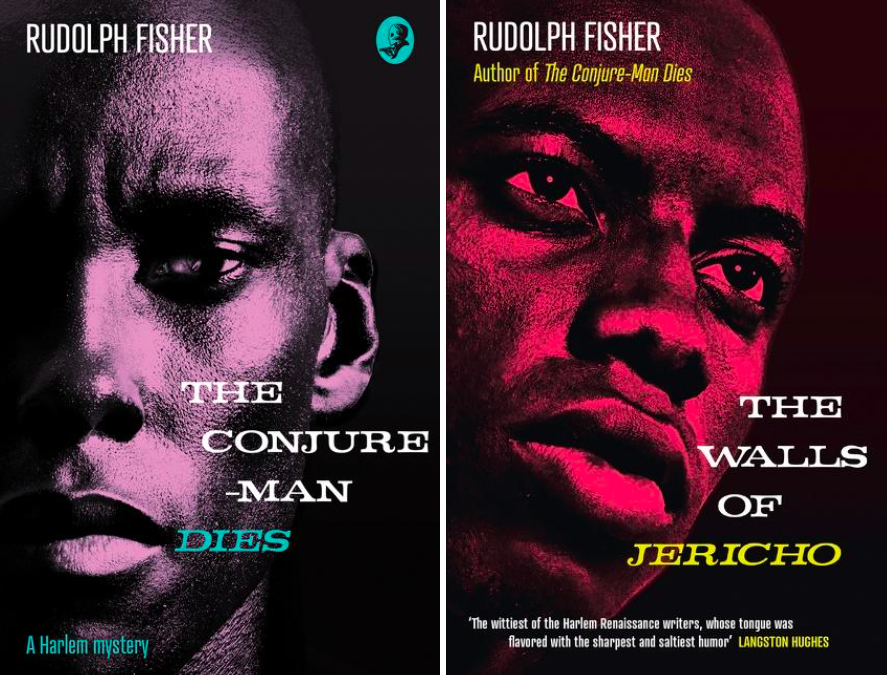
(2021 editions of Rudolph Fisher’s novels; image credits: HarperCollins Publishers)
When, in 1932, Rudolph Fisher’s The Conjure-Man Dies was published, the journal Opportunity called the mystery “startling in its cleverness,” predicting the protagonist, a Harlem doctor with a detective’s eye, would reappear. That year, Agathie Christie spun her investigative hero, Hercule Poirot, into a seventh book and William Faulkner’s Light in August reflected the weight borne by a country whose stories were rife with racial classifications. Reissued this month by HarperCollins, Fisher’s work trod themes familiar to his contemporaries while breaking ground not only as the first known crime novel by a Black author, but also as the first to feature exclusively Black characters as they contend with a resurrected murder victim who promises, “He who knows completely the past and the present can deduce the inevitable future.”
An early witness to the migrations and voices that would later breathe life into his fiction, as a toddler Fisher shared a Manhattan apartment with his mother and father, a brother almost 20 years older who had served with the 25th Infantry Regiment, a Black unit given the military’s segregation, a teenage sister still in school, the ghosts of three siblings dead, and a waiter, houseworker, and bellhop from below the Mason-Dixon line paying rent as boarders. Within the tenement, Fisher’s neighbors were a mix of native New Yorkers and newcomers from the West Indies. Afro-Cuban essayist and editor Rafael Serra lived in the building next door. On the other side stood a lodging house of European immigrants, most of whom had arrived from Germany.
The New York Times described the stretch near West 33rd Street and 7th Avenue, one block from Broadway, as a “little principality” and “the despised ‘patch.’” Before his family arrived, a woman burned her roommate to death in an adjacent building, and a paperboy lost his leg when struck by an electric streetcar. Across the street, police raided the home of women dubbed the Three Musketeers for reportedly stage-managing thefts from “innocent wanderers” when rations were light. On the corner, a hotel offered a breakfast menu of English mutton chop, broiled quail on toast, and a side of Russian caviar, with Moët & Chandon Brut Imperial available by quart or by pint. After the funeral of a police officer, a white mob ransacked Black businesses, striking residents with clubs and clamoring for lynchings in the streets. Two avenues westward, the Thirty-Third Street Baptist Church preached salvation, and a local pastor wrote to the mayor for help on Earth: “The color of a man’s skin must not be made the index of his character or ability.”
With construction planned for Pennsylvania Station and railroad lines connecting New York with the South, tenement owners began to sell their properties, and many residents found themselves moving up to Lincoln Square and Harlem. Fisher’s father, a pastor, received an assignment farther north: in Rhode Island. When the Fishers arrived in Providence, electric streetcars shuttled along Broad Street, running between downtown and the city’s south side. In the shadows of the Union Railroad storage station, in September 1906 Rev. Fisher purchased a vacant lot for $10 (today: $2,900). On the site, he established the Macedonian Baptist Church.
As Rhode Island’s manufacturing economy surged, more than 100,000 new residents within a decade pushed the population above half a million for the first time. The state’s Black population increased by 437 to surpass 9,500 — fewer than the New York City neighborhood of Fisher’s early childhood. Of the dozen other houses on their Providence street, all but the next-door neighbors were white, mostly immigrants and children of immigrants from Canada, England, Ireland and Germany working as servants, bakers, box cutters and machinists. While Fisher’s father built the church, his mother worked as a dressmaker at home. By 1910, church records noted Fisher’s father’s efforts were “proving a vigorous offspring,” with a congregation of 60 members.
(Lexington Avenue Grammar School; photo credit: Providence Public Library)
In the mornings, Fisher walked less than five minutes to a red-brick schoolhouse beside a gold and silversmith factory. As a student, he earned recognition for his writing, oration and music. At 11, to mark Abraham Lincoln’s birthday, Fisher recited in the main hall an ode to “a great soul passed from earth.” Three months later, he conjured the “tumult in the city” during 1776, rattling off verse about the Independence Bell ringing out for “glorious liberty.” With his school’s Glee Club, Fisher performed the works of Franz Schubert and delivered a solo recitative.
When Fisher entered Classical High School, the college preparatory program fell under the leadership of principal William T. Peck, a devout Baptist who had served as a delegate at a Rhode Island Baptist State Convention at the same time as Fisher’s father. At first, he avoided extracurriculars, but he returned to glee as a sophomore and added debate during his junior year. As a senior, Fisher served as treasurer of the former, president of the latter, associate editor of the yearbook and class poet. Of the languages taught at Classical, he opted for German over Greek, and expressed an intent to pursue medicine, hoping to study surgery.
(1915 Classical High School yearbook committee, including associate editor Rudolph Fisher (bottom left); photo credit: Classical High School)
Throughout high school, Fisher showed confidence on stage. At 16, he joined Rhode Island’s lieutenant governor to speak about Lincoln. At 17, he recited James Whitcomb Riley’s poetry at a school ceremony and led the debate team to win the state championships. At 18, he riled up his class dinner, delivering a speech The Providence Journal described as “replete with witty sallies, and enthusiastically applauded.” Other students dubbed him a “silver-tongued orator” and “the genius of the class — at least in extemporaneous brilliance.”
“The way apparently unpronounceable words flow from Fisher’s fluent tongue is indeed a revelation,” read his senior yearbook, “and it has certainly caused us unlimited worry to learn how he manages to swallow so much of the dictionary during the lunch period.”
Fisher’s principal urged the graduating class “to decide where to go in life and then get there.” Jim Crow laws limited how much Fisher could follow the same advice as his classmates.
(Rudolph Fisher, Classical High School, Class of 1915; photo credit: Classical High School)
Fisher entered Brown University as one of two Black students in his class. Pursuing a dual major in English and biology, he received the Caesar Misch Prize for German, placed first in the Thomas Carpenter Prizes for Elocution, and earned university scholarships for “exceptional scholastic ability” and being “the student with the highest standing in rhetoric, English composition, and public speaking.”
At a time when 1,800 Black residents of Providence marched in solidarity with silent parades held across the United States to protest lynchings and other killings on the basis of race, Fisher opened a civil forum on current issues with a musical program and hosted an afternoon lyceum to welcome public discussion.
After the United States entered the First World War, Fisher registered for the draft. Of the descriptions listed on his registration card — “White, Negro, Indian, and Oriental” — he crossed out three. Donning a khaki uniform and Montana peak hat, he drilled on campus with the Student Army Training Corps.
Weeks into Fisher’s senior year, the outbreak of the 1918 influenza pandemic led to Brown announcing a quarantine order and placing armed guards at the campus gates. Even as the war came to an end in armistice, commencement exercises the following summer bore a somberness given the dead and wounded overseas as well as the pandemic’s harm at home. A brass band led Fisher in the procession of graduating students down the hill from campus, as an honor flag displayed 42 gold stars, one for each of Brown’s former students and faculty lost in the war — more than half of whom had died from illness rather than in active battle.
Fisher served as orator during Brown’s commencement program and was selected as one of two class speakers. Noting his plans to pursue a medical degree, the Brown yearbook issued its own prescription: “Between soothing syrup and that glib tongue of yours, you ought to be a sure cure for anything.”
(Rudolph Fisher, Brown University, A.B. 1919, A.M. 1920; photo credit: Brown University)
Less than six weeks after commencement, Fisher’s father died at home. His kidneys failed after a year of nephritis, a condition more likely following exposure to the 1918 influenza strain. Widowed, Fisher’s mother moved back to New York, finding work at the Colored Orphan Asylum in the Bronx. As a “Cottage Mother,” she helped with the care and education of nearly 300 parentless children classified as “inmates” in the 1920 US census. Fisher returned to Brown in the fall to complete a master’s degree, then enrolled in medical school at Howard University in Washington, DC.
Commuting to Howard from Baltimore, where his sister taught at the Colored Teachers Training School (today: Coppin State University), Fisher studied radiology; taught courses in embryology; led lab studies on chicken, pig and human embryos; and played fullback on an intramural football team. Under the banner of Howard’s motto, “Humanity First,” Fisher earned his Doctorate of Medicine as one of 27 graduates in 1924 and accepted an internship at the affiliated Freedmen’s Hospital, founded decades earlier as a Union Army barracks that provided medical care to those who had escaped enslavement or had been displaced by the Civil War.
Although Fisher told his Howard peers he planned to practice medicine in Egypt, he remained in Washington, DC, married his girlfriend, Jane Elsie Ryder, and began to submit short stories he had written around his medical work. In February 1925, The Atlantic Monthly carried Fisher’s first piece of fiction. The issue also featured “an original unpublished ballad” by Abraham Lincoln and an essay on the former president by an assistant secretary in his administration. Fisher’s “City of Refuge” captured the awe of King Solomon Gillis, a neophyte in New York who had “probably escaped a lynching” in North Carolina after he stepped off a subway in Harlem feeling “as if he had been caught up in the jaws of a steam-shovel, jammed together with other helpless lumps of dirt, swept blindly along for a time, and at last abruptly dumped.”
(Rudolph Fisher’s first published short story, “City of Refuge,” appeared in The Atlantic Monthly in February 1925, an edition that also featured an unpublished ballad by Abraham Lincoln; photo credit: HathiTrust Digital Library)
As other stories of Fisher’s began to appear, Alain Locke anthologized an excerpt from “The South Lingers On” in his definitive collection of the era’s Harlem literature. The Atlantic hailed the author’s “profound understanding of his race.” And The Crisis, the official magazine of the NAACP, selected Fisher as the recipient of its $100 Amy Spingarn prize (today: $1,500), judged by Charles W. Chestnutt, Sinclair Lewis, Mary White Ovington and H.G. Wells.
A National Research Council fellowship at Columbia University in 1925 gave Fisher reason to return to New York. The residence of his childhood had long since been demolished during the construction of Penn Station and rebuilt into Gimbels, a 12-story department store. With his wife, Fisher made a home in Harlem. While studying bacteriology and pathology at the College of Physicians and Surgeons, he also found friendship among other writers, musicians and artists. In May 1926, Carl Van Vechten welcomed Fisher with his wife and sister after dinner to meet publishers Blanche and Alfred Knopf.
When Fisher’s debut novel, The Walls of Jericho, fell into the hands of readers in 1928, Knopf trumpeted its latest voice from Harlem as a work in line with Nella Larsen, James Weldon Johnson and Langston Hughes. Bearing the title of a short story in Paul Laurence Dunbar’s 1903 collection, Old Plantation Days, and with reference to the biblical Book of Joshua, Fisher’s satire descended upon the nuance of race, class, labor and wealth. In an interview with Vincent McHugh for The Providence Journal, Fisher said he drafted The Walls of Jericho “in great haste.”
“Its impromptu form suggested that it had been done with the left hand but I had never before seen the evidence of a left hand so skilful,” noted McHugh. “I should like to see what Dr. Fisher’s right hand can do.”
(Rudolph Fisher, undated photo; photo credit: Brown University)
During the preceding years, Fisher had managed a second fellowship from the National Research Council, practicing medicine at Mt. Sinai and Montefiore Hospitals. He conducted research into ultraviolet rays, co-writing papers with his findings for the Proceedings of the Society of Experimental Biology and Medicine and the Journal of Infectious Diseases. Fisher continued to contribute to The Atlantic and had fiction in the pages of McClure’s and reportage on white New Yorkers’ intrigue of Harlem in American Mercury. Amidst it all, he and his wife welcomed their only child, Hugh.
The end of the 1920s started for Fisher with the death of his mother. As the Great Crash ushered in the Great Depression, the private hospital where Fisher worked fell into financial trouble and changed hands. He continued in the role of superintendent under the new ownership of the facility, which too fell into bankruptcy. He paid $90 monthly (today: $1,350) to live in Harlem’s Dunbar Apartments, the first large-scale cooperative housing complex in New York built with a purpose of welcoming Black residents. Fisher’s brother, a postal clerk, and sister, a public school teacher, lived with him, his wife, and their son. They listened to radio broadcasts together, and Fisher wrote by typewriter for four hours in the mornings before work.
Fisher enlisted in the US Army as a member of the reserve medical corps with the 369th Infantry. And as an employee with the New York City Department of Health, he opened his own radiology practice at a family residence in the Jamaica neighborhood of Queens. The City Record, the official journal of New York City, misclassified Fisher as a veterinarian.
When Fisher’s second novel, The Conjure-Man Dies, was published in 1932, TheNew York Times called the follow-up to The Walls of Jericho “a puzzling mystery yarn which is at the same time a lively picture of Harlem.” The Crisis found it to be “a thrilling tale which is bound to be hailed the most unusual mystery of the year.” Opportunity, the journal of the National Urban League, argued that “firsts” like Fisher’s were “all very well indeed” and “should be noted” but instead of the work being “a good detective story” defined by the author’s race, it was all the more appropriate to conclude without qualifier, “it is a good detective story.” The reviewer predicted the protagonist, a Harlem doctor with a detective’s eye, would live on.
(The Conjure-Man Dies by Rudolph Fisher, Covici-Friede, 1932; photo credit: New York Public Library)
As Fisher conducted radio interviews, drafted an adaptation of the novel for the stage, published additional short stories, and continued his medical practice, a “stomach condition” led to multiple surgeries. While few reports surfaced about the precise cause or condition of Fisher’s health, The Crisis noted when he had received a diagnosis of “a heavy cold.” On December 26, 1934, as The New York Times reported on “the merriest” Christmas holiday since the Great Crash, Fisher passed away at Edgecombe Sanitarium in Harlem. He was 37 years old. The Times noted he had suffered “a long illness.” The Providence Journal reported it had been “a short illness.” Three days later, he was buried beside his mother in the Bronx.
Zora Neale Hurston transmitted a message by telegram to Fisher’s wife: “The world has lost a genius. You have lost a husband and I have lost a friend.” Langston Hughes later wrote, “I guess Fisher was too brilliant and too talented to stay long on this earth.”
Days later, a posthumous short story was published in Metropolitan,carrying Fisher’s detective-like doctor into another mystery. With support from the Federal Theatre Project of the Works Progress Administration, in 1936 Orson Welles brought The Conjure-Man Dies to the stage of the Lafayette Theatre in Harlem. Fisher’s wife and son kept his copyrights active, and his sister retained drafts of Fisher’s manuscripts, family correspondence and other records, which found their ways into the archives of Brown University, Emory University and the New York Public Library’s Schomburg Center for Research in Black Culture. But with time, Fisher’s legacy faded.
“He was actually one of the leading figures of the Harlem Renaissance,” said Delia Steverson, an assistant professor of African American literature at the University of Florida. “He characterizes this assertiveness, this pride, this independence, this unadulterated creativity.”
(The Conjure-Man Dies at Lafayette Theatre in Harlem, 1936; photo credit: Library of Congress)
More than 50 years passed after Fisher’s death before the University of Missouri Press compiled a collection of his short stories. In the 1990s, the University of Michigan Press reissued both novels. A now defunct London publisher included Fisher as Black Classics, and Fazi Editore in Rome brought out an Italian translation, Dark Harlem. After a 2017 hardcover edition, in January HarperCollins released The Conjure-Man Dies as a paperback and e-book, with The Walls of Jericho due to follow in May.
“When these books are published, there needs to be fanfare,” said Ray Rickman, executive director of Stages of Freedom, a nonprofit that promotes Black cultural events in Rhode Island. “It needs to be orchestrated, and there’s no orchestra leader.”
Rickman features Fisher during Stages of Freedom’s cultural walking tours in Providence. The organization is fundraising to establish a museum about Rhode Island’s African American history, and Rickman said the nonprofit is in discussions with the Classical High School Alumni Association to produce a booklet and display on Fisher for students and libraries. In recent years, artist Sandra Smith stitched both of Fisher’s novels into a square on a wall quilt commissioned for Roger Williams University, and the Rhode Island Black Historical Society and the Rhode Island Historical Society have curated exhibits featuring the life of the author.
At the University of Florida, Steverson included Fisher among two dozen literary figures and publications for a Wiki Education project to improve the quality of Wikipedia entries related to the African diaspora. Students in her survey course on African American literature conducted research, presented their findings in class, and drew from 275 references to make nearly 800 edits to improve the Wikipedia pages of their assigned topics. Within two months of their semester’s conclusion, their updated entries were viewed almost 40,000 times.
“Work like Wikipedia is going to help to provide open access to knowledge and help to fill these equity gaps,” said Steverson.
“Fisher demonstrates how certain Black voices get lost throughout time,” she said. “What we don’t want is for Rudolph Fisher to be lost in translation for the next 50 years or the next 100 years.”
(1990s paperback editions of Fisher’s novels; Image credits: The University of Michigan Press)
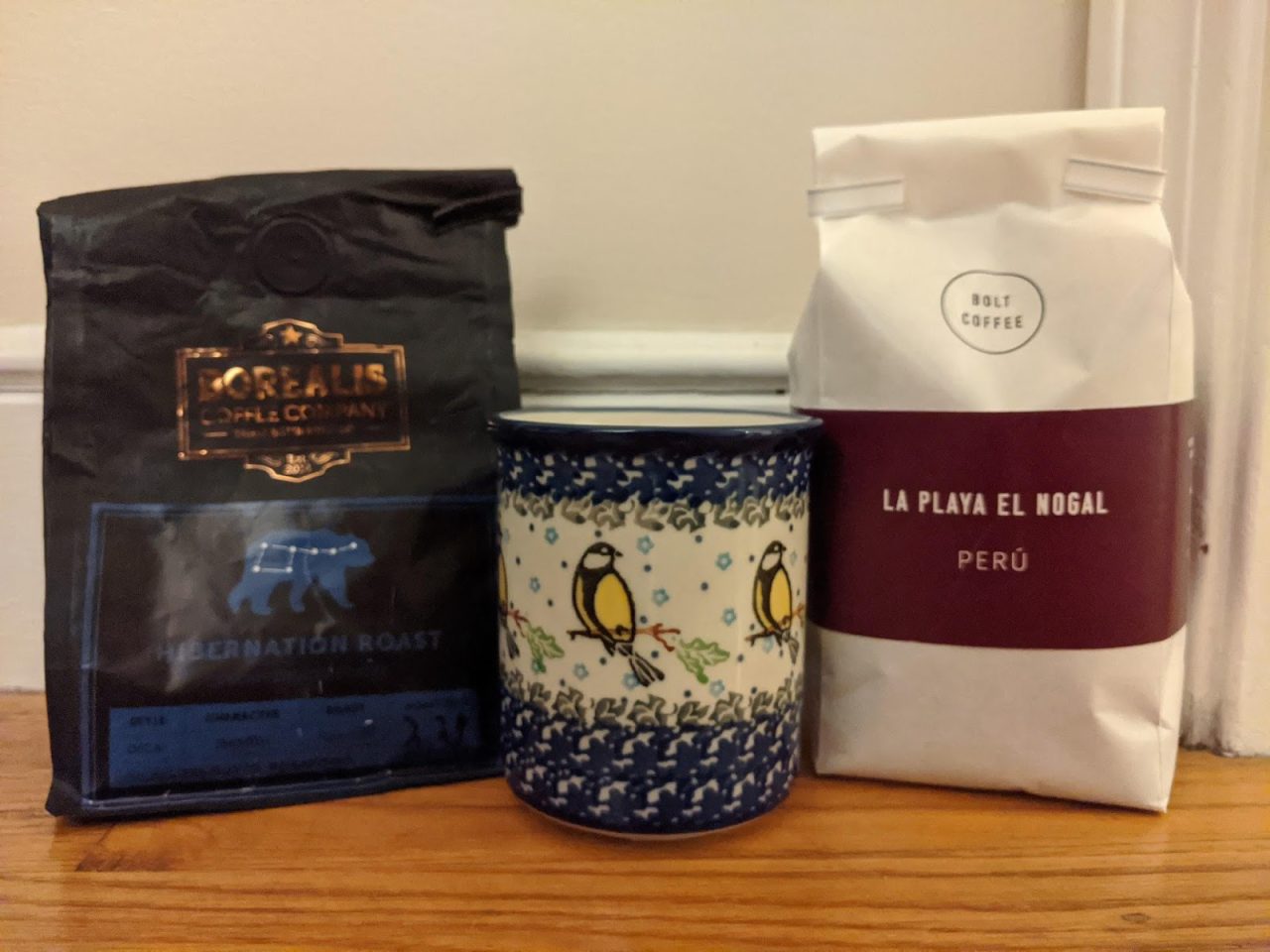
Tastes of Rhode Island coffee roasters, Borealis and Bolt; photo credit: Sean Carlson
As cafes across the country closed or adjusted their operations to confront public health and financial concerns during the coronavirus (COVID-19) pandemic, the National Coffee Association’s annual survey found 70% of American adults reported drinking coffee at least once per week. If you count yourself in that tally, whether you prefer to down a quick pick-me-up or linger over a cozy cup, the past few weeks have likely transformed your coffee routines and rituals — with consequences for local businesses.
After stay-in-place orders went into effect, Rhode Island’s coffee roasteries — determiners of the flavor profiles you smell and taste, processors turning beans from all over the world into finished roasts, and guarantors of the coffee you like reaching its point of purchase — witnessed the erosion of wholesale orders and turned toward delivery, and in some cases contactless pick-up, to continue serving their customers. Whether you delicately prepare a morning pourover, set your automatic machine with grinds enough for multiple refills, or are grappling with how to make coffee at home, first you need your beans. These roasteries shared their experiences and advice when it comes to coffee during troubled times:
The public health crisis struck just after Bolt soft opened its first standalone cafe in downtown PVD. As well as closing all four locations due to the fallout, Justin Enis, coffee director at Bolt, said the company lost about 97% of its wholesale volume, with closed restaurants and other cafes cutting back on coffee orders. With much of its staff out of work, Bolt instituted a virtual tip jar on GoFundMe, committing to distribute 100% of donations to staff who relied on tips and to make company contributions based on coffee sales. A surge in online orders — a 10X increase, said Enis — has been a bright spot during a dark time. To support emergency workers, Bolt has provided coffee, granola bars and juice to the Providence Fire Department and Kent Hospital in Warwick with an open call for future collections.
How to order: Purchase through the Bolt website. Local customers can choose to collect their orders at Bolt’s roastery (96 Calverley St, PVD), which remains open for pick-ups from Monday to Friday between 9am and 5pm. Bolt asks customers to wait until at least noon of the day following their order.
Special deals: Bolt ships online orders of any size within the US at a flat rate of $5. Keep an eye out for short-term specials: Bolt ran a two-week discount of 20% for all online orders and a flash sale featured 12 oz. bags of the Honduras Rafael Lara for $12, roughly 15% off its regular price, while supplies lasted.
Coffee subscriptions: Bolt offers its Roaster’s Choice Subscription, modeled on taste profiles — “easy all-day drinking,” “new and exciting” or “mix it up” — at five price tiers ranging between $17 and $56 per month based on the quantity of coffee. Subscribers are encouraged to share their taste preferences.
Additional retail: Bolt mug, insulated coffee tumbler, AeroPress coffee maker and gift cards.
Roasting status: To manage freshness with online orders and shipping, Bolt has changed its production process from roasting back-to-back on Mondays and Tuesdays to roasting on Mondays and Thursdays.
New tastes:Snapchilled Coffee: This iced coffee from Kagumoini, Kenya, was crafted with Elemental Beverage Company in Watertown, Massachusetts, by flash chilling large batches of hot coffee to maintain acidity, body and flavor. “That means peaches and caramel notes all day,” said Enis. Single cans or four-packs are available for pick-up at Bolt’s roastery or for delivery through Elemental. Mirror Mirror: Justin Enis of Bolt and Rob Rodriguez of Night Shift in Everett, Massachusetts cupped and coordinated together for a joint release modeled off craft brewery collaborations. The result, said Enis, is “a cherry bomb of a Colombian coffee from Cauca.” Bloom: Bolt released its Spring Seasonal Blend, promising notes of brown sugar, citrus notes and tropical sweetness.
Different approaches: “We shifted the whole business model and roastery space to facilitate the massive uptick of online orders and local pick-ups,” said Enis. With in-person chats and training on hold, Bolt turned to Instagram for live home-brew sessions and IGTV video guides for coffee instruction.
Ending on a high note: “It has been humbling to see the response in folks supporting us and feels so good to see everyone excited and sharing their joy for simply having coffee,” said Enis. “Our mission is to drive community through hospitality, and we aim to still achieve this despite the distance.”
– 250 Bullocks Point Ave, Riverside (East Providence)
After more than three years in a former railway station along the East Bay Bike Path, Borealis opened a new roastery in Pawtucket shortly before the pandemic caused the doors of its Riverside cafe to close on customers. “I’ve debated about a take-out option,” said owner Brian Dwiggins, “but my thought is that if we’re supposed to be helping flatten the curve, then we shouldn’t be encouraging people to leave their homes when they can have it delivered.” Borealis committed to allocate 20% of online sales to employees who lost their jobs and to continue health insurance for those who had enrolled in a work-provided plan. “I feel that it’s a little more tangible for the customers to see that their support is still going to the baristas they know and love,” said Dwiggins. “Doing more to promote online sales was one of my goals for this year, but this isn’t exactly what I had in mind.”
How to order: Purchase through the Borealis website. In-person pick-up is not available at the moment.
Special deals: A five-roast sampler ($65) runs roughly 15% less than if each 12 oz. or 16 oz. bag of coffee were purchased separately. The addition of 5 lb. options includes a built-in bulk discount. Shipping is free on orders above $35.
Coffee subscriptions: Borealis runs a Coffee Club featuring one or two bags of coffee per month, offered in six-month or one-year increments. Roast preferences and favorite regions are encouraged.
Roasting status: Borealis dropped one day in its roasting schedule, moving from four days per week during normal operations (ie, from Tuesday through Friday) to three. By roasting on Mondays, Wednesdays and Fridays, Dwiggins said Borealis is better able to process and ship online orders.
New tastes: “With our new roaster, we’re still fine tuning the roasts and continuing to weigh which coffees are better in Riverside and which coffees are better in Pawtucket,” said Dwiggins. “It’s a very cool machine, so we’re really taking the time to dig in and wrap our heads around the bells and whistles.” In mid-April, Borealis plans to introduce its new Ursa Major blend. With astronomical tendencies intact, the roast honors the constellation that contains the Big Dipper and can be prepared with a V60 dripper.
Different approaches: Since cupping has proven challenging with social distancing, Dwiggins has been conducting his tastings at home. Borealis is also in the process of certifying some coffees as organic.
Ending on a high note: “Small businesses are directly connected to the community,” said Dwiggins. “We are your neighbors, friends, and family members. Our businesses support other local businesses, and our employees support other small businesses and each other, so we have a much larger effect on the local economy than a national chain with the same number of employees.”
With a cafe and on-site roasting in Tiverton, Coastal Roasters relies on the support of its community, especially with seasonal ups and downs. Although revenue has dropped, with wholesale orders from restaurants and other cafes falling roughly 80%, founder Donald Machado said the retail business and grocery orders have remained steady and robust. “As owners, we have the typical stresses of balancing the safety of customers and employees and ourselves with the ability to provide a service and earn a living,” said Machado. “It causes extra stress not knowing the duration of the new environment and its short- and long-term impacts on business viability, but we feel blessed to be able to stay open even in its more constrained form.” Machado said he hopes their coffees can bring normalcy to people’s routines.
How to order: Coastal Roasters is currently open for pick-up/take-out of beans, beverages and pastries. Pick-up orders can be placed in advance using a Square site or by calling 401-624-2343. Mail order requests for delivery can only be placed by phone.
Current specials: A minimum order of two bags of coffee beans receives same-day drop-off for free in Little Compton, Tiverton and select areas in Portsmouth.
Additional retail: Coastal Roasters hats, mugs and clothing, local honey and loose-leaf teas, equipment including French presses and AeroPress coffee makers, and gift cards, through Square for online orders and at the cafe for in-store purchases.
New tastes: Coastal Roasters created a custom blend for Le Bec Sucré bakery in Middletown, featuring Indonesian, South American and Central American beans to deliver a dark, but not quite French, roast. Coastal recently introduced a Dominican Republic peaberry and sold out of its seasonal winter roast.
Different approaches: The use of online ordering for beans and beverages through Square is new, and has proven “quite popular,” said Machado. “We’re working mainly on staying open,” he said. “That’s about as exciting as we can get at the moment.”
Ending on a high note: “We appreciate all the love and kindness customers have shown, and most importantly we recognize the efforts and care our employees exhibit during these trying times,” said Machado. “We’re grateful we still have the opportunity to share our goods and services.”
“While we are happy to be able to continue to provide coffee, we are disheartened by what is happening and our hearts go out to everyone who is struggling during this time,” said Charlie Fishbein, president of the Coffee Exchange. When the small-batch coffee roaster introduced a Venmo fund for its laid-off baristas, one of the first donations came in from a former employee who had worked for the Fox Point institution more than 30 years ago. “Small businesses are the heartbeat of any community,” said Fishbein. “When we invest in our neighbors it gives all of us hope and helps us feel the impact of our care for one another.”
How to order: Home delivery is not available from the Coffee Exchange, but orders for pick-up can be placed through the Coffee Exchange website. The cafe at 207 Wickenden St is operating a to-go window on its deck from 9am until 3pm, serving drip brew and coffee beans by the pound. Customers are asked to use the code BEANPICKUP online at least 90 minutes before stopping by to collect their order. Because the to-go window closes at 3pm, orders placed after 1:30pm will be ready the following day.
Coffee subscriptions: The Coffee Exchange’s Coffee Club knocks 10% off the price of any coffee, when placed as a recurring order at intervals as short as once per week.
Additional retail: Stove-top espresso maker, hand-held coffee grinders, AeroPress coffee maker, various filters for pourovers, a Coffee Exchange-branded mug or Thermos, and gift cards
Roasting status: Because of the volume of pick-up and online orders, the Coffee Exchange has been roasting to order. “Ultimately, this means customers are getting the freshest roasted coffee possible,” said Fishbein.
New tastes: A new Vienna-roasted Laotian coffee has replaced the Vienna-roasted Costa Rican coffee, which is currently unavailable.
Different approaches: “The to-go window was added for efficiency and safety,” said Fishbein, “as was reorganizing the interior work space to provide appropriate distance between staff members.” Some revised and updated technologies have also improved how the Coffee Exchange fulfills its orders.
Ending on a high note: “The continuous operating of Coffee Exchange is totally dependent upon a few extraordinary people and some extraordinary concerned customers,” said Fishbein. “Hopefully, we’ll be able to continue some level of services going forward, and once we’re able to get back to full operation, it’s these people — people who have been the heart and soul of this business, currently working today or unemployed — who will take us back to normalcy. Now, that’s a condition I never thought I’d aspire to.”
“The rules have changed. But, our coffee hasn’t…,” opened an April newsletter from Dave’s Coffee. “One of life’s little comforts, something that brings happiness, is something that is familiar. Something that brings a smile to your face. Coffee is that something in our world.” With its Charlestown location open for take-out and plans in place for its PVD cafe to follow suit, Dave’s has benefited from selling limited groceries to support its suppliers and grocers increasing their coffee orders. “I feel very strongly that small, local business plays a huge role in our economy,” said Dave Lanning, founder of Dave’s Coffee. “My primary concern as a small business owner is to keep generating revenue so that I can keep current employees working and bring back those affected as soon as possible in a safe manner.”
How to order: Purchase through Dave’s website. The Charlestown cafe reopened on Friday, March 27, with coffee, baked goods, and select groceries from local suppliers. Customers can call (401-315-2160), visit ChowNow, or use the Dave’s Coffee mobile app for Android and iPhone. Lanning said Dave’s plans to reopen its PVD cafe using the same system.
Coffee subscriptions: Dave’s serves up a weekly or monthly coffee subscription program for repeat roasts or a rotation with Roaster’s Choice. After the first order, each bag of coffee is discounted 15%.
Additional retail: A robust selection of grinders, kettles and coffeemakers as well as mugs, t-shirts and flannel-wool ear-flap caps and Dave’s take on the Rhode Island tradition of coffee syrup.
Roasting status: With online sales and grocery stores increasing their orders, Lanning said Dave’s has seen only a slight decrease in its roasting volume.
New tastes:Falcon: Dave’s seasonal cold-brew blend took flight in time for the warmer weather.
Different approaches: As well as coffees and items from the bakery, Dave’s added common pantry items to its menu, including milk and butter from S.B. Winsor Dairy in Johnston and almond, soy and oat milks. While reducing the number of stops for customers in need of the basics, the addition of a few groceries also helps local suppliers.
Ending on a high note: “Thank you for your continued support and all the kind words of encouragement we’ve received,” wrote Lanning to conclude his April newsletter. “Stay strong. Stay positive. Stay healthy.”
Roasting coffees since 1953, Downeast Coffee focuses on wholesale and direct sales, without operating a cafe of its own. “Our business is down significantly and many of our customers are completely shut down or not ordering at all,” said Mike Kapos, vice president of sales and marketing at Downeast. “Our team here has a healthy combination of fear and hope, and we will persevere.”
How to order: Purchase through Downeast’s website. In-person pick-up is not available at the moment.
Special deals: With a nod to the necessity of coffee for many of those able to work from home, the checkout code WFH provides a 20% discount and guarantees free shipping.
Additional retail: Branded mug, baseball cap and a trucker hat; otherwise, Downeast encourages brewing coffee at home and offers a 10% discount (using a code found on their website) on the necessary, or complementary, coffee-making equipment when purchased through Espresso Parts.
Roasting status: A large decrease in volume has decreased the frequency of roasting, said Kapos. “Otherwise, nothing has changed with the roasting process specifically other than implementing CDC guidelines in our plant and companywide to ensure the health and safety of our team and customers.”
Different approaches: Downeast is working with home-delivery services Roch’s Fresh Food in Rhode Island and Pepper Pantry in New York to offer its coffees direct to customers. Drive-through coffee service has been “a lifesaver,” said Kapos, noting Brewed Awakenings whose Cranston and Warwick cafes remain open for take-out. The challenges have encouraged greater focus on growing online traffic too.
Ending on a high note: “Small businesses are the backbone of Rhode Island and the country,” said Kapos. “Although this is a shocking and devastating time, we know that our company, our industry and fellow small businesses in Rhode Island will bounce back stronger than ever.”
– Hope Artiste Village, 999 Main St, #108, Pawtucket
One cafe, currently closed:
– 130 Westminster St, PVD
Nineteen years ago, New Harvest started up with an aim of “making great coffee accessible to real people.” An influx of online orders has given new meaning and urgency to the long-standing local roaster’s efforts. With bakeries, cafes, restaurants, hotels and universities pausing or scaling back their operations, New Harvest’s wholesale business has taken a hit. “Like every other small business right now, we are struggling from day to day to navigate this wrenching new reality,” said Rik Kleinfeldt, founder and co-owner of New Harvest. As grocery stores continue to stock coffee from New Harvest, Kleinfeldt encourages support of Urban Greens Co-op Market (93 Cranston St, PVD), which opened in June 2019. With its trainings and events on hold, New Harvest’s step-by-step instructions for using a French press, Chemex, Kalita Wave or AeroPress coffee maker offer advice for anybody trying their hand at home.
How to order: Purchase through New Harvest’s website. In-person pick-up is available at the roastery on premises at Hope Artiste Village from Monday through Friday between 9am and 3pm. Customers are asked to call (401-438-1999) or email beforehand. As well as standard shipping options, New Harvest introduced its own next-day home delivery in North Providence, Pawtucket and Providence.
Special deals: Free shipping is available on orders of $75 or more.
Coffee subscriptions: New Harvest’s monthly Coffee Club includes a coffee mug with the first order. Subscriptions run for six months or one year, with an organic option, and shipping costs are covered.
Additional retail: A range of home coffee-brewing equipment, including kettles, scales, French presses and various coffee makers as well as New Harvest t-shirts, tote bags and gift cards.
Roasting status: Although its Pawtucket roastery remains open for production and purchases of coffee beans, New Harvest is operating at the moment with approximately 85% less staff, said Kleinfeldt.
New tastes: In early March, before the travel shutdowns, Kleinfeldt traveled to Atitlán, Guatemala, to visit the coffee cooperative La Voz que Clama en el Desierto behind the Guatemala La Voz organic single-origin now available from New Harvest.
Different approaches: New Harvest is no stranger to the Farm Fresh RI Winter Farmers Market in Pawtucket — and its seasonal counterpart, the Hope Street Saturday Farmers Market, held in PVD’s Lippitt Memorial Park from May through October — but its weekly set-up relocated to the outside courtyard at Hope Artiste Village, with coffee for sale on Saturdays between 9am and 1pm through April.
Ending on a high note: “One thing that inspires me in this crisis is how the local food community has come together to help each other,” said Kleinfeldt. “A bunch of farmers and producers collaborated on home delivery, for example, through Pat’s Pastured website,” an initiative that includes Rhode Island providers of flowers, vegetables, cheeses, seafood, meats, poultry, and, of course, coffee.
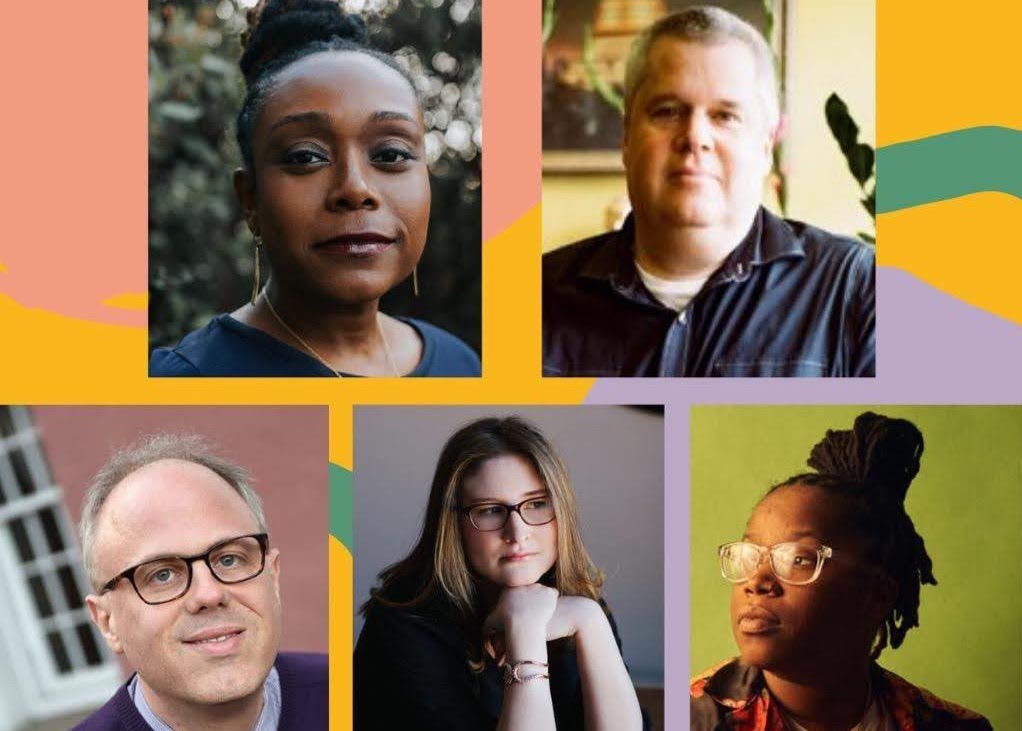
Authors joining Twenty Stories for its first online Saturday Night Stories series on Saturday, March 28; image courtesy of Twenty Stories
After coronavirus (COVID-19) concerns caused What Cheer Writers Club (whatcheerclub.org) to close its co-working space and podcasting studio in downtown PVD and to cancel in-person events beginning on Monday, March 16, program manager Jodie Noel Vinson contacted members to encourage the community of writers to support each other and continue to share their work through Slack. Alongside streams for announcements, podcasters, various genres of literature and general discussion, What Cheer introduced an #online-events channel that within a day surfaced invitations to Facebook Live events including a RI Black Storytellers talk on sharing stories with audiences of different ages, a PVD PechaKucha with 20-second bursts from 20 people on managing isolation, and a reading accompanied by a stiff drink or a cup of tea.
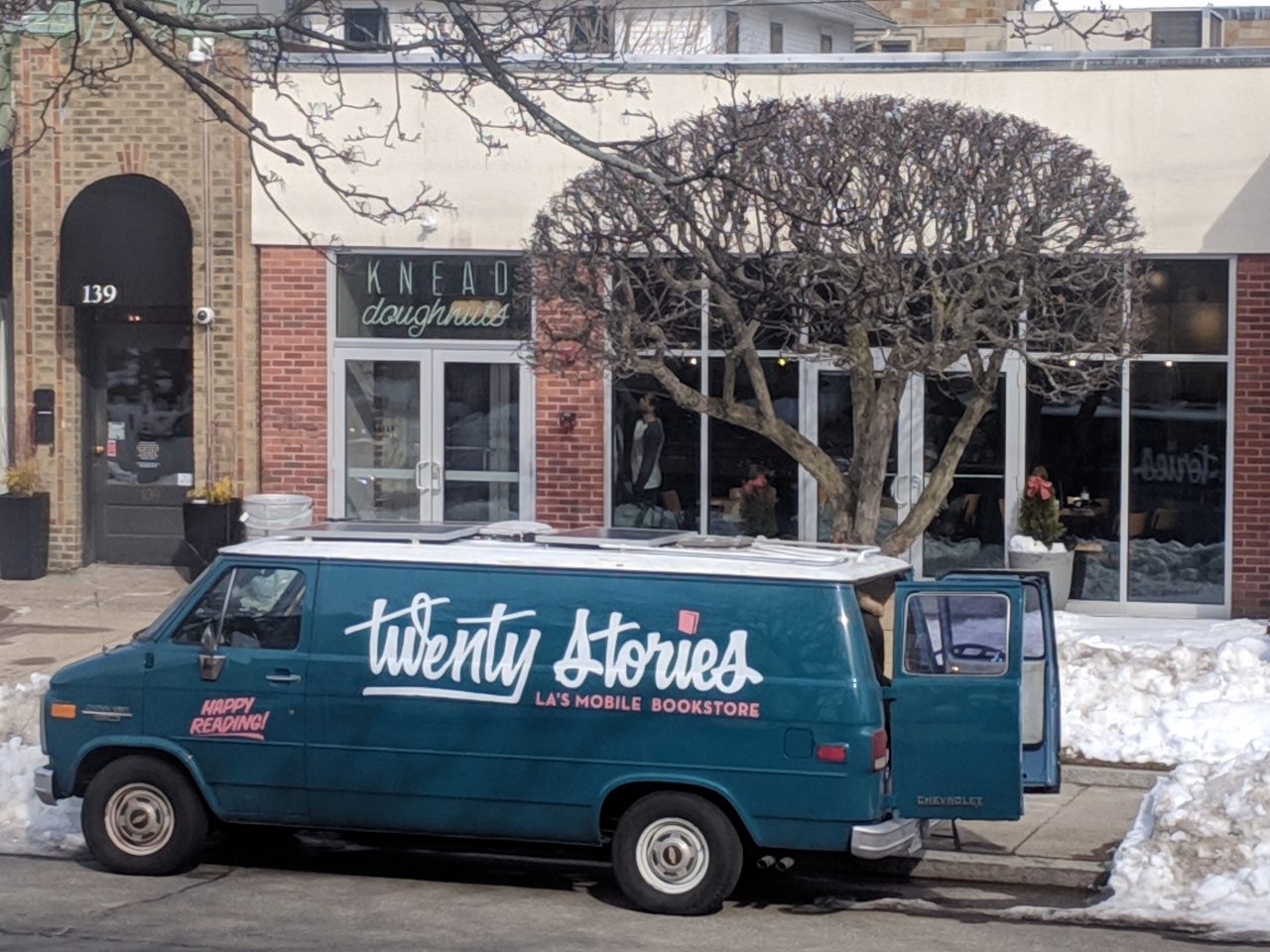
As bookstores around the world confront a public health crisis of indeterminate length with punishing effects on their operations and the communities they bring together, PVD’s indies have looked to online sales as a short-term salve to maintain their long-term lifeblood. Books on the Square (471 Angell St, booksq.com) turned the parking lot at the rear of its store into a books-to-go pick-up zone for phone, website or email orders. Planned author events, book clubs and children’s storytimes, however, have been cancelled or postponed. Riffraff in Olneyville, Symposium Books downtown and Twenty Stories in Fox Point are experimenting with adapting, and even expanding, some of their in-person activities onto digital platforms.
Remember, if an upcoming book club or literary livestream helps you choose the next addition to your reading list: the events might be online, but their hosts are local. While your nearest or favorite independent bookstores are closed, you can still buy books from them directly at a time when every purchase makes a difference to their overall health.
Art of translation with Riffraff
A note on Riffraff’s website (riffraffpvd.com) reminds its visitors how the Olneyville bookstore and bar (60 Valley St, #107A) “was opened with a deep, abiding appreciation for the in-person experience, for face-to-face conversations about books and everything else.” (Read Motif’s profile of Riffraff at its second anniversary and a Q&A with Riffraff’s co-founders.) So long as its doors remain closed, Riffraff’s events are postponed with the exception of its book club exploring the theme of women in translation.
On Tuesday, April 7 at 7pm, Riffraff will use Zoom to host a discussion of August by Romina Paula (Feminist Press, 2017). The introspective and at times discomfiting novel of a homecoming in the wake of a friend’s death was first published in Spanish in the author’s native Argentina (Agosto, Editorial Entropía, 2009) before making its way into English — and into the US — thanks to the craft of Jennifer Croft, who was later recognized with a Man Booker International Prize for her translation of Flights by Nobel Prize-recipient Olga Togarczuk.
While Riffraff offers a $1 discount for book-club purchases made through its bookstore, now managed by email or online form, the only requirement to participate is to have read August in advance. If you need a drink as an accompaniment, co-owner Emma Ramadan recommends a Fernet con Coca.
Super-casual symposium with Symposium
During its decade and a half in business, Symposium Books (240 Westminster St, symposiumbooks.com) has hosted a range of author readings, reading groups, record release parties, zine launches and art gallery openings. While the COVID-19 closures put Symposium’s events lineup on hold, the bookstore took a “super casual” and “zero pressure” approach for its latest book club pick, Where the Crawdads Sing by Delia Owens (G.P. Putnam’s Sons, 2018), with an invitation to chat on Tuesday, March 24.
Instead of focusing discussion around the entirety of the novel, now in its 80th week on The New York Times best-seller list, co-owners Anne Marie Keohane and Scott McCullough asked social-media users to start chiming in after reading as few as 10 or 20 pages. While it’s unclear if they’ll repeat the effort for their next book-club selection, yet to be announced, they’ll share updates about future book chats open to all via Facebook (Symposium Books), Instagram (@symposiumbooks), and Twitter (@SymposiumBooks).
New Saturday series with Twenty Stories
Twenty Stories (twentystoriesla.com) announced Saturday Night Stories, a new series streamed in two parts, with an Instagram Live reading followed by a Zoom salon. (Read Motif’srecent feature on how Twenty Stories has adapted its business during the pandemic.) The idea surfaced after an in-store event planned for Friday, March 13 turned into an Instagram Live video stream to celebrate the publication of Andrew Altschul’s novel The Gringa.
From his home in Fort Collins, Colorado, Altschul will collaborate with Twenty Stories and San Francisco-based literary magazine ZYZZYVA to host an evening featuring five authors with new books or whose book tours have been canceled due to coronavirus.
The first round will take place on Saturday, March 28 at 9pm featuring:
Margaret Wilkerson Sexton (The Revisioners, Counterpoint, 2019)
Daniel Handler (Bottle Grove, Bloomsbury, 2019)
Rachel Vorona Cote (Too Much, Grand Central, 2020)
Twenty Stories will stream five five-minute readings on Instagram (@twentystoriesla). To incentivize purchases through its online events, the bookstore will invite anybody who places an order for at least one of the authors’ books to a subsequent salon on Zoom for a freeform conversation with the writers. The series will continue on Saturday, April 4 and Saturday, April 11 with authors yet to be named.
And readers of Exquisite Mariposa by Fiona Alison Duncan (Soft Skull Books, 2019) will join Twenty Stories, again on Zoom, for its fiction book club on Sunday, March 29 at 11am.
Even more local literature online
Friday mornings at 11am, What Cheer Writers Club hosts a #coffeebreak with members on Slack; screenshot provided by What Cheer Writers Club
For What Cheer Writers Club’s own events, they’ve moved over to Zoom. On Saturday, March 28 at 1pm, Jamie Michalak and Kelly Murphy will share their experience collaborating to write and illustrate their forthcoming children’s book, Crumb’s Treasure (Candlewick, 2021). On Thursday, April 2 at 5pm, a virtual Member Meet Up will include a Nonfiction Showcase with 10 writers reading 5-minute shorts or excerpts from longer works. On Fridays at 11am, members are welcomed to a virtual coffee chat. On Sundays at 12:30pm, local science-fiction and fantasy writers gather together. Providence Writers Group is also meeting every first and third Sunday via Zoom, and a new organization of Science and Environmental Writers in Rhode Island (@SciEnRI) aims to get together online. Besides updates on its Slack channels, What Cheer Writers Club sends a newsletter detailing a robust collection of literary activities and news relevant to local writers — with more to come in the weeks ahead.
“These times are revealing the shape of our community and that it can look many ways across different mediums,” wrote Vinson, What Cheer’s program manager. “But more than anything, it is revealing how essential our community is.”
PVD’s Twenty Stories curates a monthly selection of 20 books; photo credit: Twenty Stories
After converting a 30-year-old Chevy G20 van into the Twenty Stories bookmobile in 2017, Alexa Trembly and Emory Harkins drove around Los Angeles sweltering through summer highs, some days struggling to sell as many as three books. While relocating in 2018 to Rhode Island, where Harkins grew up, their van broke down in the desert of New Mexico. Several months into running a bookshop at Hope Artiste Village in Pawtucket, in 2019 they faced a period with double rent after moving to the Fox Point neighborhood of Providence. Despite its hurdles, Twenty Stories has curated a monthly selection of 20 works of fiction, nonfiction and poetry.
“We carry, normally, one dystopic novel each month, but not in March,” said Trembly by phone as the coronavirus (COVID-19) pandemic escalated. “Maybe it felt too real.”
Once the Centers for Disease Control and Prevention (CDC) confirmed the first case of coronavirus in Rhode Island on Tuesday, March 3, Trembly and Harkins began to implement precautions at their bookstore. Maintaining regular business hours, they wiped down their counters with sanitizer and asked customers to use contactless payments when possible. The following week, on Monday, March 9, Governor Gina Raimondo announced a state of emergency. Two days later, she discouraged events with more than 250 people. Trembly said she understood the warnings as a matter of large gatherings rather than about staying open.
“Business seemed to be the same as usual,” said Harkins, “maybe a little busier.”
“People were coming in a lot, kind of saying, ‘Oh, I need to stock up on books. We don’t know what’s going to happen,’” said Trembly. “There was a lot more up in the air at that point.”
On Thursday, March 12, Providence Mayor Jorge Elorza revoked entertainment licenses across the city, shuttering movie theaters and concert venues. When Twenty Stories opened the following morning, Trembly and Harkins were prepared to host an evening celebration for Andrew Altschul’s novel The Gringa, published by Melville House Books earlier in the week. Within hours though, Harkins said, their assessment of the risks caused them to change plans.
“We have a wide age range of customers who come to our events,” said Harkins, “and we just felt a responsibility to not have those people interact with each other.”
“That’s been a really big hurdle and struggle,” said Trembly, “not just for businesses, but for everyone right now.”
After discussing with Altschul, visiting from Fort Collins, Colorado, and moderator Darcie Dennigan, a resident of Providence, Twenty Stories announced the event would take place online instead. Altschul drove to Providence from Worcester, Massachusetts, following a cancelled talk at the College of the Holy Cross, and participated in an Instagram Live video stream with Trembly and Harkins in an otherwise empty bookstore. Dennigan joined from home.
“We usually meet the authors we have events with, and we either shake hands or hug,” said Harkins. “It was strange because we were bumping elbows and keeping distance even while we were putting on this event together.”
Twenty Stories breaks out its original bookmobile in front of Knead Doughnuts in March 2019; photo credit: Sean Carlson
In July 2018, Belletrist, an online book club run by actress Emma Roberts and producer Karah Preiss, welcomed Trembly and Harkins for an Instagram Live chat from their van. The video stream featuring Altschul and Dennigan was the first to be run by Twenty Stories. Citing Instagram’s analytics, Trembly said 250 people watched the conversation within 24 hours, five times greater than what she considers a good in-store turnout. Declining to share numbers, Harkins said the corresponding book sales were lower than what they would have expected if the evening had taken place in person and they’re working on ways to encourage purchases around future virtual events.
“It was kind of like a making-lemonade-out-of-lemons situation,” said Trembly.
Foot traffic at the bookstore remained steady on Saturday, March 14, as the number of confirmed coronavirus cases in Rhode Island jumped from 14 to 20. Harkins said customers were looking for “quarantine books” as the necessity of social distancing set in. Two hours after opening the following morning, Trembly and Harkins made the choice to close their bookstore indefinitely. They donated a portion of the weekend’s sales to the Rhode Island Community Food Bank to assist children and families facing a time of food insecurity.
“Social media has always been a starting point for our store,” said Trembly about the relative ease of adapting their business to the Internet. “I know some retail stores, brick and mortar, don’t have online shops immediately, and I think that will definitely be a harder transition.”
After locking up, Trembly and Harkins expanded their online shop to include not only their current monthly curation, but also an array of children’s books, cookbooks and other works of fiction, nonfiction and poetry. They’re in the process of updating their listing of art books and adding to the titles in stock. They’ve dropped off a few custom orders at front doors around Providence, but otherwise Harkins said he has been back and forth between the bookshop and local post offices. Anybody who places an order can ask for a dance move posted to Instagram Stories. Harkins said he and Trembly struggled for days with how to do a “dinosaur dance,” as a customer requested alongside Too Much: How Victorian Constraints Still Bind Women Today by Rachel Vorona Cote. Trembly said she and Harkins are also investing time in Palm Leaf, an online periodical they created in 2017. Hosted on the Twenty Stories website, the initiative features a range of literary interviews and contributed writing.
“We’re optimistic people and we’re staying pretty optimistic,” said Trembly, “but the longer it goes on, this anxiety builds a little bit.”
In December 2019, Twenty Stories hired two part-time booksellers, the first staff besides the co-founders. They haven’t worked since the bookstore shut. To cope with the crisis, Trembly and Harkins said they might assess the low-interest federal disaster loans approved by the U.S. Small Business Administration.
“We’re anticipating at least a 50% reduction in sales as long as our shop on Ives Street remains closed,” said Harkins.
One week after closing their storefront, Trembly and Harkins emailed the Twenty Stories mailing list to encourage support by shopping online, placing special orders, attending virtual events, purchasing a gift card or even writing a review. They said they remain in touch with neighbors, other booksellers, and local restaurants, retailers and small businesses as they confront an incomparable experience, recognizing how many friends and colleagues are caught too.
“The amazing thing about Providence is all of the small businesses really do care about each other, like even more than ever,” said Trembly. “I don’t think people see it as much as being competitors as much as being a community.”
When Trembly and Harkins settled on Exquisite Mariposa by Fiona Alison Duncan as their most recent fiction book-club selection, they anticipated sitting with customers on Sunday, March 29 for a late-morning gathering accompanied by a spread of baklava from Aleppo Sweets, a Syrian bakery and cafe next door. Instead, they replaced the in-person discussion of Duncan’s novel, which The Los Angeles Review of Books called “a quest for the Real in the age of Instagram,” and made plans for future events, using online video conferencing hosted by Zoom.
“Everyone always hates on social media,” said Trembly, “but in this context it’s really cool to see how it could keep that community — kind of hold that community space now.”
The view down William Street in Listowel, County Kerry; photo credit: Sean Carlson
While we greet St. Patrick’s Day in Rhode Island this year with parades cancelled, restaurants and pubs closed, and gatherings discouraged on account of the coronavirus pandemic, we’re looking back to the time a Providence resident won a pub in Ireland. In 1997, Trevor O’Driscoll graduated from Brown University with a bachelor’s degree in history. He moved to New York City and, along the way, entered a 50-word Guinness writing contest. The prize: Finucane’s at 12 Upper William Street in Listowel, County Kerry. Motif’s Sean Carlson knows Listowel well, as his mother grew up a few miles away in the village of Moyvane. In an interview, O’Driscoll, now a middle-school teacher and resident of Providence, revisits his detour as an Irish publican.
Sean Carlson (Motif): It’s quite the story, right. You’re 23 years old, and you win not only a pub, but also the adjacent bottle shop (ie, liquor store) and residence overhead. What were you thinking?
Trevor O’Driscoll: It was all a blur. My first thought was I needed to take accounting courses, but in the end I just put all of my furniture out on the street on the Upper East Side of Manhattan. One month later, I was living in Ireland running the pub with two friends from Brown. One quit his graduate teaching position and the other quit his job on Wall Street. I had been a paralegal at a big law firm before leaving for the Finucane’s, and people who worked with me said I was the most famous person at the firm since a paralegal had been on “Jeopardy.”
SC: For context, in 2004 writer Duane Swierczynski noted inThe Big Book O’ Beer that Listowel had one pub for every eight residents. This stat understates the historic role of Listowel as a bustling market town with people stopping in from the surrounding area, that it has a major literary festival and horse races that bring in significant crowds, and that it’s a frequent pass-through. But yes, it had a lot of pubs. How did this inform your approach to business?
TO: It didn’t really hit me that there were so many pubs until I was actually there. It was a town of about 3,000 residents and had anywhere between 45 and 53 pubs operating at any given time. As far as business went, we were able to ride an initial wave of curiosity and excitement to keep the pub full. Over time we began to run one-pound, then one-Euro, Budweiser nights, threw parties with Fenway-style grilled sausage, pepper and onion sandwiches, and even installed a big screen television for soccer matches. But certainly the sheer number of pubs made it interesting to keep a crowd coming in regularly over the two and a half years I was there.
Trevor O’Driscoll at Finucane’s pub in Listowel, Ireland with his grandparents and his sister; photo courtesy of Trevor O’Driscoll
SC: And for all of the excitement, I’d imagine you had, there’s also a major step to running a business and an isolation in being far from home, especially at that age. Mobile phones were scarcely in existence at the time and Internet connections were hard to come by. How did you manage and any lessons from that experience about being alone and/or staying connected?
TO: We had a constant stream of visitors coming to Listowel from the States. I remember one time a good friend I made while working as a paralegal in Manhattan, John McEnroe, Sr. — yes, the tennis champion’s father — came to see us. I was only a year out of college and had plenty of friends who were eager to drop everything and come to Ireland. Some stayed for days, others for weeks. Friends of friends would seek us out too, and I was able to make trips to England and elsewhere in Europe. I bought a big old desktop computer with terrible email access and stayed in touch back home when epic-length emails were still a thing. Sports were always a great connector too. We were able to get about one NFL game a week and maybe two MLB games a week, broadcast in the middle of the night, of course. Playoffs were always a good time to connect with what was going on at home. I had everyone gambling at the bookie’s down the street on NFL games. We also made a ton of new friends. I joined a rugby team with one of the friends from Brown who was working with me there. The other friend of ours, a former All-American soccer player, joined the local football team. We also, of course, made enemies.
SC: And how about sports? You played Division I baseball while at Brown, but less than a year after watching the Florida Marlins win the World Series, you’re watching Kerry lose the All-Ireland Gaelic football semi-finals that year to Kildare. Were you baffled? Or a quick learner?
TO: I’d studied abroad at UCC in Cork, Ireland, so had a foundation of the culture. In fact, when I was studying there, I helped start a softball team. We played one game against some Dutch guys and lost 19-18 in extra innings. We ended up following GAA matches closely, and even scored tickets to the All-Ireland football championships in Dublin. I remember during that GAA run, early on in my time there, we went with a huge bus trip to one of the playoff matches a few hours away. This was when I realized how important singing was in the Irish culture. The guys on the bus belted out song after song as we drank our way to the match. I’ll never forget when they commanded us three Yanks to sing a song. A song? But we didn’t know any songs. We eventually tried to lead them in “The Star Spangled Banner.”
SC: While Ireland’s literature had long been recognized, there had been a particular stir of interest: poet Seamus Heaney won the Nobel Prize for Literature in 1995. Frank McCourt’s Angela’s Ashes won a Pulitzer Prize in 1997. Do you remember what you were reading?
TO: I was definitely reading Frank McCourt and his brother Malachy’s books. I had a lot of down time there so found myself reading a lot of David Foster Wallace. Infinite Jest had published only a couple of years earlier. John B. Keane was a local playwright of some renown who had his own pub in town. He had written a play about a woman who owned my pub back when women didn’t do that sort of thing. Reading definitely kept me sane-ish.
SC: You were only a couple of months into your time in Ireland when a car bomb in Omagh, County Tyrone claimed 29 lives and injured more than 200 people. While that was roughly five hours away from your new home in Listowel, how do you remember confronting the pain and impact? (Personal aside, I remember being in my aunt’s kitchen in Limerick when the horrific news came in.)
TO: I remember the profound sadness people felt, and the public moments of silence that everyone took very gravely. A year or so later I drove through Omagh and saw the devastation, still cordoned off with fencing. It was horrific.
SC: Bill Clinton made an official visit to Ireland as the sitting US President in September 1998. His motorcade actually passed through Listowel en route to the beach town of Ballybunion. Irish and American adorned storefronts and crowds gathered to watch. What was that like for you?
TO: The secret service had been through and made sure the town was secure. Rumors abound that they had even welded the manhole covers shut. We had hoped he’d stop in at our bar. In fact, we wrote the White House a letter to extend a formal invitation, but, politically speaking, it was probably wiser for him to pop in to a different locale. There were rumors that were said to have been confirmed that the secret service had vetted three pubs in town and that President Clinton would stop at one. John B. Keane’s bar down the street from mine was on the list, so I packed myself in there and waited, but he chose another pub. Later, my friends were with him when they unveiled a bronze statue of Clinton playing golf in Ballybunion.
SC: You were also there at a remarkable time of change, as Ireland’s economy was thriving and the Irish pound was still the currency but with expectation of the Euro’s arrival. How did your time there challenge or reshape your understanding of Ireland’s place in the world?
TO: Ireland benefitted majorly from the European Union. It was interesting because we were there when the switch from the Irish pound to the Euro was taking place. At first the bank account statement gave us our balance in both pounds and Euros. Then, we had to get a new cash register to handle both currencies. Eventually the switch was made. I remember people hoarding their pounds and the government warning the people they only had a limited window to convert them to Euros. This was the time of the Celtic Tiger, and lots of European Union funding was flowing in for infrastructure and construction in general. My best friend was a scaffolder and when he saw cranes he saw money. He also spoke fluent Arabic from his time in the circus as a guy who set up tents, but then became the trapeze catcher for the trapeze family that did that high-flying act and spoke Arabic. I went on a few jobs in Dublin with him. The negative consequence of this was that the new highways ended up bypassing many of the small towns and pubs that would have otherwise benefitted from folks passing through. The rise of having a TV in the pub, of which I’m guilty, started to change the culture in real ways too.
SC: Overall, you were there for a bit shy of three years. What brought you home? Were you tempted to stay on? And have you been back — or how often do you get back — since?
TO: A good friend’s dad once told me he liked what I said to a reporter when I was asked how long I’d stay. I said, “Let’s start with forever and work backward.” After three years and three different friends who stayed with me and helped with the pub, it was time to get back to the States to figure out what was next for me. I actually lived in a one-room efficiency at the Jersey Shore and tended bar while I put the pub on the market back in Listowel. It was a good way to readjust to life back home, but readjusting came with a surprising culture shock. I’d even adopted a bit of a lilt to my accent, which some people thought I put on, but I was so used to speaking in the rhythms of my adopted hometown and didn’t even know I was doing it. I got back to New York and became a newspaper reporter and editor in Brooklyn up until September 11, 2001. Then, my priorities shifted dramatically and I got into teaching.
SC: You returned to Providence to complete your master’s at Brown, then went on to teach and work in administration for a few different schools in the area. Any lessons from your time in Ireland that you bring to the classroom?
TO: Being the master of ceremonies of a sort in front of a room full of people who’ve been drinking is not entirely different than standing in front of a room full of 11-year-olds. The key is you’ve got to get them to talk to each other or you’ll get exhausted and lose your mind.
Bookshelf at the Providence Athenæum, photo credit: Sean Carlson
During October 1918, the Providence Public Library closed for three weeks on account of the influenza pandemic, known as the Spanish flu. That year, the outbreak claimed the lives of 941 Providence residents, and another 1,365 people across Rhode Island. In The Providence Journal,the city’s health superintendent suggested: “Keep at arm’s length from everybody,” “Don’t go where you have to crowd close to others” and “Don’t let people talk in your face.”
The advice echoed on March 13, 2020, as the Providence Public Library announced a suspension of all public initiatives due to the coronavirus (COVID-19) pandemic. Two hours later, the Providence Community Library system, a separate non-profit that in 2009 assumed management of the Providence Public Library’s neighborhood branches, likewise announced a hiatus. As other libraries across the state and country are putting many of the community services they provide on hold, an active library card can still unlock countless hours of films, e-books, audiobooks and other explorations from home during a time of social distancing.
Detailed below are some of the resources available with step-by-step instructions for getting set up, regardless of your level of tech savviness. Even though many individuals and families have ample choice when it comes to their video streaming and e-reading preferences, these options feature some unique selections otherwise unavailable and overlooked ways to deepen your understanding of the world around you. Complementary to any other services, with nothing more than your library card these tools can be fun, informative and free for your own use.
Art-house films, documentaries and educational courses
Often overshadowed by other streaming video sites, Kanopy includes a range of independent and foreign films as well as documentaries, children’s programming and college-level instruction. And they’re available if you have a public library card from Barrington, Coventry, Cranston, East Providence, Jamestown, Lincoln, Middletown, North Kingstown, Providence Community, Providence Public or Warwick libraries in Rhode Island or Attleboro, Berkley or New Bedford in Bristol County, Massachusetts — or if you have a student or faculty log-in to Moses Brown School or Wheeler School in Providence or many colleges and universities.
Watch The Florida Project, Lady Bird and Moonlight. Revisit classics from Charlie Chaplin and Federico Fellini. Learn about the injustice faced by the Central Park Five and the story behind the Helvetica font. Witness The Battle of Algiers, L’avventura and Rashomon. Feel your heart beat with Björk’s film debut in an Icelandic rendering of a Brothers Grimm fairy tale.
If you have kids at home, Kanopy Kids includes Arthur, Berenstain Bears, and Sesame Street as well as a collection of full-length films, introductions to historical figures, and Little Pim’s language learning. If your upcoming travels are canceled, discover the history of ancient Egypt, medieval Europe and the Celtic world instead. Or study up on 6,000 of The Great Courses to figure out how to draw, brush up on algebra, understand robotics, tackle screenwriting and learn about great military blunders, infectious diseases, and raising emotionally healthy kids.
How-to: After downloading the Kanopy app or selecting “Get Started” at Kanopy.com, sign up for a new account, then select the library option. Search by location and log in using the number on the back of your library card and your PIN. After confirming your library, you’ll be prompted to sign in with a name and email address, or else you can sync your Google or Facebook account.
Note: Be selective, as your library might limit the number of films you watch per month through Kanopy. (For Providence Public Library, that limit is six.) Access to Kanopy Kids and 6,000 classes through The Great Courses, however, remains unlimited. Some films such as a SPIA Media Productions trilogy on the Cape Verdean community in Fox Point and Councilwoman, a documentary about the life and election of Carmen Castillo to Providence City Council, require a special request and library approval. To understand why, read Film Quarterly’s explanation of the cost structure behind Kanopy’s partnerships with libraries and academic institutions.
Books, books and more books, only in the cloud
If you prefer the familiar spine-crack of your trusty hardcover or paperback, consider finding a way to support the independent bookstores providing a mail-order or digital alternative as they struggle in the wake of coronavirus closures. But if your librarians know you as a regular book borrower or you’ve exhausted the back-up supply on your nightstand or bookshelves, members of the Ocean State Libraries system and the SAILS Library Network of Southeastern Massachusetts have access to borrow digitally from a repository of full-length audiobooks and e-books. Best-sellers and page-turners tend to feature prominently, so you may find this a particularly useful option if your next book club is meeting by phone or video conference.
How-to: If you’re on a mobile device, download the OverDrive app from Google Play on Android or the App Store on iOS. If you’re on a computer, visit OverDrive.com. Click “sign up,” and then “sign up using library card.” After you enter your library card number and PIN, you’ll find a rather blank interface with little more than rectangle and the option to “Add a title.” Click on that option. At this point, you’ll be prompted to select your library. Search by name, city, or zip code. After you select your library, you’ll yet again be required to enter your library card number and PIN through the Ocean State Libraries eZone or SAILS interface. You’ll see a list of general recommendations, but if you want to search for a title or author, be sure to click on the word “Search,” and not on the magnifying glass that looks like it would provide search functionality.
Note: Make sure you know if you’re requesting an e-book for reading or an audiobook for listening, as both formats appear listed side by side. Once set, tinker with the settings to optimize the brightness and font size — and, for audiobooks, playback speed — that best accommodate your needs. Once you’re successful in checking out your e-book for a length of 7, 14 or 21 days, you’ll want to select “Download EPUB ebook,” which isn’t the most intuitive instruction but will add the title to the front page of the OverDrive app or homepage.
One more service running the digital gamut
Several libraries across Rhode Island — Coventry, Cumberland, East Greenwich, Glocester (Harmony), Greenville, Providence Athenaeum, Providence Community Library and Warwick — and North Attleborough and Seekonk public libraries in Massachusetts, provide access to Hoopla, which integrates films, e-books, audiobooks, comics, music and television programming into one platform. These cover mainstream territory, from Legally Blonde and Daddy Day Care to No Country for Old Men and Good Will Hunting to Amelie and Amores Perros as well as plenty of harder-to-find works. The ability to easily refine by language reveals selections available in Arabic, Khmer, Yiddish, Zulu and dozens more.
As we confront a worrisome and indeterminate local and global public health crisis, you may find it helpful to learn from the experiences of 1918 by borrowing books like America’s Forgotten Pandemic, More Deadly Than War, and Very, Very, Very Dreadful, or you may appreciate having greater choices for education and entertainment unrelated to the current moment. Wherever you are, as you stay indoors to help flatten the curve to mitigate the impact of the coronavirus pandemic, your closed library likely has open resources you may have overlooked.
“A public library is, in essence, the public serving itself through a large collection of books, so planned as to respond to all the varying needs of the community,” wrote librarian William E. Foster upon the opening of the Providence Public Library’s current building in 1901. As the renovation and reopening of the physical space at 150 Empire Street is on hold, the role of public libraries to serve their communities’ varying needs at all times remains no less vital.