Author: Sean Carlson

  • At Home in the In-Between: Julia Sanches on migration and movement

    At Home in the In-Between: Julia Sanches on migration and movement

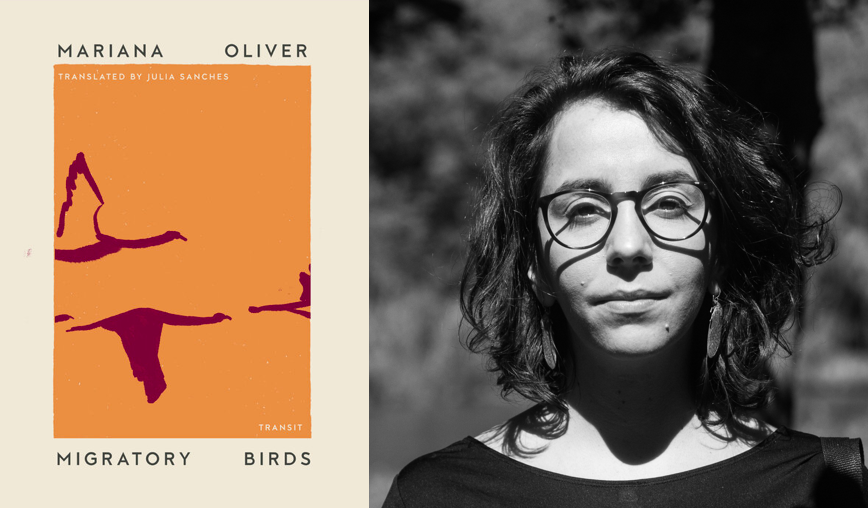
    Julia Sanches and Mariana Oliver’s Migratory Birds.

    In 2017, a podcast from Letras Libras, a literary magazine published in Mexico and Spain, aired the essay “Aves Migratorias” contemplating the journeys of Bill Lishman. In his homemade aircraft, the artist and aviator featured in the film Fly Away Home settled into a self-propelled seat in the sky to lead a migration of Canadian geese. New to Newport and scouting potential projects for translation, Julia Sanches listened to the segment in her apartment, enrapt as the author Mariana Oliver read her work: “Algunas veces, de manera inesperada, es posible anticipar fragmentos del futuro en un momento.” Sanches heard how the words might sound taking flight in another form: “Sometimes, out of the blue, you catch a glimpse of the future.”

    Born in São Paulo, Sanches moved to Manhattan when she was three months old on account of her father’s employment with a multinational corporation. From their apartment west of Central Park, Sanches’ mother walked with her through the American Museum of Natural History and the Metropolitan Museum of Art. She babbled with strangers on the city’s public transit, and often returned to the family’s rental unit having lost a shoe during her day’s outings. Her parents’ social circle centered around other Brazilians, and they returned to Brazil annually to visit family.

    When Sanches’ family moved to the suburbs of New Jersey, followed by New York’s Hudson Valley, her mother hesitated to welcome friends into their house. She heard Americans were litigious, and also worried she might serve her guests the wrong meal. When Sanches traveled to Brazil, her cousins called her “gringa” — foreigner. She would fall silent their first week back, then engage fluently in Portuguese. The inverse happened in Englsh upon returning to the U.S.

    When Sanches was eight, her family moved to Mexico City, where they lived for five years. The summer before September 11, 2001, they returned to New York’s Hudson Valley for “some consistency,” her parents said. After several months Sanches recalled as “not a fun time to be a foreigner in America,” her family relocated to Switzerland where she spent her teenage years.

    “I hadn’t stepped foot in Europe,” said Sanches. “I may have even confused it with Sweden for a while.”

    In high school, Sanches added French and Italian to her knowledge of English, Portuguese, and Spanish. After undergraduate studies at the University of Edinburgh in Scotland, she pursued a master’s degree in literature and translation at Universitat Pompeu Fabra in Barcelona where she picked up Catalan, the primary language of Catalonia, an autonomous community in Spain. As the country struggled with a years-long economic crisis, Sanches read young adult book manuscripts in English for a publishing house and wrote “reader’s reports” in Spanish for their eventual publication in Catalan. She then tried her lot with the publishing industry in New York. Moving to Brooklyn, Sanches stepped into a role as an assistant at the Wylie literary agency.

    Sanches hadn’t stepped foot in Rhode Island before she and her partner moved to Newport in 2017 when he accepted a role as an art conservator for a regional nonprofit. They found a more welcoming community in PVD, buoyed by the comfort of living in a city where nearly 44% of the population traces family origins to Central and South America. While focusing primarily on her literary translations, Sanches worked part-time at Riffraff, a bookstore and bar in Olneyville.

    After her introduction to Mariana Oliver’s writing through the Letras Libras podcast, Sanches tracked down her manuscript published by the Mexican Ministry of Culture as part of a project developed to support the country’s writers 35 years old and younger. Several U.S. literary journals turned down Sanches’ initial translation of the opening essay on Lishman’s aerial feat, but a friend and fellow translator Charlotte Whittle, who completed her master’s degree at Brown University, commissioned Sanches to translate another of Oliver’s essays for the online magazine Words Without Borders for an edition on the theme of “wandering and isolation.”

    In Oakland, California, co-founder of independent publisher Transit Books Adam Levy read Sanches’ translation in Words Without Borders. Levy and Sanches had overlapped briefly at the Wylie Agency, and he reached out to commission a complete translation of Oliver’s work. Throughout the process, Sanches and Oliver messaged almost daily on WhatsApp around editorial nuance. In one case, Sanches grappled with an excerpt where Oliver intentionally used Spanish words derived from Arabic origins like aceituna and naranja. Because the English equivalents of olive and orange stemmed from non-Arabic roots, she opted for apricot and tangerine instead. Oliver asked Sanches to leave a voice message reading the copy aloud, so she could compare the cadence of the language. In 2021, Transit published Migratory Birds

    On March 4, PEN America awarded Sanches its annual PEN Translation Prize for her rendering of Oliver’s work. The judges wrote: “Migration is as natural to humans as to so many species of birds, but we have never before read such a light yet profound illustration of this principle as in Migratory Birds, brought to new audiences in Sanches’ outstanding translation.”

    As the announcement took place at a ceremony in New York, Sanches was fast asleep late at night in Barcelona on a residency program in preparation for translating the 1977 novel El temps de les cireres by Montserrat Roig. Oliver live streamed the awards in Mexico, sending videos and messages of her celebration to Sanches as digital packets in flight across the Atlantic.

    “It’s possible that the reason I was so drawn to this book has to do with its expansive geography, and its mirroring of my own experience of the world, in a way,” said Sanches.

    “There is no place more like home for me than spaces of multiplicity and in-betweenness.”

    Julia Sanches’ translation of Mariana Oliver’s essay collection Migratory Birds was published by Transit Books.

  • The Power Wielded by Writers: Joanne Leedom-Ackerman on the fight for freedom of expression

    The Power Wielded by Writers: Joanne Leedom-Ackerman on the fight for freedom of expression

    After boarding a bus in Pakistan’s capital of Islamabad for a day trip to the ancient archeological site of Taxila with the nonprofit International Center for Journalists in 2013, I fell into easy conversation with my seatmate. A former member of the Brown University Board of Trustees, Joanne Leedom-Ackerman had long served on the boards of arts, journalism, and human rights organizations. As we trundled past colorful patterns and calligraphic adornments on cargo trucks likewise journeying along the national highway lined with jacaranda and cedar trees, Leedom-Ackerman reminisced about her own history advocating for freedom of expression.

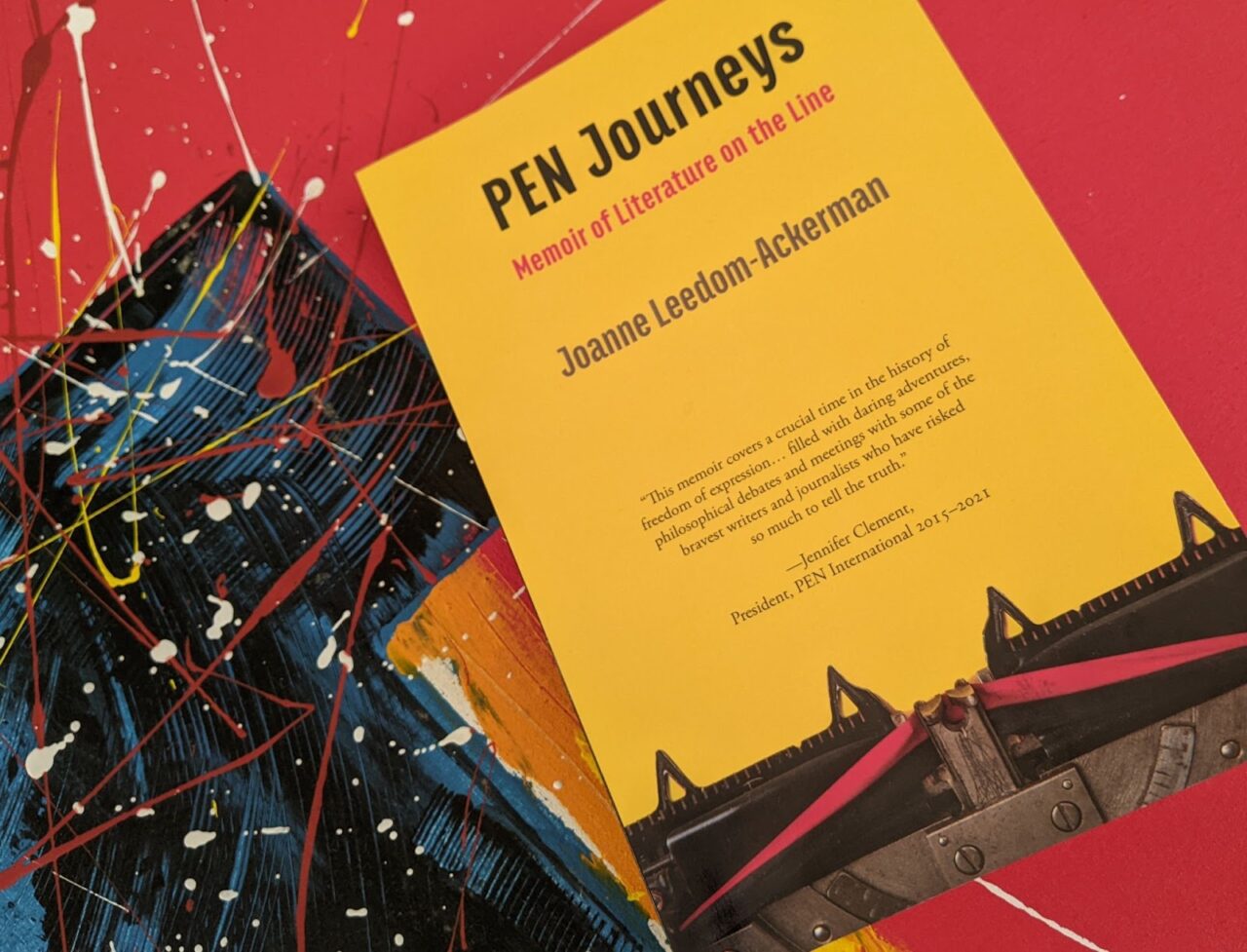
    As a vice president emeritus of PEN International, who previously chaired the organization’s committee for writers imprisoned around the world, she recalled certain high-profile campaigns: supporting Salman Rushdie in the wake of the 1989 fatwa calling for his death, defending Orhan Pamuk against criminal charges after referring to the Armenian genocide, and calling for justice following the assassination of Russian journalist Anna Politkovskaya. In a new memoir, PEN Journeys: Memoir of Literature on the Line, published by the British poetry house Shearsman Books, Leedom-Ackerman sets these chilling attempts to suppress literary and media freedoms alongside the inner-workings of PEN’s branches in more than 100 countries.

    During a virtual event hosted by the International Center for Journalists to celebrate Leedom-Ackerman’s book release, the author Salil Tripathi referenced the murder of Wall Street Journal correspondent Daniel Pearl in Pakistan twenty years ago as a horrifying turning point in the curtailment of free expression through an escalated and targeted use of violence. But beyond foreign correspondents, the writers most often confronting threats to their lives and livelihoods locally in Pakistan are those writing for their audience in Punjabi, Pashto, Urdu and other regional languages. The same holds true around the world, from the ongoing detention of poets and novelists, to harassment and sexual violence against women writers in particular.

    PEN Journeys reinforces the sobering reminder that for every story of successful advocacy, there are far more failures — and all the more reason to share their words, in both the original and in translation. As for the power still wielded by writers imprisoned, in exile, in need of refuge, or otherwise at risk, Leedom-Ackerman summons the Russian poet Osip Mandelstam:

    You took away all the oceans and all the room.

    You gave me my shoe-size with bars around it.

    Where did it get you? Nowhere.

    You left me my lips, and they shape words, even in silence.

    Joanne Leedom-Ackerman’s memoir PEN Journeys: Memoir of Literature on the Line was published in 2022 by Shearsman Books.

  • Experimental Compositions: The illusion and immersion of Happy Place

    Experimental Compositions: The illusion and immersion of Happy Place

    (Happy Place: Dan Lippel (guitar), Andrew Smiley (guitar), Will Mason (drums), Kate Gentile (drums), Gelsey Bell (vocals), Charlotte Mundy (vocals); photo credit: Bryan Sargent)

    As late January’s nor’easter dropped nearly two feet of snow in Tiverton, Will Mason prepared for his students’ return to in-person classes following extra Omicron precautions. After a week of slow snowmelt, heavy rains gave way to a flash freeze. When Mason stepped outside on Saturday morning for a walk with his dog, he described the ice-encrusted environment as a “juxtaposition of motion and stillness, force and resistance.” Mason listened to the wind. With a mild apology for departing from his postmodern milieu, he recalled a poem by Wallace Stevens:

    For the listener, who listens in the snow,

    And, nothing himself, beholds

    Nothing that is not there and the nothing that is.

    An assistant professor of music technology and theory at Wheaton College in Norton, Mass., Mason advises his students that “interesting music is made by interesting people.” Encouraging them to cultivate different sources of inspiration, he argues that a film or a book, or a walk around a city or on a rural trail, could subsequently manifest in art as much as hours in the thrall of the composers he teaches most often: Johann Sebastian Bach and Duke Ellington.

    “I try to have it feel like an experimentation sandbox and less like a math class,” said Mason.

    During a childhood day trip to Boston from his hometown of Falmouth, Maine, Mason slipped from his seat at the Museum of Science’s Mugar Omni Theater during an immersive panorama – the scenes and sounds triggering an involuntary perception of action rather than observation. In high school, he drove around Portland’s suburbs lost in the counterintuitive time signatures of the drums on Radiohead’s albums, Kid A and Amnesiac. As an undergraduate studying political science and contemporary improvisation at Oberlin College, a liberal arts school and musical conservancy 30 miles west of Cleveland, Mason discovered a vast world in the avant-garde.

    Having recorded and toured with Like Bells, instrumentalists in the footsteps of Do Make Say Think, Mason moved to New York for a PhD program in music theory at Columbia University. While living in the East Village of Manhattan, he suffered a sudden inability to sleep, explaining in an essay: “it was a watershed year in both my academic and musical life and I couldn’t shut my mind off at the end of the day, and irritation at being unable to sleep only compounded the situation.” Mason’s struggles with insomnia and anxiety led to hallucinations, and new ideas.

    “I spent a lot of nights sitting at my kitchen counter sketching music,” said Mason. “In general I became fascinated with the ways that exceptional or aberrant psychological states have contributed to various musical traditions across the globe and across history.”

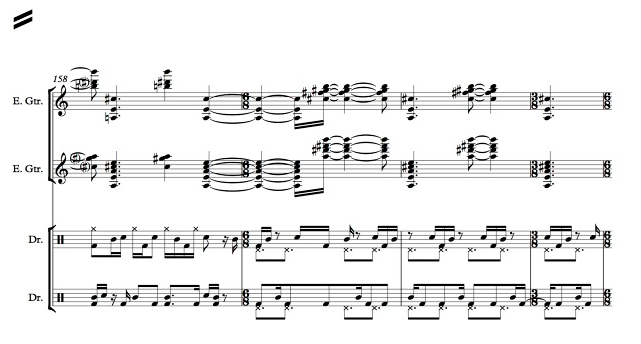
    While Mason mitigated his risk of psychoses with treatment, the drafts he composed during what he considers “a kind of productive isolation” laid the framework for a two-drum, two-guitar avant-rock project, Happy Place, named with an ironic nod to its bleak origins. After the 2016 release of Northfield, the four-piece welcomed sopranos Elaine Lachica and Charlotte Mundy. The sextet mixed its 2020 album, tendrils, at Machines with Magnets in Pawtucket. The vocals, Mason said, contrast with “lower, crunchy guitars” and the “low end heft” of distorted drums.

    With the instrumentation of Northfield’s “Rapture!,” which threatens like the brooding swarm of Isis’ The Mosquito Control EP, Mason sought to telegraph feelings of both anguish and ascendance.

    Dissonant and disconcerting, Happy Place’s albums imbue the forceful quirk of Shellac and Don Caballero with the spirit of Sun Ra. Released by the independent label Exit Stencil Recordings, both Northfield and tendrils could be at home in the older catalogs of Southern and Touch & Go Records. The band’s artistry fits as much in a time machine to the warehouse shows of Fort Thunder as in a black box theater on campus at Berklee College of Music.

    After moving to RI for the position at Wheaton, Mason anticipated performing live, but the pandemic put those intentions on hold. Around classes, he began to adapt his dissertation into a book on the illusory feelings conjured by “human-machine couplings in the studio” – the tools used to make modern music. He wrote new compositions from his parents’ home on the island of Vinalhaven, Maine, and sought inspiration on woodland walks in neighboring Little Compton.

    As well as listening to “the junipers shagged with ice, / The spruces rough in the distant glitter” on a snowy day with Wallace Stevens, Mason returns to John Cage’s lectures on silence and the Alaskan journals of John Luther Adams. Crediting composer Pauline Oliveros, Adams reflected, “These days, most of us are inundated with music and other sounds. I feel very fortunate to live in a place where silence endures as a pervasive, enveloping presence.”

    “Doing and knowing are inseparable,” said Mason. “I try to keep things very hands-on.”

    Happy Place makes its RI debut with Brooklyn-based free-jazz player Ned Rothenberg at The Columbus Theatre, 270 Broadway, PVD on Sat, Mar 12. Doors 7pm. Show 8pm. All ages. $15 (at press time). Proof of full COVID-19 vaccination required.

  • The Nature We Build Around Us: A conversation with Connor Burbridge of Nuts & Bolts Nursery Co-op

    The Nature We Build Around Us: A conversation with Connor Burbridge of Nuts & Bolts Nursery Co-op

    (image source: Nuts & Bolts Nursery Co-op)

    With hopes that March melts February’s freeze and April’s showers again bring May flowers, Motif’s Sean Carlson interviewed Connor Burbridge of Nuts & Bolts Nursery (374 Farnum Pike, Smithfield), a cooperative housed at the permaculture nonprofit Revive the Roots. Opened in 2021 as a worker-owned nursery specializing in edible perennial plants, Nuts & Bolts is working to build an alternative food system that combats climate change, increases biodiversity, and promotes social and economic equity. Before getting your hands dirty with yardwork this spring or wiping them clean of responsibility, review the University of Rhode Island’s searchable guide to locally native plants and the small, sustainable steps to take in your own neighborhood

    Sean Carlson (Motif): It can be easy to think of “nature” as a defined place like a park or preserve, a destination within set borders. How should we consider this concept?

    CB: The funny thing about nature is that it reinforces this idea that it’s separate from us, or that we’re above it. But humans have shaped the world for more than 200 thousand years. Even today, parks and forests are usually heavily managed by government agencies. Nature is the world we build around us, whether cities made of concrete and metal or neighborhoods full of trees and soil. There are complex interactions between rural areas, suburbs, and cities, with a flow of people, goods, and raw materials going back and forth between them all. We should choose and shape what nature we live in, and our co-op chooses to work towards one of biodiversity, sustainability, and equality.

    SC: What would you suggest to those who’d say they aren’t gardeners or naturalists?

    CB: There’s nothing wrong with starting small, experimenting, and making mistakes. Everything is a learning process. Start on a smaller scale with lower maintenance plants, like mint or basil in a planter, and get to know how to identify and use some common edible “weeds,” like dandelion or mulberry. Ask questions of other gardeners or growers and maybe check out events or workdays at a local community garden. One secret is that a lot of plants die, even for the best gardener or farmer. It’s okay if your plants don’t end up producing vegetables. It’s okay if you get too busy and your garden turns to weeds. Keep trying. Eventually, you’ll learn to be a better observer and let the plants teach you. There are many ways to grow. You will find edible and useful plants everywhere. Maybe there’s something growing in your local park that you won’t know is useful until you start gardening and paying attention to the ecosystem.

    SC: For reasons of cost and convenience, many readers will turn to larger retailers for gardening supplies. How can they leave the best possible footprint?

    CB: There are many incredible local nurseries and plant centers across our state, and I hope that people will give them a chance. Our nursery in Smithfield, for example, is small but we are deeply rooted in the community and support local grassroots projects. We will help people with whatever they’re dreaming up for their backyard food forests or however they’re hoping to experiment. Even if people think they don’t have a green thumb, we will be sure to get them started with the right edible plant. We want to see people growing food because it’s good for their health, their happiness, and their families. Grow food. Make art. Our belief is that we can build a regenerative culture and a caring community in the face of climate change. You won’t get all that at Home Depot.

    SC: The concept of nativism is commonly associated with policies against immigration. Do you ever worry about the language of native plants and invasive species?

    CB: An important thing to consider around native plants is that first we are on native land. Calls to restore historical plants to an ecosystem without addressing the issue of Indigenous people’s rights to their ancestral homelands is a deep injustice. The Indigenous people of the northeast woodlands had, and still have, incredibly complex systems for managing whole forests and rivers by understanding the connections within an ecosystem. Now, people can identify more corporate logos than they can plants, so part of the problem around invasives stems from a lack of awareness and poor ecosystem management practices. If we listened to Indigenous people, our perspectives would be different, the solutions would be more nuanced, and we would better recognize the relationship between environmental issues and social injustice.

    SC: How can more mindful stewardship of the land outside our doorsteps help us all?

    CB: Ultimately, everyone comes from a family and culture that at one time or another was based around farming and living in connection to the land. People might be 100 years removed from that culture but that connection is still there. Gardening and growing food can actually teach you so much about yourself and the world around you. In Farming While Black, a book reflecting on the experiences of Soul Fire Farm in Petersburg, NY, author Leah Penniman writes about the importance of connecting to your ancestral traditions through food and farming. This is important work for us white folks as well. Throughout history, many European farming peoples were kicked off their lands and forced to move into crowded cities. Part of the work to heal the wounds of white supremacy in particular is to rebuild these cultural connections to the environment and food, and address the harms done to ecosystems and cultures around the world.

  • Vocalizing Grief: Dr. Jones heals while experimenting with Hawthorn

    Vocalizing Grief: Dr. Jones heals while experimenting with Hawthorn

    Kate Jones, recording as Dr. Jones; photo credit: Ryan Lopes and Leiyana Simone

    While working as a nanny in Los Angeles, Kate Jones joined a drop-in chorus. She had sung in school choirs while growing up in Rhode Island and Vermont, but her newfound community traded hymns for harmonies of “No Hate, No Fear,” and choral covers of Bauhaus and OutKast. Founded to resist the fatigue of recurring protests, the group replaced rally shouts with shared song. Jones was unable to attend the political demonstrations but found similar sentiments performing at other local events, including at UCLA’s Hammer Museum of contemporary art.

    Adept with a vocal range that extended from choir to a cappella and from folk to pop, Jones wrote her own music on a keyboard, guitar and ukulele in her East Hollywood apartment, but couldn’t remember screaming since childhood. At 9, Jones lost her mother to breast cancer. More than a decade later, three months after Jones graduated from Providence College, her father passed away from esophageal cancer. Silent sorrows knotted into frustration and shame.

    “I had this sort of spiritual, but also very childlike, view of death,” said Jones. “I was always really comfortable talking about my parents and my loss and my grief in a really matter-of-fact way, but extremely uncomfortable in actually being able to allow myself to feel it or express it.”

    Under the name of Dr. Jones — believing in the healing quality of music in general, and the voice in particular — in 2017 Jones released Thundercloud Plum. The six-song EP vacillates from the robust Q Division-engineered “Gold & In Style” to a banjo- and synth-laden rendition of “Gloria in Excelsis Deo” to raw cuts recorded by mobile phone. Since returning to Providence in 2019, Jones has collaborated with Laila Aukee on Hawthorn, a full-length in progress named after the herb traditionally used for cardiovascular support. With echoes of Markéta Irglová and the XX, Jones’s latest single “What is Happening” surfaces her struggles with relearning to cry.

    “It felt like this revelation that I was almost embarrassed by,” said Jones, “that I had made such a big deal out of these things I felt like I couldn’t do that are supposed to be natural and seem so easy to so many people.”

    In her previous bands the Sugar Honey Iced Tea, Dr. Jones & the Shiners, Hott Boyz, and the Tequikees, Jones’s vocals stretched across musical landscapes, from bluegrass to psychedelic to classic R&B. With a poppier yet grounded touch to her first two singles from Hawthorn, Dr. Jones draws from the breakthroughs she found in therapy, herbalism, collective chorus and dance aerobics — “fiercely non-competitive,” she said — to give form to feelings. 

    “Songwriting and singing has always been a way for me to unload and work through some of my own pain and grief,” said Jones. “Perhaps mine can also have its little place in the larger spectrum of that musical body, that allows for healing to take place.”

    Dr. Jones, Host, and Grace Ward play The Columbus Theatre, 270 Broadway, Providence on Tue, March 1. Doors at 7pm. Show at 8pm. All ages. $10. Proof of full COVID-19 vaccination required.

  • The Gems of August Wilson: A conversation with Michelle Cruz of Trinity Rep

    The Gems of August Wilson: A conversation with Michelle Cruz of Trinity Rep

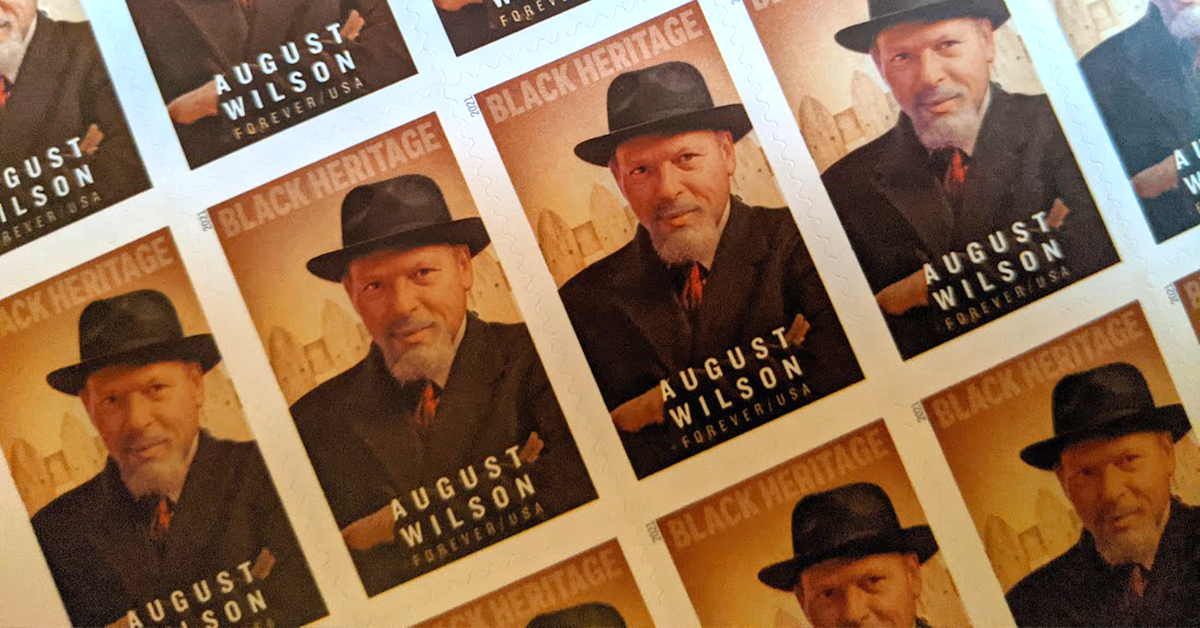
    In 1987, when August Wilson’s Fences received the Pulitzer Prize for Drama, the Providence Journal’s arts critic William Gale hailed the Pittsburgh playwright: “His plays leap from his own gut. They’re about things that really count — family relationships, the Black experience in America — and they have many colors, a multitude of themes, great seriousness along with humor and gusto. They strike where you live.” 

    Later that year, Trinity Repertory Company brought Wilson’s work to Providence. From its 1987 production of Ma Rainey’s Black Bottom set in a studio with the eponymous blues legend to Radio Golf in 2020 charting an aspiring politician’s attempt to reconcile community interests with urban development, Trinity Rep has cycled through the struggles Wilson wrote of in the 20th century. (The Providence Black Repertory Company, a now-defunct nonprofit that spun out from acting workshops at AS220, staged Fences in 2001, as did the Mixed Magic Theatre in Pawtucket in 2013.) With Gem of the Ocean opening at Trinity Rep on Feb 24, Motif’s Sean Carlson interviewed the director of community engagement Michelle Cruz about how Wilson’s words continue to strike.

    Sean Carlson (Motif): This year marks the 40th anniversary of the first production of Jitney – and 35 years since the first Trinity Rep production of Wilson’s work. Why do his plays continue to resonate?

    Michelle Cruz: In many ways, we harken back to whether Black Americans would have been better to stay in the South. Time and time again, we’re faced with this question in his characters — some of whom we see grow older and whose future generations of family we meet – and wonder, are they truly faring better? Was the Great Migration that great? What have generations of residents gone through with redlining and unfair housing practices? What has that lack of opportunity done to the possibility of generational wealth? Whether here in Providence or Wilson’s Pittsburgh, parallels unfortunately remain.

    SC: The last show Trinity Rep staged before COVID-19 was Radio Golf. With Gem of the Ocean now opening, it’s like Wilson bookends a period that has pulled on these threads of family and community.

    MC: More eyes have opened to the disparities Wilson explores, absolutely in minority families but also those who have, all of a sudden, found themselves in a place of hopelessness and restlessness.

    Christopher Lindsay and Ricardo Pitts-Wiley star as Citizen Barlow and Solly Two-Kings respectively in Trinity Rep’s 2022 production of August Wilson’s Gem of the Ocean

    SC: For more than a year, you’ve led an August Wilson reading group. How did the program start?

    MC: “10 Weeks with August Wilson” began with a personal goal. Months into the pandemic, I decided to escape into the Century Cycle of Wilson’s plays. At Trinity Rep, we were trying to connect with our audiences virtually. I mentioned my goal, and our education director thought we could get folks to delve into Wilson. Our class sold out in a day. Attendees love being placed in these decades. We have people from Sri Lanka, New Zealand, and of course locals of all ages, from a board member to a father and daughter who bonded by reading Wilson in what has otherwise been an isolating time. [Ed. note: Trinity Rep’s next class on Wilson’s work begins Feb. 26, with registration currently open.]

    SC: The Netflix release of Ma Rainey’s Black Bottom as a feature film last year includes an astounding performance by Viola Davis as the eponymous blues singer. Davis grew up in Central Falls and graduated from Rhode Island College. She debuted on Broadway in a 1996 run of Wilson’s Seven Guitars. How have you seen Davis’s talent and trajectory inspire others locally?

    MC: She’s an absolute inspiration to many, whether interested in acting or not. Representation matters: The sheer presence of someone who looks like you can plant that seed to strive for more. I remember the Adams Central Library in Central Falls showing the film Fences and walking toward a nearby street, Viola Davis Way, and feeling a huge sense of pride. Ma Rainey is such a needed story to tell, for what was going on with race in the recording industry, the theft of Black music, and her struggles as a woman in the business. Actors are storytellers and Davis’ story is powerful – for students, other actors and our community.

    SC: What’s on your mind as you prepare for Gem of the Ocean to open at Trinity Rep?

    MC: Gem of the Ocean is a lyrical masterpiece of myth and history. W.E.B. DuBois spoke to the notion of developing Black theater that was “by us, for us, near us and about us.” Years later, in his speech, “The Ground on Which I Stand,” Wilson reminds us of the connections of Black theater to its origins on the slave plantations of the South, either as forced entertainment for slaveowners and guests or as an investment in a tradition of the arts for spiritual survival, in the spirit of their ancestors.

    SC: For readers unfamiliar with Wilson, where should they begin? 

    MC: With the man himself. Read Wilson’s autobiographical How I Learned What I Learned. He shares inspirations for his characters and tells us about his life, including quitting school after a plagiarism accusation because a paper he wrote was “too good” and spending his days at the Carnegie Library instead. Walk in his footsteps. Sit with him listening to neighbors at local diners. Then, delve into his Century Cycle masterpieces chronologically, decade by decade. It’s a journey and time well spent.

  • From Isolation to Consolation: The pandemic recordings of David Summit

    From Isolation to Consolation: The pandemic recordings of David Summit

    Personal Summit (Source: David Summit)

    In the singer-songwriter tradition, the Earth’s elevation often stands as a measure of life’s ups and downs. Merle Haggard was always on a mountain (when he fell). While Burl Ives left a legacy down in the valley, Johnny Cash looked for the man on the hill and Dolly Parton found comfort in her Tennessee mountain home. More recently, Iron & Wine went upward over the mountain, Dom Flemons went backward up another one, and Conor Oberst looked inward from a peak he saw as upside-down. In a state known better for its sea level than its great heights, David Summit began to chart his musical ascent from a low point in a Rhode Island attic.

    A former guitarist in Trophy Wives, a pop-punk band that played several dates on the 2015 Vans Warped Tour, Summit was in his final year at Rhode Island College studying classical guitar and music education when he suffered a concussion. The impact of his injury left Summit feeling like a different person, he said, and created a sense of distance from family and friends. In solitude beneath the eaves of the roof at his Warwick home, he wrote musical arrangements and lyrical accompaniments over a period of ten months, between November 2017 and July 2018. 

    “It was a lonely time in which I spent traveling inward to dark places of my being, and allowing that dark part to speak and do the writing,” said Summit.

    After emerging from reclusivity, Summit has released his debut, Our June, Us All, in 2019. The solitary accomplishment swirls with the layers of an ensemble, borrowing across genres to deliver a despairing yet spirited album with a poetry and musicality that shifts between sparing and soaring. In the wake of his seclusion, Summit said he found community at a regular open mic night for writers, musicians, and other artists at Twenty Stories bookstore (107 Ives St., Providence). He asked his new friends to contribute their own touches to his followup album — “a sort of artifact of our meeting,” he said. In all, sixteen collaborators contributed vocals or instruments in sessions recorded mostly as a series of live performances, without cuts or edits.

    “I don’t really trust art that isn’t raw,” said Summit. “Art can be sold, but art isn’t selling anything.”

    The resulting record, In All My Travelin’, reveals a more vibrant, optimistic side of Summit, anchored by a toe-tapping, harmonica-driven rhythm and a busker’s knack for storytelling. Released on March 28, 2020, less than three weeks after Providence venues shuttered due to Covid-19, Summit shifted his record release party from AS220 to an Instagram livestream.

    “I do find it ominously ironic that it was released during such a dark time in which traveling is not only limited, but restricted,” said Summit while abiding by the state’s shelter-in-place order.

    On the heels of Travelin’, Summit released four more albums since the beginning of the pandemic. All In or Nothing collects the folksy B-sides left over from the Twenty Stories sessions. Only Joy, recorded with an artist identified as Lillian Rose, serves as an acoustic act of adoration for Summit’s infant daughter that doubles as a soundtrack to a film of family footage. Even Split, which Summit describes as a “pretty sorrowful” album and “the ‘looking in’ to Travelin’s ‘looking out,’” opens a richer window on his internal state, with glimmers of possibility still peeking through. In early October, on Summit’s 28th birthday, he released Red Fox at the Whippoorwill, his first collection of covers, steering from Bob Dylan to Blind Pilot.

    While Whipporwill is titled in reference to the motel cabin in Lake George, N.Y., where Summit recorded the tracks, it also borrows from his closing rendition of Hank Williams: “Hear that lonesome whippoorwill / He sounds too blue to fly.” Stepping into his choice of covers with the comfort of a worn coat, Summit unfolds the rises and falls of others with his own touch. Playing John Prine, he reflects, “Hey, how lucky can one man get.” And like Don Williams and Jason Molina of Songs: Ohia before him, Summit excavates ground trodden by Townes Van Zandt to dwell in a state against which “All the mountains and the rivers / And the valleys can’t compare.”

    “I am continuing to work on new projects all of the time,” said Summit. “I’m looking forward to seeing what opportunities open up as the world does.”

    The recordings of David Summit: Our June, Us All (2019), In All My Travelin’ (2020), All In or Nothing (2020), Only Joy (2021), Even Split (2021), Red Fox at the Whippoorwill (2021).

  • Crushing Metal: Burr Buzzes Alongside Don’t Grow Old

    Crushing Metal: Burr Buzzes Alongside Don’t Grow Old

    Nefarious Industries serves up a new pairing with Burr and Don’t Grow Old 

    Casey Belisle, Mike Dantowitz, and Justin Enis (L to R) of the band Burr and Providence coffee roaster Bolt (photo credit: Burr)

    Long used for pulverizing minerals, the burr mill transformed food production by improving the consistency of ground grains, corn, and coffee. At Bolt Coffee’s Providence flagship (61 Washington St.), barista Casey Belisle, assistant roaster Mike Dantowitz, and coffee director Justin Enis wield a Mythos grinder manufactured by Nuova Simonelli for espresso and an EK43 from Mahlkonig for filtered coffee. The motorized models replicate the mechanics of a handheld salt or pepper mill, crushing beans into the grinds that — with the ratio of water, its temperature, and brew time — define the flavor profile of a cup of coffee. Too fine of a grind increases the likelihood of a sludgier or bitter taste, whereas too coarse of a grind can contribute to a weak or watery brew. On the sound system at Bolt’s roastery (96 Calverey St.), Belisle, Dantowitz, and Enis share an appreciation for heavier, slower grinds, like the sounds of Electric Wizard, Thou, and Yob. With a nod to their trade, they apply a similar precision to metal with their band, Burr.

    Founded in 2017, Burr, the band, started out as an afterwork jam session at Belisle’s studio space in Central Falls. 

    “We got the name Burr by trying to find a coffee term that sounded like a doom name,” said Enis. “We love our burr grinders and their ability to create a more narrow ‘particle distribution’ allowing the brewer to achieve a higher extraction with more sweetness when dialed in.”

    Dantowitz played guitar in Tape Eater and other New Bedford punk and hardcore bands, Belisle set the drumbeat for the quirky mathrock of 14foot1 and lighter projects like Roz and the Rice Cakes, and Enis entered the University of Rhode Island as a jazz bass major and went on to make up half of the duo SONGS. After two years playing together as Burr, on the eve of Thanksgiving in 2019, they released their debut, Radial Alignment, on Bandcamp. With tracks like “Touch of Cream” and “Spent Grounds” teasing their careers in coffee, the band’s heaving instrumentals conjured raw notes of Pelican and Russian Circles. The Covid-19 landscape introduced a more serious edge to their songwriting. Six months into the throes of the pandemic, Burr returned to Big Nice Studio (25 Carrington St., Lincoln) where audio engineer Bradford Krieger refined a punishing single. Their latest release, a six-minute dirge on a split 7” with Don’t Grow Old, is now available from Philadelphia-based label, Nefarious Industries.

    “We all were feeling tired, angry, anxious, frustrated, scared—” said Enis. “We hope that listeners can feel the trough of the pandemic and social issues in ‘Particle Distribution.’”

    While Burr whirs through a penetrating doom, New Bedford’s Don’t Grow Old sound like they grew up on the blistering constraint of Botch and Jane Doe-era Converge. 
    The idea for the joint project emerged after the bands shared a bill in New Bedford. A follow-up date at AS220 (115 Empire St., Providence) with Losst and Cyttorak fell victim to Covid-19 cancellations, but on October 16th the bands reunited for their record release party at ​​the Paradise McFee Gallery (104 William St, New Bedford). The following Monday morning, the members of Burr were back to the grind at Bolt.

    Limited Edition Double Band Pairing

    Burr and Don’t Grow Old’s split 7” is available as a limited release from Nefarious Industries 

  • Our State of Public Health: A narrative beyond the pandemic

    Our State of Public Health: A narrative beyond the pandemic

    On the morning of February 28, 2020, a day before the first confirmed COVID-19 case in Rhode Island, the Block Island Chamber of Commerce promoted the island’s largest rental property as a destination for family vacations, retreats, reunions and weddings. Featuring 12 bedrooms and 11.5 bathrooms, Hygeia House was built during the Gilded Age and run by a doctor-cum-hotelier who used the building for a period to house his medical office. He promoted “a salubrious island getaway, where sea breezes, fresh water and clean air would restore health.”

    The name of the one-time hotel conjures an ancient character: Hygieia, the goddess of cleanliness and self-care in Greek and Roman myth. Today, her legacy lingers in language and in symbol, and not only on Block Island. In Athens, a shrine in her name sits within the Acropolis. In Rome, her statue stands with a wreath of laurel at the Trevi Fountain. In Providence, she kneels chiseled into the seal arched above the central window of the former home of the Rhode Island Medical Society, across from the State House.

    Dr. Newell Warde, executive director of the Rhode Island Medical Society, said the symbolism of Hygieia could be seen as a shift from emphasizing treatment to prioritizing prevention and public health.

    At a briefing on Capitol Hill that afternoon, Dr. Nicole Alexander-Scott, the director of the Rhode Island Department of Health, awaited the COVID test results of students and faculty from Saint Raphael Academy in Pawtucket who had returned from a winter break touring from Milan to Barcelona by way of the French Riviera. In the meantime, and in line with the World Health Organization, she encouraged the practice of good hygiene — advice harkening back to its namesake Hygieia and the art of health.

    Since the first confirmed cases traced to the Pawtucket high school’s European trip, COVID has infected at least one in seven Rhode Island residents. Of the more than 3 million dead worldwide, nearly 2,700 people locally have lost their lives. But statistics alone can’t measure the physical and emotional tolls, and while no community has been spared, the distribution of suffering mirrors longstanding inequalities. 

    Sustained health inequalities, in terms of both access and outcomes, gave way to the language of “health equity” among policy makers. In 1990, U.S. Senator Claiborne Pell of Rhode Island co-sponsored Senator Barbara Mikulski’s bill, the Women’s Health Equity Act, to coordinate initiatives “relating to disease, disorders, or other health conditions that are unique to, more prevalent in, or more serious for women, or for which risk factors or interventions are different for women.” The bill didn’t move forward. In 1993, U.S. Senator John H. Chafee of Rhode Island proposed the Health Equity and Access Reform Today Act, shortened to the HEART Act, as a bipartisan proposal for universal health insurance. It, too, proved unsuccessful.

    Across the Atlantic, England introduced a framework of Health Action Zones to spur investment in areas with high rates of “social exclusion.” A US proposal to define similar Health Opportunity Zones across the country failed to gain enough support, but while it was under consideration the CDC collaborated with other federal agencies to convene its inaugural Weight of the Nation conference to minimize the health risks resulting from obesity rates. During opening remarks, Dr. Thomas R. Frieden, director of the Centers for Disease Control and Prevention (CDC), introduced a pyramid for understanding and improving public health. At the foundation of his framework, the most influential factors were socioeconomic: poverty, education, housing and inequality.

    The “Health Impact Pyramid” model resonated with a representative in attendance from Rhode Island. And in 2012, the state health department’s division of community, family health and equity introduced its own version. Three years later, with $2.15 million in funding from the CDC, Rhode Island defined 10 urban and rural areas as Health Equity Zones (now 11), allowing nonprofits and local governments to qualify for financial support to develop “innovative approaches to preventing chronic diseases, improve birth outcomes and improve the social and environmental conditions of our neighborhoods.”

    Announced by the Rhode Island Department of Health two months before her confirmation as director, the responsibility for the implementation of Health Equity Zones fell to Alexander-Scott. Growing up in Brooklyn, Alexander-Scott witnessed neighborhoods with shifting demographics — and their influence on the state of public health. By the time Alexander-Scott turned 5, the borough’s population had shrunk by 14%, losing more than 650,000 white residents and gaining 66,000 Black residents within the span of a decade.

    Alexander-Scott attended St. Saviour High School, a Catholic all-girls college preparatory school in the neighborhood of Park Slope. She co-captained her varsity basketball team, played varsity volleyball, served in student government, and participated in math league, mock trial and the earth club. She made National Honor Society and the Société Honoraire de Français. 

    “I remember her at the altar,” said Rita Draghi, an art teacher at St. Saviour. “She reminded me of a queen. At such a young age, she was so full of poise and confidence. I knew she would go far.”

    At Cornell University, Alexander-Scott majored in human development and family studies. On the Dean’s List, she also worked for a summer in AIDS advocacy in the Bronx and witnessed the university grapple with the fifth on-campus suicide of a student in a span of four years. Following in her mother’s footsteps, who was a nurse, Alexander-Scott attended medical school at SUNY Upstate Medical University in Syracuse, an hour north of her alma mater. There, she received the James L. Potts Award in honor of a doctor who helped develop Upstate as one of the country’s first programs to increase the opportunities for historically underrepresented students in the field of medicine. She began her residency at Stony Brook University Hospital on Long Island weeks before September 11, 2001.

    Alexander-Scott arrived in Providence in 2005, during the city’s hottest summer on record. A fellowship placed her for two years in the pediatric departments of the Alpert Medical School and at Hasbro Children’s Hospital followed by a rotation in adult medicine at hospitals affiliated with Brown University. She traveled to Kenya and South Africa on medical missions, and moderated a conference on disparate healthcare issues for people of color in Rhode Island. Her first contribution to a medical journal detailed a local outbreak of an atypical form of bacterial pneumonia. Although the infection was found at school, she concluded “interrupting household transmission should be a priority during future outbreaks.”

    As Rhode Island’s economy and employment buckled following the Great Recession, Alexander-Scott taught at Brown, served as a physician at multiple hospitals, and consulted with the Rhode Island Department of Health’s division of community, family health and equity. She first stepped into the public eye when defending Rhode Island’s shift in policy to move HIV testing from opt-in to opt-out. As a physician tending to infectious diseases, she witnessed the H1N1 swine flu pandemic. She also started her Master of Public Health degree at Brown.

    “She always challenged me to look outside the medical room we were in and think about how we could best serve patients in their everyday environment,” said Dr. Sando Ojukwu, an attending physician at the Children’s Hospital of Philadelphia, whom Alexander-Scott mentored at Brown’s Alpert Medical School.

    In October 2014, Dr. Alexander-Scott provided public briefings on Ebola while then-director of the health department, Dr. Michael Fine, led the state’s response, including addressing Rhode Island’s Liberian community to ask for help in sharing health advice even as they worried and mourned for loved ones as the epidemic swelled in West Africa.

    “Health is not possible without community,” Fine said in a statement introducing Health Equity Zones.

    When Alexander-Scott stepped into her role as director of the Rhode Island Department of Health in May 2015, she inherited a budget for the fiscal year of almost $126 million and responsibility for nearly 500 full-time employees. Only 18% of the department’s budget came from the general fund allocated by Rhode Island’s elected officials. More than half came from federal government sources. Programs involving family and community health and equity accounted for 57% of the annual budget, an annual increase of 27%, broken out across health disparities, healthy homes and environments, chronic care and disease management, health promotion, preventative services, and perinatal and early childhood health. 

    A sold-out Health Equity Summit hosted more than 300 attendees representing “every aspect of the determinants of health,” Alexander-Scott said in a video. In a Providence Journal op-ed, she championed the implementation of Health Equity Zones, writing “regardless of where we live, the costs of disparities are felt throughout our state.” She cited racial, economic and educational gaps in health: Black infants in Rhode Island were twice as likely to die before their first birthday than white infants, and residents without a high school diploma were twice as likely to smoke cigarettes than college graduates.

    “Your ZIP code should not determine your life expectancy,” Alexander-Scott told the Rhode Island Health Center Association annual meeting during her first year, repeating a refrain spoken by others before her.

    A 2018 health department brochure highlighted examples of “immediate impact” in the communities designated as Health Equity Zones, including training in mental health first aid and suicide prevention in Washington County, the passage of a cigarette and vaping ban in Bristol’s town parks, and a “Walking School Bus” program to improve elementary school attendance in the Providence neighborhood of Olneyville. A 2019 factsheet credits the model with contributing to a 44% decrease in childhood lead poisoning in Pawtucket, a 24% decrease in teen pregnancy in Central Falls, and 46 people in West Warwick diverted from the criminal justice system to receive opioid treatment. Amidst the COVID pandemic, Health Equity Zones informed community testing, education and vaccination programs, including the distribution of 400,000 surgical masks. And for 2021, the health department solicited proposals from municipalities and organizations in 15 additional communities to establish new Health Equity Zones with grants starting at $150,000 for infrastructure and $50,000 for capacity building.

    But not all tides have lifted in the Ocean State. Since 1995, the percentage of adults with diabetes grew from 4.6% to 10.8% — affecting those without a high school diploma three times more than those with a university degree. United Health Foundation placed Rhode Island as the least healthy state in the country in measures of housing and transit. The age of housing in Rhode Island left 31% of homes with the potential of elevated lead risk, the second highest after New York. In 2019, the health department found that only 20% of the physical spaces licensed for infant and toddler care met its definition of quality, with 18 of the state’s 39 municipalities altogether lacking any quality care.

    Since Alexander-Scott’s column in The Providence Journal, the racial gap in infant mortality she cited has more than doubled: The latest state data found Black infants in Rhode Island were 4.2 times more likely to die in their first year of life than white infants. In response, the health department convened an advisory group. The educational gap in smoking rates also doubled: In 2019, 5.4% of Rhode Islanders with a college degree smoked while the number climbed to 21.9% among those who didn’t complete high school.

    Despite a vision that “all people in Rhode Island will have the opportunity to live a safe and healthy life in a safe and healthy community,” even before COVID the health department noted that “for the first time in modern years the current generation of children may have a shorter life expectancy than their parents.”

    The current pandemic revealed how better public health could minimize individual harm. A draft of the state’s vaccination rollout cited estimates that accounted for Rhode Islanders living with high blood pressure, 10% with asthma, 9% with diabetes and 6% with heart disease — conditions that could benefit from testing, data reporting and prevention efforts refined during COVID. In terms of health insurance, 4% were uninsured and 29% were underinsured, leaving a third of the state more likely to need guidance for preventative care.

    Over the past year, reported rates of domestic violence, opioid deaths and substance abuse climbed. Even with vaccination progress, the virus and its variants will define the health landscape for years, with its long-term impact yet to be seen or measured in education, foster care and special needs programs.

    The costs associated with managing the pandemic tripled the Rhode Island’s Department of Health budget from $193 million during the 2020 fiscal year, which covers July 2019 to June 2020. With a 2021 budget of $642 million — 85% from federal funds and 63% allocated to COVID care — Alexander-Scott now manages an organization of more than 500 employees. (Note: Although that number seems large, it’s 37% of Blue Cross Blue Shield of Rhode Island’s 2020 revenue.)

    In every crisis is a struggle for the narrative that lives on. As public officials and the general public have turned the pages following an uncertain plotline, there’s a temptation to close the book on the pandemic altogether. But COVID is only a chapter that speaks to the past and the future of public health — of whose stories are remembered and whose suffering is remedied. With or without the sea breezes of salubrious island getaways, all communities need more than hygiene, clean water and fresh air. For too many still, even those foundations remain a myth.

    “At the beginning of COVID everyone was linked together, but now it’s about ourselves,” said Ojukwu. “Until we can view others as part of us, that’s what really pushes empathy and the change we need.”

  • Khmer During COVID-19: A conversation with Andy Chao of the Cambodian Society of Rhode Island

    Khmer During COVID-19: A conversation with Andy Chao of the Cambodian Society of Rhode Island

    Photo credit: Cambodian Society of Rhode Island

    One week before COVID-19 caused Rhode Island to enter a state of emergency, the Cambodian Society of Rhode Island announced its plans for the Khmer New Year. Along the Pawtuxet River in Cranston, Buddhist monks from the state’s temples would bless attendees during a morning ceremony as local Cambodian families gathered to remember and honor their ancestors. At night, a Khmer dance troupe would perform as the featured act in an annual celebration intended to preserve a cultural heritage. With nearly 6,000 Rhode Islanders identifying as Cambodian in the 2010 U.S. Census and nearly 4,000 residents living in a household in which Khmer is spoken, their experiences differ across generations. The cancellation of the April event ushered in a year focused instead on community health and safety.

    Between 1975 and 1979, an estimated 1.2 million to 2.8 million of Cambodia’s nearly 8 million people were murdered or starved to death under the Khmer Rouge. In the preceding period, from 1969 to 1973, the U.S. Air Force conducted covert bombing campaigns — Operation Menu and Operation Freedom Deal — which led to the deaths of an estimated tens of thousands of civilians. By 1980, half a million Cambodians were estimated to be living in limbo in refugee camps in Thailand. In a statement delivered to a U.S. Congressional subcommittee, a program director with the International Rescue Committee advocated for urgent assistance with their resettlement: “They are the survivors brought back from the edge of death… It would be too cruel and ironic a fate if they were to be abandoned and forgotten.”

    In Rhode Island, thousands of Cambodian refugees found a new home, but little immediate refuge. Reports from the 1980s noted doctors declining appointments on account of language limitations and frequent victimization by landlords, employers and neighbors. Local community organizations started up to provide support and advocate for the new arrivals. Four decades later, Rhode Island today has the largest per capita Cambodian population in the country. At the start of another Khmer New Year, Motif’s Sean Carlson interviewed Andy Chao, president of the Cambodian Society of Rhode Island, about the organization’s evolution and community-based health outreach during the COVID-19 crisis.

    Sean Carlson (Motif): From your beginnings as a resource for new refugees, how has the Cambodian Society of Rhode Island (CSRI) adapted to the needs of the community you serve?

    Andy Chao: We were founded in 1982 to bring Cambodian refugees and their families together and to help them transition into life in America. As they began to stand on their own, we shifted more into cultural arts to help preserve and educate others about our Cambodian heritage. One thing that hasn’t changed over the years is our advocacy for members of the Khmer community. This past year, during the COVID-19 pandemic, we shifted our energy and efforts toward becoming a health resource as well. We now plan to further expand our mission to include more social work geared toward Cambodians locally.

    SC: For those who came as refugees to Rhode Island, what effects have you seen from their traumas?

    AC: The families who fled and came to the United States often missed out on their education and had undiagnosed PTSD after surviving genocide and war. In many cases, they were never taught how to effectively communicate with one another, and this only led to fractures and disagreements continuing for generations within our community. Families often don’t know how to handle conflict or find resolution, or how to use their communication skills to deepen how they understand one another. We see this worsened by the language barrier that exists today between Khmer elders and youth. We hope to be able to provide social workers who are bilingual in Khmer and English and can assist with therapeutic and meditative care. Our elders need closure. Many still live with the pain they experienced 45 years ago.

    SC: This week marks the Khmer New Year. You usually celebrate the holiday with an event held at Rhodes on the Pawtuxet in Cranston. How have you had to adapt on account of the pandemic?

    AC: Because of COVID-19, we haven’t been able to hold any community events or social gatherings. We cancelled our annual Khmer New Year celebration, annual community potluck, and annual community camping trip. These events usually bring in donations, so we’ve also faced financial struggles for the year. We’re fortunate to have an all-volunteer board so we’re able to function even with low funds, but the past year has been tough on everyone in our community so we haven’t expected too many donations. Thanks to the Rhode Island State Council on the Arts, we were able to acquire emergency funding to keep us afloat and upgrade our old technology to be able to host virtual meetings and events.

    SC: But you’ve also taken steps to provide public health information and support within the community.

    AC: We held multiple COVID-19 testing events at the heart of the West End of Providence. Collaborating with the West Elmwood Housing Development Corporation (WEHDC), we handed out almost 1,000 bags of adult masks, children masks and hand sanitizer within the Khmer community. One of our initiatives was to bring PPE to every Cambodian-owned business, and we counted nearly 60 — though we know we missed a lot. We translated the Rhode Island Department of Health’s flyers into Khmer, and we distributed hundreds of copies. We worked with Wat Thormikaram, the temple across the street from our office, to register Cambodian residents for vaccination appointments. And last winter we held a flu clinic as well.

    SC: The COVID-19 testing events you’ve managed have been open to the public, not only to Khmer speakers or the Cambodian community. How did this initiative come together?

    AC: One of our board advisors, Phanida Phivilay, acted as a liaison with the Department of Health. She connected us with the National Guard team who’s organizing COVID-19 testing, we chose a date and we set up our first testing event to welcome Khmer-speaking and other members of our local community. Every time we held another testing event, we improved based on what we learned from the previous one. Overall, we’ve tested around 400 people for COVID-19. Many Cambodian elders came into our office with no idea how to answer the questions required for testing. Without our translation and interpretation, it would have been difficult for them to be tested anywhere due to the language barrier. Being a center for the community, we were able to help folks who were scared to feel more comfortable.

    Khmer flyer advertising CSRI’s COVID-19 testing; also distributed in English and Spanish

    SC: The Department of Health has published some COVID-19 materials in more than a dozen languages, including Khmer, but its testing and vaccination portals are available only in English, Spanish and Portuguese. What’s your process for sharing information in Khmer? How do you get the word out?

    AC: We use the English versions hosted on the RIDOH website and hire translators to write up Khmer editions. We post these at local businesses and temples. We also include them with the bags of PPE we distribute. Word of mouth is especially important because that’s how news travels within our close-knit community. For many of our elders, because they left school early in Cambodia, they may not be able to read well even though they speak Khmer — and would rather learn from talking with others or listening to podcasts. It’s important that our flyers don’t only include words, but that our visuals speak for themselves.

    SC: Are you also leading on any community initiatives around vaccination efforts?

    AC: While we haven’t been able to provide vaccinations yet, we offer general support and answer any questions our community may have about the vaccination in general or about registering for updates or making appointments. We’re discussing with the Rhode Island Department of Health and the National Guard whether we can offer vaccinations, either at our temple on Hanover Street in Providence or in the West End Community Center’s gym since our office is so small. But we’re waiting on vaccine availability.

    SC: What unique needs or sensitivities should be taken into consideration when discussing vaccination?

    AC: We still see a stigma attached to Western medicine and practices. Some of this relates to drug abuse within our community as a way to cope with the PTSD and intergenerational PTSD of war. For refugees, medicines were not readily available when growing up in Cambodia. If they were available, they were expensive. As a result, many of the elders in our community weren’t educated about different types of medicine, and that lack of education can equal a lack of trust. We see that now with the COVID-19 vaccination. But the best way to address these hesitations is not just to force people to take it, but to help them understand what it is and how it works. We can’t look down on those who are uncomfortable with the vaccine and treat them like they are ignorant. This will only make members of the community less likely to ask the questions on their minds and eventually to warm up to the idea of getting vaccinated.

    SC: We’ve discussed community outreach overall, but are there any personal stories you can share, too?

    AC: One older Cambodian man and his family were referred to us by another organization who had difficulty communicating with him in Khmer. After being hospitalized with COVID-19, he had been discharged but didn’t understand what the next steps were with his care or how to get his vehicle back from hospital parking. We were able to speak with the hospital about his situation and ensure he faced no extra charges as a result of the confusion. Every two weeks, we checked up on him and his family and dropped off boxes of fresh groceries. Another time, a single mother with a toddler reached out to ask for help with getting masks for her child. Adult masks are easy to find, but you rarely see children’s masks.

    Preparing PPE for local distribution; Photo credit: Cambodian Society of Rhode Island

    SC: Given the difficulty of the past year, have any particular Cambodian-owned businesses stood out?

    AC: While so many businesses have been shutting down during COVID-19, we want to highlight two new Khmer businesses: Pailin Cuisine (705 Cranston St., Providence) and We Stand Social Club (174 Taunton Ave., East Providence), which is a tattoo parlor and tea cafe. Both opened up despite the challenges and have been especially active in the community. We Stand even sponsored the West Elmwood Intruders youth football team and held a turkey and toy drive to help during the holidays.

    SC: And how have you been processing recent incidents of anti-Asian vitriol and violence nationally? 

    AC: The recent spike in attacks toward Asians feels like history repeating itself. When Southeast Asian families came to the United States in the 1970s, we experienced a lot of racism, hate, and attacks — so much to the point where we even formed gangs to protect ourselves. It’s still not talked about a lot, and it’s a part of American history that many outside of our community seem to either forget or ignore. Anti-Asian hate is finally gaining mainstream attention, but our only hope is that we can see lasting action and support. When we were refugees, they had nothing to hate on us for, so focused on our physical appearance. Now, we’re scapegoated because of COVID-19. China is blamed for a pandemic that would have affected millions regardless of its origins, and somehow all Asians are facing repercussions.

    SC: Thank you for sharing with Motif. Is there anything else you’d like other Rhode Islanders to know? 

    AC: We’re one of a few Southeast Asian non-profits that have long advocated for Cambodian and other communities: the Alliance of Rhode Island Southeast Asians for Education (ARISE), the Providence Youth Student Movement (PrYSM), and the Center for Southeast Asians (CSEA), which started out as the Socio-Economic Development Center for Southeast Asians (SEDC). Together with these organizations, we pushed for social justice and spoke up to represent voices that were going unheard. For decades, we’ve spread awareness and made steps toward reforming the systems that keep us marginalized.