An umbrella group calling itself “Rhode Islanders for Ukraine” announced a vigil in support of the Eastern European nation, now fighting against an invasion by Russia, to be held Saturday, March 26, at 4pm on the south side of the RI State House, “to pray and raise financial support for humanitarian relief efforts in Ukraine. This is a bipartisan effort with neighbors representing many of the world’s religions coming together in a moment of unity to encourage not only peace for Ukraine but also assist in supporting the tremendous number of refugees in their plight.”
This vigil is separate from, and could be interpreted as opposing, the weekly demonstration held on the opposite side of the State House at the same time that advocates for a strictly pacifist view, including dismantling NATO and stopping military aid to Ukraine.
As retail gasoline prices rise above $4.00 per gallon, a lot of misinformation and even disinformation is circulating purporting to explain this. Let’s try to get to the real reasons.
Gasoline edging toward $4.00/gallon on Mar 8, 2022, in Seekonk, MA. (Photo: Michael Bilow)
The historical peak for retail gasoline was in 2008 when the consumer price reached what would be $5.20 per gallon today, adjusted for inflation, and we are still far from that. According to the widely cited AAA tracker, as of Mar 9, the average retail price in RI is $4.287; it was $3.624 a week ago, $3.468 a month ago and $2.706 a year ago. Why?
The gasoline price at the pump is 15% taxes, 16% distribution and marketing, 14% refining, and 56% crude oil, according to the US Energy Information Administration. (Diesel is about the same, although refining is slightly more expensive.) Crude oil, of course, is the big variable.
Crude oil is a commodity traded on the New York Mercantile Exchange (NYMEX) where its price is determined by open and public auction between buyers and sellers. Supply and demand causes the price to change: when there is an imbalance in favor of supply the price goes down; when there is an imbalance in favor of demand the price goes up.
Cost factors of retail motor fuel.
(Source: https://www.eia.gov/petroleum/gasdiesel/ )
In the market there are two main types of crude oil: West Texas Intermediate (WTI) and Brent, both of which are similar and easy to refine into useful consumer products such as gasoline. The primary difference is that WTI is the benchmark in the US and Brent is the benchmark everywhere else. Brent is the pricing benchmark for the Organization of Petroleum Exporting Countries (OPEC), an international cartel that tries (usually unsuccessfully) to manipulate supply. Sometimes one is cheaper than the other, but generally they track closely together.
Most of the trading action is in “futures,” which are contracts for the delivery of product some number of months in advance. Producers of crude oil can offer a contract now and buyers will pay cash to obtain the right to buy at a specific time and specific “strike” price. The cash can then be used to fund the production process, including exploring, drilling, mining, and transporting. Buyers are guaranteed future supply at a fixed price: if the market price of crude oil rises above the strike price specified in the contract, they can sell the contract itself at a profit.
What is essential to understand is that the price rises and falls based on the consensus expectations of the mass of buyers and sellers participating in the market. Trading futures contracts reflects not supply and demand in buying and selling of actual oil, but predictions about what the supply and demand will be in the future. Anyone can look up the current price of oil futures on the NYMEX. For example, at the moment, the contract for delivery of one barrel in April is $124.66 (-10.06% today), in May is $120.66 (-11.59%), in June is $116.50 (-11.96%), and so on. This means the instantaneous market consensus is (more participants believe) that the crude oil price will fall rather than rise.
Obviously, the recent invasion of Ukraine by Russia has spooked the oil market, but the actual cost of energy is not yet reflected in retail prices that are instead being driven by worries about the future.
The recent gasoline price spike almost entirely reflects market psychology and worries about the future. Existing markets have figured in the consolidated expectations of many buyers and sellers as to how difficult it will be to obtain reliable supply in the coming weeks and months, and distilled that down to price changes. Energy is inherently a worldwide concern and is fungible: Although the US has robust sources, shortages in Europe or Asia will drive up prices everywhere. No one can control the market, neither big oil companies nor governments.
Now that you know what really determines the price of crude oil, the major variable factor influencing the price of retail gasoline, what other oil-related ideas are true or false?
The US public assigns blame by preconceived assumptions, not facts
YouGov: Who would you blame most for rising gas prices?
(Source: https://today.yougov.com/topics/science/survey-results/daily/2022/03/09/fbad0/3 )
A YouGov survey asking “Who would you blame most for rising gas prices?” found that the public overall was evenly split, Biden 36% and Putin 35%. But there was enormous partisan polarization:
The US imports little crude oil from the Middle East and almost none from Russia
When the US imports crude oil, 61% is from Canada and 11% is from Mexico. Only 8% is from Saudi Arabia and 3% is from Iraq. Rounding out the top five sources of crude oil imports to the US, Colombia (in South America) accounts for 4%.
The US is a net exporter of oil and has been since 2020
US becomes a net exporter of oil.
(Source: https://www.eia.gov/energyexplained/oil-and-petroleum-products/imports-and-exports.php )
Although the US imports more crude oil than it exports, so much of it is refined for export that overall the US exports more oil than it imports. In other words, the rest of the world is paying the US to employ its superior refining technology.
Different sources have different costs
Oil comes from a lot of different sources in different places. Some is harder to extract and some is easier, so the costs vary among these sources. As the market price falls, more expensive sources become unprofitable and are taken off-line; as the market price rises, more expensive sources become profitable and are brought on-line. The process of physically enabling and disabling sources of supply takes months, so it always lags behind demand.
There are also costs that vary geographically: labor is paid more in developed countries such as the US than in developing countries, so often leases remain unused for production simply because it is cheaper to produce oil outside the US. This is why, with crude oil prices at historical lows until recently, US oil production decreased.
Consumer behavior and demand is changed by price
When gasoline prices spiked in 2008, so many commuters in RI decided to switch to RIPTA instead of private cars that buses had to skip picking up passengers because they were already full. Unfortunately, much of RIPTA funding comes from the gasoline tax, so a decrease in demand for gasoline reduces funding for public transit.
Federal government policies have little effect on the price of energy
Criticism of the Biden administration for canceling the Keystone XL pipeline project, regardless of one’s view on whether the decision was correct, ignores the fact that no fuel would have passed through it until 2030 at the earliest, so far into the future that it has no current effect on prices or supply.
Similarly, controversy about shutting down the Canadian Line 5 pipeline under the Great Lakes has misrepresented it as a US federal government proposal somehow connected with climate change, when in fact it has been the State of Michigan concerned that the pipeline, in operation since 1953, poses a danger of leakage and widespread contamination of fresh water supplies.
Biden administration leasing policies are constrained by court orders
Ironically, a legal dispute over climate change has tied the hands of the Biden administration from issuing oil and gas leases. Estimating the “social cost” of carbon dioxide greenhouse gas emissions, the Trump administration set a valuation of $7 per ton on the grounds that effects outside the US did not have to be counted, while the Biden administration set $51 per ton after taking into account worldwide effects. Eleven states with Republican attorneys general sued to overturn the change, and a federal court blocked it. The practical result was to leave the federal government with no legally valid number, and therefore no way to evaluate applications, freezing the lease review process.
Europe has a huge problem because of dependence on Russian energy
Russia crude oil exports by destination.
(Source: https://www.eia.gov/todayinenergy/detail.php?id=22392 )
While the US has the luxury of banning Russian oil imports as Biden did yesterday, Europe is far worse off depending on Russia for 40% of its natural gas and 25% of its oil. All European countries are not in the same position either: Russia supplies Poland with 67% of its natural gas but Ireland with only 5%. Experts estimate, that Europe could replace 85%–90% of Russian natural gas with some combination of imported liquified natural gas (LNG) shipped by boat, mostly from the US, and expansion of renewable sources. No one knows what the economic and political effects would be of a large cutoff that could result in sharp inflationary price increases and even rationing. Retail gasoline in most of Europe already costs more than the equivalent of $8.33 per gallon.
Russia faces economic devastation if Europe drastically cuts imports
Russia oil exports by destination.
(Source: https://www.eia.gov/todayinenergy/detail.php?id=33732 )
Russia gets about two-thirds of its export revenues from energy, so any sizable reduction would result in severe damage to its economy, plunging the nation into real poverty well beyond what any sanctions could do by focusing on currency exchange and the banking system. The European Union’s stated plan to try to eliminate two-thirds of its energy imports from Russia by the end of this year is uncharted territory.
Neo-Nazi protesters waving flags emblazoned with a swastika, “SS” runes, and a “Totenkopf” (death’s head) disrupted an event at Red Ink Community Library on Cypress Street near Billy Taylor Park in Providence. The reading at 6pm on Monday, Feb 21, was intended to commemorate the 174th anniversary of The Communist Manifesto as part of international Red Books Day.
“The Red Ink Community Library is an independent… lending library and reading room, and organizing space in the Mount Hope neighborhood of Providence,” David Raileanu, director of Red Ink, told Motif. “We had about six or seven people indoors plus another 10 or so who were watching the live stream” on Facebook, he said.
Neo-Nazi flag displayed outside Red Ink Community Library, Feb 21, 2022. (Source: Still frame extracted from video on Twitter)
“It was around 6:40pm when there was a loud banging on the windows as well as shouting, some yelling coming from the sidewalk in the street. A couple of our members went outside to see what was going on and it was very apparent that a group of people who were wearing insignia associated with fascist and nazi groups were attempting to disrupt and ultimately disband our meeting,” Raileanu said. “It was very, very disruptive. So the people who went outside – I personally didn’t go outside and see what was happening – but the people who did told me that there were at least 20 or 30 people and as many as possibly 50 people outside. And so, being so significantly outnumbered, it was safer for all of us to stay indoors and tell them to go home and leave us alone. They did not do that. Apparently some people in the neighborhood called the police and after seven or eight minutes, five or six squad cars showed up and the disruptors outside started to disband.” A video clip of the angry demonstration was shared widely on social media
Asked about the reaction to the protest, Raileanu said, “I was inside. My perception was that it was terrifying, that there was a palpable sense of fear among the group, and yet everybody remained calm and resilient and maintained an admirable sense of poise in the face of what appeared to be imminent danger.”
Raileanu said no one in his organization called the police. On Twitter, the Red Ink account wrote, “The Nazis continued to put on their show until Providence Police asked them to leave. While we didn’t ask for help from the police, it was only the threat of state violence that ended this disruption.”
“They were shouting for probably 10 minutes, I think, and then it was another 10 minutes or so [after the police began to arrive], so altogether the incident lasted less than 30 minutes. We were able to regroup as a meeting around 7:15pm,” Raileanu said. “The police came back and spoke to us. They said that they saw the people who came to disrupt the meeting get into their cars and go home, but that they would leave a squad car here just to make sure that we were able to finish.” Raileanu said he was not aware of any personal injury or property damage.
According to the Providence Police report, at about 6:40pm, “District 8 and 9 received information and were advised a group of Neo Nazis were proceeding to the Red Ink Community Library… to interrupt the individuals who were inside attending a reading… Upon arrival we observed approximately 15-20 subjects (from the Neo Nazi group) standing outside and striking the front window of the Red Ink Community Library with their hands. As soon as all of the District 8 and 9 cars arrived on scene with the overhead emergency lights on, the neo-Nazi crowd began to disperse… Police did not observe any damage to the building.” The report confirms that a police car and an officer remained on the scene until about 8:15pm without further incident. The report also specifies that the police body-worn cameras were activated, but the footage has yet to be made public.
No arrests or charges were reported. If the protesters stayed on the sidewalk, didn’t obstruct the storefront and committed no act of vandalism, then their actions may have been perfectly legal, regardless of the neo-Nazi banners and insignia, and as a result there was little the police could do to stop them beyond simply maintaining a presence.
Based on chants that included “131,” it is believed that the neo-Nazi protesters were affiliated with “NSC-131,” a Boston-based, far-right fascist group: “NSC” stands for “National Socialist Club” (“National Socialist” is the root of the term “Nazi”) and “131” is intended to represent the letters of the alphabet “ACA” that stands for “Anti-Communist Action.” The group claims to be active in the six New England states, including RI, and on fringe social media they frequently post video recordings of their protests. The FBI, with primary responsibility for monitoring organizations like NSC-131, declined comment to Motif.
“We had received a notice from Lucy Parsons Center and Democracy Center in Boston, back in October, that these kinds of groups did exist, and that we should be on the lookout for them,” said Raileanu. NSC-131 orchestrated a similar demonstration at the Lucy Parsons Center and has been identified as the group responsible for hanging white supremacist banners from highway bridges.
According to Raileanu, “Nothing has ever happened to Red Ink in the past. This place has been a joyous place, a place of celebration of socialist values and a place where we have found community and promoted knowledge and education. There have been no incidents up to this point.”
“We intend to be a celebration of socialist values: community, equality, knowledge and education,” Raileanu said. “If we are on the opposite side of fascists and nazis, we are on the right side.”
As a result of this incident, Red Ink has announced a virtual “community safety forum” at 11am, Saturday, Feb 26, on Zoom.
A federal mandate issued by the Centers for Medicare and Medicaid Services (CMS) requires health insurers to either directly cover or indirectly reimburse each insured individual for up to eight at-home over-the-counter COVID-19 rapid antigen test (RAT) kits per month, up to $12 per test. Families on the same insurance plan are eligible for RAT kits on an individual basis, so a family of four would be eligible for eight each, or 32 tests, per month. (See “Free rapid COVID-19 tests available: US government web page, pharmacies”, by Michael Bilow, Jan 18, 2022.)
On its web page, CMS poses the question “Will I have to pay for my test up front?” and then answers it: “The Biden-Harris Administration is strongly incentivizing health plans and insurers to set up a network of convenient locations across the country such as pharmacies or retailers where people with private health coverage will be able to order online or walk in and pick up at-home over-the-counter COVID-19 tests for free, rather than going through the process of having to submit claims for reimbursement.”
In RI, at least, the program is completely failing to work as intended.
Our visits to major chain pharmacies, including CVS and Walgreens, confirmed according to the pharmacists on duty that RAT kits must be paid for up-front by the customer, unless filling a prescription from a health care provider, who can then seek reimbursement from their insurer – but a critical public policy goal of the mandate is to get kits into the hands of as many people as possible with the fewest obstacles. (Both CVS and Walgreens did not respond to our inquiries.) Especially in the case of patients insured by Medicaid, who are by definition poor, requiring up-front payment and then waiting for reimbursement is effectively prohibiting access to rapid tests.
Motif asked CMS about this situation, and we received a reply on Jan 21 from their spokesperson saying “As outlined in our State Health Official letter released on August 31, 2021, the American Rescue Plan Act of 2021 requires states to cover COVID-19 tests, including at home tests. As part of their utilization management, states are permitted to require a prescription for at home COVID-19 tests. Utilization management techniques, including possible prescription conditions, should not establish arbitrary barriers to accessing COVID-19 testing coverage, but could facilitate linking the reimbursement of a covered test to an eligible Medicaid or CHIP beneficiary.”
Acknowledging the obvious difference between COVID-19 test kits and ordinary drug prescriptions subject to “utilization management,” the spokesperson stated, “CMS has also recommended that states issue a standing order for pharmacies for tests, including over-the-counter tests, as opposed to requiring a prescription per person to alleviate beneficiary and provider burden. CMS continues to work closely with states as they operationalize coverage requirements and will provide any needed technical assistance.”
In other words, insurers including Medicaid are allowed to impose massive barriers to access, totally circumventing the public health goals of the CMS coverage mandate. As a practical matter, how many patients will go through the hassle of submitting in some cases multiple-page forms and supporting documentation to seek reimbursement of a $12 item? Even worse, although CMS prohibits Medicaid from assessing co-pay or passing other costs onto poor patients, those often most in need of access to rapid testing are precisely those most unable to pay up-front.
Has RI followed the CMS recommendation to issue a standing order that would function as a general prescription, allowing patients to charge RAT kits directly to insurers when picking them up from pharmacies instead of having to pay up-front and seek reimbursement? Motif asked that question of the RI Department of Health, and spokesman Joseph Wendelken replied on Jan 24, “We don’t have a standing order in place right now, but this is something we are actively evaluating.” That was two weeks ago.
Blizzard Warning in effect from Sat Jan 29, 12:00am EST until Sun Jan 30, 12:00am EST.
RI has declared a state of emergency and imposed a travel ban Sat until 11:59pm for all vehicles. RIPTA has suspended all service Sat.
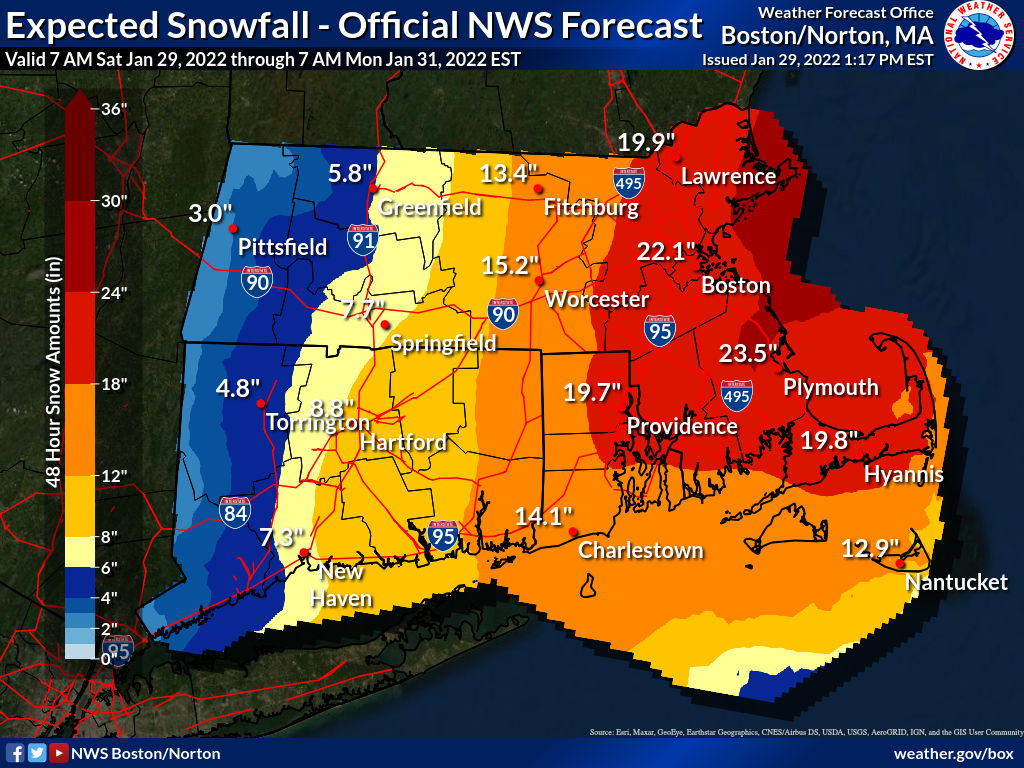
A classic “nor’easter” winter storm is bringing blizzard conditions and an estimated 12–24 inches of snow to southeastern New England between Fri 9pm and Sat 8pm. Snowfall rates of 2–4 inches per hour are possible, resulting in near-zero visibility and extremely difficult travel.
Median accumulation at Providence is 20 inches, with probabilities near 100% for at least 2 in, 99% for 4 in, 98% for 6 in, 95% for 8 in, 84% for 12 in, and 45% for 18 in.
Forecast models are in agreement on the strength of the storm, with the potential for sufficiently rapid development to be classed as “bombogenesis,” defined as a drop in central pressure of at least 24mb over 24 hours.
The most probable scenario according to forecast models is that the offshore storm will produce heaviest snow over Cape Cod and the Islands with decreasing amounts to the west, placing Providence at the western edge of the “extreme impact” region, and Hartford and Worcester in the “major impact” region. Deviation of the storm track either to the west or the east could significantly increase or decrease severity, respectively, at Providence.
High winds are expected, their strength depending upon how closely the storm tracks, but gusts to 60MPH are possible close to the storm.
Astronomical high tides are a certainty for Saturday, causing a risk of coastal flooding.
“WICKED BIG STORM” state highway sign in RI on I-95 (Jan 27, 2022)
(Photo: Michael Bilow)
Every residential address in the US can order four rapid antigen test (RAT) kits for free, expected to be delivered in late January, through an official government web page: covidtests.gov (which currently redirects to a site operated by the US Postal Service special.usps.com/testkits). Persons need enter only their name and shipping address to place a free order, and optionally can enter an e-mail address to be notified about order progress. The ordering system opened publicly one day earlier than had been announced.
According to the web page, “the tests available for order: are rapid antigen at-home tests, not PCR; can be taken anywhere; give results within 30 minutes (no lab drop-off required); work whether or not you have COVID-19 symptoms; work whether or not you are up to date on your COVID-19 vaccines; [and] are also referred to self-tests or over-the-counter (OTC) tests.” It is recommended to take an at-home test “if you begin having COVID-19 symptoms like fever, sore throat, runny nose, or loss of taste or smell; or at least 5 days after you come into close contact with someone with COVID-19; or when you’re going to gather with a group of people, especially those who are at risk of severe disease or may not be up to date on their COVID-19 vaccines.”
This free program is separate from and in addition to a federal mandate that private health insurers either directly cover or indirectly reimburse each insured individual for up to eight at-home over-the-counter RAT kits per month, up to $12 per test. Families on the same insurance plan are eligible for RAT kits on an individual basis, so a family of four would be eligible for eight each, or 32 tests, per month.
Coverage applies equally regardless of whether the private health insurance plan is purchased directly or as part of a group such as through an employer. Most insurers will pay directly for the tests at point of purchase, such as an in-network pharmacy, much the same as prescription drug coverage, but otherwise may require the insured person to pay up-front and submit receipts for reimbursement.
Medicare (as opposed to Medicaid) pays for laboratory tests but not at-home tests, and may require prescription by a health professional; however, some Medicare Advantage programs may cover at-home tests, so it is necessary to check the specific plan.
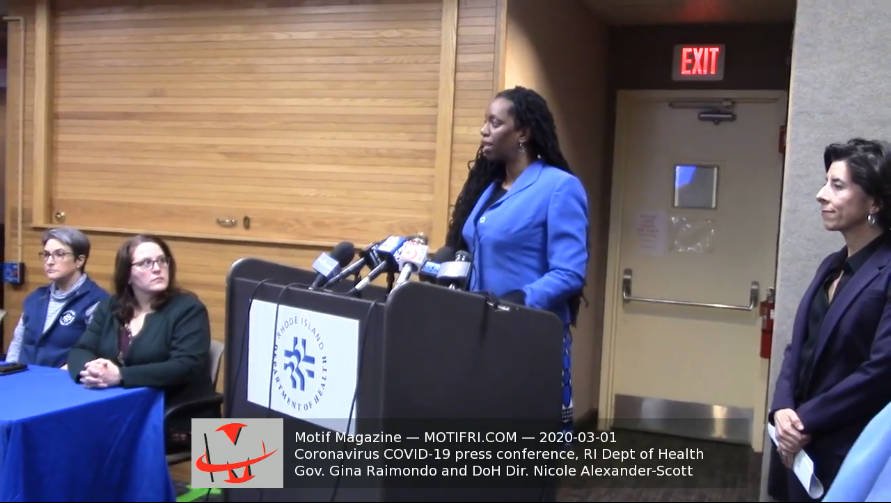
RI Department of Health Director Nicole Alexander-Scott announcing the first case of COVID-19 in the state on Mar 1, 2020, with Gov. Gina Raimondo to her left.
(Source: https://www.facebook.com/motifri/videos/599954260585364)
Dr Nicole Alexander-Scott, MD, MPH, who has served as director of the RI Department of Health (RIDOH) since 2015 and spearheaded the state’s response to the COVID-19 pandemic from the beginning, has resigned effective two weeks from today, according to a statement from Gov. Daniel McKee, and the governor “regretfully accepted.” She will continue in a consulting role for three months following her departure to assure continuity, the statement said.
Alexander-Scott had her own encounter with the virus, testing positive on Dec 12, 2020, leading to then-Gov. Gina Raimondo, Commerce Secretary Stefan Pryor, and vaccine expert Philip Chan, MD, of RIDOH and Brown University School of Medicine observing a precautionary quarantine as close contacts.
A native of Brooklyn, NY, Alexander-Scott is a nationally recognized expert in her field. She completed a four-year combined fellowship in infectious diseases of adults and children at Brown University, after finishing a combined internal medicine and pediatrics residency at SUNY Stony Brook in 2005 and medical school at SUNY Syracuse in 2001. She obtained a master’s degree in public health (MPH) from Brown in 2011. The statement from the governor noted that she is one of the five longest-serving state public health leaders in the nation.
“Dr. Alexander-Scott has been a steady, calm presence for Rhode Island as we’ve worked together to fight the COVID-19 pandemic,” said Governor Dan McKee in the statement. “Her leadership has been crucial to our whole of government response – helping Rhode Island become number one in testing nationwide and getting more people vaccinated per capita than nearly any other state in the country.”
“Serving as the director of the Rhode Island Department of Health has been the most rewarding experience of my career,” said Dr. Nicole Alexander-Scott. “I would like to thank all Rhode Islanders for their trust over the past two years as we have navigated this unprecedented public health crisis together. It has been an honor to serve you. I would also like to thank all the healthcare providers and community partners who have supported the work we have been doing at RIDOH since 2015 to ensure that everyone has an equal opportunity to be healthy, regardless of their ZIP code, race, ethnicity, sexual orientation, gender identity, level of education, or level of income. And finally, I would like to express enormous gratitude to the members of my RIDOH family. They embraced me, taught me, challenged me, picked me up when I was down, and had my back every step of the way.”
In addition to co-leading the state’s response to the pandemic, the statement noted, Alexander-Scott established the Health Equity Zone program that has become a national model for how to situate needed health care facilities in underserved areas in collaboration with local community leaders, led the response to the opioid crisis by getting naloxone (Narcan) into the hands of first responders and private individuals as well as opening some of the first harm reduction centers in the country, and arranging $82 million in financing to replace the state health laboratory with a “new Rhode Island Center of Excellence for Laboratory Sciences [that] will make Rhode Island better prepared for any future epidemic or pandemic with improved public health services, be an economic driver for the state, and foster more collaboration with private industry and academic institutions.”
At time of writing, RI is in bad shape for COVID-19, with a surge of cases unprecedented over the course of the entire pandemic. RI is weeks behind where it could have been if it had taken into account clear warning signs.
At a Woonsocket press conference with Gov. Daniel McKee and others on Dec 30, Department of Health (RIDOH) Director Nicole Alexander-Scott offered a blunt assessment of the situation: “I want to share what we are expecting January to look like. It indeed is going to be a difficult month from a COVID standpoint. It’s not only here in RI, it’s regionally and it’s nationally.
COVID-19 variant tracker by region, Dec 26, 2021 to Jan 1, 2022.
(Source: https://covid.cdc.gov/covid-data-tracker/#variant-proportions )
“We’re in an unprecedented moment within an unprecedented two-years-plus period of time. The shift indoors with the colder weather, the heightened transmissibility of the Omicron variant that’s double what we were already seeing is occurring with the Delta variant, the holiday gatherings, and the general increased levels of social interaction all mean that we could sustain case numbers through the middle or end of January that will well exceed the peak we have ever experienced throughout this entire pandemic.”
She continued, “This week, we have already had three days with more than 3,000 cases each day. And we believe that what we’re seeing now is still predominantly Delta variant of COVID. Our rough estimate is that only approximately 10% or so of infections in Rhode Island right now are Omicron variant cases.”
One week later, on Jan 5, RIDOH spokesman Joseph Wendelken told Motif, “The proportion of our infections that are Omicron is now likely close to 45%. This is a rough estimate.”
It was widely misreported in the press that the US Centers for Disease Control and Prevention (CDC) estimated that 73.2% of US cases were the Omicron variant as of Dec 18, but this was not any kind of direct measurement but just a projection from a mathematical model whose boundary condition assumptions had been exceeded, and the estimate was later revised down to 22.5%. For samples collected the week of Dec 26 to Jan 1, the CDC estimates 95.4% were Omicron, but that it has been somewhat slower to spread in the Northeast with only 82.4% of cases in that same week.
RI COVID-19 daily cases (blue), 7-day moving average (red), 7-day moving average per 100,000 population (yellow); from Jun 5, 2021, to Jan 5, 2022. (Source: https://covid.cdc.gov/covid-data-tracker/#trends_dailycases_7daycasesper100k)
After a prior gubernatorial press conference on Dec 15 at the State House, Alexander-Scott told Motif in a private interview that indications suggested the Omicron variant was two to three times more transmissible than the Delta variant. That early expectation has been generally confirmed since.
RI COVID-19 case counts: columns are date, daily cases, 7-day moving average, 7-day moving average per 100,000 population.
(Source: https://covid.cdc.gov/covid-data-tracker/#trends_newtestresultsreported )
However, Gov. McKee said he didn’t see signs of a surge before Thanksgiving. In response to a question at the Dec 30 press conference from Boston Globe reporter Brian Amaral about why the state was, only a few weeks ago, talking about closing rather than opening testing and vaccination sites, McKee defended the timeline of his administration’s response to the surge, claiming that it took them by surprise. “I think that we always tend to look in the rearview mirror on things. Perhaps if you had a crystal ball, you could have done that. But remember, we didn’t: Until coming up to Thanksgiving [Nov 25], this issue was not on the table. Infection rates increased on Dec 4, and then did again on Dec 11 weekend, and Dec 18.”
I pushed back at that press conference: “Governor, I respectfully would not characterize the data that way. It looks to me that we’ve been seeing a significant increase just on the state’s own data… getting back to about the middle to the end of October. I specifically remember asking that question at a press conference at around that point.”
McKee responded, “I’ll look at those numbers again out of respect to the question, but I don’t believe that’s accurate. …When we get back together again, if I’m wrong I’ll certainly admit that.”
Amaral reported in the Boston Globe on Jan 4, 2022, that he had obtained a copy of the “State of the Spread” dated Nov 16, 2021, a regular internal report circulated to state leaders, that showed an alarming increase in cases and predicted a surge in a matter of weeks.
The date of that report was the same day as another gubernatorial press conference where I directly raised the spiking case loads with Alexander-Scott and McKee after they emphasized percent positivity from testing, and I cited specific RIDOH data trends indicating that the RI seven-day moving average was then up around 240 daily cases per 100,000 population, up from 130 in October and 10 to 20 times higher than June and July.
RI COVID-19 daily cases (blue), 7-day moving average (red), 7-day moving average per 100,000 population (yellow); from Jan 23, 2020, to Jan 5, 2022. (Source: https://covid.cdc.gov/covid-data-tracker/#trends_dailycases_7daycasesper100k)
Alexander-Scott responded, “It’s a true reflection on the Delta strain that we have been talking about. The Delta variant is significantly more contagious than earlier versions of COVID-19. It’s why we need vaccination, testing, masking, distancing, ventilation, all of the tools fully activated.
“It is possible to get us through what we are anticipating as the winter is approaching. People are going indoors, it’s colder outside. … Rhode Island is a population that is more densely populated. We have seen throughout the pandemic that our numbers in terms of cases per 100,000 are higher in general, connected to some of those demographic factors, which is why we balance it with percent positivity, but all of it is going in the direction that is anticipated. We hoped not but we knew we would be ready. We’re well vaccinated. We’re still seeing cases that are higher among those who are not vaccinated. So that’s true evidence and indication of how important it is to get vaccinated. And then making sure all of the other mitigation steps that we’re talking about are followed as a critical approach.”
According to CDC data, the seven-day moving average of daily cases per 100,000 population in RI was 143.95 on Oct 31, 256.19 on Nov 16, 727.51 on Dec 15, 1,377.62 on Dec 30, and 2,346.89 on Jan 5; by contrast on Jul 1, that number was 10.48. Almost all of this surge was the Delta variant, as the Omicron variant was only assigned a Greek letter in late November and the first case in RI was announced only in mid-December (“Omicron in RI: First patient identified”, by Michael Bilow, Dec 11, 2021).
Of course, the official numbers generally do not reflect at-home tests that have become increasingly common in the last few weeks and therefore almost certainly represent an official undercount. RI does lead the nation in testing, but it still is not enough.
COVID-19 deaths (blue), cases (yellow), and testing (green) per 100,000 population, by state; as of Jan 5, 2022. (Source: https://coronavirus.jhu.edu/testing/states-comparison )
None of this should have come as a surprise. My question at the Nov 16 press conference explicitly cited data released by RIDOH and CDC on the web, hardly a secret from anyone who bothered to look.
There is no question that McKee is guided by a tension between needing to keep open the economy and the schools and preventing the spread of a deadly virus. But by missing warning signs of the coming surge for weeks, he has imperiled those key goals.
In a few weeks there will be only two situations in schools: planned closings and unplanned closings. Keeping bars and restaurants open will not do any good if customers are too scared to go out. With COVID-19 prevalence in RI literally more than 200 times worse in January 2022 than July 2021, being scared may just be basic prudence.
RI has updated and renamed its “401Health” app (previously “Crush COVID RI”) for Google Android and Apple iOS, the office of Gov. Daniel McKee announced today. The main purpose of the update is to add support for displaying the user’s vaccination record via a securely trusted QR code, which can be read by another app, the SMART Health Card Verifier, also available for both Android and iOS. The updated app continues to support previous features such as maintaining a private diary that the user can choose to share with contact tracers should that be necessary, links to schedule tests and vaccination doses, and access to display published statistical data about the COVID-19 situation in the state.
The two components, the record holding app and the verifier app, depend upon cryptography to assure the record comes from a trusted issuer, such as the State of Rhode Island, and has not been tampered with or modified. The system is similar to how web browsers handle sensitive information, such as credit card numbers for on-line purchases. In theory a QR code record could be printed out onto physical paper to be scanned by a verifier, but it is unclear at this time whether the RI apps or web sites will support this in addition to dynamic on-device display.
In order to make this work, RI has joined the SMART Health Card Framework administered by the Vaccine Credential Initiative (VCI), a non-profit coalition of government and non-government health care and technology organizations headquartered from Boston-based MITRE Corporation (formerly “MIT Research”) using an open-source public protocol specification licensed by Boston Children’s Hospital. The Framework is supported worldwide, including in the US, Canada, the UK, Japan, and Israel. The full technical specification details, as with many open-source projects, are publicly downloadable from GitHub.
The Framework is only a set of specifications, and it is up to the SMART Health Card Verifier App, published by the Commons Project, to implement the verification process, scanning and testing presented credentials (a QR code) against the CommonTrust Network’s Registry of trusted record issuers, also maintained by the Commons Project.
VCI publishes a “Code of Conduct” that “expects verifiers to adhere to the following core set of requirements in order to protect and properly interpret SMART Health Cards: Verifiers shall not store SMART Health Cards, or any data included within them, beyond what is required for verification at the time of presentation. Verifiers shall check SMART Health Cards against a list of trusted issuers. Verifiers shall comply with all applicable laws, including the California Consumer Privacy Act.”
According to the Computational Health Informatics Program (CHIP) at Boston Children’s Hospital that licenses and administers the underlying system, “SMART Health Cards contain just the information required to display your vaccination history and/or test status, and the choice to share your Card is up to you. In most cases that means: They contain: Your legal name and date of birth; Your clinical information; Tests: date, manufacturer, and result; Vaccinations: type, date, and location. They should not contain: Your phone number; Your address; Your government-issued identifier; Any other health information.”
The governor’s office said in its statement, “The VCI coalition prioritizes privacy and security of patient information, making medical records portable and reducing healthcare fraud.”
According to the Commons Project, their SMART Health Card Verifier App will “Quickly scan a SMART Health Card to confirm COVID-19 vaccination using the Verifier app at your small business, live music venue, school, or sporting arena. Scanning a SMART Health Card QR code reveals: Whether the SMART Health Card is valid; Whether the issuer is in The CommonTrust Network’s Registry of trusted issuers; [and] Key information on the SMART Health Card (issuer name, vaccine type, dates of vaccine doses, and name and date of birth of vaccine recipient).”
“By embracing the open-source SMART Health Card Framework, Rhode Island joins seven states, numerous countries, and pharmacies such as CVS, Walgreens, Rite Aid, and Walmart that are already utilizing the secure SMART Health vaccination technology for record standardization. The State looks forward to partnering with Connecticut and Massachusetts as they onboard in the coming weeks and months,” McKee’s office said in its statement.
“Rhode Island has administered close to 2 million doses of COVID vaccine and almost 300,000 booster doses, and our neighbors deserve a convenient, safe, and efficient way to access and store their vaccination record,” McKee was quoted in the statement saying. “I have downloaded my vaccination card to my phone and it was very simple. If you haven’t gotten vaccinated yet, it’s not too late. If you haven’t yet, get boosted.”
“We want to make it as easy and convenient as possible for you to securely access your vaccination information,” Department of Health Director Nicole Alexander-Scott was quoted saying in the statement from the governor’s office. “This new app is a great way to verify for others that you have received the critical protection that comes with a COVID-19 vaccine primary series and booster dose.”
Treatment with monoclonal antibodies (MABS) is recommended and authorized to keep patients who test positive for COVID-19 out of the hospital, reducing the severity of mild to moderate symptoms. The treatment is done on an outpatient basis by a one-time infusion that takes several hours. In RI, however, there is a logistical backlog on quickly delivering MABS treatment to patients.
Motif was approached by a reader who tested positive on Friday, Dec 10, but was told the earliest opportunity for MABS treatment would be Wednesday, Dec 15. In response to our inquiry, RI Department of Health (RIDOH) spokeswoman Annemarie Beardsworth confirmed that “most MAB providers are scheduling three or four business days after a patient’s/provider’s request. This time-frame is due to the very high demand occurring currently, but is also exacerbated by patients and/or healthcare providers calling multiple MAB infusion sites to see where they can get an appointment soonest, scheduling multiple appointments at different MAB infusion sites, and then not canceling appointments they don’t attend. This causes a tremendous amount of unnecessary administrative burden on the MAB providers and slows down the scheduling process.” She continued, “Unfortunately, when patients do not cancel appointments they don’t plan to attend, it prevents other patients from using that appointment slot. Some MAB providers tell us they can see as many as 8-10 no-show appointments per day. RIDOH reminds all patients to cancel any MAB appointments they are not planning to attend so that other patients can get their needed treatment.”
There are logistical obstacles beyond just patient no-show appointments, Beardsworth told Motif. “Rhode Island has an adequate supply of MAB product in Rhode Island and we have been administering at a very high rate of our biweekly federal allocation. Like most other states in the country, Rhode Island is experiencing a healthcare worker shortage, so there are fewer providers than we’d like who can administer MAB. RIDOH is actively working to recruit and onboard more MAB providers. The MAB that is the easiest and fastest to administer is in short supply federally, so combined with fewer providers who can administer MAB, each administration takes longer when using the other infusion (IV) products.”
While three or four business days is still within the 10-day limit after onset of symptoms, almost a year ago when the treatment was first made available in RI, on Friday, Jan 8, 2021, RIDOH Director Nicole Alexander-Scott said, “Rhode Island now has a doctor-recommended treatment for COVID-19 that is extremely effective at preventing people from developing severe disease and from being hospitalized because of COVID-19. The key, though, is starting early: The earlier you start treatment after testing positive, the better and more effective this can be. After completing a simple infusion, intravenously, of this treatment, many people with COVID-19 start feeling better as early as the next day. The treatment does not require hospitalization, and it’s intended to help prevent people from actually having to be hospitalized.” (See “New Treatment Available: Monoclonal antibody treatments for all eligible RI patients”, by Michael Bilow, Jan 9, 2021.) At that time, she said the plan was to have infusion sites co-located with larger testing sites, so that eligible patients can get the new treatment immediately after testing positive by a rapid test. “We’re working to build out as many different infusion sites as possible, particularly at places where there is a lot of testing already occurring, so that you can just go to the next room if you’re at one of our testing sites that’s able to accommodate this and get access to the treatment. We want to get at every element,” Alexander-Scott said.
It stands to reason that patients would benefit from following longstanding RIDOH advice to get tested as soon as possible after symptom onset and to seek MABS treatment, if indicated, as soon as possible after a positive test result.
The RIDOH website – covid.ri.gov/covid-19-prevention/treatment – has information about who is eligible for MABS: “You can use MABS if you test positive for COVID-19, started having mild to moderate symptoms in the past 10 days, and are at high risk for progressing to severe disease.” It also describes who should not get MABS, how to obtain MABS if you have no primary health care provider or no health insurance, and lists – covid.ri.gov/mabs-infusion-services – MABS infusion service providers.