Two eastbound lanes have been repurposed to carry westbound traffic across the Providence River over the Washington Bridge on I-195 in time for the Friday morning commute, the RI Department of Transportation (RIDOT) announced in a statement at 2:45am. The westbound side of the bridge had to be closed on an emergency basis due to structural failure. Originally expected to take weeks and then on Thursday promised to be opened this weekend, RIDOT beat their new deadline by several days.
“RIDOT will reopen most ramps that had been closed. However, the Gano Street off-ramp (Exit 1-D) will remain closed as will the on-ramps to I-195 West from Veterans Memorial Parkway and Taunton Avenue,” the statement said. Congestion should be reduced and is expected to improve as drivers become accustomed to the new traffic pattern, RIDOT said, but some motorists may find recommended detours more efficient for them.
While the eastbound capacity of the bridge had to be reduced to repurpose the two bypass lanes for westbound travel, the net benefit of increasing the westbound capacity above zero should reduce congestion overall. Prior to the emergency closure, the Washington Bridge carried 96,000 vehicles daily, RIDOT said.
Estimated travel times for each detour route are posted on the continuously updated Washington Bridge closure page at www.ridot.net/WashingtonBridgeClosure, RIDOT said. Alternative routes are listed as follows:
Local traffic in East Providence: Use the Henderson Bridge and rejoin I-195 West at Gano Street.
Southeast Massachusetts west of Fall River, MA: Take Massachusetts Exit 1 and follow Route 114A to Route 44 West. Follow onto Route 114 (Pawtucket Avenue) or Route 1A (Newport Avenue) to I-95. This is the preferred routes for trucks.
Southeast Massachusetts east of Fall River, MA (including traffic coming from Cape Cod and the New Bedford area): Take Massachusetts Exit 14-B to Route 24 North. Follow to I-495 North to I-95.
Engineers have deemed it safe to use the otherwise closed westbound bridge for light emergency vehicles, such as police cars and rescue ambulances, one at a time, but not for heavy vehicles such as fire trucks, RIDOT said.
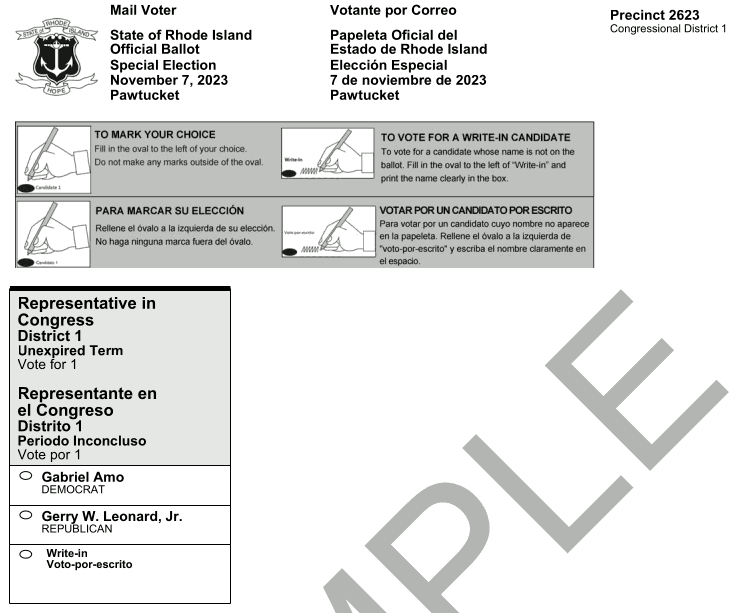
Sample ballot for RI special election, Nov 7, 2023, if you lived at the Motif office.
A special election to fill the US House 1st district seat vacated by David Cicilline will be held Tue, Nov 7, between candidates Gabriel “Gabe” Amo (D) and Gerry W. Leonard, Jr (R). Half of the population lives in the 1st district, and the other half in the 2nd district (represented by Seth Magaziner) will not be having a special election.
Polling places are open in almost all cases from 7am to 8pm, although there are occasional local exceptions. Where and how to vote can be found at the elections web site of the Office of the Secretary of State: vote.sos.ri.gov/Voter/VoteatthePolls
RI requires photo identification at the polls, either currently valid or expired not longer than six months. Valid identification is:
RI driver’s license/permit
US passport
ID card issued by any federally recognized tribal government
ID card issued by an educational institution in the United States
US military identification card
ID card issued by the US government or State of Rhode Island (RIPTA bus pass, etc.)
Government issued medical card
RI Voter ID card
The 1st district is heavily Democratic, with analysts estimating that had the redistricting map from the most recent census been in effect for the 2020 presidential election, the vote would have been 65% for Joe Biden and 35% for Donald Trump.
Gabe Amo
(Photo: candidate web site)Gerry Leonard
(Photo: candidate web site)
Amo previously worked for President Joe Biden as deputy director of the White House Office of Intergovernmental Affairs from 2021 to 2023 and for RI Gov. Gina Raimondo as director of public engagement and community affairs in 2020.
Leonard retired in 2019 at the rank of colonel after 30 years of service in the US Marine Corps, including as vice president of operations, chief of staff and COO with the US Marine Forces Reserve, and as chief of plans and chief strategy officer of the NATO International Security Assistance Force.
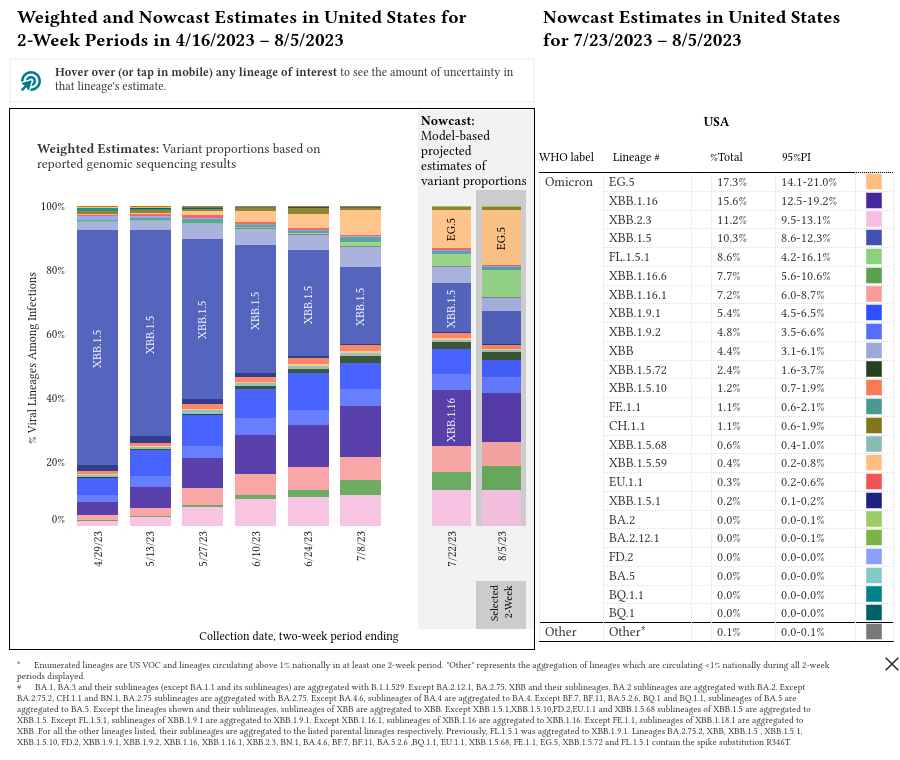
A new subvariant of SARS-CoV-2, the virus that causes COVID-19, is increasing in prevalence with initial US detection primarily in the New England area. Labeled EG.5, it was discovered outside the US on Feb 17 and is a minor mutation from the XBB.1.9.2 subvariant. The entire lineage, including XBB.1.9.2, EG.5, and a further subvariant EG.5.1, is subsumed under the “Omicron” label, but EG.5 and its descendants have often been unofficially labeled “Eris” (after the ancient Greek goddess of strife and discord). Indeed, the use of the Omicron label for so wide a variety of subvariants has called into question the continuing usefulness of the label.
SARS-CoV-2 variants lines of descent.
(Source: US CDC)
At this time, there is no evidence to suggest that EG.5 is more virulent than other subvariants of the Omicron group, although observed increasing prevalence suggests at least slightly increased transmissibility. It is expected that vaccines effective against the broad class of Omicron variants will continue to be effective against EG.5.
EG.5 was designated as a “variant under monitoring (VUM)” on Jul 19 by the World Health Organization (WHO). A VUM is the least serious classification assigned by WHO, after the most serious “variant of concern (VOC)” and the second most serious “variant of interest (VOI),” among the set of three. Variants are reclassified, promoted as they increase in circulation and demoted as they decease in circulation.
SARS-CoV-2 variants in circulation, as of Aug 5, 2023.
(Source: https://covid.cdc.gov/covid-data-tracker/#variant-proportions )
EG.5 has become prevalent on the United Kingdom, Israel, and other locations outside the United States. For samples collected in the US during the two-week period ending Jul 8, the Centers for Disease Control and Prevention (CDC) reports EG.5 accounted for 7.5% nationally but 15.9% in New England, although the CDC estimates it is now for the two-week period ending Aug 5 the most common subvariant nationally at 17.3%, displacing XBB.1.16 at 15.6%, XBB.2.3 at 11.2%, and XBB.1.5 at 10.3%. There is insufficient data to break out an estimate of current prevalence in New England, and the most recent public data on RI variants is from May.
While there has been a minor uptick of virus detection in wastewater samples in RI, levels have been consistently low since March and do not seem to forecast a surge in the near future. COVID-19 hospitalizations and deaths in RI have likewise been low, with 58 hospitalizations in July, down from 75 in June, and eight deaths in each of July and June.
RI wastewater monitoring of SARS-CoV-2 virus, as of Jul 23, 2023.
(Source: https://ri-department-of-health-covid-19-data-rihealth.hub.arcgis.com/ )
RI is seeking a new state poet, often informally known as the “poet laureate,” for a five-year term beginning January 2024. The role carries an honorarium of $1,000 annually. Applications close at 11:59pm on August 21, 2023, and the web portal will strictly enforce this deadline.
Established by law in 1987, the position is open to “practicing poets” who are domiciled in RI and plan to remain so through the end of the term in January 2029, are at least 18 years old, and are not currently enrolled in an arts degree-seeking program or in high school. For this purpose, a “practicing poet” is defined as a person who “intentionally creates or practices poetry that: has sought learning or training in the artistic field from any source, not necessarily in formal academic institutions; is committed to devoting significant time to artistic activity, as is possible financially; is or is working towards earning some portion of their income from their art.”
Tina Cane. Photo credit: Mary Beth Meehan
The outgoing state poet is Tina Cane who was appointed in 2016. Previous state poets are Michael Harper (1988-1994), the late C.D. Wright (1994-1999), Thomas Chandler (1999-2006), Lisa Starr (2007-2012), and Rick Benjamin (2013-2015).
“Through leadership and the power of poetry, our state’s poet provides inspiration to all Rhode Islanders in addition to being an important literary and educational resource,” said Governor Daniel McKee in a statement. “Thank you to Tina Cane for her service to Rhode Island and thank you to the State’s Arts Council for taking charge of the nomination process. I look forward to reviewing the nominees.”
“We expect to provide a diverse and strong field of recommendations to the Governor,” said Lynne McCormack, Executive Director of the Rhode Island State Council on the Arts (RISCA) said in a statement. “We are looking for a state poet who will build appreciation of and participation in poetry and literary activities among the state’s residents.”
Applicants are asked to submit a resume or CV, a one-page statement explaining your goals and interest, a letter of nomination from a RI resident speaking to your connection with the state, work samples, and optionally a link to a web page. A peer review panel from RISCA will forward five finalists to the governor, who will make the final choice. Staff members and council members of RISCA, and their immediate families, are ineligible. US citizens and non-citizens who have a taxpayer identification number (TIN), including refugees, immigrants, and temporary residents, are eligible.
Nine sites in RI will be open to visitors for the annual amateur “ham” radio Field Day this weekend, Jun 24-25, 2023. Details about each of these sites and contact information for the groups running them are available — arrl.org/field-day-locator — on the web.
Amateur “ham” radio is often the last line of communications in time of disaster. When earthquakes, blizzards, hurricanes, floods, tornadoes, or even armed enemy action shut down the ordinary means of communication, knocking out conventional electricity and telephone systems, often radio hams using their personally owned portable equipment, running on batteries, generators or solar power, have been the only way of moving critical information into and out of an affected area. Since 1933, in every peacetime year, the national organization of amateur radio operators, the American Radio Relay League (ARRL), has conducted a nationwide exercise to test and demonstrate this emergency response capability. Despite the serious purpose behind it as an emergency drill, tens of thousands of ham operators enjoy the fourth full weekend in June as an opportunity for an annual fun camping expedition where radio clubs set up equipment in places not usually used for such purposes.
Listed by radio callsigns assigned by the Federal Communications Commission (FCC), the nine sites in RI in 2023 will be: WA1USA (RI Emergency Management Agency) and W1DDD (Blackstone Valley Amateur Radio Club) in North Scituate, W1SYE (Newport County Radio Club) in Portsmouth, W1CRI (Charlestown Emergency Operations Center Radio Club) in Charlestown, W1MB (Fidelity Amateur Radio Club) in East Greenwich, W1OP (Providence Radio Association) in Warwick, W1AQ (Associated Radio Amateurs of Southern New England) in Pawtucket, KC1CUE (Coventry Emergency Management Agency) in Coventry, KK1PMA (Providence Emergency Management Agency Radio Amateur Civil Emergency Service) in Providence.
The W1DDD site operated by the Blackstone Valley Amateur Radio Club (BVARC) that we featured in 2015 will be operating in 2023, setting up a radio transmitting and receiving demonstration station using tents and trailers on the grounds of the Scituate Senior Center, 1315 Chopmist Hill Rd, Scituate, the former location of the Chopmist Hill Inn. At W1DDD in North Scituate, according to BVARC Public Information Officer Ronald Blais (whose personal callsign is KB1RYT), “The two-day event provides visitors the opportunity to discover the skill, science and service provided by amateur radio, including emergency communications. Two radio stations will be set up on the grounds, including a GOTA (Get on the Air) station, where visitors will be afforded the chance to operate radios and make contacts with other hams worldwide. The stations will be on the air continuously from Saturday 2pm to Sunday 2pm.”
The W1SYE site operated by the Newport County Radio Club (NCRC) at Glen Park, off Gilbert Barker Lane, in Portsmouth, is also particularly set up to welcome visitors.
All listed stations are open to the public and youth are especially encouraged: amateur “ham” radio has often been the catalyst for young people and teenagers to pursue a tinkering or technical inclination that as adults led them to careers in engineering or science. Even children as young as six years old have managed to learn enough to pass the government licensing examinations covering basic radio theory and operating rules, earning their “ham” licenses from the FCC.
RI law (§17-12.1-1) ordinarily requires the presidential preference primary election to be held on the fourth Tuesday in April of each presidential election year, but in 2024 that would fall on the first day of the Jewish holiday of Passover (Pesach), the day immediately following the Seder held the prior sunset. An eight-day holiday in the diaspora, the first two and last two days are observed by religious Jews following Sabbath-like practices that would interfere with voting, such as avoiding travel by vehicle, working, using electricity or fire, and spending money. Three other states (Delaware, Maryland, and Pennsylvania) share the same conflict.
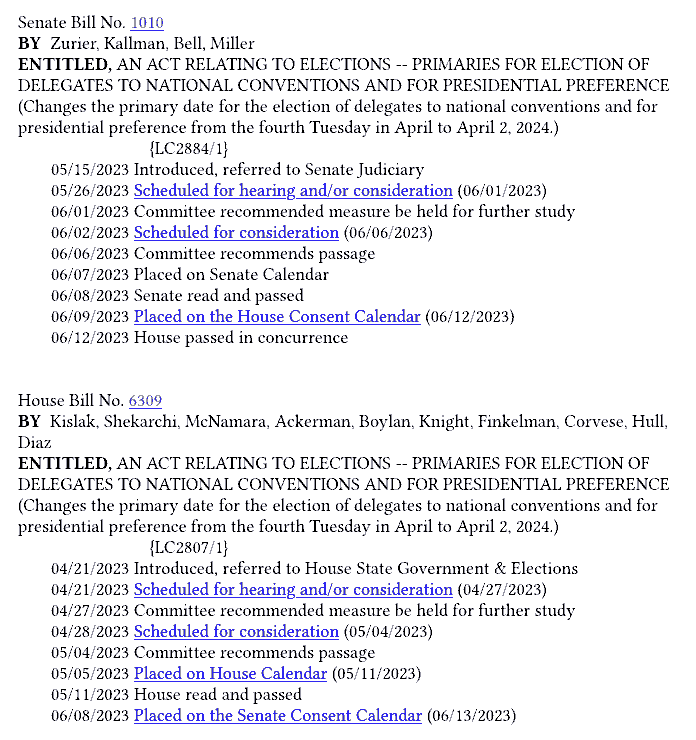
The RI General Assembly has adopted a one-time change to the primary election from April 23 to April 2, three weeks earlier, to accommodate the holiday. The bills principally sponsored in the Senate (S.1010) by Sen. Samuel D. Zurier (D-3) and in the House (H.6309) by Rep. Rebecca Kislak (D-4) were passed on Jun 12 and Jun 8, respectively, and sent to the governor who is expect to sign them into law.
Seems crazy, but it has been 7 years since The Quahogs have released an album. In the interim, the world went crazy, a few times. The band suffered a tremendous loss with the passing of drummer Nick Iddon from cancer last year. The good news is new tunes are coming, with a new album in the works for later this year. Fresh off taking home Best Rock Band at Motif‘s RI Music Awards, check out the first track from the new record, “For What Reason,” a classic early 70’s Stones like romp, below. My favorite part of the video, besides seeing the shots of Nick, is how the vocals don’t line up with the live shots.
We’re honored to present the official premiere of this new vid!
Manipulated image aired on Russian state television of Donald Trump in an orange suit with shortened arms and small hands.
Former President Donald J. Trump was finally arraigned yesterday in New York state court on felony charges with a bare-bones 16-page indictment alleging 34 separate counts of “falsifying business records in the first degree… with intent to defraud and intent to commit another crime and aid and conceal the commission thereof, made and caused a false entry in the business records of an enterprise” by authorizing and improperly recording payments to “Lawyer A” (Michael Cohen). In a separate 13-page “Statement of Facts” filed with the court, Manhattan District Attorney Alvin Bragg provided background details supporting the indictment. Arraignment is the formal procedure in a criminal case where the defendant is notified of the charges and asked to enter a plea; Trump pled “not guilty.”
Apparently this sort of procedure is common in New York state courts, but the practical effect is to leave out much of the substance of the charges that would be of interest to the public. By contrast, in federal courts it is customary to file a “speaking indictment” that provides a unified narrative containing significantly more specificity. Indeed, the vagueness so far provided makes it impossible to defend against the charges, so there will have to be an elaborate dance of paperwork where the defense demands, for example, that the prosecution explicitly say what they mean by “another crime,” which could plausibly be anything from tax evasion to campaign finance violation. Other than running up legal costs at thousands of dollars per hour billed in six-minute increments, I cannot imagine why this obviously basic and necessary information is not in the initial filings.
The allegation of “intent to commit another crime” is far from a mere technicality: it is my understanding this is a critical element, itself a factual claim subject to proof beyond a reasonable doubt, that under New York state law converts the act of “falsifying business records” from a misdemeanor to a felony, which is what makes possible the current charges where the statute of limitations would have already tolled for such misdemeanor charges. In fact, the conduct charged occurred outside the five-year statute of limitations even if a felony, and presumably the prosecutor relies on stopping the clock while the defendant was out of state — when he was serving four years as president in Washington.
Nor do I understand why this is 34 separate counts: the essence of the allegation is making a series of smaller payments to reimburse “Lawyer A” for one big payment of hush money ($130,000) to “Woman 2” (Stephanie Clifford aka Stormy Daniels), a pornographic movie star, to prevent her from disclosing her claim of an extramarital sexual relationship with Trump, following a similar payment of hush money ($150,000) to “Woman 1” (Karen McDougal), a Playboy model, to prevent her from disclosing her claim of a nine-month extramarital affair with Trump. The counts are not logically segregable in the sense that Trump could be found guilty of some and not others: either the series of payments were all illegal or none were, implying they should be tried as a single count.
If the claim of “another crime” turns out to be campaign finance violation, the prosecution argument would seem to be that “Lawyer A” conveyed money to further Trump’s presidential campaign beyond the legal maximum and without proper disclosure, and the expected defense argument would be that the motive was to prevent personal rather than political embarrassment.
If “another crime” alleged is a federal rather than a state offense this could prove fatal to the entire case, and because Cohen agreed to a plea deal no court ever ruled whether his actions were illegal at all. In his book People vs. Donald Trump, Mark Pomerantz, former outside counsel to the Manhattan DA in the Trump investigation, wrote: “Does the reference to ‘another crime’ include federal crimes, or just state crimes? This was an important legal question in the context of the hush money investigation, because Cohen (with the agreement of Trump and others at the Trump Organization) had used phony documents and invoices to commit and conceal a federal election law violation, but there appeared to be no comparable state crime in play. So, to charge Trump with something other than a misdemeanor, [District Attorney for New York County] would have to argue that the intent to commit or conceal a federal crime had converted the falsification of the records into a felony. No appellate court in New York had ever upheld (or rejected) this interpretation of the law.”
Indeed, it seems likely that none of the people involved in making the payments even contemplated that they may legally constitute campaign contributions, but Trump according to the DA Statement of Facts may have hung himself out to dry on that: “The Defendant directed Lawyer A to delay making a payment to Woman 2 as long as possible. He instructed Lawyer A that if they could delay the payment until after the election, they could avoid paying altogether, because at that point it would not matter if the story became public.”
The problem is that the prosecution filings are so far sorely lacking in sufficient detail for the public even to understand what crimes are alleged, and it will take months for that information to trickle out in the process of give-and-take motion proceedings in court. This plays into the usual Trump strategy of delay, and the next court hearing in the case is scheduled eight months from now on December 4. It could happen that the entire indictment is dismissed by the court without the public ever learning the prosecution theory of the case, which would be bad for the public interest.
NYU Prof. Ruth Ben-Ghiat, perhaps the leading expert on how democracies collapse into authoritarianism (and whose book Strongmen was highly praised by me in a review in 2020), forcefully argues that criminal accountability is an important way of piercing the machismo image cultivated by prospective dictators, noting that it was the possibility of murder charges against Benito Mussolini that caused him to finally dismantle the trappings of democracy that interfered with his fascist project. “The essence of authoritarianism is getting away with crime. That’s why this indictment [of Trump] is so important,” she tweeted on March 30.
Explaining her tweet at greater length, she wrote the following day: “While in the short-term Trump will milk this indictment to raise money and become more popular with his base, based on my research for Strongmen, prosecution is fundamental to showing a nation that the leader is not in fact above the law, not untouchable, not immortal nor a semi-deity. As I recount in my book, prosecution of Italian PM Silvio Berlusconi and Chilean dictator Augusto Pinochet after they left office started the deflation of their personality cults and reputations.… This indictment matters because it asserts the power of the law to punish anyone. It also sends a statement that government officials will not be swayed by authoritarian threats. Right now, our democratic judicial system is working, and our free press can report on it.”
Trump faces additional criminal investigations that range from a federal special prosecutor looking into his culpability for the January 6, 2021, Capitol riot and his possession of classified documents to a state prosecutor in Georgia looking into an election fraud and purported fake elector scheme. Most of these other possible criminal matters are far more serious than falsifying business records to conceal paying off a porn star, a matter where a jury could reasonably see Trump more as the victim of extortion than as the perpetrator of a crime. I would be a lot more comfortable if the first-ever criminal charge against a former president of the United States rested on a far less shaky and uncertain foundation.
Chatter using the WhatsApp and Telegram instant-messaging services and other social media prompted police departments in major metropolitan areas, including New York City, Los Angeles, and Chicago, to issue warnings about a “Day of Hate” planned for Saturday, Feb 25, by Neo-Nazi antisemitic organizations as an effort to target Jews and Jewish organizations for harassment and potential violence. Because Saturday is the Jewish holy day of Shabbat (Sabbath), Jewish organizations have called for responding in a “Shabbat of Peace.”
Anti-Defamation League (ADL) call for “Shabbat of Peace” in response to “Day of Hate,” Sat, Feb 25, 2023.
Jewish Rhody, the publication of the Jewish Alliance of Rhode Island, quoted its president and CEO, Adam Greenman: “Since first being alerted to the ‘National Day of Hate,’ the Alliance has been working to coordinate efforts with local and state law enforcement. We have also been keeping our community partners up to speed on the latest news from our national security partner, Secure Community Network. While there have been no credible threats made, we urge our communities to remain vigilant this day and every day. It can be infuriating to know a day like this is being planned, but our community is strong, vibrant, and above all, resilient. Together, we will rise above this hate.”
Asked by Motif “Has Providence put out anything on this ‘National Day of Hate’ matter?” the public information officer for the Providence Department of Public Safety answered, “Not at this time that I have been made aware of.”
Vandalism at Red Ink Community Library, night of Feb 20, 2023.
(Source: https://twitter.com/RedInkPVD/status/1628074671399743517 )Vandalism at Red Ink Community Library, night of Feb 20, 2023.
(Source: https://twitter.com/RedInkPVD/status/1628074671399743517 )Neo-Nazi flag displayed outside Red Ink Community Library, Feb 21, 2022.
(Source: Still frame extracted from video posted at https://twitter.com/guateguanaco/status/1495928149892288518 )
On Feb 21, 2022, Neo-Nazi protesters disrupted an event at Red Ink Community Library in Providence, making noise and waving flags emblazoned with a swastika, “SS” runes, and a “Totenkopf” (death’s head), but in 2023 there was vandalism and damage, Red Ink posted on Twitter: “Last night an anti-communist message was sent to us in anticipation of our Red Books Day celebration of the publication of the Communist Manifesto. Last year they showed up with flags to intimidate, this year they threw bricks through the window.” The post included photographs of glass shards and a brick on which was written “commie scumbags.”
The Anti-Defamation League (ADL) said on Twitter: “We are closely monitoring tomorrow’s anticipated ‘Day of Hate’ campaign and are in touch with local law enforcement agencies. As always, please report any bias or hate incidents to ADL at http://adl.org/incident and please join us in celebrating a #ShabbatOfPeaceNotHate.”
Leaked NYPD law-enforcement bulletin on antisemitic “Day of Hate” planned for Sat, Feb 25, 2023.
(Source: Lakewood News Network)
In a leaked law-enforcement bulletin obtained by the Lakewood News Network in New Jersey, the New York City Police Intelligence and Counterterrorism Bureau warns of “Domestic Violent Extremist” planners “of this overtly racist, anti-Semitic event are instructing likeminded individuals to drop banners, place stickers and flyers, or scrawl graffiti as a form of biased so-called activism” who are asking participants to “photograph or record direct actions and submit them online in order to create a compendium of exploits from around the country.” Various sources have identified some of these extremist groups as the Goyim Defense League (GDL), the National Socialist Movement (NSM), Crew 319, and Clockwork Crew.
Statement from NY Gov. Kathy Hochul on “Day of Hate” planned for Sat, Feb 25, 2023.
New York Gov. Kathy Hochul issued a statement on Twitter: “I have directed [New York State Police] and [New York State Department of Homeland Security and Emergency Services] to closely monitor the safety of Jewish communities this Shabbat. While there are no credible threats to New Yorkers at this time, we will remain vigilant. My top priority is the safety of New Yorkers.”
The nebulous and decentralized nature of the “Day of Hate” leaves it unclear where on the spectrum of risk it poses, ranging from a bunch of online posts that go no further up to violent terrorist acts and murder. The Jewish Telegraphic Agency, an independent service providing news to the Jewish community since 1917, noted the environment of increasing antisemitism: “The alert came roughly a week after two Jews exiting morning prayer services were shot on consecutive days in Los Angeles, allegedly by a man with antisemitic motives. Last fall, two men were arrested in Penn Station for threatening violence against New York City synagogues, and weeks earlier, police in New Jersey warned synagogues in the state about a ‘credible threat.’”
After 12 years representing RI’s first district in the US House of Representatives, David Cicilline will step down effective Jun 1, 2023, according to a statement released by his office late this morning. He will become president and CEO of the RI Foundation, a major philanthropic organization, replacing Neil Steinberg who announced his retirement several months ago.
Cicilline has held the seat since Jan 2011, most recently re-elected in Nov 2022 to a term ending in Jan 2025, defeating Republican challenger Allen Waters, 63.8% – 36.2%. The district is considered a safely Democratic seat, and the margin of victory is comparable to that estimated in the subsequently redrawn district for the most recent presidential election in 2020. As a result, a Democratic primary to fill the vacancy is expected to be fiercely competitive, effectively setting the stage for an easy win in the general election.
The Office of the RI Secretary of State said that the timing of a special election would, by law, be determined by the governor. “A vacant seat in the House of Representatives is filled through a special election. In collaboration with the Board of Elections, the Department of State will begin the special election process once requested by the Governor,” a spokesman told Motif. The law provides that the special election will be held on the first Tuesday after the first Monday of the month.
UPDATE Feb 23: The office of Secretary of State Gregg Amore told Motif, “We are beginning to map out a possible timeline for the special election that would comply with elections law and create enough time to satisfy all of the procedural elements of holding a special election. Once the election is called for, there will need to be a candidate declaration period, a signature collection and verification period, and internal ballot preparation. Then, federal law requires that mail ballots are sent to overseas voters [primarily active duty military] 45 days before both the primary and the general. At this time, we believe that statutorily, the earliest a primary could be held would be August 8. If the primary were to be held on August 8, the general would likely follow on October 3. If the primary were to be held September 5, the general would likely follow on November 7. These are only preliminary, possible dates. Later dates are possible. No dates have been set or confirmed. The Department of State is working collaboratively with the Governor’s Office, the Board of Elections, and the local cities and towns to ascertain the feasibility of different scenarios.”
Cicilline previously served as mayor of Providence from 2003 to 2010 and in the RI House of Representatives from 1995 to 2003. He is an attorney by profession, graduating from law school at Georgetown University in 1986 and receiving a bachelor’s degree from Brown University in 1983.
In a statement, Cicilline said, “The chance to lead the Rhode Island Foundation was unexpected, but it is an extraordinary opportunity to have an even more direct and meaningful impact on the lives of residents and families of our state.” He characterized the RI Foundation as “one of the largest and oldest nonprofit community foundations in the nation.”
Cicilline did not address the issue in his statement, but it is a reasonable inference that a significant factor in his decision to leave Congress was his party’s loss of majority status in the Nov 2022 election, greatly reducing his ability to accomplish anything in the narrowly divided chamber after being relegated to the minority. In his previous term, he served on the Foreign Affairs Committee and the Judiciary Committee, holding the chair of the latter’s Antitrust, Commercial, and Administrative Law Subcommittee.
“I write today to convey my deepest and most sincere gratitude to the residents of the First Congressional District. I am extremely grateful for the support of the people of Rhode Island, my dedicated staff, and the help of the many organizations and individuals that I have had the privilege to partner with over the past twelve years,” Cicilline said in the statement. “I once again extend my genuine and heartfelt appreciation for the honor to have served as your representative in the United States Congress.”
Continuity of office will be preserved, Cicilline said in the statement: “I will remain in office until I officially submit my resignation to the Speaker of the U.S. House of Representatives and Governor McKee on May 31, 2023. Constituents can continue contacting my office for assistance with federal agencies and to share your opinion or request information on pending legislative matters before Congress. After June 1, 2023, members of my staff will continue to operate offices in both Rhode Island and Washington, D.C. under the supervision of the Clerk of the House of Representatives until a new Member of Congress is elected. My office will provide additional information in the weeks ahead regarding this transition period.”