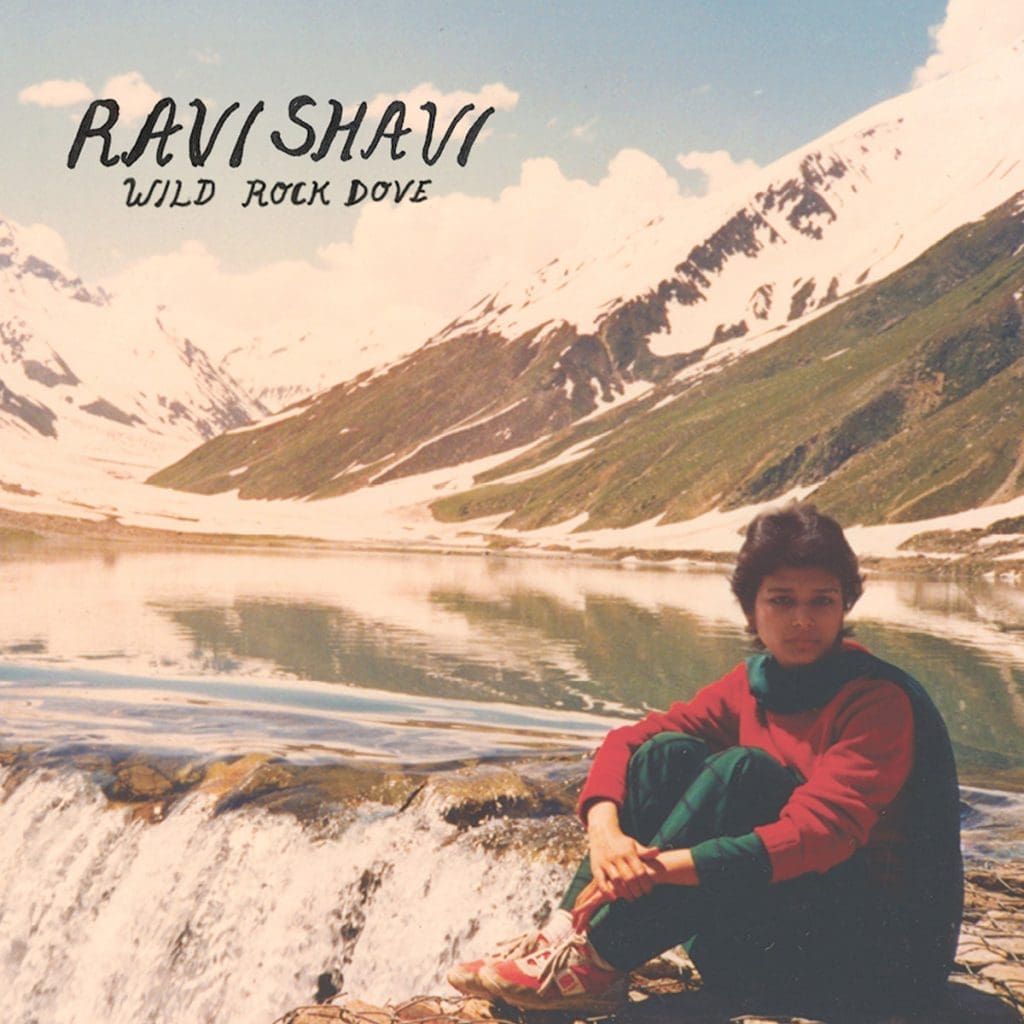
Ravi Shavi, a band that has been around since 2011 and started as a moniker for Rafay Rashid’s music project, has evolved and become more rooted in its creative approach and performance, as evidenced by the band’s new record, Wild Rock Dove. Currently made up of Rafay Rashid (vocals, guitar, bass), Chuck Perry (guitar and bass), Shahjehan Khan (guitar), Nick Politelli (guitar), and Ben Tucker (drums), Ravi Shavi is a band that has a punk through line, aiming to have a good time, engage in social commentary, and ask its audience to embody themselves fully. I sat down with Rafay, the band’s frontman and lead lyricist, to dive deeper into his story.
Mayté Antelo-Ovando (Motif): We’re here to talk about your new album, when is it coming out officially?
Rafay Rashid: It’ll be out officially June 12, and that’s also the date that the vinyl will be available via Almost Ready Records. Our working release show will be us opening for Spoon on June 19 at Fete Music Hall. We may throw a party or have a more official release show later.
MAO: Tell me about the cover of the album.
RR: It’s a picture of my mom.
MAO: I totally thought it was you!
RR: Funny you thought it was me. That’s my Mom the year that I was born, 1990, on a vacation with my dad in Pakistan (his dad took the picture).
MAO: What made you choose that picture for the cover of this album?
RR: I just love the image, there’s a continuity of a shrouded figure, a person, in the last few albums. Somehow this time, we ended up having someone facing toward the camera; the face is visible. I also just think it’s a beautiful picture, the fact that it’s shot in Pakistan, on film, and there are a few songs that feel a bit more homey — they’re about childhood and Pakistan. And the picture is bright and warm, and that felt a little happy too, romantic in a way, which I think this album is: It’s more like blooming. There’s less angst, it’s less rigid and fast.
MAO: One of the things that I noticed listening to this very Ravi Shavi record, where I can picture you dancing, was that there were songs I recognized. How long have you been playing some of these songs, and why release them now?
RR: It’s been a while since our last official Ravi Shavi record. We had the Erase Demo record that we put out last year, but that felt like a side venture. So it’s been about six years since our last record, Special Hazards. There were a few songs that we had been playing for many years that had just never made it to a recording. And we decided, okay, these three or four songs need to exist on a record somewhere. “Moneyback” and “Soulless” we’ve had probably the longest, since 2018, 2019.
MAO: And “Fresh Hell”?
RR: “Fresh Hell”’s been kicking around for not as long, but it’s been a staple of our live set. Then “New Brown Neighbors” too (songs which have earlier recordings as well).
MAO: What is the Ravi Shavi bread and butter?
RR: Aw, don’t make me answer that! I don’t know, but it’s something identifiable, clearly, because I’ve shared the record with close friends and I’ve gotten that feedback, that it’s somehow like a return to form, with a little bit more – the classic cliche — maturity. I think it’s also because a lot of the people have heard our very recent material, where it got political, it got stripped away, and like more dissonant.
MAO: Seeing you live, when I reflect on what I would call the funk that sort of takes over you when you’re performing, I wonder – what is that like for you?
RR: It’s funny because it’s evolved over time, and actually I just had this kind of slight epiphany today, that I don’t always need to do that when playing music. l don’t need to be possessed by this really frenetic kind of energy, which I think came from probably nerves being channeled into something engaging; and just like a full release. Very early on I wanted to give the performance my whole energy. I was channeling, obviously, you mentioned funk, so James Brown, but then also punk bands, like the constant leg wobble thing came from Joe Strummer, but it wasn’t conscious. And then also watching my dad dance, when he and his friends would get together and play loud music, there was always a bit of eccentricity to his movements, and I found that that was the thing that captured people’s attention.
MAO: As I listened, I realized there were lyrics I’ve completely missed, maybe due to the frenetic live energy. One song says “I lost my green card laying in my bed,” and another, “Wild Rock Dove,” says, “Why don’t you go back to your country?” Talk to me about the choices you’ve made lyrically.
RR: A lot of it is autobiographical, and it’s coming from a place of trying to connect with other people who are like me and may have had similar experiences. I found that specificity can be pretty powerful in terms of reaching people, an audience. I grew up in a pretty deep minority. I’m not trying to make a record about identity politics, but I think it’s a part of my story, and it’s a bit of a “write what you know” kind of thing.
MAO: Would you mind telling me more about your background?
RR: Yeah, born in Pakistan, my family moved here when I was 5, so I was 11 years old after 9/11 and the rise of Islamophobia, and seeing the reproduction of a certain type of image of a brown or Muslim person in the media, I think stuck with me. The discrepancy between the image of an artist and the image of a terrorist — so vast, and you certainly saw more of the latter than the former. I think that’s why I really took to Shahjehan’s old band, the Kominas. They played with those images of the stereotypes, and wore them as a way to say, “Fuck you,” and be funny about it.
MAO: Given that you’ve been around since 2011, what are the things that keep you going in making music?
RR: That’s such a big question. I think a lot of it is momentum, and it just feels very good to do. It feels like a very immediate, in your body, kind of release. And one of the best parts about it is the socializing aspect. I really don’t enjoy making music in a vacuum, a lot of it is just having friends and having something fun to do with them. That’s how music started for me, I was just in the shed of my friends’ parents’ backyards, or in the woods, improvising songs and making joke albums. A lot of it was asking, “What are we gonna do when we hang out?” You can only talk for so long, the talking has to become musical at some point.
MAO: Another song that jumped out at me was “Misbehave.” You sing, “I see my friends who like to party, you want to misbehave.” I wrote in my notes, “This is the audience participation song!”
RR: Yeah! We haven’t really played that live yet. We did it a few times, but only when we were testing it out.
MAO: And what was the motivation for this song?
RR: I think that’s a tough one. In a weird way, it’s sort of a sobriety, slash not, anthem. It’s asking, “What do you do with the inclination to misbehave and transgress, once you get sober?” Because there’s still that desire to push buttons and kind of lose inhibition, and yeah, just misbehave.
MAO: How do you misbehave when you’re sober? What does that look like?
RR: Yeah, just jokes, and never really fully behaving in the first place.
MAO: It makes me ask, what would happen if we were just not inhibited?
RR: Exactly. I mean, that’s a lot of what I’m after these days is how to get to that state of total loss of inhibition, without having to take mind-altering substances that cloud your judgment and create inconsistency in terms of how you feel about your own shit.
MAO: I wonder if for you, music sort of does that?
RR: Yeah. I think so. It allows me to get a little freaky.
MAO: I love it. Is there anything else you want to say?
RR: I’m very proud of just everyone’s contributions, to have the old staple of Nick’s guitar, and then adding Shaj and his harmonies, and then Chuck’s sort of unhinged guitars, and then Ben Tucker’s air-tight kind of drumming. It just felt like a really great group. We also had horns and synth by Chase Ceglie and Robbie Crowell. And then Brad Krieger just nailed it with our marathon [recording] session at Big Nice. Also special shout-out to Daniel Tanner and John Faraone for additional arrangements on the album!!
If you’re as intrigued as I was after this conversation, imagine how much more you’ll learn by getting the new record! I hope you dance with abandon, reflect on what brings you peace,- and maybe yell, “misbehave,” at the top of your lungs when you listen. Follow this PVD-based band @ravishavi and at ravishavi.bandcamp.com