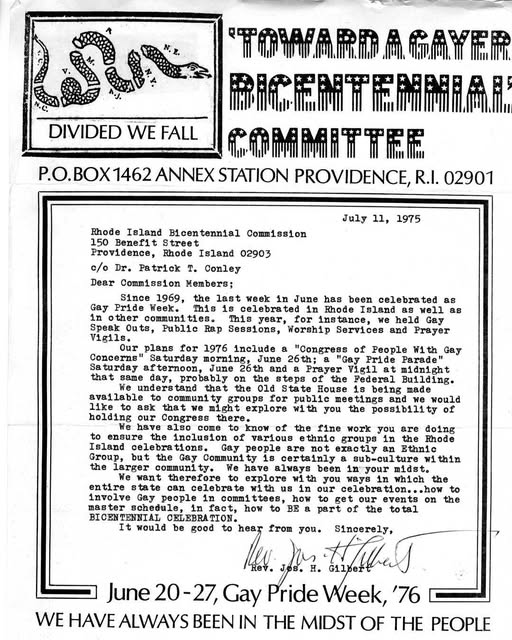
(Source: US National Archives)
As the United States celebrates its 250th anniversary in 2026, those of us old enough to remember the 200th anniversary in 1976 tend to be fondly nostalgic for the “Bicentennial” in what seemed a less troubled time, when patriotism could be unironic. That’s somewhat of a false memory: the Vietnam war, the Arab Oil embargo, and the Watergate scandal had only recently ended. It was not all rumpus rooms and avocado-colored kitchens.
Sexual relations between consenting adults of the same sex was a criminal felony in RI since the 1800s, the “abominable and detestable crime against nature, sodomy,” carrying a minimum seven-year sentence, the constitutionality of which would be affirmed by the US Supreme Court in 1986. That law would not be repealed by the RI General Assembly until 1998; in 2003, the US Supreme Court would finally declare such relationships constitutionally protected.
Although RI had long been a refuge for dissenters of every kind, acceptance of sexual nonconformists was tacit at best. In 1776, the same year the Declaration of Independence was adopted, a member of the Quaker community in Cumberland claimed to have died and been reborn as a genderless person, calling themselves the “Public Universal Friend” and avoiding all pronouns. Gay bars opened in Woonsocket, the Palm Garden in 1945 and Mirabar in 1947, the latter still in continuous operation although relocated to Providence.
The modern LGBTQ rights movement is often dated to the Stonewall riots of 1969 when, for the first time, the patrons of a gay bar resisted what had been regular and routine harassment by the New York City Police. It was a courageous act only a few years later in 1975 for an LGBTQ group in RI to ask publicly for formal permission, a year in advance, to participate in the state-sanctioned Bicentennial events. The request letter was signed by Rev. Joseph H. Gilbert, a gay man who in the 1960s, according to the LGBTQ Religious Archives Network, “was arrested and charged for sending ‘a love letter’ to another man through the US mail. Although not sexually explicit, the letter was considered ‘obscene.’… He was convicted and served two years in federal prison in California.” Ordained to the ministry by the Metropolitan Community Church (MCC), an LGBTQ-friendly denomination, he was assigned as the first pastor of the RI chapter in 1974.
What happened next led to a landmark federal court decision, as Judge Raymond Pettine explained in Toward a Gayer Bicentennial Committee v. Rhode Island Bicentennial Foundation, 417 F. Supp. 642, 643 (1976):
On July 11, 1975, the plaintiff Toward a Gayer Bicentennial Committee (the Committee) submitted a proposal to the defendant Rhode Island Bicentennial Commission (the Commission) describing plans for a “Congress of People With Gay Concerns,” a “Gay Pride Parade,” and a midnight Prayer Vigil, all to be held on June 26, 1976, during National Gay Pride Week. The Committee sought to have these activities included in the Commission’s calendar of Bicentennial events and requested use of the Old State House as a site for its proposed Congress. The Commission denied the Committee’s request, giving two reasons: first, that there was an insufficient nexus between the Committee’s proposal and the Bicentennial, and second, that practices advocated by the Gay movement are of questionable legality.
Even after a ruling by the court, Providence Mayor Vincent “Buddy” Cianci denied a parade permit, apparently fearing both reputational harm to the city and political backlash. Represented by ACLU cooperating attorney Stephen Fortunato, Jr., who would later become a RI Superior Court judge, the group had to make repeated trips to court to force compliance, eventually getting the definitive injunction order from a clearly exasperated Judge Pettine only one day before the planned event. Throwing it together on short notice after substantial uncertainty, around 70 marchers paraded in Kennedy Plaza carrying signs and playing kazoos. In an era when raids of gay bars were still a frequent occurrence, Police Chief Walter McQueeney described the court-ordered parade as “a disgrace.”
Today, in a city widely regarded as LGBTQ-friendly with two openly gay mayors (including the current one), the RI PrideFest event is a popular full day with live entertainment and vendor booths at District Park, 120 Peck St, PVD, beginning June 20, 2026, at 11:30am, and capping off with an illuminated night parade along Dorrance St, Washington St, and Weybosset St, beginning around 8:00pm. No longer only a few dozen people with signs and kazoos, the parade in 2001 moved to the evening hours after sunset, becoming one of the few illuminated night Gay Pride parades in the country, now comprising hundreds of marchers and many elaborately decorated floats. It has become the most attended event of the year for the city.
Decades later, RI Pride is so thoroughly part of the “establishment” that in 2019 my parade contingent was immediately behind the Warwick Police delegation, headed by the chief, and immediately ahead of the members of the state legislature.
Judge Pettine, now legendary for his many civil rights and civil liberties rulings, closed his prior opinion on the case (417 F. Supp. 632, 642 (1976)) with a personal observation:
I cannot help but note the irony of the Bicentennial Commission expressing reluctance to provide a forum for the plaintiffs’ exercise of their First Amendment rights because they might advocate conduct which is illegal. Does the Bicentennial Commission need reminding that, from the perspective of British loyalists, the Bicentennial celebrates one of history’s greatest illegal events?