Author: Emily Olson

  • Power Up with Plants

    Power Up with Plants

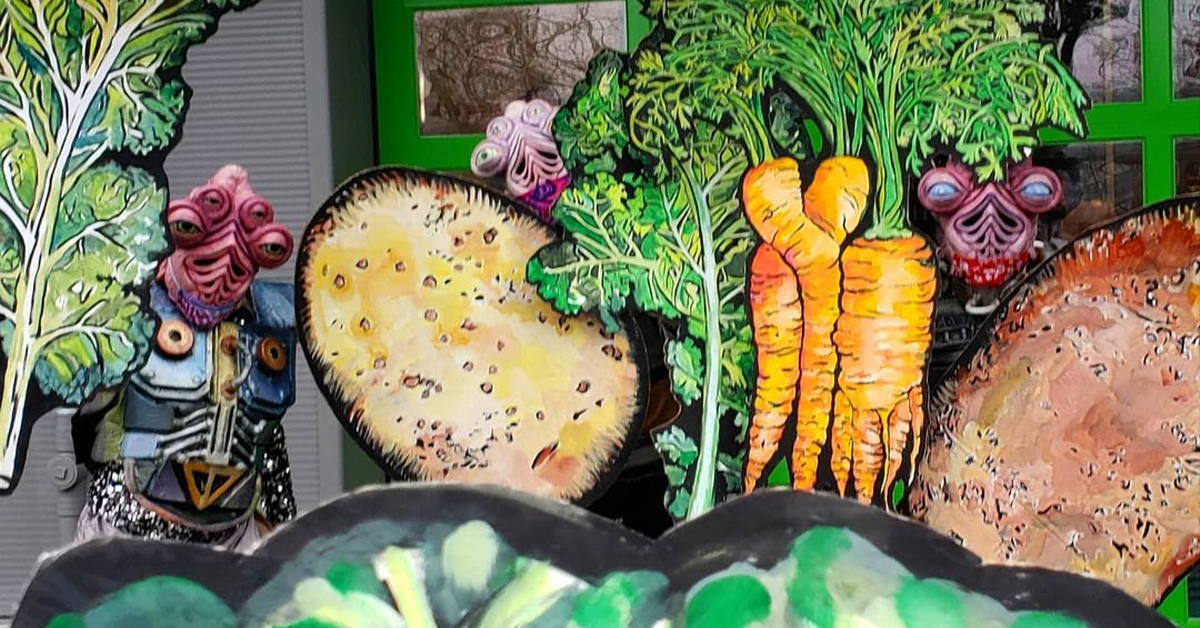
    Sandra Musial, MD, is passionate about food, its impact on health and sharing that knowledge with others. So she, along with two other doctors who share her passion, started a group called Plant Docs. In pre-pandemic days, the Plant Docs ran five-week workshops in the basement of vegan food hall Plant City that taught people how to embrace a whole food, plant-based diet. “Pairing medical intervention with a restaurant is a cool concept,” said Musial. “It’s about health, but it’s also about enjoying food.” I recently spoke with Dr. Musial about the health-transforming power of plants.

    Emily Olson (Motif): When it comes to their diet, what do Americans get wrong?

    Sandra Musial: The traditional western American fare is leading to crazy levels of obesity, hypertension, diabetes, cancer. All of these are diseases of the western world. Countries that are still eating from the land have lower rates of all of these diseases. Instead of eating whole foods — fruits and vegetables, whole grains and legumes — people are eating highly processed foods with lots of added sugars, oils and refined flours. I work at a pediatric obesity clinic and there are kids who in an entire day will never eat a fruit or vegetable.

    EO: School-provided lunches must drive you mad.

    SM: I think if we improved school lunches, it would have a mass effect on the whole US population. And children would bring that education home. A few years ago, WIC [the nutritional program for women, infants and children] improved the quality of their food package by limiting juice and decreasing refined flours and flour products. The national rates of obesity in that 3- to 5-year-old range went down, and they think it’s attributed to this mass improvement in the federal WIC package.  

    EO: What impact can a whole food diet have on health?

    SM: You can reverse many of the diseases of the western world. Obesity, Type II Diabetes can be reversed, you can open some of the plaque in the coronary arteries. Studies have shown that end-stage cardiac patients, when put on a strict healthy diet, can add years to their life.

    EO: Then why do we turn to medicine to correct these problems?

    SM:  I don’t know that people are being told it’s an option. But if every doc said, “You can go on this pill that you can take for the rest of your life and have surgery and die early, or you can have a lifestyle change,” people still might not want to make changes.

    EO: Is it an economic issue?

    SM: There is some truth to that. Broccoli is more expensive than soda, but on the same budget, if you buy dried beans and that’s your protein, that’s the most economic and nutritious protein there is. It’s more complicated than that, of course. People who live in the inner city don’t always have access to fresh whole foods. And it’s a multigenerational thing. If that [style of eating] is all you’ve ever known, it’s hard to get away from it.

    EO: So what’s the answer?

    SM: I think we have to have a multi-pronged approach to education, and I think it has to start with one-on-one at the doctor’s office. Medical schools have to do a better job teaching future doctors about nutrition. And there needs to be more community and government involvement to reverse what has happened [in food policy] over the last 30 years.

    EO: Tell me about the Plant Docs classes.

    SM: We limited each class to 20 people who want to learn the importance of eating plant based. Each participant would meet one-on-one with a doctor at the beginning and the end of the series, and we’d send them to a lab for blood work during the first and last weeks. Participants come from all walks of life. We’ve had vegetarians who want to give up dairy and want more ideas for vegan cooking, and we’ve had people who are scared after a heart attack. If there were enough people, I’d love to do a series with special interest groups.

    EO: Any final thoughts?

    SM: [Holistic health practitioner] Ann Wigmore said, “Food can be the most powerful form of medicine or the slowest form of poison.” I love that. Our cells become what we feed them. If you feed them whole foods, they become healthy, boost your immunity and fight disease. Or you can slowly kill yourself. You really are what you eat.

    The Plant Docs will resume classes when it is safe to do so. Email sandy@plantdocspvd.com to get on a mailing list. For more information, go to fb.com/plantdocspvd or plantdocspvd.com. Scholarships for classes are available.

  • On the Cover: Laura Homsey

    On the Cover: Laura Homsey

    Artist and illustrator Laura Homsey caught our eye when we saw her rendering of Dune Brothers Seafood in paper. The Brooklyn resident told us, “I took a vacation to Providence two years ago and had such a good time at the restaurant that I created an art piece.” We meandered from our interview to praise Dune Brothers’ chowder before she proved herself a true out-of-towner by exclaiming, “I loved those fried balls of dough that go with it!”

    We talked about what she loves most about collage and working with paper. “I like being able to build,” she said. “I struggle with working in 2D, so having a shape in front of me that I can put together was easier for my brain.”

    The detail in her work is particularly striking, and she said she owes that aspect of her work to a boy with autism she supported for a couple of years. “He taught me to look for the tiny details in everything,” she said. “He didn’t speak, but would point out the tiniest details in our world, and I create pieces with him in mind.”

    To see more of Homsey’s work, follow her on Instagram @petitpaperstories or visit her website at petitpaperstories.com

  • If You Build It…

    If You Build It…

    The Artists’ Exchange joins the ranks of those keeping holiday traditions in tact, but with a twist. Fans of their annual gingerbread house decorating contest are invited to take part in the merriment this year from their own home. Between December 3 and 6, prospective builders can pick up their gingerbread house kit from The Artists’ Exchange at 50 Rolfe Square, then share photos of their creations with the organization for the chance to win free camps and classes. For more information, go to artists-exchange.org

  • Well Seasoned Shopping

    Well Seasoned Shopping

    Gabrielle Halliday is a seasoned chef who moved from Rhode Island to the wilds of Houston, Texas, where the budding entrepreneur started Seasoned, an online marketplace for BIPOC business owners in the food industry.

    Halliday said of Seasoned’s inception, “There’s really a need to support Black people and minorities, and I realized there isn’t a place on the internet where BIPOC business owners can come together and sell their stuff.” So with her typical go-getter attitude, she did.

    “I wanted to provide a place where people can sell their hand-crafted items, get support nationwide and be part of a community that supports them.”

    The Seasoned store offers food and drink items, kitchenware and wellness products, and it’s the perfect one-stop-shop for anyone looking for gifts for the foodie in their life.

    To shop or for information on becoming a vendor, go to seasonedstore.com. Follow the company on Facebook at fb.com/seasonedstore or on Instagram @seasonedstore

  • Assurance of Insurance

    While you’re decking the halls, don’t forget that it’s open enrollment season through HealthSourceRI. Virtual open enrollment info sessions will be held throughout the month that will help you get signed up. To ensure active coverage by January 1, sign up by December 23. For January coverage, sign up by December 31. And the very last day to sign up for 2021 coverage — barring qualifying life events — is January 23, which will give you coverage starting February 1. For more information, go to healthsourceri.com

  • Putting Down Roots: Local artists draw inspiration from nature

    Putting Down Roots: Local artists draw inspiration from nature

    Mowry Commons, a project of Revive the Roots

    Revive the Roots is a non-profit organization located in Smithfield that teaches and practices permaculture, an agricultural philosophy that recognizes the inextricable relationship between people and nature and works within an ecosystem’s natural patterns. The non-profit provides space to visitors at Mowry Commons, land leased from the estate of Mary Mallory through the town of Smithfield. On the grounds are community gardens, walking trails along the Woonasquatucket River and an edible forest garden. Adjacent to the land is a 300-year-old farmhouse that’s slowly being brought back to life. This is where Bradford Adelard and Hannah Purcell Martin live with What Cheer Flower Farm professional flower growers Nick and Crystal. 

    After two years of successfully working the 18 acres that comprise Mowry Commons, Revive the Roots approached the town of Smithfield and asked them to let the organization use the house as a base of operation. In return, the nonprofit agreed to restore the farmhouse under the historical curatorship of Preserve Rhode Island. Revive the Roots covers the cost of materials and provides the physical labor. “Our work kind of pays forward rent,” Adelard explains. “The last project we did was a porch restoration that paid our rent through February 2023.” 

    Rainbox planters, arbor and benches by Bradford Adelard, Fatma Masood and Zach Murdoch at Eagle Square, PVD.

    Adelard is a woodworker who, after purchasing a sawmill with his friend Zach, began doing work with the Woonasquatucket Watershed Council. “The parks department cuts down a lot of trees, and then they just sit there,” Adelard says. “So we turn those trees into lumber that we use for park installations around the city.” The largest project he did was at Black Locust Pocket Park near The Steelyard. “We put in two arbors, four benches, a big deck and rainbox planters that have a hidden reservoir. The goal is to use local resources to improve public space and build community.” 

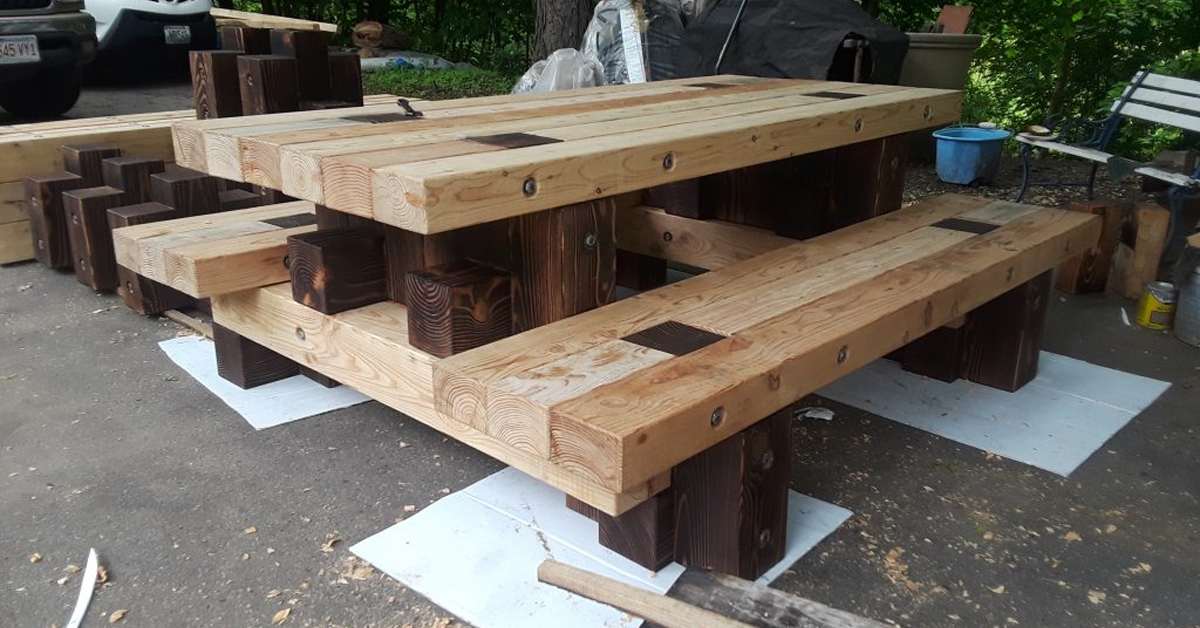
    Modular tables by Bradford Adelard at Newport Bike Barn, constructed from Local Tamarack Wood.

    Woodworking isn’t the only type of art Adelard enjoys. He also does leatherworking and blacksmithing. “I’ve been doing a lot of fabricating for the farm,” he says. 

    The farm also serves to inspire Martin’s art. Although Martin dabbles in different mediums — she recently discovered a love of glassblowing — she’s primarily a painter. “I spend a lot of my time on a 25-acre preserved piece of land, so that really influences a lot of my work,” she says. “Even something as small as the act of pulling weeds is an interesting experience of uprooting things and examining the root structure or the destruction of something nature creates. It’s caused me to learn so much more about plants and flowers.” She spends a lot of time studying what she cultivates. “No two flowers are the same,” she continues. “You might think one daisy looks like another daisy, but it doesn’t. It’s pretty mind blowing.”

    Hannah Purcell Martin. Habitat. Watercolor on paper, 33″ x 25″.

    Martin’s parents raised her and her sister with the understanding that much like the daisies, no two children are exactly alike, so they chose to homeschool their daughters. “My parents wanted us to do things that a typical school schedule really limits,” Martin explains. “Having time to myself and being self directed and self motivated allowed me to early on develop an understanding that self direction comes from a base of your own interest and passion. A lot of my friends were homeschooled as well, and I think each one of them has really succeeded in figuring out the profession-as-personality thing. When you get a little more freedom to explore, it leads to figuring some things out about yourself sooner rather than later.”

    Martin’s personality led her into the profession of gallery management. “One of [Revive the Roots’] board members is a horticultural genius. He opened a store in Providence called Home Grown. Its outdoor nursery space has rare perennials with a focus on some native plants. The inside will have garden gear and home goods that are nature-focused and local.” Upstairs is a substantial gallery space that Martin will manage and a studio space that she hopes will allow her more time to paint.

    Hannah Purcell Martin. Optimistic: Colder Than it Looks. Watercolor on Paper, 7″ by 10″.

    Adelard and Martin both maintain studio space in The Reliquarium, a work/live artist collective in Lincoln whose members often do projects together; their current project is building TimeZone, a puzzle game that requires players to navigate a series of challenges, each set in a different period of time. It will be unveiled at R1 Indoor Karting in Lincoln. Martin enjoys the collaborative and supportive nature of working with the other Reliquarium members. “You need a funny skill set to work with the group,” says Martin. “You have to know how to use a drill and be on a ladder, but having an artist’s eye helps.” 

    Adelard also enjoys the freedom that comes from collaboration. “We always have a project lead,” he says, “but there’s a lot of freedom to go forward and make the project your own.”    

    Revive the Roots continues to grow and is taking steps to purchase the farmhouse that Adelard and Martin call home. “It’s a sweet spot and it takes at least a few individuals to keep navigating obstacles and pushing the project forward. I feel personally responsible for that,” says Adelard. 

    Martin enjoys the continual access to the outdoors — and artistic inspiration — the farm gives her, no matter how busy life gets. “I get outside a few times every month to do a little painting from life, even if it’s a quick little watercolor or a sketch in my sketchbook. It’s a reminder that you have to take time for those things that are important.” 

    Hannah Purcell Martin. A Good Day to Burn Brush. Watercolor on paper, 7″ x 10″.

    For information on Revive the Roots, go to revivetheroots.org. For more information on Hannah Purcell Martin’s work, follow her @hannahpurcellmartin or hannahpurcellm.com. See Bradford Adelard’s work @brad_oza

  • BikeLife Lives Matter: By working together, cities and bikers can reach a solution

    BikeLife Lives Matter: By working together, cities and bikers can reach a solution

    In 2017, the Providence town council wrote an ordinance that allows Providence police to confiscate and destroy illegally ridden ATVs and dirt bikes. This October, the City of Providence, in a show of enforcement, publicly demolished 33 dirt bikes and ATVs. One week later, during a ride-out on October 18, 24-year-old Jhamal Gonsalves was involved in a vehicular incident with the Providence Police that put him in a coma where he remains today.

    Before the #justiceforjhamal campaign forced it to take a back seat, the BikeLife Lives Matter movement was working toward gaining greater acceptance for the bike life subculture in Providence, counter to what many in the culture consider its unfair villainization.

    Those within the bike community view it as a colorblind society that doesn’t ignore the issue of race, but understands it for what it is, and this understanding can provide society at large with lessons on racial diversity and unity. It’s similar to the hip-hop culture in that it intends to bring people of different backgrounds together through self expression and the riding art form.  

    The bike community is simply a group of hobbyists pursuing their passion — a creative escape born from inner cities where people are directly affected by systemic injustices brought into sharp focus by the COVID-19 pandemic. But COVID restrictions and the resultant lack of human interaction aren’t the only reason riders seek the streets for escape. As a result of the pandemic, they are also dealing with an uptick in suicides and homicides. Many feel that the safest place to be isn’t their homes, but their bikes.   

    BikeLife Lives Matter seeks to curb the problem on our city streets by including the riders in reaching a solution rather than excluding them. By involving our youth in programs that foster diversity, family and education right where they are. By changing the narrative, giving voice to the voiceless and removing the stigmas that plague the culture. The movement seeks to amplify hashtags like #BikesupGunsdown, a slogan used to curb inner city violence, or #RideoutRacism.

    The small town of Shamokin, Penn., serves as an example of what can happen when bikers and the city work together toward a mutually beneficial solution. The former coal town of 6,984 residents had experienced a dramatic decrease in foot traffic in its business district, but as a result of a new ordinance that allowed riders to drive in the city on certain streets during certain hours, the city’s economy was revitalized, and they have dirt bike riders and their tourism dollars to thank.

    Like many subcultures, bike life will challenge the status quo, and have to endure the growing pains of an acceptance phase. But as the negative perception of this art forms gradually abates, it is cementing itself as an important social justice movement. 

    Jeremy Costa is the spokesperson for BikeLife Lives Matter. To learn more about the organization, go to bikelifelivesmatter.org

  • Time for a Pause: A summary of the governor’s November 19 press conference

    Time for a Pause: A summary of the governor’s November 19 press conference

    Governer Gina Raimondo held her weekly press conference at The Vets at 1pm today. She began her press conference with good news about vaccine efficacy and Rhode Island’s being chosen to be a pilot state in Pfizer’s vaccine delivery program before she got into the data.

    The RI Department of Health today announced 921 new positive COVID cases out of 15,819 tests for a percent positive rate of 5.8%. There are 298 people hospitalized and 13 people on a ventilator. Hospitals are currently at 97% of their COVID bed capacity, and current trends point to the need for the Cranston field hospital by next week. Four Rhode Islanders lost their lives to COVID yesterday.

    Raimondo said that community spread has made it hard to pinpoint where the surge is coming from. She said that at-home social gatherings are crystal clear spreaders, but when people have been to 15 places in a week, you can’t say which place has been the source of spread. Trends have been identified, however, and positive cases seem to come from people hanging out with people outside of their households. Because of this, the governor announced an upcoming pause, which will last two weeks: from November 30 through December 13. “We are beyond the idea of phases. This is the last mile,” Raimondo said, referring to the vaccine on the horizon. This pause in activity is designed to get our state to the end of the year “without catastrophe” by overwhelming hospitals and forcing healthcare workers to provide crisis care.

    This pause entails several changes. The only change that begins today is that social gatherings are limited to one household. Beginning on November 30, high schools will be given the choice of moving to limited, in-person learning with in-person learning provided only to students with special learning needs. Restaurants will continue their early closings, with tables limited to one household only. Retail and big box stores will have to limit the number of shoppers allowed in the stores, and houses of worship will be limited to 25% capacity.

    As of November 30, colleges and universities will be closed. Offices must be closed when possible with employees working remotely. Bars, recreational venues and indoor sports facilities all will be closed through December 13.

    There will be no changes made to K-8 schools, personal care services (eg, salons), childcare, manufacturing and construction and healthcare services.

    “None of this is going to be easy and I wish we didn’t have to do this,” the governor said. “If you’re wondering why I’m waiting, it’s because I want people to have time to prepare.”

    She urged Rhode Islanders to keep in mind that this pause is only designed to last two weeks, however, cautions that, “This is only going to work if we decide to do it. If you’re asking yourself how you’re going to get around the rules, I’ll be back in three weeks planning a full state lockdown. If you’re going to do it, then this will work and in two weeks we’ll be able to slowly turn the dial back up.” Details of pause can be found at reopeningri.com.

    Thanksgiving is celebrated next week, and the governor asked citizens to celebrate only with the people they live with and avoid travel. If, however, travel is unavoidable, get tested before and after you travel, and quarantine for two weeks after you return. Rapid testing will be made available at TF Green.

    Governor Raimondo recognizes the difficulty people are having getting tested. As a result, new testing facilities are going to open and current testing facilities will increase their capacity. The governor’s goal is to double the daily number of tests performed before the pause begins on November 30. She urged people who get tested to check the portal rather than wait for contact from RIDOH, and get in touch with their contacts to let them know they were tested so that they, too, can get tested.

    Governor Raimondo will hold her next press conference next Wednesday, the day before Thanksgiving.

  • Laughter and Joy: Spiritual healing shop Spiritually Lit creates a community

    Laughter and Joy: Spiritual healing shop Spiritually Lit creates a community

    Alexandria Lynch and Jessica Rainey toast the season

    Alexandria Lynch and Jessica Rainey started their company, Spiritually Lit, shortly after the pandemic put Rhode Island on lockdown. They knew that creating things made them happy, and they sought a way to use their creativity to make others happy. On a chilly fall day, I spent some time on the front stoop with these two women, discussing their business, their philosophy and how motherhood fits into it all.

    Emily Olson (Motif): What is Spiritually Lit?

    Jessica Rainey: Spiritually Lit is all about spiritual healing. We sell crystals and make hand-poured soy wax candles, sage bundles and self care boxes that might include a bath bomb or bath salt. Everything we make or sell, we infuse with prayer, like a love prayer or a protection prayer. People are asking for a lot of protection prayers these days.

    EO: Tell me a little more about infusing your products with prayer.

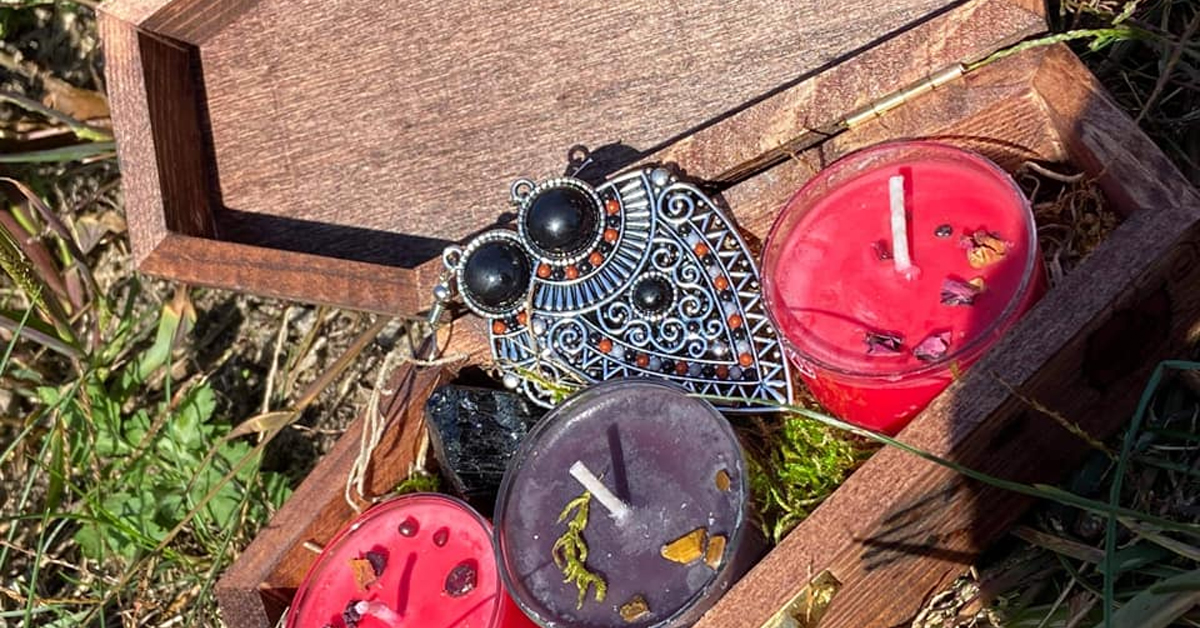
    JR: Take, for example, a protection box. I burned the Eye of Horace into the lid of a wood box. We put a piece of tourmaline in there, which is a stone for protection, and Alex made two protection candles. As Alex makes her candles, she says a little prayer or chant and then everything I do, I do the same. For a protection box, I pray to the guardians of protections against any evil, illness or negativity. 

    EO: It sounds like Wiccan and Pagan traditions play a large role in what you do.

    JR: People think of Wiccan and Pagan traditions as a dark thing, but it’s self healing. It’s a mixture of the law of attraction, knowing what you want and manifesting what you want in a good way.

    Alexandria Lynch: I embrace mindfulness in the Wiccan tradition. When I sweep, I sweep away negativity with the broom. When I stir my tea, I stir in calmness. I like to start my day with meditation and set my day with an intention. That’s magic in itself.

    EO: Alex, you have a busy 4-year-old daughter. How do you find the mental space for meditation and peace?

    AL: I make my candles when Charlotte [her daughter] goes to bed because that’s when I’m calm. Then when I go to bed, I turn my TV off and sit in my bed with a stone. I breathe in to the count of four and out to four. If I have lingering thoughts on my mind, I let the negative thoughts go and the calm thoughts flow. That’s the hardest thing to do.

    EO: Spiritually Lit does live events on Friday nights. Can you tell me about those?

    JR: Friday Night Live! Those are fun. When we started the business, we used that as a way to reach people and to let people shop during the pandemic from the comfort of their own home. And we’ve made lots of friends and connections that way.

    EO: I watched one and saw the two of you in full costume!

    AL: We love dressing up and love Halloween. So for the month of October, we’ve been getting in full costume every Friday night. We do a little live skit at the beginning of our show that sometimes is a fail, but it’s all in fun. We have big secret plans for the 30th. We have a great costume picked out.

    EO: What happens during a Friday Night Live show?

    JR: People chat with us and have fun. Sometimes we do some education about the crystals we’re selling or I choose a topic to talk about. For example, I just explained what Mercury retrograde means. We do giveaway contests. And if someone wants to purchase one of our items, the first commenter gets it, then we have contactless pickup at my house in Warwick.

    EO: What makes a good quality crystal?

    AL: The juicier the better. But specific qualities depend on the stone. Clear quartz should have rainbow flashes. With an amethyst, the deeper the purple, the stronger the energies that it carries.

    EO: Do the people who buy your products practice Wiccan or Pagan traditions? Or do they hope to gain the benefits of your prayers and expertise?

    JR: The people who buy from us just enjoy Jessica and Alex. You don’t have to be Wiccan or Pagan to smudge your house or meditate. It’s just a spiritual journey that everyone goes on.

    AL: Everything we do is about laughter and joy.

    Watch Spiritually Lit’s Friday Night Live show at 8:30pm on their Facebook page: facebook.com/Spirituallylit401 or check them out on Instagram @spirituallylit401

  • Make Mine a Bloody Mary

    Make Mine a Bloody Mary

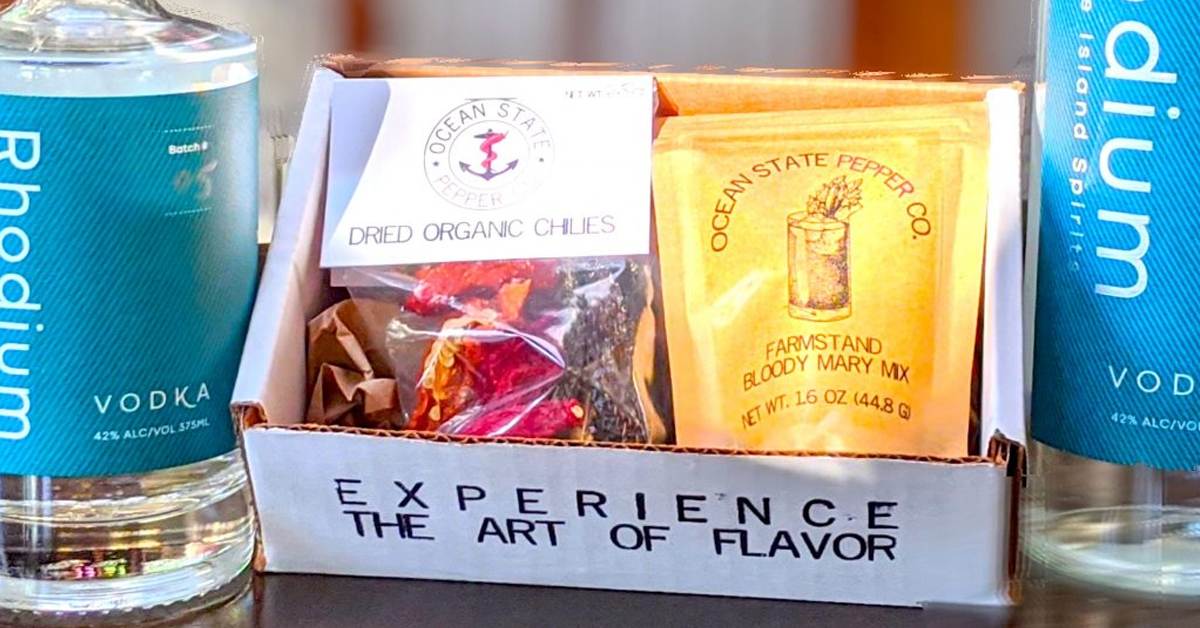
    Rhode Island Spirits collaborated with Ocean State Pepper to launch a Bloody Mary kit, and brunch just got a whole lot better. The kit comes with a bottle of Rhodium vodka, organic dried chiles for a DIY infusion of your favorite level of spiciness and a package of Bloody Mary spice mix.

    We talked with Katie Evans, who owns Ocean State Pepper with her husband, Dave Conner, about what makes a great Bloody Mary. “I like a very seasoned, meaty Bloody Mary,” she said. And their horseradish forward spice mix perfectly fits the bill. The dry mix is unique in that it allows Bloody Mary lovers to mix it with their favorite tomato juice. Evans had us longing for summer (already!) when she suggested adding the spice mix to tomatoes blended fresh from the garden.

    Cathy Plourde of Rhode Island Spirits got into garnishes with us. “My favorite garnish would probably be shrimp,” she said. Evans, on the other hand, prefers her “meaty Bloody Mary” to be vegetarian. She said, “I love a spicy pickle in a Bloody Mary.”

    Spice up brunch with your own Bloody Mary kit by going to rhodeislandspirits.com