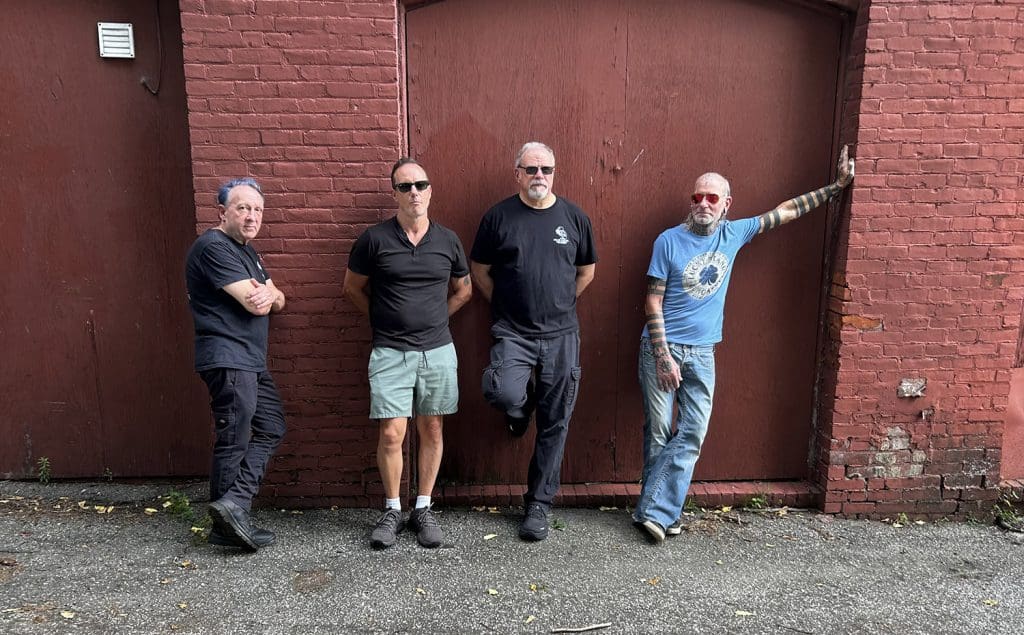
When you hear that a band that you used to follow is getting back together after a long period of not releasing music, you’re not quite sure what to expect. You conjecture that maybe they’ll be acting as a cover band of their former glory, playing the same setlist they played twenty-five years ago. However, that’s not the case with Holy Cow. When I talked to David Deschenes, longtime bass player for the band and founder of Head Chunk Records, he made sure I knew the deal. “Holy Cow never officially broke up. It just kind of stopped,” he told me. “The scene kind of went away. There was a long time that nobody was doing this type of music.” Now, decades after Holy Cow’s debut on the New England scene with a sound that was a blend of post-punk, noise, and all things dark, three original members of the group are back writing new material. Heading to the studio to record a new project this September, the band is figuring out just how a band with this much history actually plays a show in 2026.
To get a picture of how this group came together, let’s go back to New Bedford, MA in 1983, a working-class town where, as Deschenes relays, the gothic, industrial sound Holy Cow was trying to create really didn’t exist yet in America. “Nobody was really doing what we were doing,” he said. They certainly were outliers there, but Providence, with live music venues like Lupo’s and The Living Room, became the place that actually welcomed them in. “This scene just kind of opened their arms to us,” Deschenes said. It’s part of the reason why, years after those clubs made such an impact on the group, Deschenes has stayed in that world. He’s currently booking shows, including at The Met, and still maintaining relationships he developed with people in the scene back when Holy Cow was just doing open slots on a Wednesday night that only a scant crowd of people were showing up for.
The origin story of the band might be the most interesting piece of lore that Deschenes left me with, and it started as a joke. Lead singer Chris Means invented a fake persona to open for his older brother’s band, masquerading as a rock star from England who’d just arrived to tour the US. “For a little while, people thought he was who he was pretending to be,” Deschenes shared. But once people found out that this had been a prank, they ended up loving the whole idea. Deschenes wasn’t even a musician at the time, more like a roadie who happened to own a guitar that he’d noodle around with. But when the budding band’s real bass player bailed as the group began bubbling more on the local scene, the original guitarist came to Deschenes with an offer he’s still surprised he agreed to, years later. “He said, ‘These basslines are really easy, I could teach them to you.’ I said, ‘First of all, I’ve never played bass. I don’t have a bass, I don’t have an amp, I don’t have any of this stuff.’” He ended up borrowing all of it. “I stayed in the band 15 years after that,” he said. “I had never picked up the bass before the day I joined Holy Cow.”
That DIY attitude has always been one of the main tenets of the Holy Cow mindset. Deschenes started the independent label Head Chunk Records not to sign the band to anyone, but simply as a way to put their own music out. Once it existed, it was a win-win to be able to put out records for some of their friends’ bands too. “We were trying to build a little bit of a scene,” he said. We can see that philosophy manifesting again now in how the band is funding this new album: selling T-shirts and receiving help from longtime fans to cover studio costs ahead of the record. “People have been so gracious to us,” Deschenes said. “I think that’s why people bought so many T-shirts. Maybe they needed a T-shirt, but they were also trying to help.”
Holy Cow is a far cry from what I’m used to listening to and gravitate towards, or what’s playing on the radio on your drive home. Noise, dark soundscapes, screaming, and rawness aren’t what most people consider “easy listening.” But it’s rife with all sorts of musicality, and the more I sat with it, the more I was able to get into the way the group deliberately builds a world with their music. Their more recent album, Soul Box, is a good entry point for that. The intro track, “Brenna/Nauseuous in Glass,” opens on a dark, disorienting soundscape, but later tracks settle into more driving guitar or bass riffs that stick in your head, alongside heartfelt, more delicate moments that differ entirely from the punk and gothic influences that the band is known for. For example, the song “A Man” is one that Means wrote the day after his grandfather passed away, dedicated to a man everyone in the band adored. “Chris came to practice, we all cried,” Deschenes recounts. “It wasn’t a dry eye in the room. That was a beautiful, beautiful song.” This band was never just trying to be unsettling for the shock value, and it’s great that I got the backstory behind that to shed new light on the song and Holy Cow’s music as a whole. If you’ve got eclectic tastes, Holy Cow’s brand of out-there might just be for you.
As for what’s next, the plan is new music first, doing some local shows in New Bedford and Providence, then eventually an East Coast circuit of some old haunts from the band’s early days. If the response to some T-shirts and Facebook posts is any indication of the impact this group has left on its supporters, Deschenes and Holy Cow aren’t stressing over whether people still care about what they’re doing. “We won’t know for sure until we put out some new music,” he said. “But it seems like people are anxious for that.”
Keep an eye out for some new Holy Cow music this fall, and consider supporting them by grabbing a T-shirt at their Facebook page fb.com/TheLegendaryHolyCow.