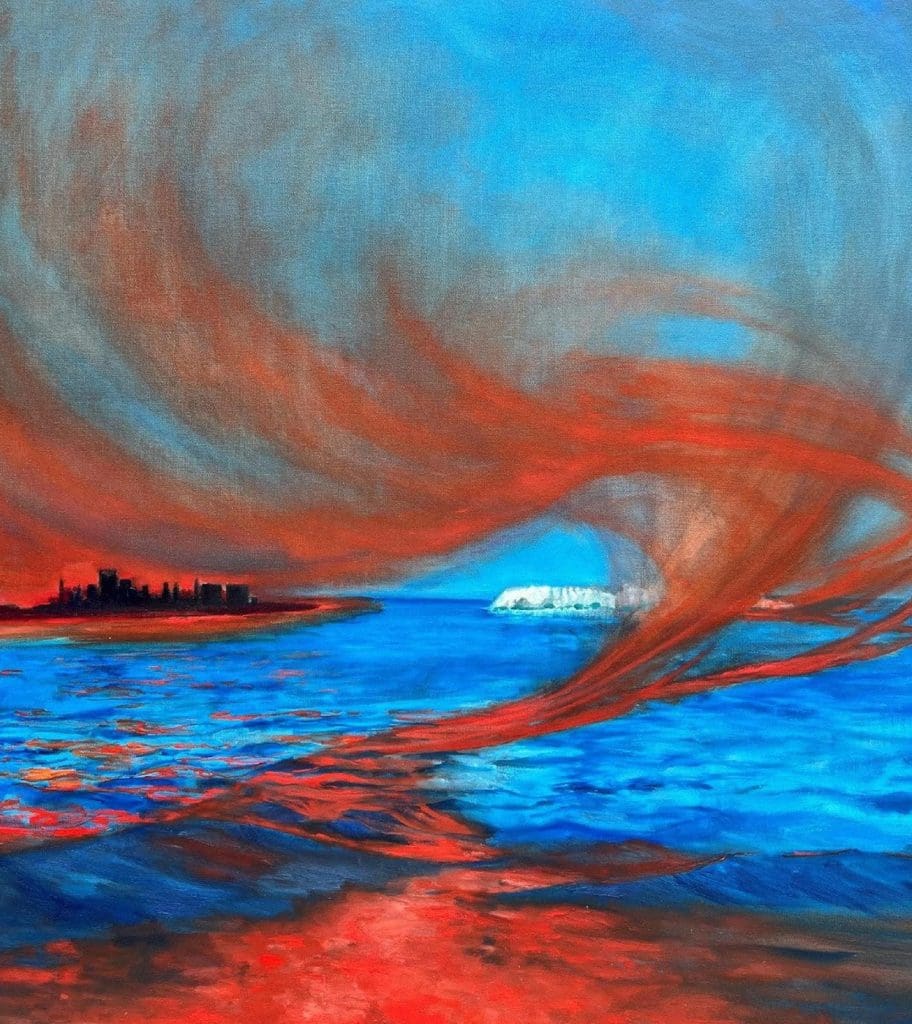
For many of us, our most common run-ins with the scientific disciplines happen in two places: the classroom or a news headline. I think it’s safe to say both might elicit quite the negative association for many people. Reading a research paper, as Ellen Matesanz, director of The Synergy Project put it, “is like going into another language. A lot of the terms aren’t familiar to people.” The project she leads at Synergy is making headway in translating. It pairs scientists with artists and gives them about a year to turn complex scientific research into something a person can stand in front of and feel. With the project’s latest exhibition on display at the University of Rhode Island’s Graduate School of Oceanography, I spoke with Matesanz about the origins of the project, its inner workings, and why it matters so much in today’s climate.
Synergy began humbly in 2013 as a one-time experiment. A PhD candidate at the Woods Hole Oceanographic Institution, curious about how the public perceives and consumes science, gathered her colleagues and a group of artists from UMass Dartmouth. Rather than assign partners, the organizers staged what Matesanz lightheartedly calls “speed dating.” Scientists and artists had lunch, got to know one another, and paired off for collaborations. The resulting work was exhibited at the Boston Museum of Science and then the New Bedford Art Museum. After that, participants graduated and the project went dormant.
Matesanz came into this project from a path that bridged both worlds. She started college as a biology major, switched to art, and spent years working at Brown University’s School of Medicine, managing science labs and working alongside physicians. “I’m not a clinician, but I worked with so many in my career that I know them very well, and I know how they work,” she shared. Now retired, she joined the board of directors at Art League RI, where an artist from the original program phoned her out of the blue and asked if she’d consider resurrecting it. “My sparks went off, both my science side and my art side,” she recounted. “I said absolutely, let’s do it.”
Since then, the project has grown quickly. The current group, Cohort #3, drew 64 applicants, and the collaborations now extend beyond Woods Hole to URI’s Graduate School of Oceanography, its College of the Environment and Life Sciences, and its College of Pharmacy. Matesanz credits her background for the structure. “I knew how to speak to scientists in a way that they would perhaps be more comfortable with. I knew how to work with artists.”
The organic nature of the pairing process is what makes the outcome feel so intuitive to visitors who check out the exhibitions. Applicants are asked to describe their work and why it matters to them, and scientists send in the kinds of charts and graphs they’d use in a paper. But no one is assigned a partner. Through a series of opportunities to meet and chat, people find the collaborator who resonates, with teams taking a couple of months to form. They then work together for months, checking in regularly while the whole cohort meets monthly over Zoom to discuss the process and any struggles.
One might think, “How does a visual artist and a scientific researcher work together to create a cohesive work when those disciplines are (seemingly) so different?” Picture an artist paired with a scientist who studies microscopic organisms in the sea. “How do you tease that out into an art form?” Matesanz asked. The answer is a lot of conversation and experimentation, an unexpected overlap between these two oceans of knowledge. The scientists are often somewhat artistic and creative, and the artists sometimes have scientific backgrounds.
“Scientists and artists are not dissimilar,” Matesanz said. “They just have a different set of processes. Science is very pure and you have factual information. It’s hard to be super creative in science. You’re going to find answers based on observation and experimentation. In art, you can do anything you want. You can be very free and expressive. So the two together have created a really interesting way of collaboration.” The commonality is that both observe closely and ask what happens if they experiment and try something different.
The same subject can manifest entirely different outcomes depending on who is working on it. Ocean eddies, for example, have been interpreted by artists in countless ways. One scientist has turned research into dance, working with a Boston dance collective to translate ocean motion into choreography. “There can be thousands of interpretations, depending on the perspective of the artist and the scientist working together,” Matesanz said.
She has seen the beauty and artistry hiding in science herself. During her time working in neurosurgery, she came across a book of microscopic images of cells from brain tissue. “You couldn’t really tell the difference between a stained cancer cell and a normal, healthy cell, because they were both beautiful,” she recalled. The experience convinced her that art, science, and nature were not meant to be sorted into separate boxes. “As a society, we’ve been more likely to silo them. You don’t need to silo them, because they overlap so much.” I mentioned how I’ve noticed the shift in K-12 schooling, where the naming convention “STEM” is now often “STEAM,” with the arts mentioned alongside the nation’s focus on science and math. “The idea of collaborative, multidisciplinary creation and learning is really the way we need to go,” she said.
Matesanz is also candid about the timing. Synergy is a way to bring a science message to “people who may not understand why a certain thing is important to our entire climate,” at a moment she describes as one of “political turmoil about science.” Art, she suggests, may be a way to reach people who would never consider reading a scientific journal.
It’s an exciting time for The Synergy Project as they grow in several directions. They have reservations at galleries around RI and into Massachusetts, plans to bring the concept to schools, and more video storytelling in the works to get this message in front of more people. Past participants always have a place as well. “Once you’re a Synergy partner, you’re always a Synergy partner.” She spearheads this passion project pro bono, out of her own love for the work. The question of who this work is meant for has an easy answer. “Everyone,” Matesanz enthusiastically explained.
The current exhibition, “Environmental Currents: Art and Science Explore our Changing World,” is on display now through November 18 on the URI Narragansett Bay Campus. Cohort 3’s second half will be on display soon after, with an opening reception on Friday, December 4 from 5 to 7 p.m. The reception will be free and open to the public.
Visit synergyexperience.org to learn more about their past exhibitions and to keep up to date with future events.