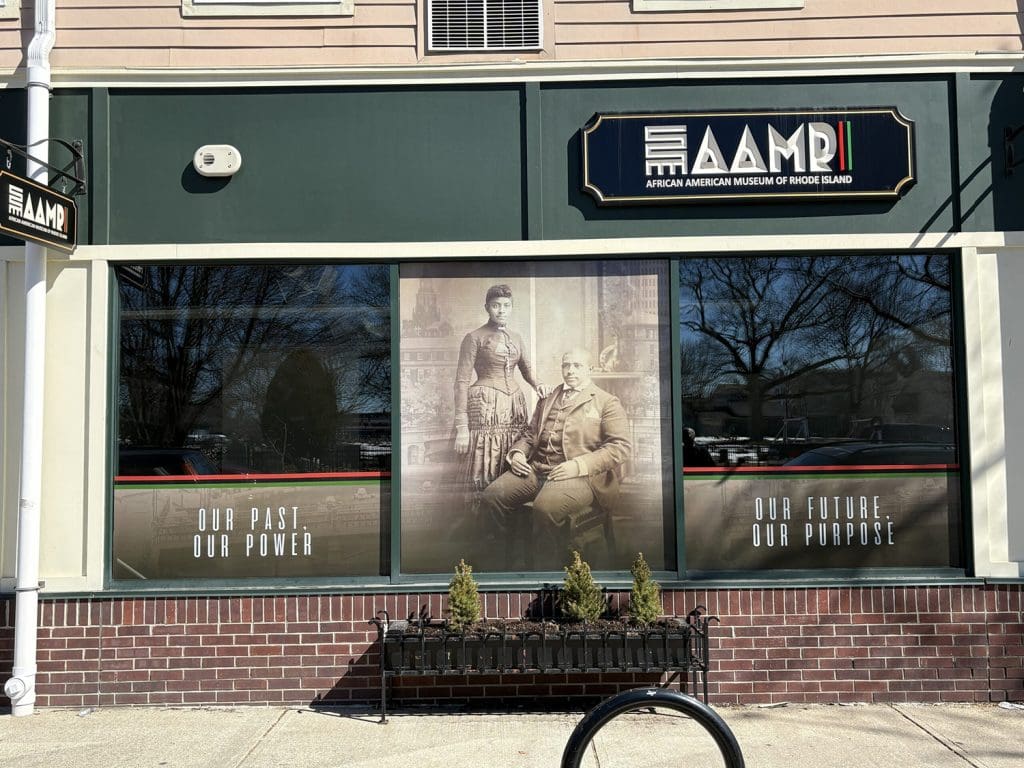
I think museums and the culture around them have historically gotten a bad rap. When you think of museums, you might associate them with classism, inaccessibility, and wealthy donors and patrons. There’s also the issue of who decides which art is displayed and whose history is deemed valuable enough to preserve. So when I came across news that the African American Museum of Rhode Island had opened this April at the First Space Gallery on Broad Street, I expected a conventional museum space: stories of famous Black Americans and pieces of history I might have learned about in school or heard through television, music, or other pop culture. What I found instead was not your typical museum at all, but a cultural hub built by the community it’s meant to serve that intentionally foregrounds the untold stories of the people who are Rhode Island’s Black history, even if you’ve never heard their names.
The idea for this museum has been in the works since 2024, when a group of concerned community members, led by founder Helen Baskerville-Dukes, realized the striking circumstance that there was not a single Black-operated museum anywhere in RI. I was able to chat with Dr. Melaine Ferdinand-King, the museum’s Associate Director and inaugural curator, about how this grassroots effort came together in such an impactful way and why she chose to open its doors with this first exhibition, “Welcome to the Neighborhood: Mapping Black Providence in Art and Archives 1940s-1970s.”
“We found it especially important for African American folks to be able to tell their own story and to be able to serve in leadership when it comes to the discovery, preservation, and dissemination of African American history and cultural ideas,” Dr. Ferdinand-King told me. From 2024 to now, a board organized fundraising, built partnerships, and worked with great care toward this year’s opening. It includes a space for exhibitions that will rotate throughout the year, but will also serve as a space for community gathering and intermittent programming, done in collaboration with institutions like the Rhode Island Historical Society and the University of Rhode Island.
That intentionality, handing the story back to the people usually left out of it, is precisely what the museum was able to execute so well in this inaugural exhibition, “Welcome to the Neighborhood,” which focuses on Black Providence life from the 1940s through the 1970s. Not the household names of Black history, but what the exhibit calls “Black quotidian.” I asked Dr. Ferdinand-King why she chose the everyday over stories of Black exceptionalism, or what W.E.B. DuBois called “the talented tenth,”” as a first impression for the space.
“History is made up by those in-between moments, by the people who are not famous, by the people who are doing the cooking and the cleaning and the teaching in our everyday lives,” she explains. She pointed out that museums, as institutions, have a habit of “privileging a select few, the talented tenth, as the torchbearers of our social and political groups, when really, like how the museum was founded, it just took everyday people with an idea and with an intention to organize in order to make a wonderful dream come to fruition.”
That philosophy shows up across each wall of the space. One section lays out the mechanics of urban renewal in PVD and how the Federal Housing Act of 1949 gave cities the authority to demolish neighborhoods labeled “blighted,” and how that level landed, again and again, on the places where Black residents lived. I think it’s also worth noting that the concentration of Black residents in specific neighborhoods was not their decision, but was imposed on them because they were intentionally excluded from white neighborhoods. But no matter the city, the story of Black Americans has always been one of resilience, community, and joy, despite the trials they’ve faced in this country. Towards the back of the room, I loved getting a glimpse of what daily life was like in these neighborhoods: the Black-owned businesses that lined streets, the role churches played, the recreation and youth programs kids grew up in, and the political organizing that took place. One idea that really stuck with me is that “families were expected to share some responsibility for community oversight and mutual aid. You always hear the saying “it takes a village,” and I think this community ethic that, unfortunately, we don’t see so much anymore in the modern day, is fascinating .
None of this archiving was easy work, either. “There weren’t too many archives that were made accessible to us in forming this exhibition,” Dr. Ferdinand-King shared, noting that even the Rhode Island Black Heritage Society’s own archive remains closed to the public. Instead, the exhibit was built out of basements, attics, and living rooms, compiling family photographs, some of them damaged, reproduced, and framed by volunteers, alongside images from renowned photographer Omar Bradley.
I think my favorite component of the exhibit had to be the Memory Map, an interactive piece built in collaboration with the Map Center in Pawtucket, where visitors pin their own neighborhoods and memories onto PVD’s geography. Dr. Ferdinand-King described it as “a kind of ephemeral monument,” and one story from it has stuck with her: a visitor who placed a pin and suddenly remembered dancing in the street as a child, a memory she said she hadn’t recalled in decades. “It gives me chills thinking about it,” Dr. Ferdinand-King said, “because we don’t give enough credit to the ways that these interactive spaces can create wellings of emotion, and that emotion is not only special and sentimental, but it’s also significant data. It means that people feel connected to their geographies and connected to the place.”
Over the next few years, the museum hopes to expand into a full research center with an acquisitions department, a place where families can donate photographs, documents, and artwork. When asked what the museum hopes its visitors get out of the experience, Dr. Ferdinand-King left me with this: “People say it all the time, but we’ve been here before. History shows us that there’s nothing new under the sun. It’s just that all of these situations, these instances, the fraught political terrain, look a little different. But this is a shared history. It is a method of white supremacy to divide and conquer,” explaining how separate museums for different groups is segregation of memory itself. “If you care about this country, you should care about all sides of its telling.”
I strongly encourage you to take a walk through the space yourself and learn something new about local history. Go see “Welcome to the Neighborhood,” sit with the Memory Map for a moment, placing a pin on your house and comparing it to what the neighborhood was like ‘back in the day.’ If you’re able, consider chipping in to support the museum as well: a museum built by community members needs the rest of its community to do our part and be their support system. The beautiful thing that sets this museum apart is that it’s an open door.
Learn more, plan a visit, or donate at aam-ri.org, or follow on Instagram @aamuseumri.