Category: Nationally relevant

Articles relevant beyond the local area
  • Suspect Dead in Brown Mass Shooting and MIT Professor Murder: Authorities say crimes committed by single suspect

    Suspect Dead in Brown Mass Shooting and MIT Professor Murder: Authorities say crimes committed by single suspect

    Claudio Manuel Neves-Valente, identified by authorities as the suspect in both the Dec 13 mass shooting at Brown University in Providence that killed two and injured nine and the Dec 15 murder of MIT Professor Nuno F.G. Loureiro in Brookline, MA, was found dead of a self-inflicted gunshot wound on Dec 18 in a storage locker in Salem, NH.

    In a Thursday night press conference in Providence beginning around 9:30pm, local and federal police said that Valente, age 48, and Loureiro, age 47, had been undergraduate classmates together at the Instituto Superior Técnico in Lisbon (Portugal). Loureiro graduated with bachelor’s and master’s degrees in physics in 2000, while Neves-Valente was “terminated” according to a report in Vanity Fair. In a press conference in Boston beginning around 10:30pm, US Attorney for Massachusetts Leah Foley confirmed the same suspect committed both crimes.

    An affidavit filed by Providence Police in RI said Neves-Valente was a Portuguese national who was a PhD candidate in physics at Brown on a student visa during Fall 2000 and Spring 2001 semesters, taking a leave of absence and eventually withdrawing in Fall 2003. He then appears to have left the United States until receiving permanent resident status in 2017 through the “Green Card Lottery,” which has a 0.25% chance of success with over 20 million applications.

    The suspect took considerable effort to evade capture, Foley said, switching out European SIM cards to prevent cellular telephone tracking and covering the Florida registration plate on his Boston rental car with a Maine plate not registered to any vehicle. Col Oscar Perez, Providence Police chief, said the suspect used side streets and avoided main streets to try to evade plate reading cameras.

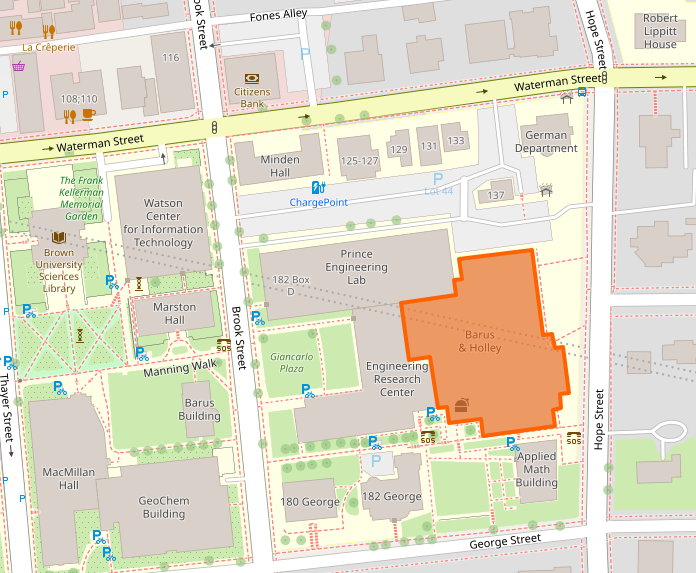
    There were two main breaks in the case, according to the affidavit. A Brown custodian told police he recalled meeting a suspicious person in the Barus-Holley Building, the site of the Dec 13 shooting, earlier on Nov 28 and Dec 1, and this person matched the appearance of the “person of interest” and walked with a limp. This report enabled police to find surveillance camera video from inside the building on Dec 1.

    Reddit post by “John” on Dec 15 at 9:30pm EST. Source: https://www.reddit.com/r/providence/comments/1pnkwoq/comment/nu9c70a/ )

    The second break resulted from an individual identified by police only as “John” who posted on Reddit, the social media web site, on Dec 15 at 9:30pm EST, by user “lamin_kaare” in the “r/providence” subreddit:

    I’m being dead serious. The police need to look into a grey Nissan with Florida plates, possibly a rental. That was the car he was driving. It was parked in front of the little shack behind the Rhode Island Historical Society on the Cooke St side. I know because he used his key fob to open the car, approached it and then something prompted him to back away. When he backed away he relocked the car. I found that odd so when he circled the block I approached the car and that is when I saw the Florida plates. He was parked in the section between the gate of the RIHS and the corner of Cooke and George St.

    According to the affidavit, police regarded this post as highly credible once they learned of it because a Brown faculty member reported on Dec 17 an encounter at 9:15am on Dec 11 with a suspicious gray sedan with Florida plates driving unusually slowly on Waterman Street toward Thayer Street.

    When made aware that Providence Police wanted to speak with him, “John” approached two officers near Brown Alumni Hall and agreed to be transported to headquarters for a voluntary interview. He said he noticed the suspect because he was dressed inappropriately and inadequately for the weather, wearing a “flimsy” jacket and gloves. He said he first encountered the suspect in a bathroom in the Barus-Holly Building about two hours before the shooting, was in close proximity and “locked eyes” with him. After this encounter in the bathroom, the suspect exited the building into the parking lot.

    “John” decided to follow the suspect along Manning Street and near the RI Historical Society saw him approach a gray or silver sedan which flashed its lights as if being unlocked by a key fob, but when the suspect saw “John” turned and walked away from the vehicle. “John“ looked inside and saw two “fanny pack” bags on the floor, then remained in the area, seeing the suspect return repeatedly but turn away each time he saw “John” in what was described as “a game of cat and mouse.” Finally, on George Street, the suspect began running away and “John” ran after him, “speed-walked” past him, and turned around to confront the suspect, saying “Your car is back there. Why are you circling the block?” The suspect then said, in what “John” said seemed an Hispanic accent, “I don’t know you from nobody. Why are you harassing me?” After that, the suspect walked back toward the car and “John” broke off.

    Subsequently on Dec 17 at 11:12pm EST, ‘John” posted again on Reddit

    The following is all I will say regarding the matter. This evening I spoke to Providence Police, the Rhode Island State Police and I imagine the FBI were listening in another room. They know who I am. I am not the individual posted in the recent round of photos. I wish that individual Godspeed and if they have yet to come forward I strongly encourage them to do so. All the law enforcement personnel that I interacted with today were extremely professional and worked hard to really put me at ease. Respectfully, I have said all I have to say on the matter to the right people. If any follow up is needed the right people know how to reach out to me. Though it is certainly your right to try, any news media attempting to reach out to me will not receive a response. This is a pseudo-PSA and my participation in the comments will be limited to upvoting reasonable takes. Thank you for your time and let’s hope the POI is apprehended soon so the authorities can get to the bottom of this. Hopefully you all are able to enjoy the holidays with your family and loved ones but if you are not may the following days treat you kindly.

    Once the police had the location and description of the car, a Nissan Sentra, they were able to use surveillance camera video from the RI Historical Society and city-operated Flock traffic cameras to determine the plate number, which led to the Alamo Rent-a-Car office on Boston, which had identifying data for the lessee including financial information and surveillance video of the rental transaction on Dec 1 at 11:36am. The first hit of the plate on the Flock readers was later that same day at 5:50pm, at the intersection of Camp Street and Doyle Avenue. The Flock readers detected the plate a total of 14 times.

    With this financial information, authorities determined that the suspect had rented a locker at Extra Space Storage in Salem, NH. When the FBI SWAT team arrived, the suspect was already dead from a self-inflicted gunshot wound. He had the rental car and two handguns, one found near his thigh and the other near his leg.

    As of early Friday morning, authorities said they do not know a motive for either crime and do not know why the suspect targeted Brown University or his former classmate from Portugal.

    Strong public support has been expressed on social media for giving “John” the $50,000 reward offered by the FBl.

  • First Snow of Season in RI Likely Early Sun: Accumulation 3 – 5 inches expected

    First Snow of Season in RI Likely Early Sun: Accumulation 3 – 5 inches expected

    Winter Weather Advisory in effect from December 13, 10:00 PM EST until December 14, 07:00 PM EST

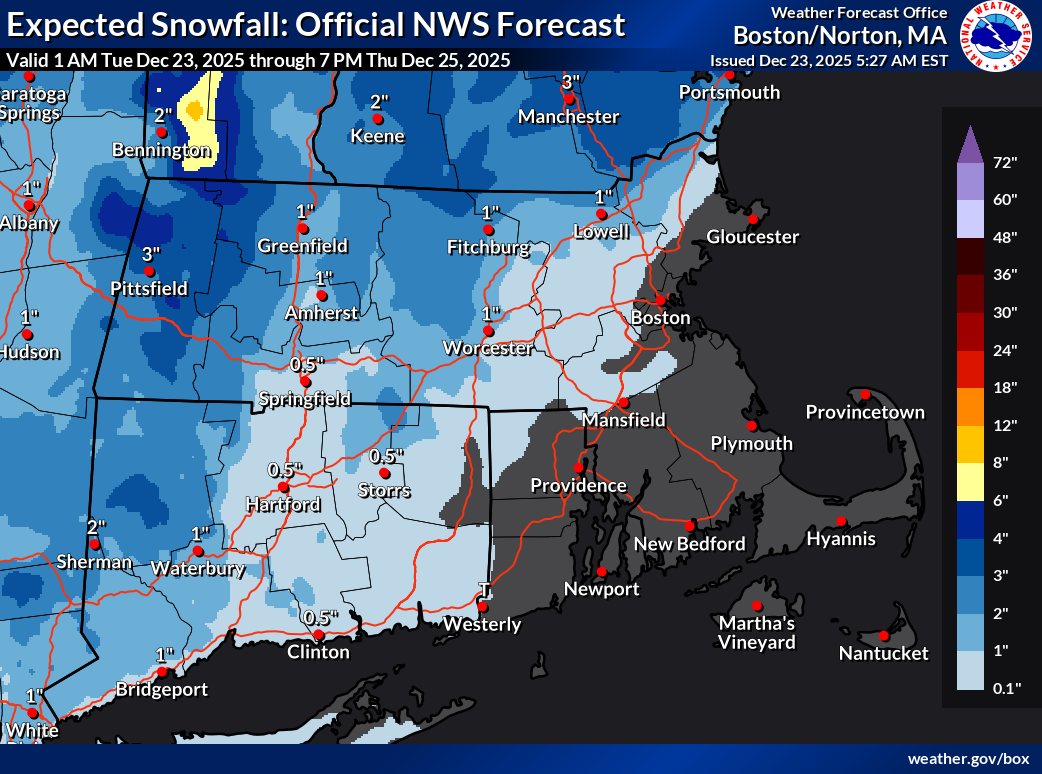
    At Providence, a weak storm system is expected to bring 3 – 5 inches of snow Sun 1am – 9am. A Winter Weather Advisory Sat 10pm – Sun 7pm covers RI south of Providence, including Bristol, Kent, and Washington Counties, but technically not Providence per se.

    Current probability in the metropolitan area is of at least 0.1in 98%, 1in 94%, 2in 84%, 4in 51%, 6in 24%, 8in 6%, 12in near 0%. The most likely scenario is that snow will begin Sun 1am and continue as all snow, with almost no chance of mixing with or changing to rain; the bulk of accumulation will occur during the earlier part of the storm, snow tapering off before ending Sun 9am although some straggling snow could continue as late as 9pm.

    A stream of cold and dry air from the north is expected to keep nearly all accumulation toward the south, with somewhat higher amounts along the southern coast, the opposite of the familiar nor’easter. That mass of air will result in temperatures falling into the teens overnight Sun into Mon, reaching down to 14°F immediately before sunrise and Mon afternoon high 27°F. After another cold night Mon into Tue, dropping to 21°F, warming will bring afternoon highs Wed 44°F and Thu 45°F.

    At Gillette Stadium in Foxborough, MA, the site of the NFL game between the Buffalo Bills and the New England Patriots, snow is expected to end hours before the Sun 1pm kickoff time, temperature 30°F and snowfall on the ground a dusting to 1 inch.

  • Two Killed, Eight Injured in Shooting at Brown University: “Person of interest” released from custody

    Two Killed, Eight Injured in Shooting at Brown University: “Person of interest” released from custody

    Two were killed and another nine were injured in a shooting shortly after 4pm Sat, Dec 13, on the first floor of the seven-story Barus and Holley Building, 184 Hope St, Providence, the engineering and physics department headquarters on the Brown University campus. As of 11pm, Providence Mayor Brett Smiley said the shooter remains at large and unidentified, and a “shelter in place” precaution remains in effect for the campus and surrounding area.

    Providence Police supplied to Motif a surveillance video taken from the exterior of the Barus and Holley Building, showing a man considered the suspect walking north on Hope Street and turning right to walk east on Waterman Street. The suspect is seen wearing dark clothing, including a hat and gloves, and is never facing the camera. No other “useful”video has yet been identified by police, although they are actively reviewing other footage.

    All of the shooting victims were students, confirmed Brown President Christina Paxson, and were being treated at RI Hospital. Of the eight surviving victims, one is reported in critical condition, six are reported in “critical but stable” condition, and one is reported in stable condition. (A ninth person took themselves to the hospital after realizing they had minor injuries; they were treated and released.)

    Smiley said the city is not at this time recommending cancellation of events, and the police will deploy a heavy protective presence. Reportedly, Trinity Rep canceled their Sat evening show and Providence Place Mall closed early on Sat. However, a concert with an estimated 12,000 attendees went ahead as scheduled at the Amica Mutual Pavilion (Civic Center) with an enhanced police presence.

    RI Gov. Daniel McKee said that he has spoken with President Donald Trump and FBI Director Kash Patel, who offered assistance. The FBI has set up a web tip line – fbi.gov/brownuniversityshooting – and Providence Police set up a telephone tip line 401-652-5767. The FBI site allows uploading photo and video files.

    UPDATE Sun Dec 14, 6:45am: Brown University has lifted the “shelter in place” order. CNN reports that dozens of police officers raided a (still unnamed) hotel and took into custody a “person of interest” who may or may not be the shooting suspect.

    UPDATE 7:25am: Smiley confirmed that a “person of interest” has been detained. Col. Oscar Perez, chief of Providence Police, said that he was limited in details he can share about the detained individual. Ted Docks, special agent in charge of the FBI Boston office, implied the detention was accomplished by local law enforcement. Perez declined when asked to identify the hotel where the detainee was located or to discuss their affiliation with the university. Perez said that street closures in Providence at this point are for the purpose of preserving and collecting evidence on and near the campus. Smiley says that enhanced police presence is intended to be “comforting and reassuring,” not because of any concrete threat, and they are still not yet ready to identify the victims.

    UPDATE Mon Dec 15, 12:30am: The “person of interest” will be released from custody, RI Attorney General Peter Neronha announced at a late night press conference. While “certainly there was some degree of evidence that pointed to the individual… that evidence needed to be corroborated and confirmed. And over the last 24 hours, leading into just very, very recently, that evidence now points in a different direction.” This means, “We have a murderer out there,” he acknowledged. Smiley said that ”the news is likely to cause fresh anxiety for our community.”

  • Predictions for 2026 Include Increasing Crises: US pushing the envelope of political and economic instability

    Predictions for 2026 Include Increasing Crises: US pushing the envelope of political and economic instability

    I am not optimistic in the short term, but I am in the long term. I’ve watched the country go through terrible upheavals, back to the Vietnam War and the election of Richard Nixon as president, which in combination normalized cynicism about whether society is trying to help or hurt ordinary people.

    The leaked Pentagon Papers revealed that the Vietnam War had no goal and could not be won, but worse, that the government knew this as it lied to the public and for years continued wasting the lives of soldiers on a hopeless cause. The Watergate scandal, where Nixon, a Republican, tried to rig the upcoming election by sending spies to plant listening devices into Democratic headquarters, and then covered it up, resulted in his forced resignation.

    What ultimately protects the nation is not the “checks and balances” taught in school, but the willingness of the people themselves to stand up and say, “I’m as mad as hell and I’m not going to take this anymore!” The American Revolution was fought by a bunch of ordinary people who simply did not like being told what to do by a king and parliament thousands of miles away. The 50501 movement (“50 protests. 50 states. 1 movement.”) named its protest events “No Kings” as an explicit evocation of this history, drawing five million participants in June and seven million in October. The widely publicized Lichbach–Chenoweth–Stephan “3.5% rule” is an empirical finding in political science that the probability of a non-violent protest movement to succeed in overthrowing even the most repressive and autocratic government reaches near-certainty if a large enough minority support it, even passively. For the US, 3.5% of the 330 million population is about 11.5 million: The No Kings events, repeatedly breaking their own records as the largest single-day protests in American history, are approaching that.

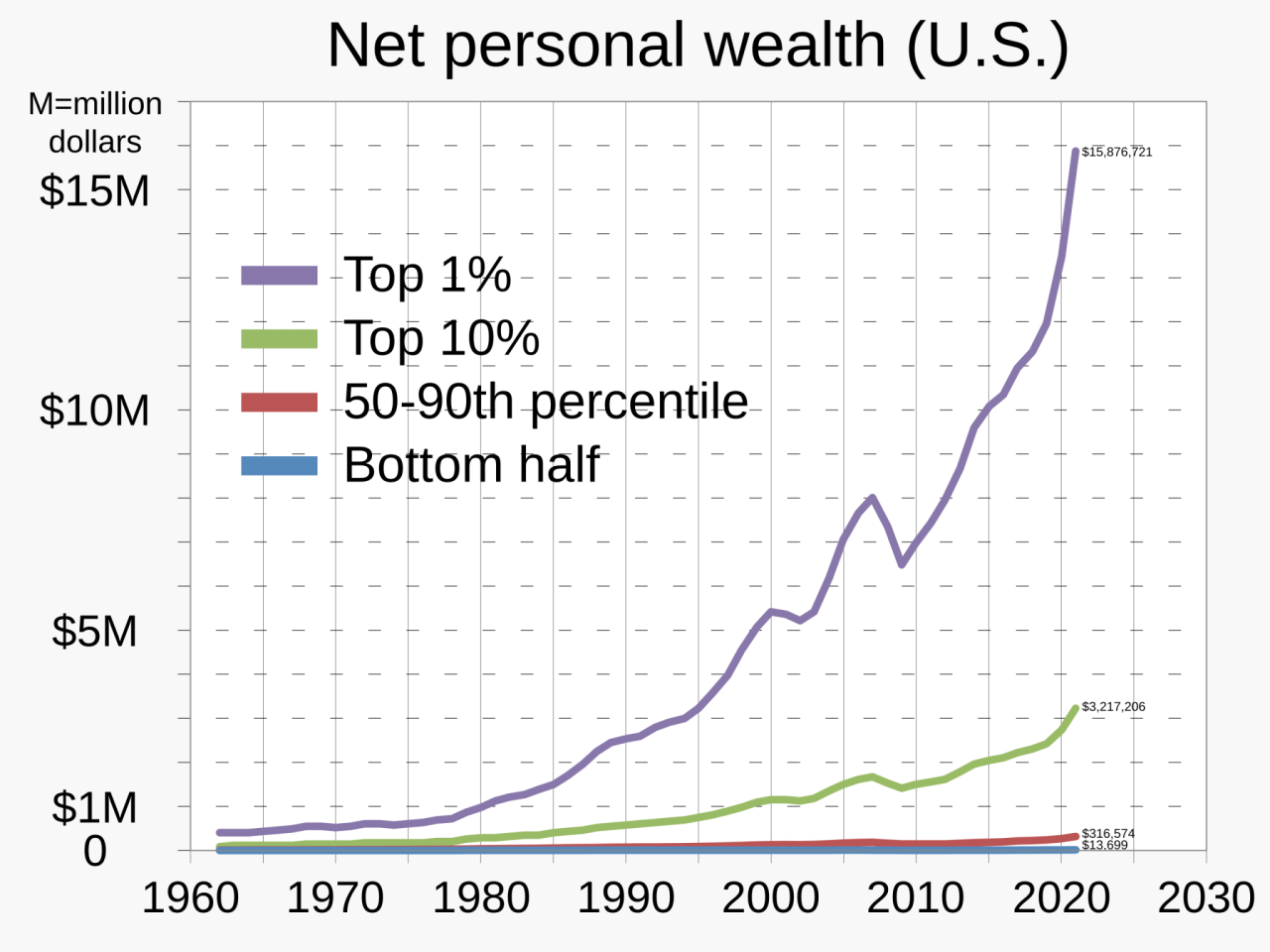
    Source: https://commons.wikimedia.org/wiki/File:1962-_Net_personal_wealth_-_average_in_percentile_ranges_-_linear_scale_-_US.svg Credit: RCraig09 (CC-BY-SA 4.0)

    I see Donald Trump’s MAGA movement not as anything fundamentally new or different, but as the end stage of the Tea Party movement, a point I made in 2019 during Trump’s first term. From the end of World War II in 1945 until the peak of the Nixon era around 1970, the economy grew in such a way that it benefited everybody, raising the income and standard of living of the poor as well as the rich. Since about 1980 and the Ronald Reagan era, almost all of the benefits of the phenomenal growth in national wealth accrued to the richest 20%, leaving the poorest 80% effectively stagnant in real income and standard of living. Such growing income inequality is unsustainable. What is really going on here is a generational transfer of wealth to old people, sticking their children and grandchildren with trillions of dollars in debt, pushing them out of the traditional middle class so they will never, for example, be able to afford to buy a house.

    Across the tax cuts by the Trump administration in 2017 and 2025, the non-partisan Congressional Budget Office (CBO) predicts the national debt will increase an additional $4.4 trillion (beyond the already primed-to-occur $1 trillion every 100 days), Medicaid will be cut by $800 billion by removing 11 million people from health insurance, and Supplemental Nutrition Assistance Programs (SNAP “food stamps”) will be cut by $300 billion. At the same time, defense spending will increase by $150 billion and immigration enforcement will be increased by a factor of ten to $150 billion. Rural hospitals and medical providers will go out of business.

    Trump cuts to international health assistance will result in 4 million AIDS deaths and an additional 6 million HIV infections by 2029. Trump cuts to medical research of $1.8 billion, mostly through the National Institutes of Health, will devastate universities where they will be forced to lay off highly skilled staff and close laboratories, leaving a swath of research destruction that will take decades to repair.

    Adding to such political and economic instability, Donald Trump himself exhibits obvious indications of clinical dementia, frequently evidencing paraphasia both phonological (“Thick and thrim,” when he meant, “Thick and thin”), and semantic (“Israel faces the threat of Zionism”). Widespread speculation that he is concealing congestive heart failure or transient ischemic strokes, or both, arises from his swollen ankles, bruised hands, apparent drooping on one side of his face, and unexplained disappearance from public view for days at a time. Recently, Trump claimed to have undergone MRI testing but not to know on which part of his body it was performed. In 2020, during his first term, Trump was clearly hiding information from the press and the public about his testing positive for COVID-19, so there is ample precedent of him hiding health issues.

    Trump might get away with lying about tariffs because only 45% of the public know they are taxes paid by American importers and ultimately consumers, but people know from personal experience he is lying about the price of groceries and of electricity. People understand the extremely simple issue of the Epstein files, sensing a cover-up of conduct almost certainly embarrassing if not criminal. These are tenuous lies that are already starting to unravel.

    To summarize, during the next year I expect a crack-up of the existing government structure. There is a substantial chance, maybe a likelihood, that Trump will face health issues leaving him unable to function – he may even die – before the midterm elections in 2026. Congress is reverting to polarized paralysis and repeated standoffs, even government shutdowns, every few months, the next due to explode on Jan 30.

    One good sign is that Congress will investigate possible war crimes of murdering shipwrecked survivors, after attacks on small Venezuelan boats, a bipartisan effort announced by the House and Senate Armed Services Committee chairs and ranking minority members, the latter including Sen. Jack Reed from RI.

    The No Kings protests will get even bigger, but that could go either way in terms of results: Hopefully enough members of Congress will read the handwriting on the wall and assert themselves against the president; or Trump will give in to his gut inclinations and send troops to pacify what he sees as an insurrection.

    The way out in the long term, meaning after the midterm election, is for a broad consensus to develop that tax cuts for the old and wealthy, funded by heaping unmanageable debt onto the young and middle-class, has to stop, not only because it is unsustainable in practice, but because it is fundamentally immoral. If we are lucky, the newly elected Congress will be in a position to pursue this. The Founders of our nation wrote in the memorable Preamble to the Constitution that their goal was, “To form a more perfect Union, establish Justice, insure domestic Tranquility, provide for the common defence, promote the general Welfare, and secure the Blessings of Liberty to ourselves and our Posterity.” That posterity thing was not a mere afterthought.

  • No Kings Day

    Reporting by Steve Ahlquist and Sabrina Ruiz

    On October 18, at least 15,000 people gathered outside the Rhode Island State House in Providence, joining countless other cities and towns across the United States to condemn President Trump’s fascist overreach and to declare that America has no kings, and the power belongs to the people.

    Here are all the speakers at the event. Direct links to each speaker are indexed in the description:

    The march was so long that the beginning of the march met the end of the march when it looped back towards the State House.

    A rule called the 3.5% Rule developed by political scientist Erica Chenoweth suggests that if a peaceful protest can sustain participation by 3.5% of a population (or more), it has a real chance of influencing policy and politics. 39,000 people would be 3.5% of RI. If the numerous geographic protests of October 18 are added together, we are close but not quite there yet with something like 20 – 25,000 total. Nationally, about 7 million people took part, with a mathematical goal of about 12 million. Considering the first round of No Kings protests, June 14, attracted around 10,000 in RI between multiple sites (4 – 5 million nationally), we seem to be accelerating rapidly. The 3.5% is meant as an indicator, not a magic number, where protesters represent a level of broader dissatisfaction among those not inclined to protest. But if this movement can continue growing at this pace, it could represent real change – so keep an eye out for the next No Kings rally near you. Most of the notifications come out through social media from local activists, but you can also keep an eye on nokings.org

    Speakers at the October event included emcee Alisha Pina, PVD Mayoral candidate David Morales, and RI state senator Tiara Mack.

    Emcee Pina declared, “This is what we deserve — peaceful treatment, human kindness … Right now we don’t need a king. We don’t need a fascist. We don’t need dictators. We don’t need tyranny. And we sure don’t need hate … We’re going to help when ICE comes. We’re going to help our neighbors because that’s what they are. They are not others, they are our neighbors. They’re Rhode Islanders.”

    “Say it loud and say it clear! Immigrants are welcomed here!” Morales told an enthusiastically receptive crowd, “And for that reason, we are here today to reject all forms of fascism, including ICE, because ICE is not welcome in Rhode Island! … Together we’re going to demonstrate that Rhode Island is a home for everyone, especially our immigrant brothers, sisters, and nonbinary friends.”

    Tiara Mack added, “I am here to remind you that love and solidarity are more important than what they try to do to divide us … No action of solidarity is too small … It is our duty to fight for our freedom.”

    With some attendees dancing around in inflatable or over-the-top outfits, and a calm police presence watching over events, the demonstrations were entirely, inspiringly non-violent.

  • Opinion: TRUMP’s ALL-POWERFUL EXECUTIVE BRANCH CAN’T DISGUISE HIS CLUELESS CABINET

    Our Republic was designed around independence to prevent any one person, institution, or corporation from taking too much power over neighboring communities, organizations, or government branches. The Constitutional laws, courts and Congress that reflect most Americans’ virtues enforce the checks and balances on executive power and partake in a social contract in which Trump has broken. 

    Trump has put on a great show of strengthening the Executive branch of government over Congress and the Supreme Court. Some of his cabinet appointments and their questionable cuts to public funds were not even approved by Congress. Yes, RI’s overbilling on Medicaid and lack of adequate recycling facilities is fraudulent and wasteful but we’ll never know the depths of waste, fraud, and abuse that happen elsewhere, because Trump fired the Inspector General responsible for determining its existence, and blocked the courts from inspecting for it. If waste, fraud, and abuse exists elsewhere in RI or in the federal government, few Rhode Islanders will enjoy tax relief from cuts to it, as federal workers are still paid to work from home. Fire first, ask questions later. 

    Trump has cut funding for badly needed housing and infrastructure without Congressional pushback, even downplaying the need for the FEMA to help states fight natural disasters. Meanwhile Hollywood burns down, Providence homelessness worsens and our bridges fall apart. Instead of showing compassionate concern and a sense of urgency, the first thing Trump can think of asking fire-ravaged CA or NC is whether they have voter IDs and will “be nice to him.” Do you think these disaster victims are thinking about whether their state has less woke ideas or whether state militias can provide as reliable and trustworthy assistance as FEMA? The state of RI can’t tackle either homelessness or bridge reconstruction without federal funds, and has had to choose the latter over the former. Millions of dollars were appropriated for infrastructure by the previous US administration, only to have the current administration cut funding for low-carbon building materials (like concrete and cement RI has already imported a ton of). Expenses continue to rise even as federal funding shrinks.

    Congress and the Supreme Court alike have refused to step in and check the President’s ambitions, preferring to ignore or not to weigh in on many of their former responsibilities, including protecting our rights (aka, 14th amendment, affirmative action), our funds, or holding the President accountable for his attempted coup in January of 2021. Congress helped Trump bend the law and pick Supreme Court justices whose appointment should have belonged to the previous administration. One more liberal on the Supreme Court would have saved women’s reproductive health from years of hand wringing, red tape, and overall conservative condescension — and preserved the dignity of Black people whose posts at government and business alike are undermined. 

    Trump could go a long way in making sure his executive cabinet is not only loyal, but better at what they do, as the strength of the executive branch over the opposition cannot hide the mediocrity of Trump’s cabinet. For one, Trump could send his Secretary of State abroad instead of his son in case there’s a foreign policy crisis requiring expertise. His Intelligence and Defense secretaries are incompetent as they, in addition to disdaining women’s service in the military, repeatedly and knowingly leaked top-secret war plans or left them in a printer, which is both sloppy and sexist. I wonder why many military and law enforcement personnel continue to support the President’s cabinet even after knowing this, or after he insulted McCain’s valor in Vietnam and praised what he called a beautiful day and beautiful people who battered Capitol police officers. 

    Secondly, his push for a more production-oriented economy conceals his department’s ongoing push for over-consumption detrimental to Americans health and savings accounts. The Secretaries of Energy and the Interior should know that our already record-high supplies of US oil extraction remove the need to cut down forests for drilling. The so-called “energy emergency” ignores reduced need for large, gas-guzzling cars, and demand for a wider array of less expensive fuel sources. What we actually need is more refineries, not oil rigs, and this reveals Trump’s misunderstanding of supply chains. The gasoline and asphalt important for fueling our cars and paving our roads is imported into Providence from Gulf Coast refineries, along with the aforementioned concrete, cement, and lumber from Canada. Trump’s tariffs will continue to make driving and road maintenance more expensive in a state already notorious for its rotten roads. The cost of tariffs will also offset clean building materials planned for use to rebuild the Washington Bridge prior to the President’s cancellation of our funds.  Rhode Island’s construction of much needed wind farms also risks losing federal funding after millions were spent on state-of-the art manufacturing boats on the Long Island Sound. In addition to energy infrastructure, how about retail and transit reforms instead of oil extraction? There is no mention in Project 2025 about anti-trust enforcement to revive local town economies or the Department of Transportation’s affordable railway investments to connect them. Providence could insource the manufacture of electrical, HVAC and transportation equipment to offset the loss of toy and textile manufacturing in the city, and to make jobs more accessible for Providence residents who may not drive.   

    Similarly, Secretary of Health RFK Jr. makes little mention about reducing sugar and corn syrup on our shelves for diabetics, which is a far more urgent healthcare need than reducing additives and preservatives in food and water. RFK also downplays the need for vaccines and the FDA to prevent harm that would come from uniformed choices. Trump’s “Mandate for Leadership” already promotes advanced science through Department Energy so why would RFK downplay its importance for medical science as vaccines and cancer research also fall under that umbrella? The military has to vaccinate people before they enlist to keep their fighting units safe and effective so it’s a wonder why some Republicans who support the military make such a fuss about vaccine mandates. If RFK Jr. cuts funding for vaccines and fluoridated water, it will mean more cavities and sicker, less vaccinated people. The lack of a sound drug policy and healthy alternatives to current food and fossil fuels affects Americans’ health. 

    Trump should also restore funding to education and the arts, including PBS and NPR. How could Republican law-makers who are well-educated writers fear or despise public education and the arts? What do Republicans that cut the arts and PBS expect to see when they visit Europe on vacation one day, and how do they expect to educate our children? We need books, trades and Harvard brains which stand more of the test of time than guns, military brawn, or the Spartan ”macho” culture too often reflected in our current times.

    Lastly, cuts to the Department of Education, in addition to cuts to racial diversity in our universities and workforce, will make us a dumber country with even more inequality. RI public schools need funding so students can afford books, computers, and lab equipment, to prepare students for jobs in the state, so they can compete with other states and with the rest of the world.  High taxes and inappropriate regulation in the state of Rhode Island already strain downtown businesses that otherwise employ more young, middle-class workers. We must continue to provide services and funding that help students learn, so they can contribute to the RI economy after graduation. We need to reform rather than cut the Education Department, which teaches DDID students and protects them from discrimination. Cutting education and social services are only a drop in the bucket in savings for taxpayers and Congress is responsible for keeping it running regardless of the President’s opinion. The President would also be wise to keep those few cabinet members that are competent and listen to the Federal Reserve and Labor Commissioner McEntarfer’s feedback on employment statistics, instead of firing her. What’s his next labor commissioner going to report, lies about the economy? Lincoln once picked a disagreeable “team of rivals” as a cabinet, which didn’t sail smoothly during his own first term, but who were at least competent. Trump may want to get his act together or else devolve the executive branch into another revolving door cabinet as confusing as his 1st term in office.

  • Opinion — Zohran Mamdani and the Pyrrhic Victory of the Democratic Party: Why he is the leftist version of Donald Trump with all of the same problems

    Opinion — Zohran Mamdani and the Pyrrhic Victory of the Democratic Party: Why he is the leftist version of Donald Trump with all of the same problems

    Zohran Mamdani protest sign (Credit: Oleg Yunakov, CC-BY-SA-4.0 via Wikimedia Commons)

    Mayor-elect of New York City Zohran Mamdani is a self-avowed “democratic socialist,” and his policy proposals include free public transit, free child care, city-run grocery stores, and free everything else, all funded by increasing taxes on corporations and wealthy city residents. Mamdani has based his suddenly rocketing popularity on telling people what they want to hear, untethered from reality. His promises are the flip-side of MAGA promising to revitalize fossil fuels, domestic manufacturing, and heavy industry, which by now should be clear to everyone were a con game that could never happen. MAGA was not even able to reduce the price of eggs.

    I really despise Donald Trump, and I pretty much called him a fascist a week before he won the 2016 presidential election. I wrote then, “In many respects, the extremes of right and left are indistinguishable, leading to serious challenges of basic definition… Presumably when Adolf Hitler called himself a ‘national socialist’ and Bernie Sanders called himself a ‘democratic socialist,’ they had two different meanings in mind for the same word – but they did, nevertheless, use the same word.”

    While one could make a plausible case for higher taxes on corporations and the wealthy on a national basis, especially as a way to limit disastrously growing inequality, it is outright absurd on a citywide basis. Firstly, trying to impose heavy taxes within a city, even New York City, will motivate the parties heavily taxed to consider simply moving elsewhere. It is a hassle for a major corporation or a wealthy individual to exit the United States, but much easier to move from New York to Texas. Secondly, imposition of such taxes is beyond the power of the New York City government, and would require action by the state legislature in distant Albany; even New York Governor Kathy Hochul, a Democrat, has explicitly opposed the Mamdani tax plan.

    As Mamdani will soon find out, telling people what they want to hear may be a strategy for short-term increased popularity and even election victory, especially when running against opponents who are seriously flawed – disgraced former Governor Andrew Cuomo and extremist talk-show host Curtis Sliwa, who came to prominence almost 50 years ago as the founder of the Guardian Angels, a roving band of vigilantes

    In the late 1970s and early 1980s, New York City was widely perceived and portrayed as a dystopian wasteland in works of fiction such as Escape from New York and in real life by bad actors such as subway shooter Bernhard Goetz. MAGA seems stuck in this false mythology of decades ago, as when Donald Trump bought a full-page ad demanding the death penalty for the Central Park Five – five Black boys, aged 14 to 16, charged with raping a jogger, who turned out to be innocent after their confessions were shown to have been coerced.

    Indeed, some of Mamdani’s proposals have merit if they could be funded. In 2015, I endorsed making bus rides free in RI by eliminating fares entirely, arguing it would lead to economic growth. I asked the then-executive director of RIPTA, Scott Avedisian, about this, and he replied, “Find me $50 million and I’ll do it.” Ironically, as the former mayor of Warwick, population 83,000, Avedisian was far more in touch with the basics of practical governance than the newly elected mayor of New York City, population 8,800,000.

    The real danger from Mamdani is not that he will prove to be a disappointing mayor unable to keep any of his key promises, which seems inevitable, but that Democrats will mistake the sources of his popularity and embrace his unworkable ideas. That is exactly what has trapped Republicans in the unreality of MAGA, where “alternative facts” and “truth isn’t truth” (Rudy Giuliani), have come to define post-truth politics.

    Since his student days, Mamdani has defined himself as anti-Zionist and sought to delegitimize the State of Israel, and more recently has defended his use of the slogan “Globalize the Intifada,” criticized by ADL Executive Director Jonathan Greenblatt as “An explicit call for violence. ‘Globalize the Intifada’ celebrates and glorifies savagery and terror…” On another occasion, Greenblatt said, “Antizionism is antisemitism. Antizionism as an ideology is rooted in rage. It is predicated on one concept: the negation of another people.” Entire articles have been devoted to documenting many conflicting and inconsistent statements, including “What Zohran Mamdani has actually said about Jews, Israel and antisemitism.” After the election the ADL announced a public tracker called a “Mamdani Monitor.”

    More than one thousand American rabbis signed an open letter, “A Rabbinic Call to Action: Defending the Jewish Future,” stating, “When public figures like New York mayoral candidate Zohran Mamdani refuse to condemn violent slogans, deny Israel’s legitimacy, and accuse the Jewish state of genocide, they… ‘Delegitimize the Jewish community and encourage and exacerbate hostility toward Judaism and Jews.’”

    It would be a mistake for Democrats to learn from this a perhaps fatally flawed lesson that normalizing anti-Zionism is a recipe for electoral success, as Republicans learned from the remark famously attributed to James Baker, secretary of state under George H.W. Bush, “Fuck the Jews, they don’t vote for us, anyway.” In the world’s city with the largest number of Jews, Cuomo, despite his liabilities as a deeply disgraced former governor, outpolled Mamdani among Jewish voters by a 2-to-1 margin, indicating the profound distrust the Jewish community has for Mamdani. Exit polls found 67% said the candidates’ positions on Israel factored into their vote, with 38% calling those positions a major factor.

    Democrats enjoyed remarkable electoral success on Nov 4, winning the governorships of New Jersey and Virginia by much greater margins than expected, and winning a few races they were not expected to win, such as attorney general in Virginia, and surprisingly increasing their majority in the Virginian House of Delegates from 51 to 64 seats. Democrats broke the Republican supermajority in the legislature of Mississippi, an overwhelmingly Republican state. California Proposition 50, allowing the state to redistrict congressional seats to offset a competing move in Texas, passed 63.9% – 36.1%, possibly deciding majority control of the US House of Representatives in the Nov 2026 election.

    Both the far-right and the far-left, by their nature, need to find scapegoats to blame when their policies fail. Each lives in a fantasy world where their utopian policies would work if not for the nefarious forces conspiring against them. Cheaper eggs? Climate change? Free child care? You’re angry that the only job you can get is gig work with no benefits? That can be fixed by sending masked thugs to abduct Latinos off the street and prevent them from competing with you. You’re angry that you’ll never be able to afford a middle-class lifestyle and buy a house? That can be fixed by punishing those foreign globalist bankers stealing your money. Trump and Mamdani will be pandering for scapegoats, but different scapegoats for different failed policies. History demonstrates that it is never just the Jews even if it starts with the Jews.

    Democratic success was in large part a reaction against MAGA insanity, including masked ICE thugs kidnapping people off public streets and boasting about shooting others; a government shutdown that puts at risk food aid for the poor, weather prediction, and safety of air traffic control; and physical demolition of the East Wing of the White House. Countering MAGA effectively is going to be helped neither by promising free stuff that cannot really be delivered nor by demonizing Jews.

  • Full SNAP Benefits Must be Paid by Fri, Nov 7, Court Orders: Judge seems incredulous that partial payments resulted in delays; government appeals

    Full SNAP Benefits Must be Paid by Fri, Nov 7, Court Orders: Judge seems incredulous that partial payments resulted in delays; government appeals

    Michael Bilow of Motif attended the 3:30pm court hearing and is reporting based on his personal observations.

    At a hearing in US District Court in Providence on the afternoon of Thu, Nov 6, Judge John J. McConnell Jr seemed incredulous that the option in his Oct 31 order to make partial instead of full Supplemental Nutrition Assistance Program (SNAP) (formerly “food stamp”) payments for November, intended to speed up the process and get those partial benefits to recipients by no later than Wed, Nov 5, actually introduced delays that the government contended could add weeks or months. Because the federal government provides money to state governments for further disbursal to recipients, and states never before needed to calculate partial payments, the practical effect was to introduce substantial procedural delay in making benefits available for use, the judge was told.

    The failure of Congress to authorize spending in the new fiscal year that began Oct 1 has resulted in a shutdown of the federal government, including monthly US Department of Agriculture (USDA) SNAP payments due Nov 1 to about 42 million recipients.

    “The administration was required under this Court’s Order to immediately make the full payment for November SNAP benefits considering the finding of irreparable harm that would occur. And just to be clear, irreparable harm means harm to families, elderly, children, and others that cannot be undone. The evidence shows that people will go hungry, food pantries will be overburdened, and needless suffering will occur. That’s what irreparable harm here means. Last weekend, SNAP benefits lapsed for the first time in our nation’s history. This is a problem that could have and should have been avoided,” the judge said from the bench.

    Kristin Bateman of the Democracy Forward Foundation, arguing for the plaintiffs, used only three of her allotted 15 minutes of argument. “This court’s order gave defendants a choice. They could fully fund November SNAP benefits, or they could come up with a plan to partially fund those benefits using the contingency funds, so long as that plan allowed for expeditious and timely payment to the beneficiaries who rely on SNAP for food, and so long as that plan was not arbitrary and capricious The defendants have not done that. By their own admission, their plan will mean that in some states, beneficiaries don’t get the money they need for food for weeks or even months, and the reasons they have given for making that choice are facially implausible. They say that they are doing that to conserve needed funding for child nutrition programs like school lunches, but tapping into those funds now to fully fund the November SNAP benefits will not take needed money away from those child nutrition programs unless the government shutdown lasts until next June. Basing a decision on such a highly unlikely set of events is not reasoned decision making, and it’s particularly unreasonable because the defendants have not explained why they would choose to let 42 million Americans, including 16 million children, go hungry now, in order to guard against the extreme outside chance that come June, there won’t be enough money to fund child nutrition programs,” Bateman argued.

    “In fact, the record shows that conserving money for child nutrition programs is not the reason; that’s a pretext. What defendants are really trying to do is to leverage people’s hunger to gain partisan political advantage in the shutdown fight. In these particular facts and circumstances, the defendants choice not to fully fund November SNAP benefits is arbitrary and capricious, and, in these particular facts and circumstances, the court should order defendants to provide that full funding immediately. It’s already six days into November. People are waiting for the assistance they need to be able to afford food, and there’s no more time to wait. So we would ask that the court enforce its existing order by requiring immediate release of the funds necessary to make full November SNAP payments,” Bateman said.

    As a result, the judge issued a new order that the federal government make full rather than partial payments for November, and that this be done within one day on Fri, Nov 7. The judge held that in addition to contingency funds already consumed to make partial payments, the necessary funds could be drawn from reserves under Section 32 of the Agricultural Adjustment Act of 1935, derived from 30% of customs receipts on imports from the prior calendar year, and therefore constitute a permanent statutory appropriation by Congress.

    “The administration erroneously and unintentionally conflates Section 32 funds and the child nutrition programs by referring to them in tandem, as though they were one and the same. In essence, they erroneously claim that Section 32 funds are to be used exclusively to fund the child nutrition program, but that is incorrect,” the judge said from the bench. “While much of this funding has been appropriated for the child nutrition program, USDA has statutory authority under 7 USC §2257 to authorize transfers of these funds interchangeably for the ‘miscellaneous expenses of the work of any bureau, division, or office of the Department of Agriculture.’”

    The judge noted that USDA had previously used Section 32 funds to keep the Women, Infants, and Children (WIC) program running, undermining any legal objection to doing it for SNAP, and drawing $4 billion from Section 32 reserves to fully fund SNAP for November would still leave more than $19 billion in the fund. While the government contends that drawing from Section 32 reserves could put 29 million children at risk of there being insufficient funds for child nutrition programs traditionally funded this way, the judge said that the evidence was that would not happen unless the government shutdown extended past May 2026, which he deemed “implausible,” and if Congress did not act to restore SNAP funding and replenish the account. “More importantly, without SNAP funding for the month of November, 16 million children are immediately at risk of going hungry. This should never happen in America. In fact, it’s likely that SNAP recipients are hungry as we sit here,” the judge said from the bench.

    Truth social post by Donald Trump stating intent to defy court orders on SNAP funding, Nov 4, 2025. (Source: https://truthsocial.com/@realDonaldTrump/posts/115492285081397189 )

    Judge McConnell repeatedly referenced a Truth Social post by President Donald Trump, “The president stated his intent to defy the Court Order when he said, quote, SNAP payments will be given only when the government opens, unquote.” (What Trump actually wrote was, “SNAP BENEFITS… will be given only when the Radical Left Democrats open up government, which they can easily do, and not before!”) The judge at the end of the hearing, which lasted less than a half-hour, returned to this point, “The defendant’s stated desire to conserve funding for the child nutrition program is entirely pretextual given the numerous statements made in recent weeks by the President and his administration officials who admit to withholding full SNAP benefits for political reasons.”

    Despite outright finding that the government claims were “pretextual,” a blunt way of accusing the government of lying, the judge was careful to acknowledge the difficult if not impossible position the attorney representing USDA, Tyler Becker, found himself in: “I’m not accusing you, and I don’t think the plaintiffs are either, of bad faith in it, or of acting inappropriate. I think what the plaintiffs are saying – I mean, they’ve not, and I think rightly so, haven’t asked for contempt – what they’re merely saying is: enforce the order that is plain and straightforward, and clearly the government didn’t read the order in its plain language in that regard…”

    Indeed, the judge noted that, as federal employees, Becker and the Court staff needed to hold the hearing were all working without pay.

    Judge McConnell in Providence appeared so angry that, without any actual request from the government, he preempted such a request and said from the bench, “The request for a stay of this decision, either a stay or an administrative stay, is denied. People have gone without for too long. Not making payments to them for even another day is simply unacceptable.” Such a stay, which would delay the effect of his order, is relatively ordinary if the case is appealed, as he clearly expected.

    After the close of the hearing, the court issued a 27-page written opinion detailing the terms of its order. Almost immediately, the government filed a notice of appeal to the First Circuit in Boston.

    The case in Providence at the US District Court for the District of Rhode Island is Rhode Island State Council of Churches et al. v. Rollins et al. (1:25-cv-00569). The case in Boston at the US Court of Appeal for the First Circuit is Rhode Island State Council of Churches et al. v. Rollins et al. (25-2089).

    UPDATE: The First Circuit in the early evening of Fri, Nov 7, denied the government request for an administrative stay of the lower court order, effectively allowing the payment of full SNAP benefits by the end of the day. The government then asked the US Supreme Court for an emergency stay, which was granted by Justice Ketanji Brown Jackson in her capacity as the duty justice assigned to handle emergencies from the First Circuit, which she granted late that night, providing that full SNAP benefits need not be paid until 48 hours after the First Circuit makes its decision, allowing time for a further appeal by either side to the Supreme Court.

    UPDATE: The First Circuit at 11:49pm, Nov 9, issued a 29-page opinion in favor of the lower court order that full SNAP benefits be paid.

    See our coverage of the SNAP crisis:

    “SNAP Benefits Must Be Paid, PVD Federal Court Rules: Contingency funds must be used despite government objections”, by Michael Bilow, Oct 31, 2025.

    “SNAP (Food Stamps) Emergency: RI announces support during federal shutdown”, by Michael Bilow, Oct 29, 2025.

  • SNAP Benefits Must Be Paid, PVD Federal Court Rules: Contingency funds must be used despite government objections

    SNAP Benefits Must Be Paid, PVD Federal Court Rules: Contingency funds must be used despite government objections

    Michael Bilow of Motif attended the 1:00pm court hearing and is reporting based on his personal observations.

    In a case with national significance and effect, Judge John J. McConnell Jr of the US District Court in Providence today granted a Temporary Restraining Order (TRO) requiring the US Department of Agriculture (USDA) to make Supplemental Nutrition Assistance Program (SNAP) (formerly “food stamp”) payments due Nov 1 to about 42 million recipients. Citing the failure of Congress to pass financial authorization for the fiscal year beginning Oct 1, 2025, the government issued notices on Oct 24 that SNAP payments would be interrupted due to insufficient funds.

    The expected halt in SNAP payments set off widespread panic among state and local governments, as well as non-profit organizations such as community food banks and churches who would have to take up the slack to feed people. RI Governor Daniel McKee declared a state of emergency and, with the RI Foundation, committed millions of dollars to address the problem.

    A similar case brought by 25 states and the District of Columbia in the US District Court for Massachusetts emerged from a hearing at 11:00am with the motion for emergency relief remaining under advisement without resolution.

    Judge McConnell found in favor of the plaintiffs on both prongs of their case. First, they argued that the law commanded the payment of SNAP benefits as an entitlement and the refusal to use available contingency funds was arbitrary and capricious. For example, holding the congressionally-authorized “emergency reserve” for a possible future emergency such as hurricane relief did not justify failing to use it for an actual present emergency such as the failure of Congress to authorize funding specifically. Second, they argued that although the “One Big Beautiful Bill Act” (HR. 1) passed by Congress in a sharply partisan division prohibited new waivers for work requirements in high-unemployment areas, it did not authorize the early cancellation of previously granted waivers.

    The judge addressed the requirements needed to grant equitable relief to the plaintiffs: likelihood of success of the case on the merits and risk of irreparable harm.

    “On the issue of likelihood of success. It is very clear to the Court, having put the issue through a very high standard, that the October 24 letter ordering the stop of SNAP funds violates the Administrative Procedure Act, both in terms of it being contrary to law as well as it being arbitrary and capricious,” Judge McConnell said, ruling from the bench. “SNAP is, to use a colloquial term, an ‘entitlement’ where those benefits are guaranteed. Obviously, to the extent there are appropriated funds, there is no doubt that the $6 billion approximately contingency funds are appropriated funds that are without a doubt necessary to carry out the program’s operation.… There could be no greater necessity than the prohibition across the board of funds for the program’s operations. In addition, SNAP benefits have never, until now, been terminated, and the United States has, in fact, admitted that the contingency funds are appropriately used during a shutdown, and that occurred in 2019.”

    “There is no doubt, and it is beyond argument, that irreparable harm will begin to occur, if it hasn’t already occurred, in the terror it has caused some people about the availability of funding for food for their family,” Judge McConnell said, ruling from the bench. “It’s clear that, when compared to the millions of people that will go without funds for food, versus the agency’s desire not to use contingency funds in case there’s a hurricane need, the balances of those equities clearly goes on the side of ensuring that people are fed.”

    The judge was even more scathing in criticizing the government cancellation of work waivers. “The failure to honor existing waivers is contrary to law. The waivers have been granted. They’re time limited. The time in many of them has not yet expired. The HR. 1 bill that was passed does not give the agency authority to retroactively apply new waiver requirements, it does not give the agency the power to take back existing and relied upon waivers that have been given to certain states. That certainly is arbitrary and capricious, because there is no logical or rational reason why that was done, and it’s particularly egregious, as the Court has pointed out in the past, when you consider the reliance on it, the balance of the equities again balance out and the public interest to requiring that waivers that have been granted be honored for their duration,” Judge McConnell said from the bench.

    The lawsuit before Judge McConnell in Providence (Rhode Island State Council of Churches v. Rollins) was brought by RI non-profits the State Council of Churches; the United Way of Rhode Island; Amos House in Providence; the Dr. Martin Luther King, Jr. Community Center in Newport; the East Bay Community Action Program (EBCAP); Federal Hill House; The Milagros Project in Woonsocket; and the RI cities of Providence, Pawtucket, and Central Falls. National co-plaintiffs are the National Council of Nonprofits; Service Employees International Union (SEIU) AFL-CIO; Main Street Alliance; and the New York Legal Assistance Group (NYLAG). Additional plaintiffs include the cities of Albuquerque, New Mexico; Baltimore, Maryland; Columbus, Ohio; Durham, North Carolina; and New Haven, Connecticut.


  • SNAP (Food Stamps) Emergency: RI announces support during federal shutdown

    SNAP (Food Stamps) Emergency: RI announces support during federal shutdown

    RI SNAP support poster (Source: https://dhs.ri.gov/programs-and-services/supplemental-nutrition-assistance-program-snap/supplemental-nutrition-hold )

    The Supplemental Nutrition Assistance Program (SNAP), commonly known by its old name, “food stamps,” is funded primarily by the federal government but run by state governments. The money ordinarily placed on Electronic Benefits Transfer (EBT) cards on the first day of every month is expected not to be available on Nov 1 due to the shutdown of the federal government.

    RI Governor Daniel McKee declared a state of emergency in Executive Order 25-02, directing all components of state government to co-ordinate efforts to get food to people who need it, including prohibiting price gouging. McKee is directing immediate payment of $6 million through Temporary Assistance to Needy Families (TANF), which uses the same EBT cards as SNAP, to qualifying families with children, assisting 20,000 families comprising 65,000 individuals. He is also providing $200,000 to the RI Community Food Bank, which gives free food to those in need. The RI Foundation is disbursing $1 million, of which $200,000 goes to the Rhode Island Community Food Bank directly and $800,000 to its local non-profit partners. The RI AFL-CIO trade labor union consortium announced a donation of $10,000.

    The state government created a special web page to keep the public informed during the emergency: SNAPsupport.ri.gov. United Way of RI operates its telephone help center 24×7, 365 days of the year, supporting more than 200 languages, reachable by dialing 2-1-1. United Way is also enhancing accessibility for in-person consultations at its 50 Valley Street headquarters in Providence.

    The RI Community Food Bank posted a list of resources on Facebook – facebook.com/100064778588074/posts/1254541556715119 – and created a web page for those looking to help – rifoodbank.org/shutdown – through volunteering or donating. The City of Providence – providenceri.gov/food – also created a dedicated page. A searchable list of food pantries can be found at rifoodbank.org/find-food.

    About 145,000 residents of RI, 13% of the population, receive $29 million from SNAP monthly, with an average benefit of $199 per month, and in almost all cases this makes the difference in rescuing them from food insecurity. According to the non-partisan Center on Budget and Policy Priorities, SNAP recipients in RI are in families with children 49% of the time, with elderly or disabled members 46% of the time, and in families with working members 32% of the time. Of SNAP recipients in RI, 25% have income below 50% of the poverty line, 46% have income between 51% and 100% of the poverty line, and only 29% have income above 100% of the poverty line; without SNAP, 20,000 recipients, including 6,000 children, would otherwise fall beyond food insecurity into actual poverty. SNAP usage nationally doubled from about 20 million people to over 40 million following the 2007 – 2009 Great Recession.

    The federal government shutdown results from partisan political disputes that prevented Congress from passing legislation authorizing expenditures for the fiscal year that began on Oct 1, 2025. This resulted in a furlough of up to 900,000 federal employees deemed “non-essential.” About half are civilian defense employees, while many others who are deemed “essential,” such as air traffic controllers and weather forecasters, are required to continue working without pay. It is estimated that each week of shutdown causes 0.1 – 0.2 percentage points in decline of GDP growth.

    This is the 11th shutdown of the modern era, and in all past shutdowns payments continued to be made for Social Security, Medicare, Medicaid, and SNAP. Why this shutdown is halting SNAP payments is a major political controversy: the Trump administration claims they have no choice other than to halt SNAP, but 25 states, including RI, sued claiming it is illegal to do so. The case is Commonwealth of Massachusetts, et al. v. United States Department of Agriculture, 1:25-cv-13165, filed in federal district court in Massachusetts. According to the complaint:

    • For decades, low-income Americans have relied on the Supplemental Nutrition Assistance Program (SNAP) to put food on the table.
    • Across various previous federal government shutdowns, SNAP benefits have never been interrupted by a lapse in appropriations.
    • Until now: earlier this month, Defendant U.S. Department of Agriculture (USDA) suspended SNAP benefits for November.
    • Because of USDA’s actions, SNAP benefits will be delayed for the first time since the program’s inception.
    • Worse still, USDA suspended SNAP benefits even though, on information and belief, it has funds available to it that are sufficient to fund all, or at least a substantial portion, of November SNAP benefits.
    • Suspending SNAP benefits in these circumstances is both contrary to law and arbitrary and capricious under the Administrative Procedure Act.
    • USDA’s suspension of SNAP benefits is irreparably harming Plaintiff States — a harm that increases every day SNAP benefits are delayed.

    “President Trump’s failure to act is cruel and unacceptable,” said McKee in a statement. “I’m continuing to call on the President to use all available options to cover November benefits. But make no mistake, Rhode Island will not stand by and allow families to go hungry. We’re taking decisive action to protect food access wherever possible and strengthen our local food banks.”

    “When the President and his Administration blame lapsing SNAP benefits on the government shutdown, they are lying to you,” said Attorney General Peter Neronha in a statement. “The USDA has billions in contingency funds for this express purpose – so that Americans don’t go hungry waiting for their federal government to get its act together. Forty-two million Americans rely on SNAP to feed themselves and their families, including nearly 150,000 Rhode Islanders, for whom this is potentially a life-threatening situation. So, as the President prioritizes golden ballrooms over access to food, we will continue to fight on behalf of all Americans.”

    Neronha’s office further said, “USDA has funded other programs with emergency funds during this shutdown, but has refused to fund SNAP, leaving millions of Americans without the assistance they need to buy food. It is clear the federal government is making a deliberate, illegal, and inhumane choice not to fund this crucial program. The lapse in benefits will have dire consequences for the health and well-being of millions across the country, who rely on the program to feed themselves and their families. This lapse will also put unnecessary strain on state and local governments and community organizations, as families increasingly rely on emergency services and local food pantries that are already struggling to fill a growing nutrition gap.”

    The governor’s office also collected statements from government and community leaders contributing to emergency relief efforts, including Lt. Gov. Sabina Matos; Bob DaSilva, mayor of East Providence and president of the RI League of Cities and Towns; David N. Cicilline, president and CEO of the Rhode Island Foundation; Patrick Crowley, president of the RI AFL-CIO; Melissa Cherney, RI Community Food Bank CEO; Cortney Nicolato, president and CEO, United Way of RI; and Kimberly Merolla-Brito, director of the RI Department of Human Services.