At Providence, solar aurora may be visible overnight Mon into Tue, although fairly unlikely. Aurora is unusual at latitudes this far south, but it typically happens a few times every year.
Weather at Providence during the potential aurora will be partly cloudy with about 50% cloud cover, temperature about 60°F and near-zero chance of rain.
The aurora is caused by a pair of solar flares on Aug 30, a relatively small magnitude M1.3 event at 1159UTC (0759EDT) and a larger and long-duration M2.7 event at 2002UTC (1602EDT), producing a combined coronal mass ejection (CME) heading toward earth and predicted to cause a G3 (strong) storm in the earth’s geomagnetic field. Such storms are usually imperceptible to humans, but, in addition to visible aurora, they may cause disruptions of radio communications and systems that rely on orbiting satellites, such as Global Positioning System (GPS), and in rare cases can affect the electrical power grid.
CME image from Large Angle and Spectrometric COronagraph (LASCO) instrument carried on the NASA/ESA SOHO (Solar and Heliospheric Observatory) spacecraft on Aug 30, 2025, at 2030UTC.
(Source: https://lasco-www.nrl.navy.mil/index.php?p=content/realtime )
Excerpt of letter from US AG Bondi to RI Gov. McKee and RI AG Neronha, Aug 13, 2025.
US Attorney General Pamela Bondi sent a letter to RI Governor Daniel McKee and RI Attorney General Peter Neronha, dated Aug 13, stating “You are hereby notified that your jurisdiction has been identified as one that engages in sanctuary policies and practices that thwart federal immigration enforcement… This ends now.” The letter demanded a response by Aug 19.
On a US Department of Justice (DOJ) web page, RI is one of 12 states plus the District of Columbia listed as “sanctuary jurisdictions,” along with a number of counties and cities, that meet one or more of nine criteria. One notable criterion is: “Limits on ICE Detainers: Cities, states, or counties that refuse to honor ICE detainer requests unless there is a warrant signed by a judge.”
In response to our inquiry, Gov. McKee told Motif, “This generic, non-specific form letter lacks any meaningful detail and does not merit a response.”
In response to our inquiry, AG Neronha told Motif:
This letter does not change my view: it’s the tactic of a bully. And the only way to deal with a bully is to let them know that they’re not going to intimidate you. Rhode Island cooperates with all federal law enforcement agencies routinely, as required by federal law. Federal law does not require the state to divert important law enforcement resources to do the federal government’s civil immigration law bidding. If the Trump Administration takes issue with this, then the doors of federal court are open to them. Until that point, my focus is elsewhere.
An immigration detainer is a formal notice to local law enforcement (typically in RI, sent to the state prison) where federal officials request that a person who is otherwise entitled to be released instead continue to be held in custody to be picked up by federal officials for deportation proceedings.
In 2014, both the federal and state governments emphatically lost in a ruling by Judge John J. McConnell Jr of the US District Court for the District of RI, in Morales v. Chadbourne, a case brought by a plaintiff unlawfully held in the RI Adult Correctional Institution (ACI) to comply with a detainer from US Immigration and Customs Enforcement (ICE), a part of the DOJ. Guatemalan-born Ada Morales had been unlawfully subjected to immigration detainers twice, in 2004 and 2009, despite having become a naturalized US citizen in 1995 after living in the US as a lawful permanent resident since the 1980s. ICE has no authority whatsoever to issue an immigration detainer against a US citizen. She was naturalized under her maiden name, Cabrera, and her married name, Morales, by chance was recorded as an alias by a wanted person in a database.
As the case slowly crawled toward trial, the First Circuit substantially affirmed this ruling on appeal. Judge McConnell excoriated both ICE and the state in the strongest terms, finding the state outright wrong, claiming they lacked discretion not to comply with an ICE detainer, which under the law was merely a “request,” meaning the state had its own duty to check Morales’ claim to be a US citizen. Judge McConnell also noted that ICE failed to meet the legal standard of probable cause in sending the detainer to the ACI, stating a purpose to “investigate” Morales’ immigration status; Morales argued that she was held only because of her Latin surname and her having been born in Guatemala.
Immediately after this court ruling, then-Gov. Lincoln Chafee issued Executive Order 22691: “Agents of the Rhode Island executive branch shall not detain an individual pursuant to an ICE Detainer… unless ICE has obtained a judicial order of deportation or removal from the United States for the individual.” Regardless of this policy directly resulting from compliance with embarrassing adverse rulings in federal court, it precisely triggers one of the criteria for being a “sanctuary jurisdiction” as now defined by the US Department of Justice.
In response to our inquiry, Steven Brown, executive director of the RI chapter of the American Civil Liberties Uunion, told Motif:
We believe that the DOJ letter is a frivolous attempt to intimidate jurisdictions that refuse to march in step with the Trump Administration’s incredibly cruel, and often illegal, attacks on immigrant communities throughout the country. Their incredibly broad definition of “sanctuary jurisdictions” – which includes places that “prohibit local funds or resources from being used to support federal immigration enforcement efforts” – borders on the absurd.
The DOJ did not reply to an invitation from Motif to comment.
(Disclosure: As was Morales, Motif reporter Michael Bilow is currently represented by the ACLU in an unrelated public records case, Bilow v. Brown University.)
Hurricane Erin is currently at Category 2 on the Saffir-Simpson wind speed scale with maximum sustained winds of 110 MPH, and further increase in strength is likely. H. Erin briefly on Sat reached Category 5 with maximum sustained winds of 160 MPH, a significant rarity. Remember that this scale accounts only for wind speed and does not reflect other potentially deadly risks such as rainfall amounts and storm surge. H. Erin is large, with hurricane force winds extending from the center up to 105 miles and tropical storm force winds up to 265 miles.
While H. Erin poses no immediate threat to New England, it would be prudent to remain alert and keep updated as it progresses northward over the Atlantic. The predicted track keeps the storm well offshore, but any changes that bring it closer would have effects no earlier than Thu and more likely Fri. At Providence, chance of rain will exceed 80% through Thu 4am. Forecast models predict a cumulative 4% chance of tropical storm force winds at Providence from Thu through Fri.
A Storm Surge Warning is in effect for Cape Lookout to Duck, North Carolina. A Tropical Storm Warning is in effect for Beaufort Inlet, North Carolina to Chincoteague, Virginia, including Pamlico and Albemarle sounds. A Tropical Storm Watch is in effect for Bermuda.
A Tropical Storm Warning means that tropical storm conditions are expected somewhere within the warning area within the next 24 hours. A Tropical Storm Watch means that tropical storm conditions are possible within the watch area, generally within 48 hours.
A Storm Surge Warning means there is a danger of life-threatening inundation, from rising water moving inland from the coastline, during the next 36 hours in the indicated locations. This is a life-threatening situation. Persons located within these areas should take all necessary actions to protect life and property from rising water and the potential for other dangerous conditions. Promptly follow evacuation and other instructions from local officials.
In addition to high winds, life-threatening surf and rip currents are likely, as well as 2 – 4 inches of rain over affected land areas and 12 – 16 inches over water.
B-614 “Ninja” stealth bomber
(Source: Wikimedia Commons, public domain)
The United States Air Force announced that the latest addition to their arsenal, the B-614 stealth bomber, nicknamed the “Ninja,” will make its first public appearance in a flyover on Saturday, Jun 14, at the Washington DC military parade that coincides with the birthday of President Donald J. Trump.
“The Ninja is the next generation of stealth technology, going beyond invisibility to radar but also to the naked eye and ear, completely transparent and silent, using techniques pioneered at the 2016 presidential inauguration to conceal crowds,” said former Trump Press Secretary Sean Spicer, coming out of retirement for the event.
“This is an incredible plane. It’s stealth — you can’t see it,” Trump enthused about the new invisible Ninja bomber. “I said, ‘How would it do in battle with your plane?’ They say, ‘Well we have one problem — we can’t see your plane.’ That’s a big problem. Stealth, super stealth. The best in the world. We make the best military equipment in the world.”
Tech-bro entrepreneur Elon Musk reportedly landed the government contract to design and build the Ninja bombers at a price of $6 billion each, paid for in cryptocurrency from the Strategic Bitcoin Reserve. “It’s an artful deal! Invisible bombers for invisible cash,” Musk said.
It will be Trump’s 79th birthday. Demographers calculate that, based on population tables, he is only 26.4% likely to die before the end of his term. “We’re hoping to turn our dear leader’s birthday into an annual event,” said Secretary of Defense Pete Hegseth, who has been assigned a special escort to make sure he does not get drunk and wander off the parade route.
Trump was reported to be gratified by the display of loyalty and support from the military on his birthday. Despite attending the New York Military Academy and playing on the basketball team, during the Vietnam War Trump received 2-S college draft deferments from age 18 in 1964 through graduation in 1968, then was reclassified 1-Y (qualified for service only in time of war or national emergency) due to bone spurs in his heels, and eventually 4-F (not qualified for military service) in 1972. The bone spurs have become MAGA folk heroes for saving Trump from the fate of “suckers” and “losers” who lost their lives while serving. The New York Times assigned a reporter and two researchers in 2018 on a substantial project to hunt down the daughters of the deceased podiatrist and his colleague who provided the medical paperwork about bone spurs, apparently as a favor to their landlord, real estate baron Fred Trump, Donald’s father.
California Governor Gavin Newsom noted that Trump’s complete lack of military experience did not dissuade him from ordering, over the objections of the governor, 5,000 Guard troops and 700 active-duty Marines from Camp Pendleton to goosestep into Los Angeles because people were waving Mexican flags. “He’s declared a war. A war on culture, on history, on science, on knowledge itself,” Newsom said. “He’s delegitimizing news organizations, and he’s assaulting the First Amendment.”
Karoline Leavitt, the fifth person to fill the formidable shoes of Sean Spicer as Trump’s White House press secretary, said from the podium that the illustrious military wisdom of the president foreshadowed the new Ninja bomber: “You can’t see it, you can’t hear it, but you know it’s there because we tell you.” The very same thing could be said of fake news.
The RI chapter of the American Civil Liberties Union (ACLU) today (Jun 2) sued Brown University over two separate disputes since 2022 where the university, authorized to operate its own police agency as the Brown Department of Public Safety (BDPS), refused to provide records of arrests and enforcement actions that all public police agencies are required to release under the RI Access to Public Records Act (APRA).
The ACLU attorney filing the case in RI Superior Court is Fausto C. Anguilla, whose office is in North Kingstown.
The named plaintiffs are Michael Bilow, who reports for Motif Magazine, and Noble Brigham, who at the time reported for the Brown Daily Herald. Acting in their personal capacities and not on behalf of their publications, both separately filed complaints against Brown University with the RI Office of the Attorney General (RIAG) who enforces open meetings and public records law. Brown claimed that, as a private non-governmental entity, BDPS was not subject to APRA. On Jan 10, 2025, RIAG ruled for Brown and against Bilow and Noble on the grounds the law requires BDPS to file copies of all relevant records with the Providence Police, and therefore would be available under APRA that way.
Contrary to claims by Brown University, the ACLU suit states:
The APRA defines a “public body” or “agency” as: “any executive, legislative, judicial, or administrative body of the State, or any political subdivision thereof… or any other public or private agency, person, partnership, corporation or business entity acting on behalf of and/or in place of any public agency.” R.I. Gen. Laws §38-2-2(1)…
APRA thus expressly provides that a private person or entity acting in place of a public agency shall be subject to its terms.
APRA expressly mandates that arrest reports “shall be made available” under its terms. R.I. Gen Laws §38-2-3.2….
In effectuating arrests, BDPS functions precisely as a public law enforcement agency within the State of Rhode Island.
* * *
BDPS exercises a function of government, namely the basic police power of enforcing laws and maintaining peace within its jurisdiction. BDPS police have the power to search for and confiscate property, to detain, search, and arrest people, and to carry deadly weapons.…
By engaging in one of the most fundamental functions of government – the enforcement of criminal laws and exercising the power to search and seize individuals – BDPS is acting on behalf of and/or in place of a government agency or public body.
The lawsuit asks “[t]hat the court issue a declaratory judgment determining that BDPS is a public body or agency within the meaning of APRA and must comply with its terms as to requests for arrest and other law enforcement records, and further declare that BDPS violated APRA when it failed to comply with Plaintiffs’ requests for arrest records.”
In a news release from the ACLU, Anguilla said, “The purpose of this action is simple. Every city and town police department in Rhode Island must provide arrest reports under APRA. Brown’s police should not be an exception.”
Plaintiff Bilow said, “Experience has proven that preventing police abuses depends on full transparency under the law, and it is a civic responsibility of news reporting to keep the public aware and informed about what is done in their name. As a journalist, I am grateful for the help of the ACLU in furthering that mission.”
Plaintiff Brigham added, “Access to police reports is a basic public right. The public should be able to understand why police have arrested someone, and Brown’s stance that its nonprofit status exempts them from the state law every municipal Rhode Island police department follows is troubling.”
Steven Brown, executive director of the ACLU of RI, said, “It is shocking that a police department would claim that it can keep secret all of its records relating to the arrests of individuals. This lawsuit involves fundamental matters of public transparency and accountability.”
Unless a settlement is negotiated, resolving the lawsuit could take months or even years.
(The case is Bilow v. Brown University, PC-2025-02879, filed in Providence/Bristol County Superior Court)
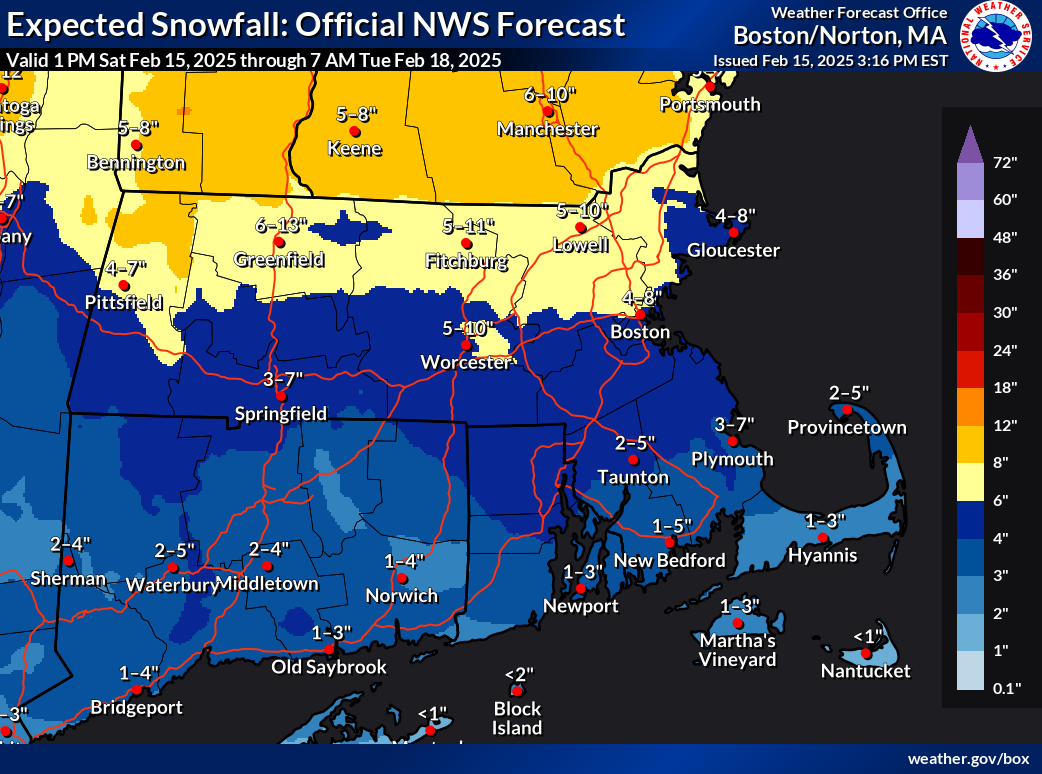
At Providence, precipitation will begin as snow Sat 5pm and change to sleet, freezing rain, and finally rain Sun 2am – 8am, before ending Sun 9pm. Icing, causing hazardous travel, is possible during the transition. Snow accumulation 3 – 5 inches is expected before the change, with temperatures rising above freezing by Sun sunrise and reaching 40°F by afternoon.
In the metropolitan area, expect 3 – 5 inches with accumulation probabilities: at least 0.1in 95%, 1in 91%, 2in 80%, 4in 45%, 6in 13%, 8in 4%, 12 in near 0%.
What will work be like in the future? Will people be replaced by artificially intelligent robots? If that happens, what kind of work will be left for people to do? And will universal basic income be necessary for survival?
The scariest part of these questions is not about potential trends in the future, but rather the thoroughly documented danger of what will happen if current trends merely continue. While there is a vast literature of economics papers published at least monthly for the past half-century, all pretty much in agreement, our society no longer bothers to notice.
Compensation Trends
In 2018, John Schmitt, Elise Gould, and Josh Bivens of the Economics Policy Institute (EPI) published “America’s slow-motion wage crisis: Four decades of slow and unequal growth,” one of many such papers distinguished not by its data but by its unusually clear language of warning: “For the last four decades, the United States has been experiencing a slow-motion wage crisis. From the end of World War II [in 1945] through the late 1970s, the US economy generated rapid wage growth that was widely shared. Since 1979, however, average wage growth has decelerated sharply, with the biggest declines in wage growth at the bottom and the middle. The same pattern of slow and unequal growth continues in the ongoing recovery from the [2009] Great Recession.” Wage changes have been worse – even negative – for some, especially women, non-whites, and non-college graduates.
Three years earlier, in 2015, Lawrence Mishel, Elise Gould, and Josh Bivens of EPI published “Wage Stagnation in Nine Charts,” each labeled with such pithy summaries as “The US middle class had $17,867 less income in 2007 because of the growth of inequality since 1979,” “Middle-class wages are stagnant – Middle-wage workers’ hourly wage is up 6% since 1979, low-wage workers’ wages are down 5%, while those with very high wages saw a 41% increase,” “Wages of young college grads have been falling since 2000,” and “The minimum wage would be over $18 had it risen along with productivity.”
Why? One big factor is that the kinds of jobs Americans hold changed, as noted in 2020 in “Forty years of falling manufacturing employment” by Katelynn Harris of the US Bureau of Labor Statistics: “Despite being a leading driver of employment growth for decades, manufacturing has shed employment over the past 40 years as the US economy has shifted to service-providing industries. In June 1979, manufacturing employment reached an all-time peak of 19.6 million. In June 2019, employment was at 12.8 million, down 6.7 million or 35 percent from the all-time peak.”
The problem is not the expansion of the service sector: After all, we need doctors and nurses, grocery workers, and many other such jobs. The problem is the contraction of the manufacturing sector, explained Mitchell Barnes, Lauren Bauer, and Wendy Edelberg of the Hamilton Project at the Brookings Institution in “Nine facts about the service sector in the United States” in 2022.
“Is this bad? Of course not. The standard of living has clearly improved … Indeed, goods can now be produced with fewer people – thanks to technological progress and automation” wrote Christian Zimmerman in 2018 on the official blog of the St Louis Federal Reserve branch. But what happens to these workers as their jobs move offshore or are automated?
In 2017, I quoted then-Gov. Gina Raimondo explaining the RI Promise scholarship program: “When I was a kid, you could graduate from high school and get a good job with a good salary to support a family. But that’s not the case anymore. In Rhode Island, it’s estimated that by 2020, seven out of every 10 [new] jobs will require some kind of education beyond high school. But right now, less than 45% of Rhode Islanders have that.” While the optimistic view is that education can solve this, there is going to be an increasing share of the population who will become unemployable because jobs they once could have held will no longer exist. College is not for everyone, especially with its cost rising three times faster than inflation for the past 40 years; but we provide almost no alternative educational tracks.
Universal Basic Income
One idea is that we should abandon the centuries-old assumption that each individual must “earn” their living or be doomed to homelessness and starvation, and instead simply give every person enough cash to survive, a concept that has become known as “universal basic income.” There have been numerous political and economic attempts to test it, but only on small and limited scales, with inconclusive results confounded by external variables. The case for UBI has historical advocates, including Thomas Paine in the early United States (1797) and Joseph Charlier in Belgium (1848), and modern advocates across the traditional left-right political spectrum. In the 1930s, trade union advocates saw universal basic income as a remedy for grossly disproportionate bargaining power between capital and labor. In the 1960s, National Welfare Rights that united disparate factions in the civil rights movement, ranging from Martin Luther King, Jr, to the Black Panther Party, saw UBI as a direct solution to poverty regardless of race. In the 1970s, conservative economists such as Milton Friedman saw universal basic income, what he called a “negative income tax,” as a straightforward replacement for traditional welfare, eliminating all of the paternalistic rules that cost the government huge time and effort to apply. He reasoned that poor people would be highly motivated and best positioned to judge how to spend their allotment. Major economic organizations, notably the World Bank and the International Monetary Fund, have seen universal basic income as an effective way to address poverty. Democratic candidate Andrew Yang called UBI the “Freedom Dividend” and made it the centerpiece of his 2020 presidential campaign.
But can we afford it? The federal debt, the amount the government has borrowed on behalf of all of the people in the country, currently stands at $36.2 trillion and is increasing by $1 trillion about every 100 days. Most of the growth in debt has occurred in recent decades. As the US Treasury put it a few months ago comparing the gross domestic product, “The average GDP for fiscal year 2024 was $28.82 T, which was less than the U.S. debt of $35.46 T. This resulted in a Debt to GDP Ratio of 123 percent.” In May 2024, the Committee for a Responsible Federal Budget reported that, for the first time, annualized interest payments on the debt ($514 billion) exceeded the cost of defense ($498 billion), Medicare ($465 billion), and Medicaid ($355 billion).
The Likely Future of Universal Basic Income
Worse, national policy has been going almost entirely the other way. As Chuck Marr, Samantha Jacoby, and George Fenton of the Center on Budget and Policy Priorities wrote in June (“The 2017 Trump Tax Law Was Skewed to the Rich, Expensive, and Failed to Deliver on Its Promises”), rather than trying to reduce poverty, tax cuts under Presidents George W. Bush and Donald J. Trump undermined the ability of the government to maintain revenue necessary to keep up with expenses: “In the three years immediately preceding the first Bush tax cuts, revenues averaged 19.5 percent of GDP, compared to 16.3 percent in the years immediately following the Trump tax cuts … according to [the Congressional Budget Office]. The revenue difference is stark: revenues in 2023, for example, would have been roughly $830 billion higher if they had totaled 19.5 percent of GDP as in the years before the Bush tax cuts.”
Former US Labor Secretary Robert Reich even predicts that the expanding debt will be exploited in a cynical political attempt to eliminate Social Security.
Motif contributor and college professor with degrees in economics and finance Maureen O’Gorman expressed the opinion to me as I was eating breakfast — I get all of my best punditry advice during breakfast — that the Baby Boomer generation has exceeded the willingness of any other to “eat its young.” That is exactly what is happening: the generation that has been electing octogenarian presidents has been borrowing profligately to give themselves tax cuts while sticking their children and grandchildren with the bill, not even stopping to worry about the profound changes likely in the next 20, 50, or even 100 years as jobs that cannot be automated become so demanding of cognitive skills and educational credentials that the average person will be unable to do them. The evidence is thin so far whether UBI will work as a solution, and it seems unlikely to be a reality in this country any time soon, but it deserves serious study and may be our best hope.
No free man shall be seized or imprisoned, or stripped of his rights or possessions, or outlawed or exiled, or deprived of his standing in any other way, nor will we proceed with force against him, or send others to do so, except by the lawful judgment of his peers or by the law of the land.
— Magna Carta, 1215
Brown University and its police department have consistently refused to respond to records requests by Motif related to arrests and court charges filed, reflecting their view that as a private institution they are not subject to laws requiring public access. Failure to respond when required is per se violation of law.
On Nov 8, 2023, a group of 20 students was arrested at a sit-in, pro-Palestine protest; according to the Brown Daily Herald, all were members of Jews for Ceasefire Now. Those charges were dropped Nov 27 after the unrelated shooting of three Palestinian Arabs in Vermont, one of them a Brown student; “We want to reduce tensions on campus, and certainly the attack on the students has helped to elevate tensions,” Brown President Christina Paxson was quoted as saying in explaining her decision. On Dec 11, 41 other students were arrested in a similar sit-in protest, but Brown refused to drop these charges. The disparate treatment of the 20 Jewish students was criticized, according to the Brown Daily Herald, by one of those arrested as part of the separate group, Brown Divest Coalition, on Dec 11: “Isabella Garo… noted that the cohort of 41 students is more racially diverse than the first 20 students who were arrested. ‘It’s also concerning that we have one group [that] did not have to navigate the system and another group that is much more racially diverse is still being subjected to the system,’ she said.” This claim, called “disingenuous” by a university spokesman, makes the identity of the arrestees newsworthy in and of itself.
Brown Police charged the Dec 11 arrestees under a special provision of state law that makes willful trespass in school buildings a non-criminal violation (§11-44-26.1), with roughly the severity of a traffic ticket, for which a first offense carries a fine of not less than $50 nor more than $500, with no possibility of jail time. This is distinct from ordinary willful trespass (§11-44-26), a criminal misdemeanor with a fine of up to $1,000 and one year in prison, or both. The clear and obvious intent of this statutory exception is to offer leniency in cases of minor misbehavior by young school students, without giving them criminal records.
On May 14, Judge Nicholas Parrillo of the 6th Division of the state District Court, over the objection of the Providence city solicitor, who was prosecuting, chose to record a “not-guilty filing” for all 41 defendants in the Dec 11 protest. This is a common practice in RI (although usually by agreement between prosecution and defense) for minor offenses, especially for first offenders: Having entered not-guilty pleas, rather than move to trial the case is postponed for a time, here six months, at the end of which the charges will be dismissed entirely if the defendant has remained of good behavior, including not being arrested for any other offense.
One of the most fundamental protections against government abuse is the right to a public trial, guaranteed in American law by the Sixth Amendment. If police could make arrests and file charges while keeping secret the identity of those arrested and the nature of the charges, it would be possible to make people “disappear.” Since the Rome Statute in 2002, enforced disappearance is formally a crime against humanity under International Humanitarian Law.
When the American constitutional framers wrote and ratified the Sixth Amendment in 1791, they had very much in mind the English Civil War of the 1640s. Leading up to that conflict, the pre-eminent legal scholar of his time, Sir Edward Coke, argued that the people had rights protected from the government and even from the king, recognized since Magna Carta became part of the English Constitution. Coke was a mentor who greatly influenced the thinking of one of his law clerks, Roger Williams, later founder of Rhode Island. Coke was cited as a legal authority by John Adams, Thomas Jefferson, and James Madison.
The US Supreme Court has clearly recognized that the public has a right of access to trials — Richmond Newspapers v. Virginia, 448 U.S. 555 (1980) — grounding that right in a combination of First Amendment freedom of the press and Fourteenth Amendment due process of law, although declining to extend to the public the Sixth Amendment protection of defendants. RI enacted the Access to Public Records Act (APRA) to provide specific procedures to facilitate the way the public obtains records, such as requiring that requests be answered within ten business days (§38-2-3(e)). RI law has a specific provision that police arrest records be released within 48 hours of a request (or 72 hours if the request is made on a weekend or holiday) (§38-2-3.2), including full name, year of birth, and nature of the charges; there are no exceptions and all adult arrest records are public.
In the days before everything was on the web, it was the traditional job of a junior reporter at a newspaper to visit each of the local police departments to obtain the daily log, detailing all of the complaints that came in regardless of whether arrests or charges resulted, and these were among the most widely read items, so readers could know what was happening in their community. Today, most police departments publish their daily log directly to the web, and larger cities (such as Providence) even publish statistical tables.
By its own terms, APRA applies not only to ordinary government departments and agencies, but to “any other public or private agency, person, partnership, corporation, or business entity acting on behalf of and/or in place of any public agency” (§38-2-2). Specifically, when the Brown University Police Department carries out a public function, including making arrests or filing criminal charges, under the plain language of the statute it is subject to APRA regardless of the general status of Brown University as a private entity. Like every other police department, it is required to disclose arrest reports, charging documents, evidence, mug shots, and all other relevant records that are of an inherently public character.
Because the Brown Police called for assistance in processing the first batch of arrests, Motif was able to obtain the list of arrestees through the Providence Police. (The City of Providence generally, and the Providence Police specifically, typically scrupulously comply with APRA.) For the second batch of arrests, Motif made a formal request to Providence for “all records, including names and photographs if available, related to arrests at Brown University on or about Dec 11 reportedly of approximately 41 students… The arrestees may have been arrested by the Brown University Police Department but were reportedly ‘processed’ by the Providence Police and, therefore, any relevant records in the possession of the Providence Police are subject to APRA regardless of the arresting agency.”
Providence Police denied any direct knowledge of the Dec 11 arrests: “The City of Providence does not maintain documents responsive to this request.… To aid in transparency, here is a bit of explanation: when we couldn’t find anything for the address of University Hall, we looked to all PPD call logs for the whole day. I’ve included a redacted excerpt from the hour before and after news reports indicated the incident happened. Nothing there (and nothing elsewhere) indicated anything happening near University Hall. The Waterman Street address at 4:30pm was in the 200 block, far to the east of campus. We then went to our communications department to see if there were any calls, and we didn’t have anything for any of the addresses we could discern for University Hall.” Our formal APRA request was then closed, and we accepted the response; it made little sense to appeal an explicit finding of an absence of records.
On Apr 29, a post on X (formerly Twitter) made us aware that the APRA response, although apparently in good faith, had to be wrong. We reopened our APRA request: “The City Council has publicly stated that the City of Providence is the charging agency of record and its solicitor is prosecuting the case, so it is inconceivable that there are no records responsive to [the] request as claimed.” The city investigated and quickly admitted their error, promising to correct it and provide the records as soon as they could:
Apologies for the delay in responding. The last month has brought greater clarity. While Public Safety apparently had no records of these arrests, the Law Department has indeed received copies of the arrest reports from Brown PD for prosecution.
I am somewhat unclear, but my understanding is that Brown Police did the “processing” of the arrested individuals, which led to our confusion here. (This is notwithstanding the reported presence of PPD officers at the site.) This is why Public Safety had no records of the arrest.
Long story short, though, we do now have the reports. However, they are hard-copies currently in the City’s case files at District Court. We are aiming to retrieve them to our office so we can scan them. Presumably Brown PD has electronic versions of them, but we express no opinion as to whether the Brown PD is subject to the APRA or whether you would be entitled to the reports from them.
On May 10, we received the records from Providence, with only the usual private information redacted, such as Social Security numbers and cellular telephone numbers. It is troubling in the extreme that it took literally five months for us to obtain records of police arrests that, under state law, are supposed to be made available within 48 hours: We could not get the records from Providence city government because they did not know they had them, we only found out they did by chance from a public tweet, and they found out from us.
List of arrestees at Brown University, Nov 8, 2023
(last name, first name)
Amullen, Ingrid Ansel
Ash, Rafael
Bloom, Samantha
Canfield, Madeline
Engelman, Ruth
Fine, Eden
Gardener, Lily
Grey, Liliana
Grossman, Eli
Klein, Simone
Lebowitz, Lucy
Marks, Anila
Mcmally, Oscar
Peters, Emila
Rabinowitz, Callie
Renaud-Levine, Maya
Robb, Jacob
Rosenzweig, Ariela
Stewart, Samual
Weil, Jonathan
List of arrestees at Brown University, Dec 11, 2023
(last name, first name, birth year)
Aboueid, Hanna (2002)
Bradley, Ava (2003)
Brand, Garrett David (2003)
Carpenter, Caitlyn Skye (2004)
Centola, Isabelle (2002)
Comer, Helene (2003)
Duke-Moe, Elizabeth (2003)
Elliot-Hart, Sadie (2002)
Epstein, Aaron Micha (2003)
Ewall, Emma Lauren (2003)
Garo, Isabella (2001)
Griffiths, Lauren (2001)
Harvey, Madison Carrell (2004)
Hattori-Lindsey, Tyshon (2002)
Hu, Karen (2002)
Ji, Mindy Kally (2002)
Joo, Alicia Sunna (2004)
Kaleel, Caroline (2001)
Kuli, Kate (2002)
Lacerte, Alex Chung (2003)
Lacerte, Bennett Shin (2005)
Levine, Ethan (2003)
Mahoney, Lorenzo (2002)
McDonald, Pilar (2000)
Nesbit, James (2002)
Noya, Lena (2002)
Ogundare, Sarah (2002)
Ouyang, Julia (2003)
Papadopoulos, Matteo Stavros (2005)
Rojas-Tineo, Mairene Raidah Nayarit (2003)
Sassan, Caroline (2002)
Schaller, Janek A (2001)
Seemar, Alexandra (2000)
Shprecher, Yuna (2002)
Spilker, Eiden (1996)
Theoharis, Samuel Athan (2002)
Venegas-Ramirez, Gabriela (2003)
Venegas-Ramirez, Isabela (2005)
Washburn, Lucas (2000)
Wei, Angela (2002)
Winger, Catherine G (2000)
Arguing that the Brown University Police Department is subject to APRA and their failure to acknowledge or reply to our request violated their obligations under the law, I filed a formal complaint with the RI Office of the Attorney General (RIAG), the primary agency responsible for enforcing open government laws including APRA, which was docketed on May 8 and served against the general counsel of Brown University on May 10. Aside from the issue of strict compliance with the law there is a practical concern that, although we have the records that Brown chose to supply to Providence for purposes of prosecution, we have no way of knowing whether additional records may exist that should be subject to public disclosure.
On May 15, Brown University General Counsel Ellen Goldgeier, in answer to the complaint, asserted that police officers in their Department of Public Safety are “Special Police for Private Institutions” deriving their authority from Chapter §12-2.1 of the RI General Laws, who therefore under §12-2.1-2 have authority strictly limited “…in and upon the lands and buildings of the institution by which he or she is employed, and upon streets and highways immediately adjacent to those lands…” (Goldgeier retired as of Jun 30 and was succeeded by Sandhya L. Iyer as general counsel in August.)
On May 20, in reply to Brown, I argued that, on the contrary, “as noted in [the] original complaint, ‘Brown University police officers’ are explicitly and specifically named as ‘peace officers’ under §12-7-21(9) and therefore have the full powers of police officers anywhere and everywhere in the state, just like all other sworn police officers employed by an ordinary municipality… The power of all ‘peace officers’ to make arrests everywhere in the state is granted by numerous broadly worded statutes, for example §12-7-3 [misdemeanors] and §12-7-4 [felonies].” Additional statutes reinforce the broad powers of Brown University police officers, such as §11-47-9 that exempts “other duly appointed law enforcement officers” from permit requirements to carry concealed firearms everywhere within the state in their personal capacity. Per the reply to Brown, “Regardless of the statute (or statutes) from which Brown police derive their authority, the act of making arrests and filing charges is still an inherently public act that makes them, when acting in that capacity, subject to APRA.”
Brown argued that it is a private institution “and not a public body,” precisely the point made in the original complaint that the plain language of APRA (§38-2-2) explicitly makes it applicable to “any other public or private agency, person, partnership, corporation, or business entity acting on behalf of and/or in place of any public agency” and therefore the reply to Brown said “the relevant question is not whether Brown is private, but rather whether police making arrests and filing criminal charges are carrying out inherently and exclusively public functions.” As my reply to Brown stated,
To hold otherwise would allow Brown and any other private party similarly situated to make arrests in secret with no public accountability or oversight whatsoever. While it is not contended here that Brown has ever acted in a manner recalling the gulags of the Soviet Union or the desaparecidos of South American dictatorships, that is nevertheless exactly what they are claiming the power to do. Hypothetically, if at some future time a police officer employed by Brown University killed someone, along the lines of the widely publicized police killings of George Floyd, Breonna Taylor, or Botham Jean, the claimed immunity from APRA could allow Brown to shield not only the circumstances of the incident but even its mere existence from public view.
The dispute is now awaiting adjudication by the RIAG: If their ruling goes against Brown, it can be appealed to the Superior Court and eventually to the Supreme Court, which could drag on for years.
While much of this dissonance may seem to revolve around obscure definitions, there are very practical ramifications. The issue is of enormous public importance: Can sworn police officers, carrying badges and guns, entitled to act as peace officers against anyone anywhere in the state, regardless of the boundaries of their employer, make arrests and file charges in court while keeping all records of their actions, including the identities of those they physically detain, completely secret?
UPDATE: The RIAG ruled Jan 10 against my ARPA complaint and held that, because Brown was required by statute to file copies of all arrest reports (§12-2.1-5 — “The special police officers shall submit reports concerning an arrest to the department processing the arrest, whether the division of state police or the police in the city or town in which the educational institution is located.”), the public could obtain them that way. I followed up with a letter to the RIAG explaining that Brown had not been complying with that statutory requirement since they “process” the arrests themselves, and asking the RIAG to direct Brown to comply. The RIAG responded that although they have enforcement power for APRA per se they have no power to compel compliance with the statute in question which is not itself part of APRA.
While there were plenty of surprises on the national front, election results in Rhode Island held little drama or surprise.
To the extent there are unanticipated results, they are in the margin – although Trump lost, he made a better showing than expected. Patricia Morgan, arguably the most coherent Republican to run for anything in RI, had a remarkable 40% showing against established, proactive and well loved incumbent Sheldon Whitehouse, and there were cities and towns that did go to Trump, beyond Johnston. Other state-wide winners were, predictably, the Democratic candidates by significant margins, including Gabe Amo and Seth Magaziner.
The overlay of Trump votes directly reflects the map of towns and cities that rejected bond requests for schools, green spaces and the arts, all of which passed pretty easily state-wide. That’s in keeping with traditional Republican tendencies. The question of whether to have a state constitutional convention, which is required on the ballot every ten years, was roundly defeated. Only Central Falls said yes. The rejections also paralleled the red-blue voting. In other words, the more Republican the town, the stronger the rejection of a constitutional convention.
The bluest communities in RI, according to the data available at press time from ri.gov, are led by Block Island. But only 1,400 people live there, about half of whom voted. Next we see Newport, Barrington and Providence. The reddest communities appear to be Foster, followed by Burrilville (as a percent of votes). The overall map kind of parallel the national breakdown – RI is bluest along the coast, and reddest inland. Also bluest in its most affluent sections, but also the most diverse, most urban, and most populated communities.
OPINION
On the national front, it’s going to take some time to process that we have signed up for another four years in a delusional pre-apocalyptic fantasyland. I know the grass was always greener on both sides of the fence back in the day, and that lure of nostalgia is powerful (see “Why the Holidays Suck,” page xxx), but seriously? The first Trump era was only four years ago, can we as a society really have forgotten the warts so quickly?
Plenty of superior pundits will have far more informed analyses in the coming day, but I’d like to highlight two factors this result says about us:
What is wrong with the men in this country? Not all of them, of course, and maybe some women too. We seem to be the only Western nation that cannot abide the idea of a female in charge. With full analysis pending, it’s already clear that men supported Trump vastly more than women. Something frightening is broken there.
One of the biggest factors was most certainly not just the economy, but the cognitive dissonance around the economy. If you are trying to pay rent or a mortgage, or you work at a small or mid-size business, you know the struggle is very real right now. Almost everyone is struggling with the day-to-day, yet we’ve been hearing non-stop about how healthy it is. The stock market is hitting record highs, unemployment is low – the inflation index is even far better than the reality most of us encounter each day. Perhaps we are measuring the wrong things and calling them economic health. This has an inevitable “Fuck You” effect, from all the little people to the big businesses, one-percenters and political spinjockies trying to tell us everything is better. It highlights a long-term class/income disparity that Trump will definitely not be remedying. An age old conflict, but one that’s exaggerated beyond common sense in the US in particular. A conflict that I think will come to a dramatic head sometime in our lifetimes. Finally, most of the economic hardship is a result of events from four and more years ago. The president has an impact on the economy, but other factors have much more pronounced impact, and most of the factors shaping the economy take time to produce results. To borrow an analogy from Obama, it’s like a cruise ship: You can try to guide it, but you can’t just turn it around. In other words, it’s not really fair to hold any president fully accountable for the state of the economy, but to the extent that we can hold them partially accountable, we just re-elected the guy who set the stage for this current economy, and whatever happens with it for the next couple of year will be largely a result of the outgoing administration, but credited to the incoming one.
Brown University’s Gaza solidarity encampment. The hand painted sign on the tent reads “Israel has bombed every university in Gaza, Brown stays silent.” (Photo courtesy of Jewish Voice for Peace RI)
On April 24, 2024, a group of students at Brown University launched a Gaza solidarity encampment, a movement that spread across college campuses across the country and across the globe demanding university divestment from companies that fund the ongoing war in Gaza.
One early spring evening, I visited the encampment on the Main Green of the Providence-based college campus and was met with a tremendous display of tents, handpainted signs, and groups of students sitting in circles sharing dinner and listening to various community members voice their thoughts. I sat on the Green with Rafi Ash, a sophomore at Brown double concentrating in Urban Studies and Mathematics, who is also the spokesperson for the Brown Divest Coalition Gaza Solidarity Encampment.
“We are here demanding to hold universities accountable for their complicity in the genocide in Gaza. For many of these encampments, that begins with divestment and to end all financial assistance to the Israeli army as it perpetuates a genocide against the Palestinian people,” Ash explained. “This is a very important step towards conceptualizing the endowment as a violent force that has perpetrated serious harm, and a step towards demanding a ceasefire.” Ash, along with around 110 other students, had been occupying the green for about six days straight, sleeping in pitched tents under the chilly air. Over the course of the day, their numbers grew to around 500 with faculty, staff, and community members all showing up in support.
Ash explained that there was a wide range in how people have been viewing these college protests. “There’s no official strike, but I think there is a realization that there can be no business as usual during a genocide,” he said. The students of the Brown Gaza Solidarity Encampment reportedly received serious threats from administration during the encampment, and there certainly was a fear of escalation amongst the students. “We’ve seen what other universities have done. We’ve seen the direct police violence carried out at so many similar institutions across the country. And we’ve seen that Brown is not afraid to arrest its students,” Ash said. “I was one of 60 students arrested last semester.” (On December 11, 2023, 41 Brown University students from the Brown Divest Coalition were arrested after occupying University Hall demanding divestment from Israel military occupation and a ceasefire in Gaza. On Tuesday, May 14, the city court ruled that these charges will be dropped provided the students are not rearrested in the next six months.)
While this fear remains in the students’ minds, the community keeps them together. “We keep ourselves safe and build security through solidarity with each other, and the more of us that are here, the more of us that are taking these risks, the smaller these risks can be,” said Ash. “We’re here together, and that’s what holds us secure.”
Photo courtesy of Brown Divest Coalition.
Ash explained that the Brown Gaza Solidarity Encampment, the Brown Divest Coalition, and the Brown Students for Justice in Palestine represent a vast majority of the Brown University population. On April 25, the Brown University Community Council, which represents a broad sample of students, staff, faculty, and Providence community members, voted in favor of “advancing divestment from the Israeli occupation of Palestine before the Brown Corporation at its upcoming meeting in May.” Following this campaign victory, the students of the Brown Divest Coalition entered negotiations with the administration that the university had never entered before.
As of April 30, these negotiations resulted in a deal struck between the Brown Gaza Solidarity Encampment and the administration; a post on the Brown Divest Coalition’s Instagram account reads, “This morning President Christina Paxson agreed to allow a group of students and faculty to present the amended Critical Edition of the 2020 ACCRIP [Advisory Committee on Corporate Responsibility in Investment Policies] report to the Brown Corporation at their meeting in May, to be brought to a binding vote in October. This is a major victory for the Brown Divest movement and the nationwide movement for divestment from Israel, and affirms the power of this encampment and encampments nationwide. With this achievement, the BDC Gaza Solidarity Encampment is ending today.” The Brown Corporation reportedly does not meet to discuss investment policies between May and October.
“Brown University has a long history of protests,” said Ash. “And it’s a history that the administrators often brag about. We’re always being told that the last generation of protesters were heroes, and the current generation of protestors is violating university policy. In the mid-’90s, students sat in University Hall, demanding need-blind admissions; and students led a hunger strike that led to a successful divestment from South African apartheid. In the library, there are displays of these protests. Brown brags about a legacy of activism on their website.”
Through all the noise, the Brown Gaza Solidarity Encampment emphasizes the importance of holding Gaza and the Palestinian people at the focus of the cause. According to the Gaza Ministry of Health, since October 7, 2023, more than 34,904 Palestinians have been killed, including 7,797 children, and “not including more than 10,000 reported missing or under the rubble.”
“We are part of so many institutions in our lives beyond our educational institutions, like the United States government, that have shown complete unwillingness to value Palestinian lives in the past months. The solution is mobilizing and building a mass movement to demand a better world,” Ash pointed out. “The underlying message is that we’re here despite all the risks, and we understand that those risks are so insignificant compared to the risks those in Gaza face simply for existing,” he said. “What does it mean to be afraid of these university functions, of these university administrators, when there are no universities left in Gaza? They’ve all been destroyed.”